NerdWallet's search traffic is worth $27.2M a month — more than any other site in this series.
Canva, the next highest, earns less from more than 3x the visits.
NerdWallet publishes roughly 6,000 articles. GeeksforGeeks publishes 180K and earns half the traffic. I ran nerdwallet.com through 4 of our tools to find out where a number like that comes from, and it is not the article count. Here are the 8 lessons you can use.
Price your traffic before you judge it
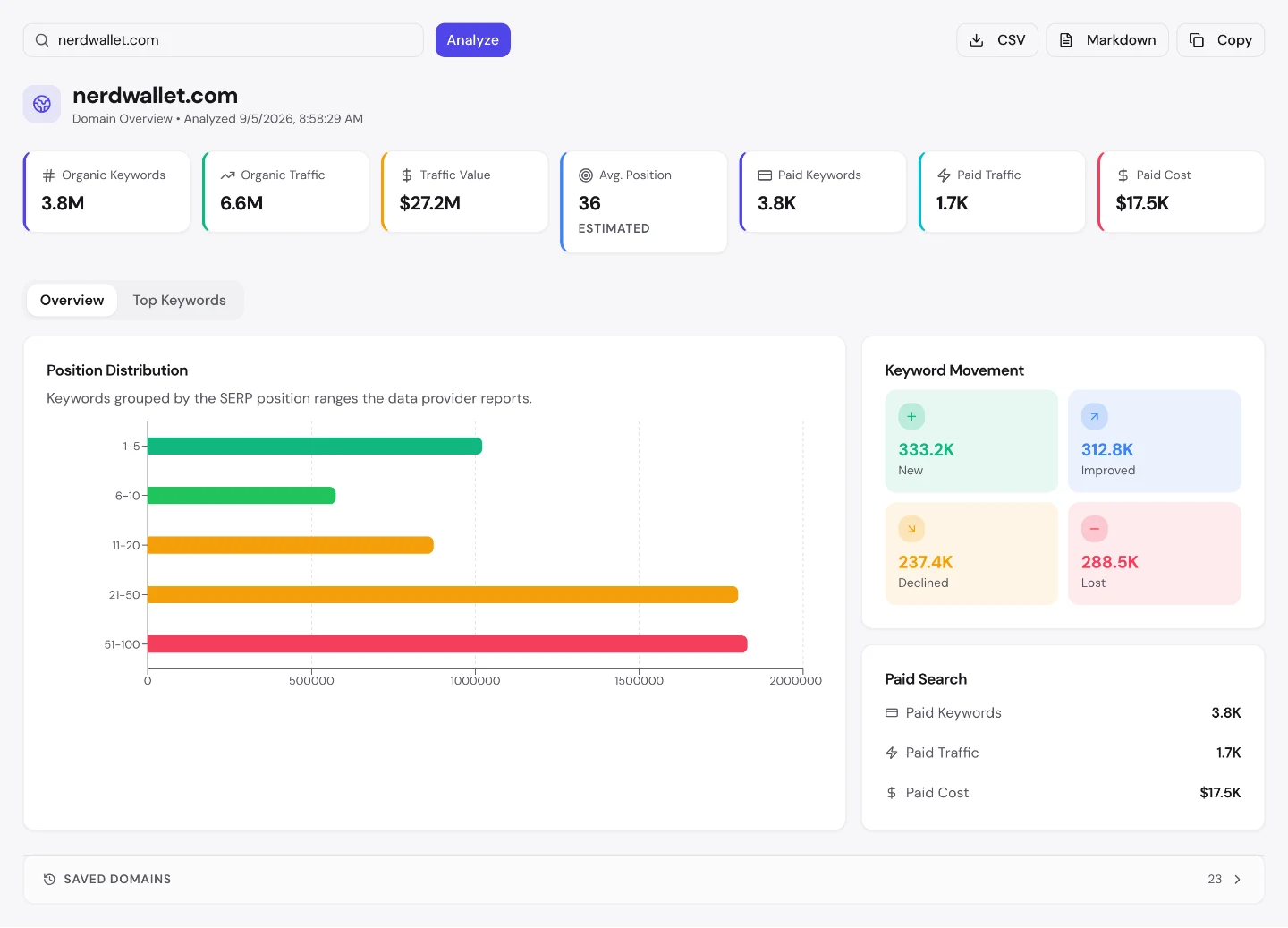
The Domain Overview prices NerdWallet's organic traffic at $27.2M a month, from 3.8M ranking keywords.
Free, and it prices the traffic. To see which specific keywords carry that value, you want the full export with cost per click attached — Semrush and SE Ranking both provide it, and the top 50 rows usually explain the whole number.
Rotten Tomatoes earns less than half that value from 5x the visits. Per visit, NerdWallet's traffic is worth roughly 10x Healthline's and 200x TED's.
The whole difference is the query. "Best credit card" carries a cost per click that "ted talk" and "bed bug bites" never will, because there is a bank willing to pay for it.
So price your own traffic before you decide whether you are doing well. A visit is not a unit of anything until you know what advertisers pay for it, and two teams with identical numbers can be having completely different years.
Compare only against your own market
Stated plainly, because it is the single most important thing this series has to say about traffic value.
Traffic value is an ad-spend equivalent: what the same visits would cost to buy at the CPCs those keywords carry. It measures advertiser demand, not audience quality and not revenue.
So a personal finance site will always look enormous on this metric and a media brand will always look small, regardless of how well either is run. TED is not failing at SEO; it is winning queries nobody bids on.
So when you benchmark yourself, compare against your own market and never across markets. A finance competitor's number tells you nothing about your media site, and quoting it to your board will only get you a target you cannot hit.
And if you are still choosing what to build, note that this metric is telling you something real: the vertical you pick sets your ceiling more than your execution does.
Map the decisions around your product
Now the finding I did not expect from a personal finance site.
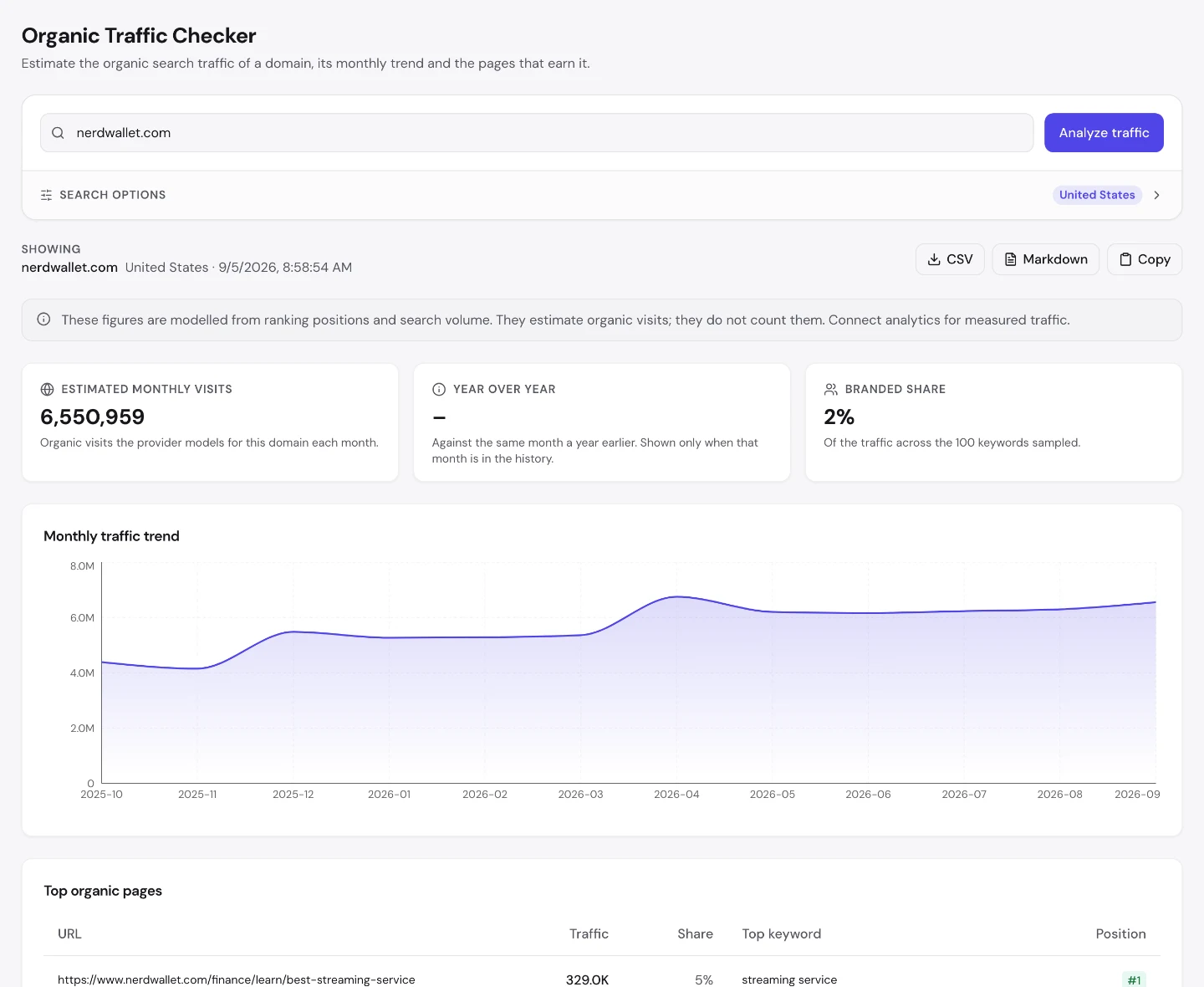
The Organic Traffic Checker puts "best streaming service" first, taking 5% of the whole site.
Streaming subscriptions are not a financial product. But choosing between them is a spending decision, and NerdWallet decided that counts.
This is the third time in this series a site's biggest page sits outside its stated subject — GeeksforGeeks' unit converters, freeCodeCamp's emoji list, and now this. The difference is that NerdWallet's looks deliberate: the adjacency is defensible, and the page ranks first rather than 26th.
So map the decisions your audience makes around your product, not just the ones inside it. That is a wider territory than most brands allow themselves, and the boundary you are respecting is usually one you invented.
Write the list this week. Every recurring choice your customer makes in the same frame of mind is a page you are allowed to own.
Build a tool for a commercial query
Behind the streaming guide sit a mortgage calculator, an auto loan calculator and a compound interest calculator — 3 calculators in the top 5, on the site with the highest traffic value in this series.
calculator.net, measured the same week, earns far more visits from its own calculator pages and a fraction of the value. NerdWallet took the same page type and pointed it at queries with a lender attached.
That combination — the tool format plus the commercial query — is the most valuable pattern I have found across all 19 sites. The tool wins the ranking because it answers instantly; the vertical decides what the ranking is worth.
You can copy both halves. Find the calculation your buyer does on paper before they buy from you, build it as a page, and you have a ranking asset that costs nothing to maintain and never goes stale.
3 of NerdWallet's top 5 pages are calculators, on the most valuable traffic in this whole study. That combination is copyable in any industry. The work is picking the calculation your buyer already does on paper.
- We find your highest-value queries first
- We build the tool that wins them
- SEO, GEO and conversion tracking included
- Book a free call, no pitch deck
Count variations per page, not words
Average position across those keywords: 36 — the strongest in this series, and far ahead of Docker Hub at the other end.
That is unusual at this scale. Sites with millions of keywords normally average deep, because most of those keywords are accidental. NerdWallet's are not.
With roughly 6,000 articles behind millions of ranking keywords, each page is ranking for hundreds of variations — which is what happens when a page comprehensively answers one commercial question rather than skimming twenty.
So track the shape rather than the average on your own site. Put your commercial pages into the Rank Tracker and watch how many variations each one picks up.
That count tells you more about a page than its word count ever will. A page ranking for 300 phrasings answered a question properly; a page ranking for 2 padded one out.
Check whether your rival is buying
The paid columns are far larger than almost anything else in this series: 3,800 paid keywords.
Every other publisher measured is at or near zero. Only Booking.com runs more, and it is a travel marketplace rather than a content business.
Among publishers NerdWallet stands alone, which makes sense when a click is worth a credit card application, and when the organic result and the paid result compete for the same query.
So check the paid columns before you benchmark a rival's visibility. If they are buying and you are not, the gap you are staring at is a budget line, not a content gap — and in this series exactly one company was buying meaningfully while everyone else was not.
Know which link mechanism you are using
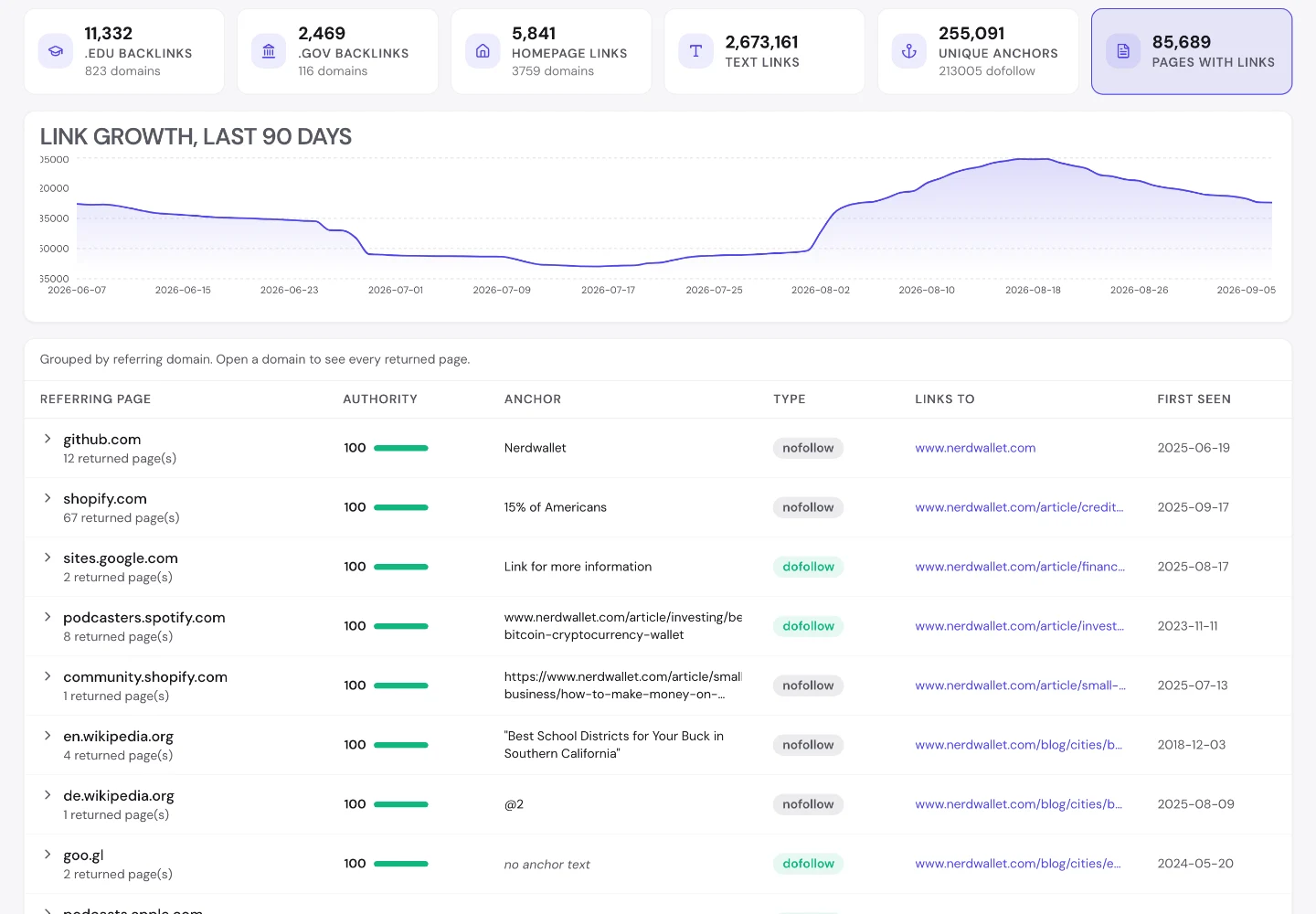
Our Backlink Analyzer reports 150K referring domains at Domain Trust 93, 82% dofollow.
The top anchors are not a brand or a keyword. They are "higher prices for credit card" and "for using credit cards due to surcharge fees" — together, roughly a quarter of the profile.
Those are fragments of the same sentence, which means one piece of NerdWallet research about surcharge fees was syndicated across the news web, and every outlet linked from the same phrase in the same wire copy.
That is a fourth distinct link mechanism, alongside templates, editorial citation and catalogue integrations: original research, distributed through news syndication. Expensive to produce, and it arrives in one burst rather than accumulating.
Work out which of the 4 you are actually running before you set a link target. They have completely different cost curves, and a plan that assumes steady monthly accumulation will look broken if what you have really bought is one spike a year.
Stop treating the audit score as a forecast
It gains more keywords than it loses and improves more than it declines, which is rare at this scale.
The Website Audit scores the homepage 88/100, with 1 critical issue still outstanding.
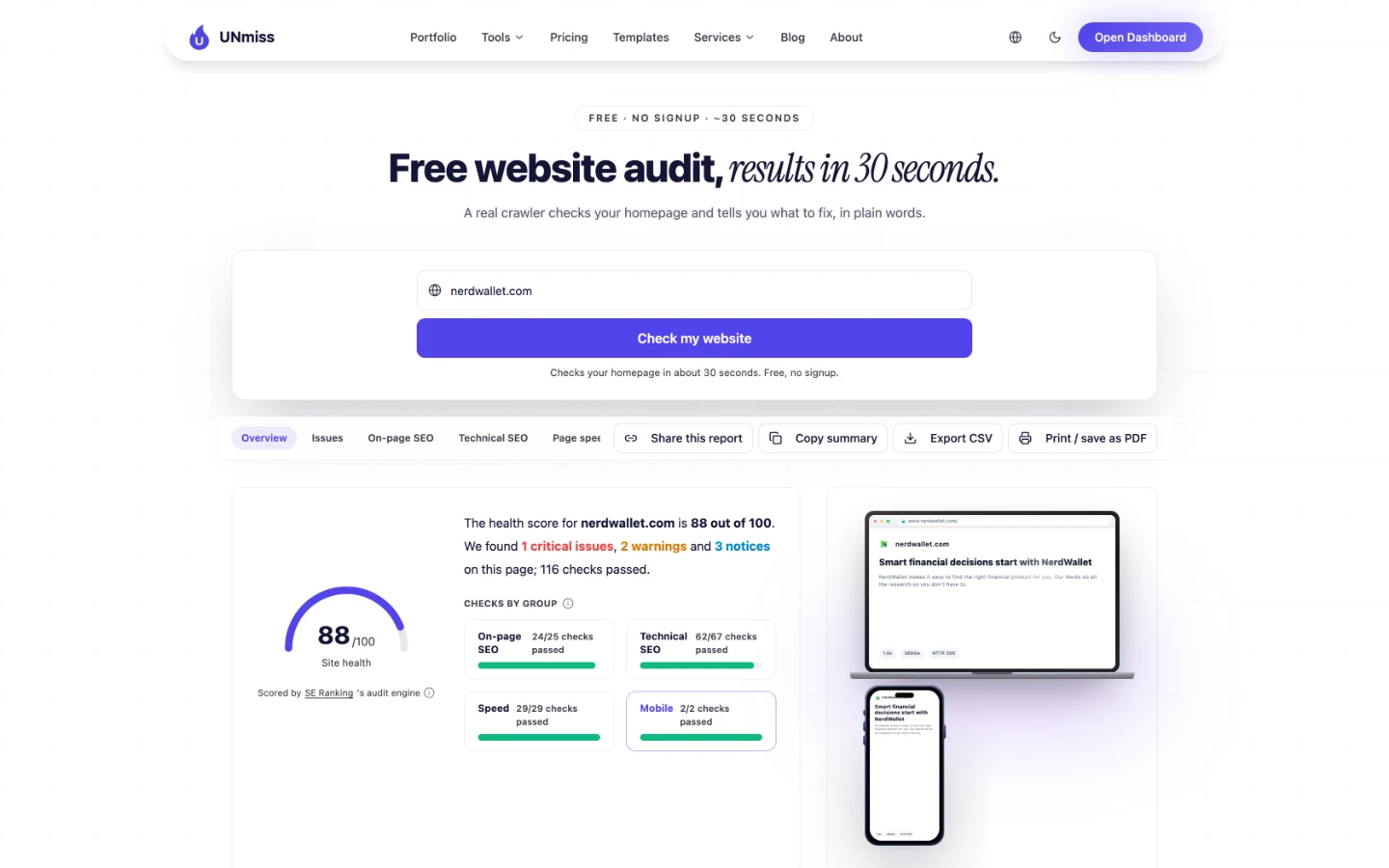
A critical issue sits unfixed on the site earning the most in this series. Dribbble and ClinicalTrials.gov both scored a perfect 100, and both are losing keywords.
That is the nineteenth data point on the same finding, and at this stage it is simply the conclusion: the audit score has predicted nothing about search performance, in either direction, across this entire series.
So stop reporting yours as a health metric to anyone who will read it as a forecast. Fix what the audit lists because broken things should be fixed — and set the growth expectation somewhere else entirely.
NerdWallet's traffic is worth $27.2M a month and TED's is worth $120K, and the difference is which queries advertisers bid on rather than how well either site is run. Domain Overview prices any domain's traffic the same way.
- Traffic value, organic keywords and average position
- Keyword movement, and the paid columns beside them
- 3 checks a day, no signup, no card
What you cannot copy
And here is what I could not measure, or had to qualify. A couple of the tools I name below are partners of ours — if you buy through those links we earn a commission, and you do not pay a cent more.
Our traffic figures are United States only and modelled from ranking positions and search volume rather than counted — for a US-focused finance site that is more representative than usual, but it remains an estimate. The keyword and backlink data underneath comes from SE Ranking, and the $27.2M is an ad-spend equivalent, not revenue. NerdWallet earns affiliate commissions on approved applications, which is a different and unmeasurable number.
The backlink figures came from the app rather than the marketing tool, which has been rate-limited for several batches. The app's BACKLINKS tile is a known defect on our side and has returned negative values elsewhere, so the total above is the page header figure and the screenshot is cropped below that tile. Our own earlier run on 22 August 2026 recorded 150K referring domains against 150K today.
I have inferred the syndication mechanism from the anchor text alone. Two overlapping fragments of one sentence across 720K links is a pattern only wire copy produces, but I did not audit a sample of the linking pages to confirm it.
The article count of roughly 6,000 comes from an earlier measurement, not this run. I did not run Keyword Research: it has an open defect returning implausible volumes.
And what you cannot copy: the vertical. Everything about NerdWallet's $27.2M depends on operating where a click is worth a lender's acquisition cost. The tactics here transfer to any industry; the number does not.
Frequently asked questions
How much is NerdWallet's search traffic worth?
Our Domain Overview prices it at $27.2M a month, against 3.8M ranking keywords at an average position of 36 and roughly 6.5M estimated US organic visits, measured 5 September 2026. That is the highest traffic value in this series; Canva is second at $20M and Rotten Tomatoes third at $13M.
Why is NerdWallet's traffic worth so much more than other sites'?
Because traffic value measures what the visits would cost to buy as ads, and finance queries carry high CPCs. Per visit its traffic is worth roughly 10 times Healthline's and 200 times TED's — a fact about the vertical rather than about how well any of them is run.
Which NerdWallet page gets the most traffic?
A "best streaming service" guide, at roughly 330K estimated monthly visits — 5% of the site — ranking first. Behind it sit a mortgage calculator at 180K, an auto loan calculator at 150K and a compound interest calculator at 120K.
How many articles does NerdWallet publish?
Roughly 6,000, from an earlier measurement — against 3.8M ranking keywords. GeeksforGeeks publishes about 180K articles and earns roughly half NerdWallet's US organic traffic.
What is NerdWallet's most common anchor text?
"higher prices for credit card" at 430K links (15%), followed by "for using credit cards due to surcharge fees" at 290K (10%) — two fragments of the same sentence, the signature of one piece of research syndicated across the news web.
Does NerdWallet run paid search?
Yes, about 3,800 paid keywords — far more than any other publisher measured. Most run at or near zero: TED 72, Eventbrite 163, Meetup 8, Zapier 203. Only Booking.com runs more, at 96K, and it is a marketplace rather than a content business.
How many backlinks does NerdWallet have?
2.9M backlinks from 150K referring domains, measured 5 September 2026, split 2.4M dofollow to 540K nofollow at Domain Trust 93, with 11K .edu links. Our earlier run on 22 August recorded 150K referring domains.
What is NerdWallet's website audit score?
88 out of 100, with 1 critical issue, 2 warnings, 3 notices and 116 checks passed on the homepage — a critical issue outstanding on the most valuable search traffic in this series, while two sites scoring a perfect 100 are both losing keywords.
The one number to take away
10x.
That is roughly how much more a NerdWallet visit is worth than a Healthline visit, measured the same way in the same week — and neither site did anything to deserve the gap.
NerdWallet operates where a click has a lender behind it. Healthline operates where a click has a symptom behind it. Same discipline, same quality of execution, an order of magnitude between them on the metric everybody reports.
The tactics in this article all transfer: build the calculator, cover the decisions adjacent to your product, publish research worth syndicating. What does not transfer is the multiplier, and no amount of execution closes it.
So use traffic value to track yourself against yourself, and never against a company in a different market. It is measuring their advertisers, not their skill.
Found something in your own report that surprised you, or measure this differently? I would genuinely like to know — the tools used are all free, so you can check every figure yourself. Measured 5 September 2026 unless stated. Domain Overview, Organic Traffic Checker, Website Audit and Backlink Analyzer figures are free runs of our own tools, all United States scope, and all modelled rather than counted where the tool says so. The article count and August comparison figures come from earlier runs. No revenue figure for NerdWallet was available to us.