Rotten Tomatoes earns $13M a month in free traffic, and 67% of the links behind it are nofollow.
Every beginner guide calls a nofollow link a wasted one. This site has twice as many wasted links as good ones, and our tools score it 91 out of 100 for trust.
I ran rottentomatoes.com through 4 of our tools expecting a clean programmatic SEO story. I got something stranger. Its top anchor text is in a language it does not publish in, and no single page comes close to owning its traffic. Here are 10 things worth stealing, and the 2 you cannot.
Stop reading your dofollow ratio as a grade
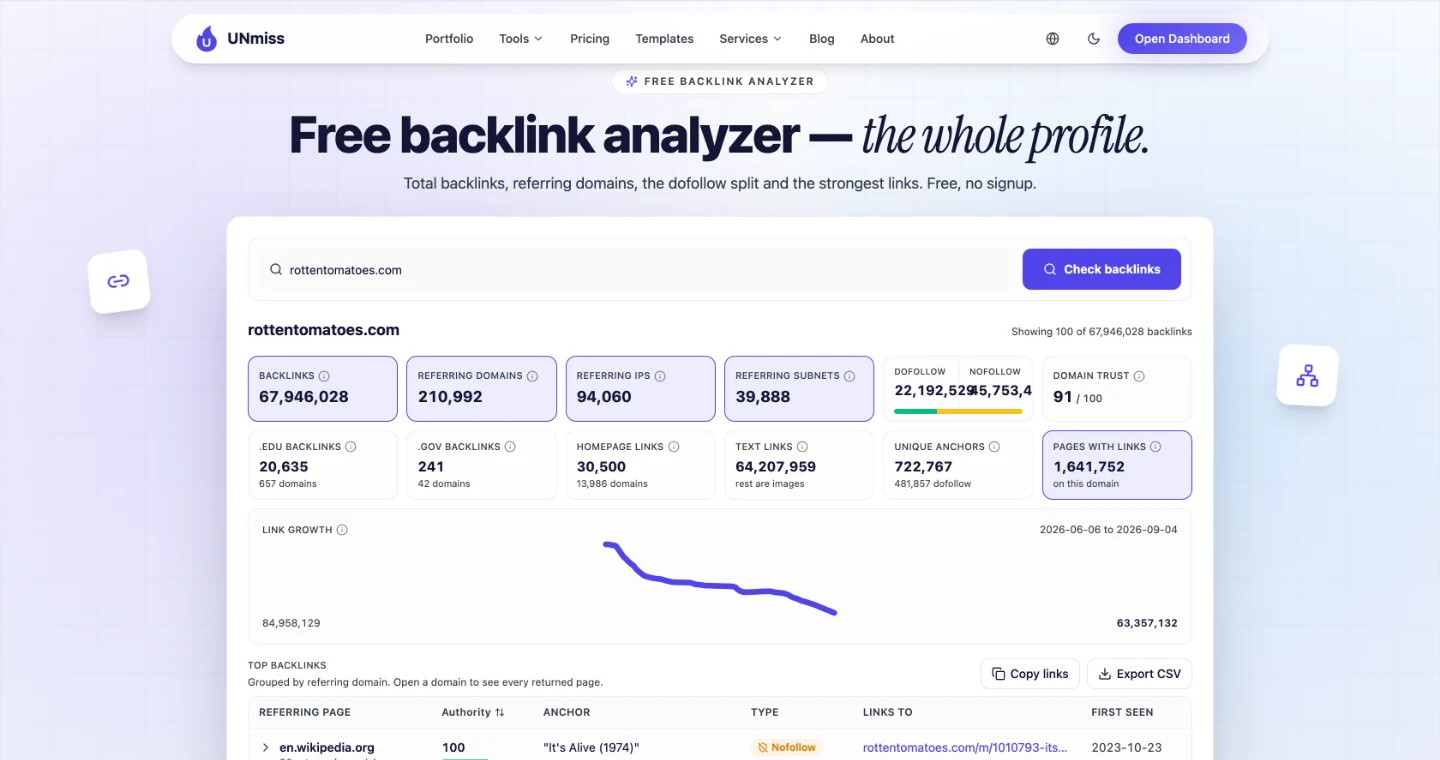
Run the numbers from our Backlink Analyzer: 68M backlinks in total. Two thirds of them are nofollow.
Free, and it shows the concentration. To find which title queries you are losing to an ambiguous match, you need the full ranking export, and Semrush and SE Ranking both give you one.
The reason is what those nofollow links are. Wikipedia citations. Reddit threads. Forum posts, news aggregators, comment sections.
Every place a person argues about a film and reaches for a score to settle it. None of them pass authority the way a guide means. All of them are real distribution.
So stop reading your dofollow ratio as a grade, and read it as a description of where you are talked about.
If yours is 90% dofollow, that is not healthier than this. It usually means most of your links were placed on purpose, which is a far smaller and more fragile thing than being cited.
Own a fact somebody else has to quote
This one stopped me. The top anchor text across the entire profile is 烂番茄 — "rotten tomatoes" in Chinese — at 39M links.
That is 58% of every backlink the site has. Its Chinese name outnumbers its English one by nearly 7 to 1.
Rotten Tomatoes publishes in English. It has, without publishing a word in the language, become the default citation for film scores across the Chinese-speaking web.
The lesson is not "translate your site". It is that a score or a rating travels across languages in a way an article never does.
If a forum in another language needs to say "this film got 87%", it links to whoever holds that number.
So ask what fact on your site could be cited by somebody who cannot read the rest of the page. Then open your own anchor list and see which languages are already there. Usually one or two are, and nobody has noticed.
Check whether one page is carrying you
The Organic Traffic Checker puts the site at 31M estimated monthly visits, and then refuses to give me a hero page.
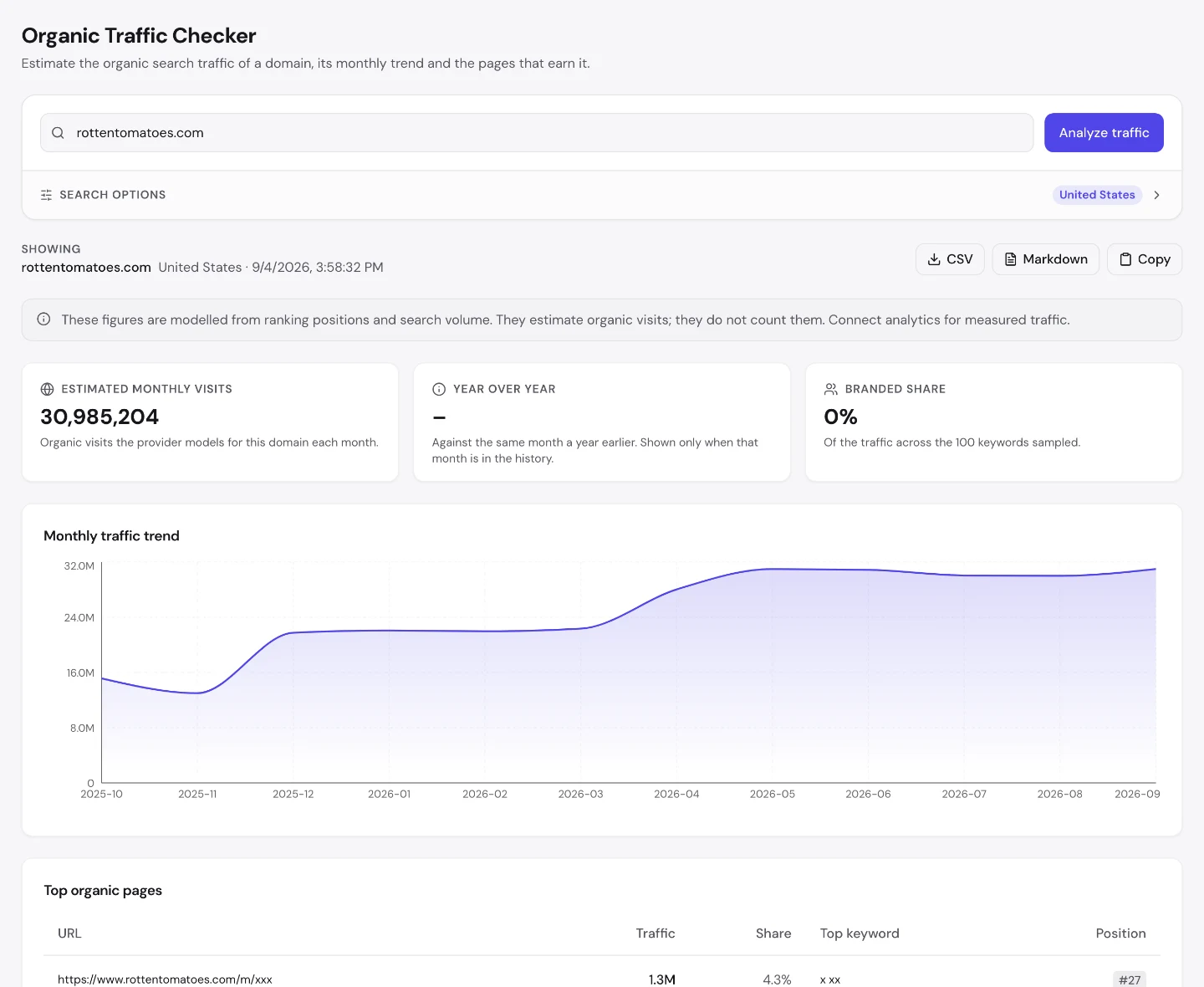
The largest single page takes 4%. The homepage takes 1%. Nothing else gets near either.
This is what a genuinely programmatic site looks like from outside. No hero, no flagship, no page you could lose and feel.
So compare it with your own top-pages report. If one page is carrying a third of your traffic, you do not have a content library. You have a single point of failure with a blog attached.
Sort your keywords by volume once
Look at what those top pages actually rank for. The biggest is a film page sitting at position 27 for a 4-letter query.
Two more are the TV series You, ranking for the word "you".
Nobody searching the word "you" wants a TV show. But a small fraction of an enormous number is still 570K visits a month.
You cannot rename your product to catch this, and chasing it on purpose is a bad idea. But it explains a pattern you will find in your own data.
A page ranking badly for a giant vague term can quietly beat a page ranking first for a precise one.
So sort your Keyword Research results by volume rather than by difficulty, just once, and see which of your pages are accidentally in that game. Grouping them with the Keyword Cluster tool makes the accidental winners obvious fast.
Weigh the query size before the position
Same table, stated as a rule. The page at position 27 earns 1.3M visits. The page ranking 3rd for "new movies" earns a fifth of that.
Position 27 is not on page 1. It is not even on page 2. It beat a top-3 ranking 5 times over, because the query behind it is vastly bigger.
This is the most useful thing in this article and almost nobody does it. Before you spend a month moving a page from 8th to 3rd, work out what that move is worth against simply existing on a term 50 times larger.
Put both into the Rank Tracker and compare the traffic, not the positions. The answer is often not the one your team expects.
Build pages for browsing, not just titles
Two of the 6 biggest pages are not about a film at all. They are Movies at Home and Movies in Theaters — browse pages, ranking #3 for "new movies" and #1 for the brand.
Those pages have no subject. They are a filtered list that regenerates itself, and they capture the enormous class of searches where somebody does not know what they want yet.
Most sites build a page per thing and stop there. The browse layer — by date, by category, by "near me", by "best of 2026" — is usually missing altogether.
It is the cheapest programmatic surface there is, because the content already exists. You are only deciding how to slice it.
If you add them, add them properly. The Website Audit will tell you whether the new pages are indexable and whether your canonicals survived the filtering.
Rotten Tomatoes wins because it owns a number people look up, not because it writes the best reviews. Owning a data point is a durable position. Working out which one you could own is where we start.
- We find the number your market looks up
- We build the pages and the data behind them
- SEO and GEO so AI answers quote you
- A free call to find your number
Read the lost column, not the total
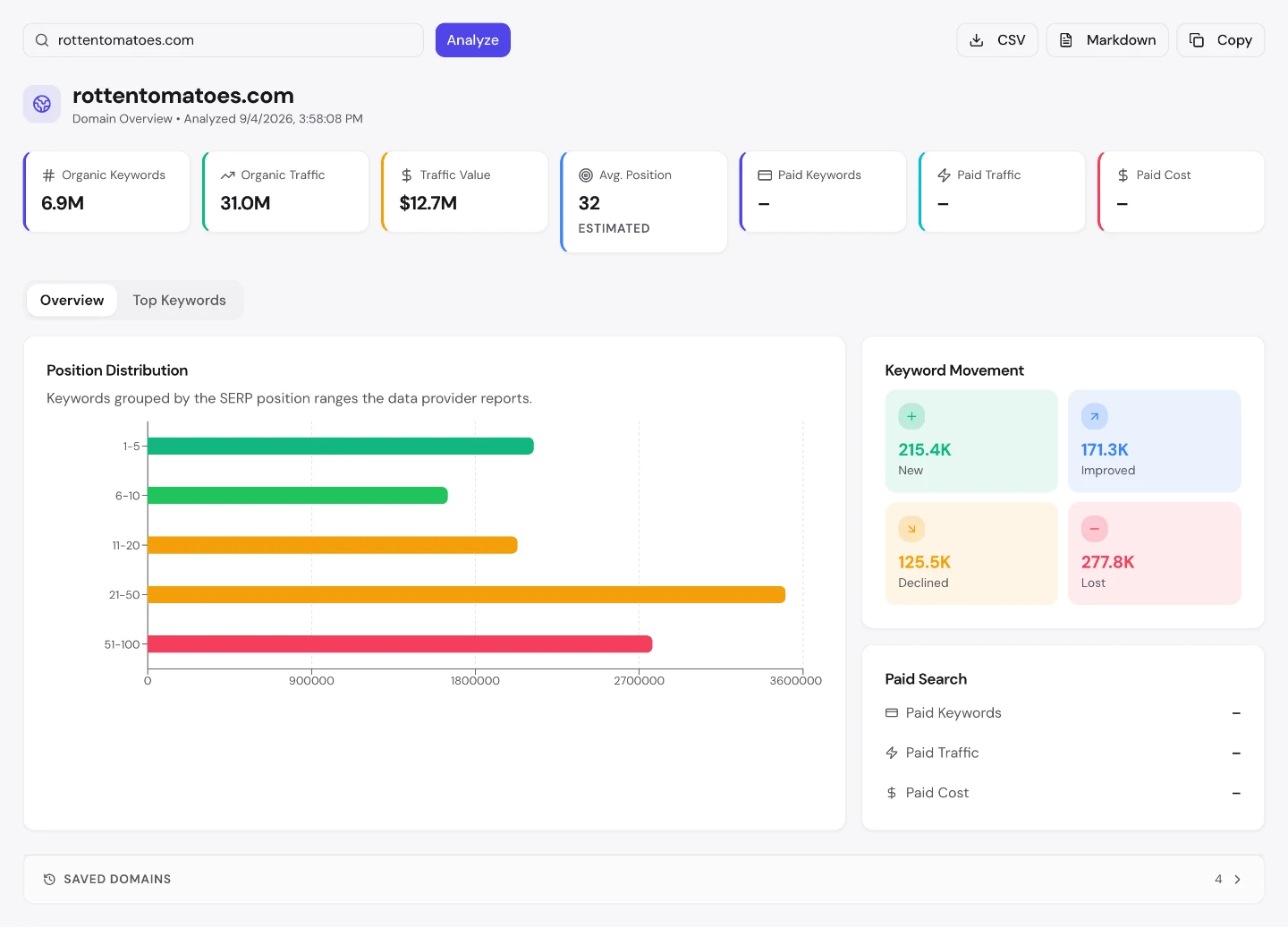
From the Domain Overview: 220K new keywords against 280K lost. Of the ones it kept, 170K improved and 130K declined.
Net, it is down 62K keywords. A site earning $13M a month in free traffic is going backwards on the measure everyone treats as growth.
Films leave cinemas. Shows get cancelled. A catalogue about culture is perishable in a way a catalogue about mortgages is not, and the churn is the cost of the category.
So read your own lost column before you celebrate a keyword total. A rising total can hide a losing trade underneath it.
The lost column is the one that tells you whether your library is decaying faster than you are refilling it. Nobody puts that number in a board deck, which is exactly why you should look at it.
Know which links popularity cannot buy
It has 21K .edu backlinks and a few hundred .gov links. Against 68M links in total, that is a rounding error.
For contrast, we measured Meetup in a separate case study. It gets a fraction of this traffic and carries 5 times as many .edu links.
Institutional links follow reference material, not popularity. Rotten Tomatoes is cited constantly and almost never by a university, because a score is a fact you quote in an argument rather than something a lecturer sets as reading.
So know which links your popularity will never buy you. If you want the institutional kind, you have to be the thing somebody assigns, and that is a different product decision entirely.
Fix the criticals and expect no growth
The Website Audit scores the homepage 81/100. Behind that: 1 critical issue, 3 warnings and 4 notices.
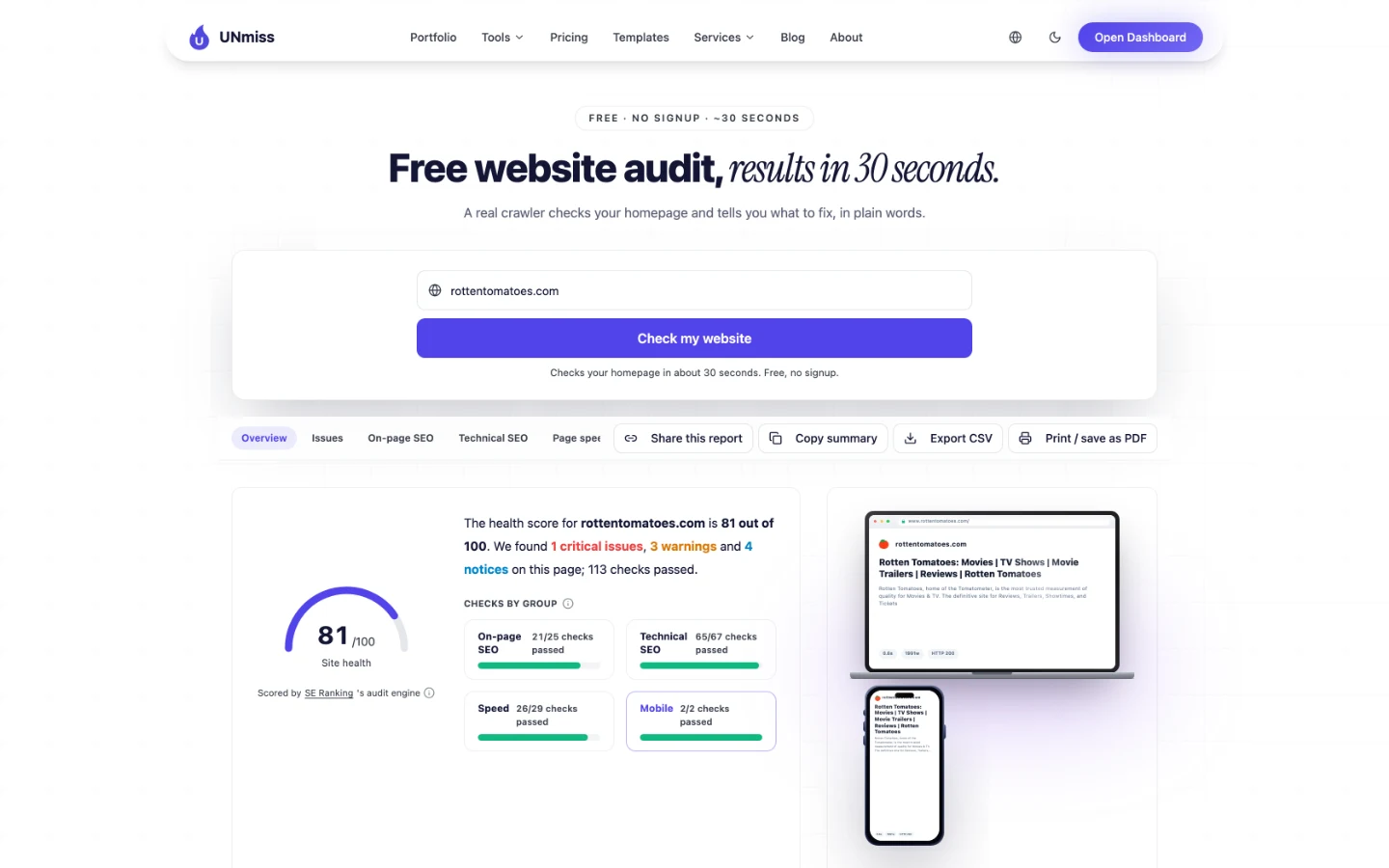
That is the lowest score of the sites in this group. GeeksforGeeks, Eventbrite and itch.io all scored higher. It is also the only one carrying a critical flag, on a site earning $13M a month.
Take the uncomfortable version. Technical perfection is clearly not what is producing this result. The links and the category monopoly are.
So fix your critical issues, and expect no growth from having done it. Your slowest pages are worth a look with Site Speed as well.
Just do not let a 95 out of 100 convince you that you have done the work that actually matters.
Be the number, not the article
Everything above collapses into one idea, and it is the one to take home.
Rotten Tomatoes does not win because its pages are better written. It wins because it owns a number.
The Tomatometer is a fact other people need to finish their own sentences. That is the only reason those 39M Chinese-language links exist at all.
If you want to know whether AI assistants already treat your number as the citable one, the AI Visibility Checker asks them and counts the answers. An article can be replaced by a better article. A number that everyone has agreed to quote cannot.
The strangest finding here took one report: 58% of Rotten Tomatoes' backlinks use a Chinese anchor. The Backlink Analyzer returns the same anchor breakdown for any domain, along with the dofollow split, referring domains and the .edu and .gov counts.
- The same report that found 39M links on a single anchor
- Dofollow versus nofollow, referring domains, IPs and subnets
- 3 checks a day, no signup, no card
What you cannot copy
And here is what I could not measure, or had to qualify. A couple of the tools I name below are partners of ours — if you buy through those links we earn a commission, and you do not pay a cent more.
Our traffic figures are United States only and modelled from ranking positions and search volume rather than counted; the tool says so on its own screen. The keyword and backlink data underneath comes from SE Ranking. The $13M is a model on top of a model — what the same visits would cost as ads at the CPCs those keywords carry. It is not revenue, and no revenue figure for Rotten Tomatoes was available to me.
The year-over-year comparison came back empty because that month is not in the retained history, so I have no trend claim to make. I also did not run Keyword Research for this piece: it has an open defect returning implausible volumes, and I would rather leave a gap than publish a number I do not trust.
One figure I deliberately left out. The traffic report gave a branded share of 0%, which cannot be right — the same report shows the homepage ranking first for "rotten tomatoes" with 380K visits. When a tool contradicts itself, the honest move is to say so and drop the number, not to publish the half that suits the story.
And the part you genuinely cannot copy: a monopoly on a score. The Tomatometer became the default because it arrived early and no competitor achieved escape velocity. You can copy the browse pages this week. You cannot decide to be the number an entire industry quotes.
Frequently asked questions
How much is Rotten Tomatoes' traffic worth?
Our Domain Overview prices it at $13M a month, against 6.9M ranking keywords and roughly 31M estimated US organic visits, measured 4 September 2026. That is a modelled figure estimating what the same traffic would cost to buy as ads at the CPCs those keywords carry. It is not revenue.
How many backlinks does Rotten Tomatoes have?
68M backlinks from 210K referring domains, measured 4 September 2026, across 40K referring subnets. The split is 22M dofollow to 46M nofollow. Domain Trust is 91 out of 100.
Why are most of Rotten Tomatoes' backlinks nofollow?
Because of where they come from. Wikipedia citations, Reddit threads, forums and comment sections all apply nofollow by default, and those are exactly the places people reach for a film score to settle an argument. 46M of its 68M links carry the attribute, and the domain still scores 91 for trust.
What is Rotten Tomatoes' most common anchor text?
烂番茄 — the brand's Chinese name — with 39M backlinks, or roughly 58% of the entire profile. The English "Rotten Tomatoes" is second at 5.8M, so the Chinese anchor outnumbers it by close to 7 to 1.
Which page gets Rotten Tomatoes the most traffic?
A single film page, at roughly 1.3M estimated monthly visits, or 4% of the site's organic traffic — ranking 27th for a 4-character query. The homepage is third at 380K visits, or 1%. No page on the site reaches 5%.
Is Rotten Tomatoes gaining or losing keywords?
Losing, on balance. Over the measured period it gained 220K keywords and lost 280K, with 170K improved and 130K declined — a net loss of about 62K against a base of 6.9M. Entertainment catalogues decay as films and shows leave circulation.
What is Rotten Tomatoes' website audit score?
81 out of 100 on our Website Audit, with 1 critical issue, 3 warnings, 4 notices and 113 checks passed on the homepage. It is the lowest score of the 5 sites measured in this batch, alongside the highest traffic value.
How many .edu links does Rotten Tomatoes have?
21K .edu backlinks from 657 domains, plus 241 .gov links from 42 domains. Against 68M total links that is a very small share, and far below Meetup's 110K .edu links despite Rotten Tomatoes having far more traffic.
The one number to take away
67%.
That is the share of Rotten Tomatoes' backlinks that a beginner's guide would tell you are worthless — and the site sits at 91 for trust, 6.9M keywords and $13M of monthly traffic value on top of them.
The nofollow attribute tells you Google will not pass authority through that link. It does not tell you the link is not working. 46M people-facing citations is a distribution channel, and it is the one thing on this list that money cannot buy.
So go and read your own anchor and dofollow split before you spend another month chasing followed links. If your profile is 90% dofollow and 2,000 links, you do not have a better ratio than Rotten Tomatoes. You have a smaller conversation.
Found something in your own report that surprised you, or measure this differently? I would genuinely like to know — the tools used are all free, so you can check every figure yourself. Measured 4 September 2026. Domain Overview, Organic Traffic Checker, Website Audit and Backlink Analyzer figures are free runs of our own tools, all United States scope, and all modelled rather than counted where the tool says so. No revenue figure for Rotten Tomatoes was available to us.