2.4M different websites link to Eventbrite, and its second-biggest anchor text is a sentence no marketer ever wrote.
"We teamed up with Eventbrite" — 3.1M links carrying that exact phrase, and 2.3M more reading "+ Add your own event".
Those are widget links: boilerplate inside an embeddable ticket button, reproduced on every site that sells a ticket. Eventbrite's link building is not a campaign, it is a product feature. Here is how the machine works, and the 9 parts of it you can copy.
You cannot outreach your way here
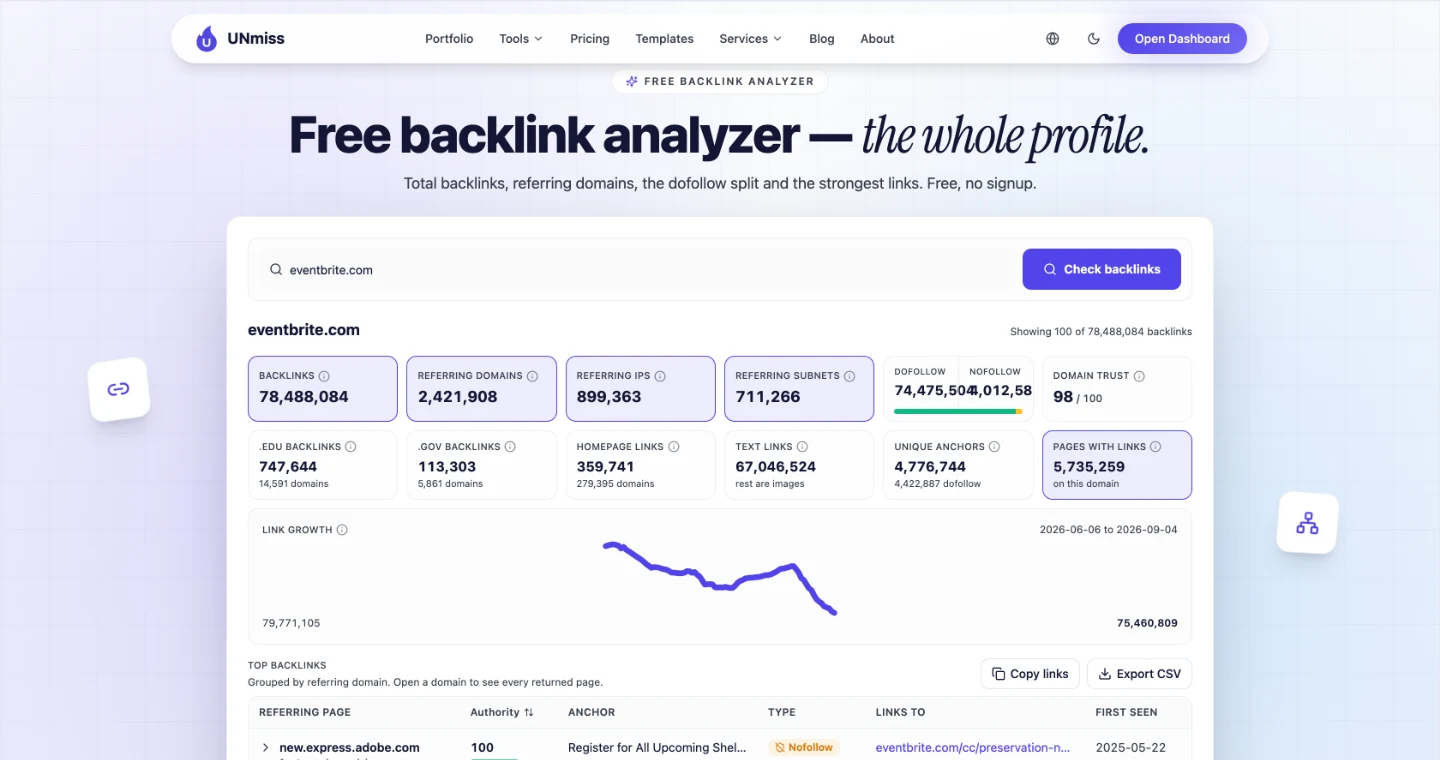
The Backlink Analyzer reports 2.4M referring domains at a Domain Trust of 98.
That is a free run. Watching a widget programme work takes months of link data rather than one snapshot, and Semrush and SE Ranking both keep referring domains over time so you can see whether it is compounding.
Referring domains is the number to watch, not backlinks. Rotten Tomatoes has about 210K of them and Meetup 340K — Eventbrite has an order of magnitude more distinct websites than either.
You cannot outreach your way to that number, and neither can anyone selling you link building. No agency, no budget and no amount of guest posting reaches it.
The only mechanism that produces it is a link other people install themselves, for their own reasons, millions of times over. So if your link plan is a list of sites to email, you are playing a different game from this one — and it is worth knowing that before you buy another quarter of it.
Give people something they will install
The brand name leads, which is unremarkable. Then "We teamed up with Eventbrite", then "+ Add your own event" — the two default strings inside an embeddable ticket widget.
Every organiser who dropped that widget onto their own site published a link without thinking about SEO at all.
This is the most copyable idea here and it has nothing to do with content. Ask what you could give people that they would install: a badge, an embed, a calculator, a status widget, a "powered by" line on something they already use.
Then look hard at the anchor text it ships with, because whatever you put in that template is what a few million links will eventually say — and you will not get to change your mind later. Start by reading your own anchor distribution. You may already have one of these running and not know what it says.
Read your dofollow share as a fingerprint
That is the exact inverse of Rotten Tomatoes, which is 67% nofollow, and the reason is structural rather than strategic. Editorial citations — Wikipedia, Reddit, forums, comment sections — default to nofollow. Widget links sit in a site's own template, where nobody adds the attribute.
So stop reading a high dofollow ratio as a better link strategy. It is a fingerprint of where your links came from.
If yours is around 95%, most of your links are self-installed or placed, and outreach will not move the number much. If it is nearer 30%, you are being cited in conversations, and an embeddable widget will do nothing for you. Those are different assets carrying different risks, and neither is the healthy number a beginner's guide implies.
Check your template for duplicate URLs
Now the flaw, and it is a big one.
The Organic Traffic Checker shows two different URLs for New York events — one ranking 3rd, the other 23rd. The "today" listing appears twice as well.
Most of the biggest pages on the site are really just 2 pages, each published at 2 addresses. A URL scheme changed, or two region formats both stayed indexable, and the authority for one query is now split between them.
Go and check your own faceted or location URLs for this today. If you generate pages from a template you almost certainly have some, and nothing will tell you unless you look.
Run 2 or 3 variants of the same page and confirm the canonical tags point at one another rather than each claiming to be the original — the Website Audit reports them. Then use the XML Sitemap Generator to see how many near-duplicates you are submitting on purpose.
Browse pages beat event pages
Look at what actually ranks: the homepage, a city listing, a "today" listing, a nightlife category. Not a single individual event.
Eventbrite hosts millions of events, and the pages earning its search traffic are the filtered lists on top of them. A nightlife browse page ranks 4th for "club near me".
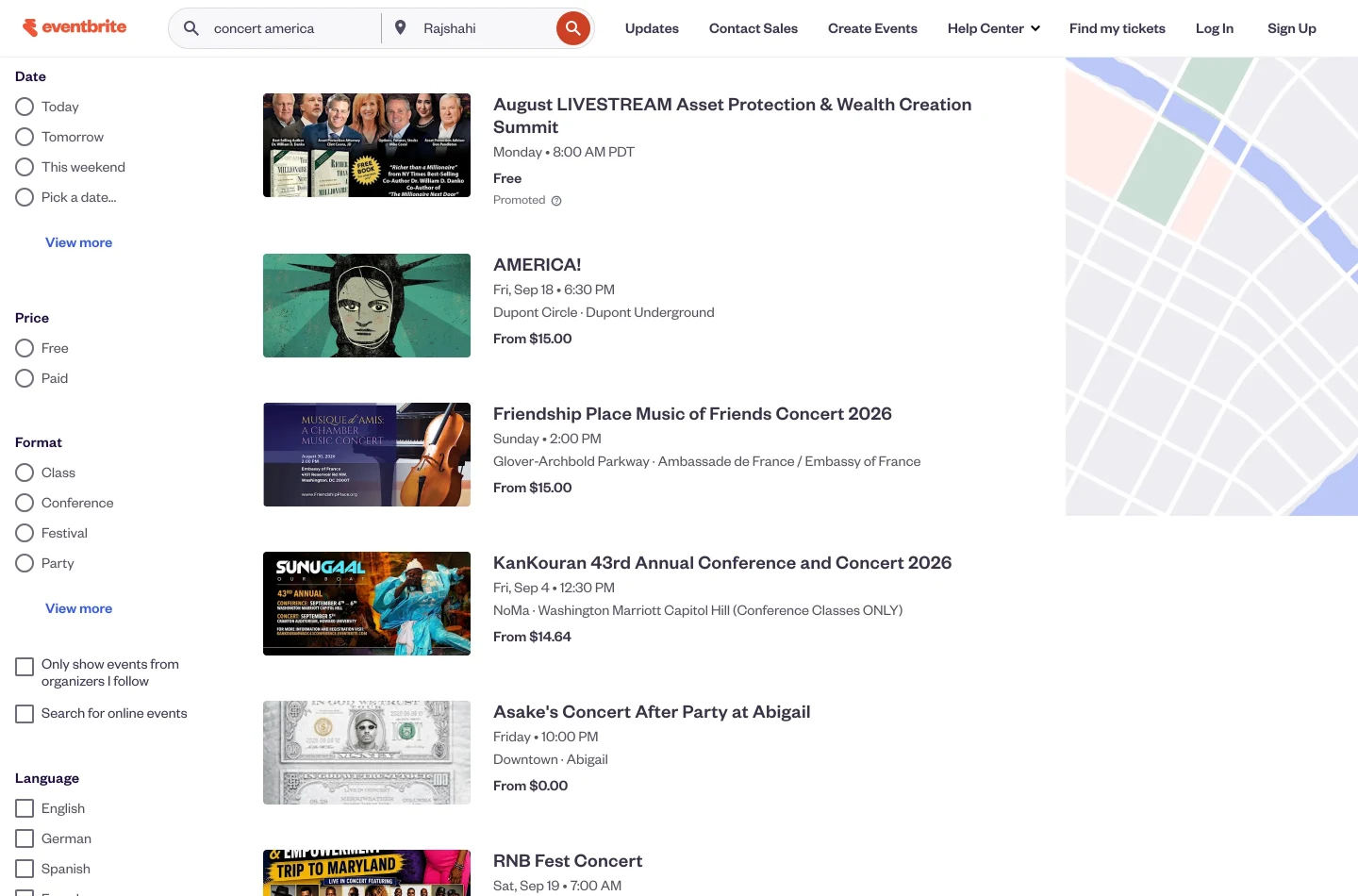
The reason is intent. Somebody searching for a specific event already knows its name and usually arrives from the organiser. Somebody searching "what's on tonight" has no name to type, and the browse page is the only thing that can answer them.
If you run a marketplace or a catalogue, this is the layer to build: not more item pages, but more ways to slice the items you already have. It is the cheapest programmatic surface in existence because the content is already written. Draft the template copy once with the Content Brief Generator and it will read like a page rather than a filter.
Eventbrite's links come from a widget other people put on their own sites. No outreach programme competes with that. If you have something worth embedding, we will build it and make the links count.
- We design the embeddable thing worth installing
- Built, hosted and tracked for you
- Link building where a widget will not do
- A free call before anything is scoped
Split branded from the rest before target-setting
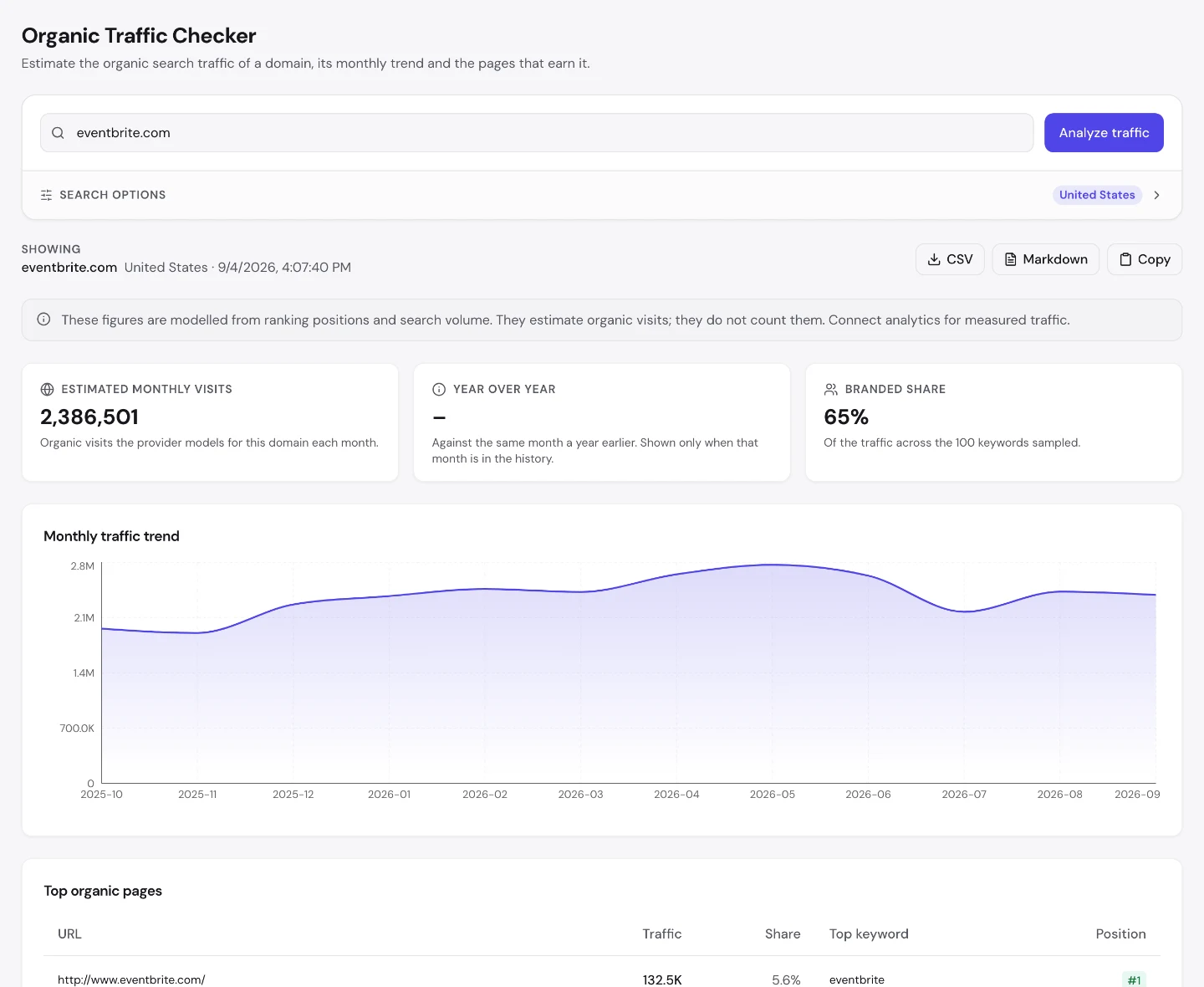
Branded share: 65% — the highest in this batch.
Two thirds of Eventbrite's visits are people typing its name. Only about a third are genuine discovery, from a site with millions of ranking keywords.
Set that against GeeksforGeeks at 1% and the trade is clear. Eventbrite's traffic is defensible — an algorithm change cannot take your name away — but its content is doing far less work than the keyword count suggests.
Run this split on your own site before you set next year's targets. Non-branded traffic is the number that measures your SEO; branded traffic measures everything else your company does, and reporting them as one figure will get you credit you did not earn and blame you did not deserve. The Rank Tracker keeps them apart week to week.
Measure net keyword movement, never gross
From the Domain Overview: it added 310K keywords and lost 270K.
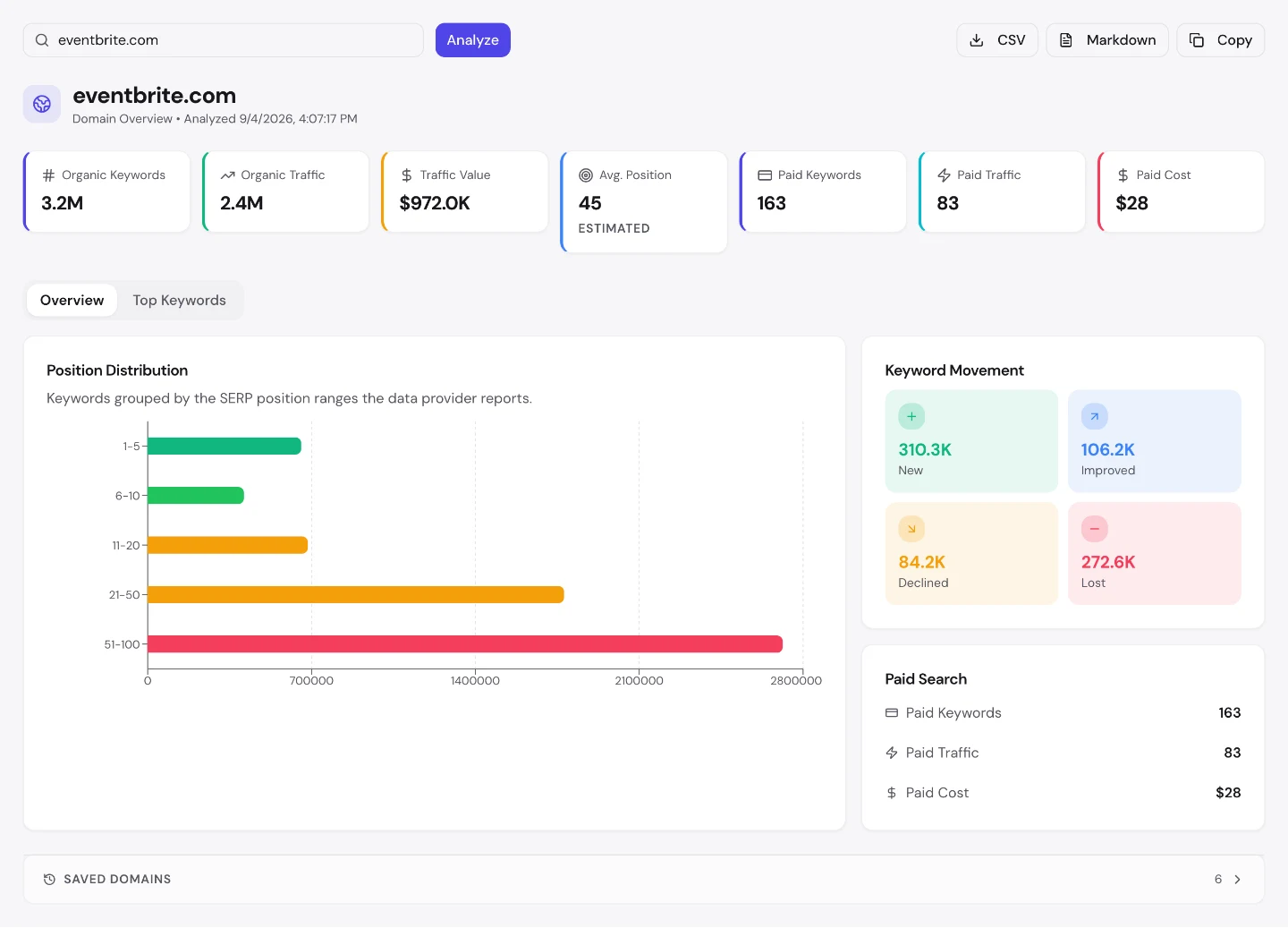
Net positive, just — but nearly 88% of everything it gained went to replacing what it lost.
Events are the most perishable content there is. Every page carries a date, and after that date the query behind it stops existing. Eventbrite pays that churn tax at a scale most sites never see.
If your pages expire, report your net keyword movement and never the gross. "We added 300K keywords" is the kind of headline that describes a business standing still, and you will be the one holding it when somebody finally divides one number by the other.
Read the critical list before the score
The Website Audit scores the homepage 86/100 — but with 2 critical issues outstanding.
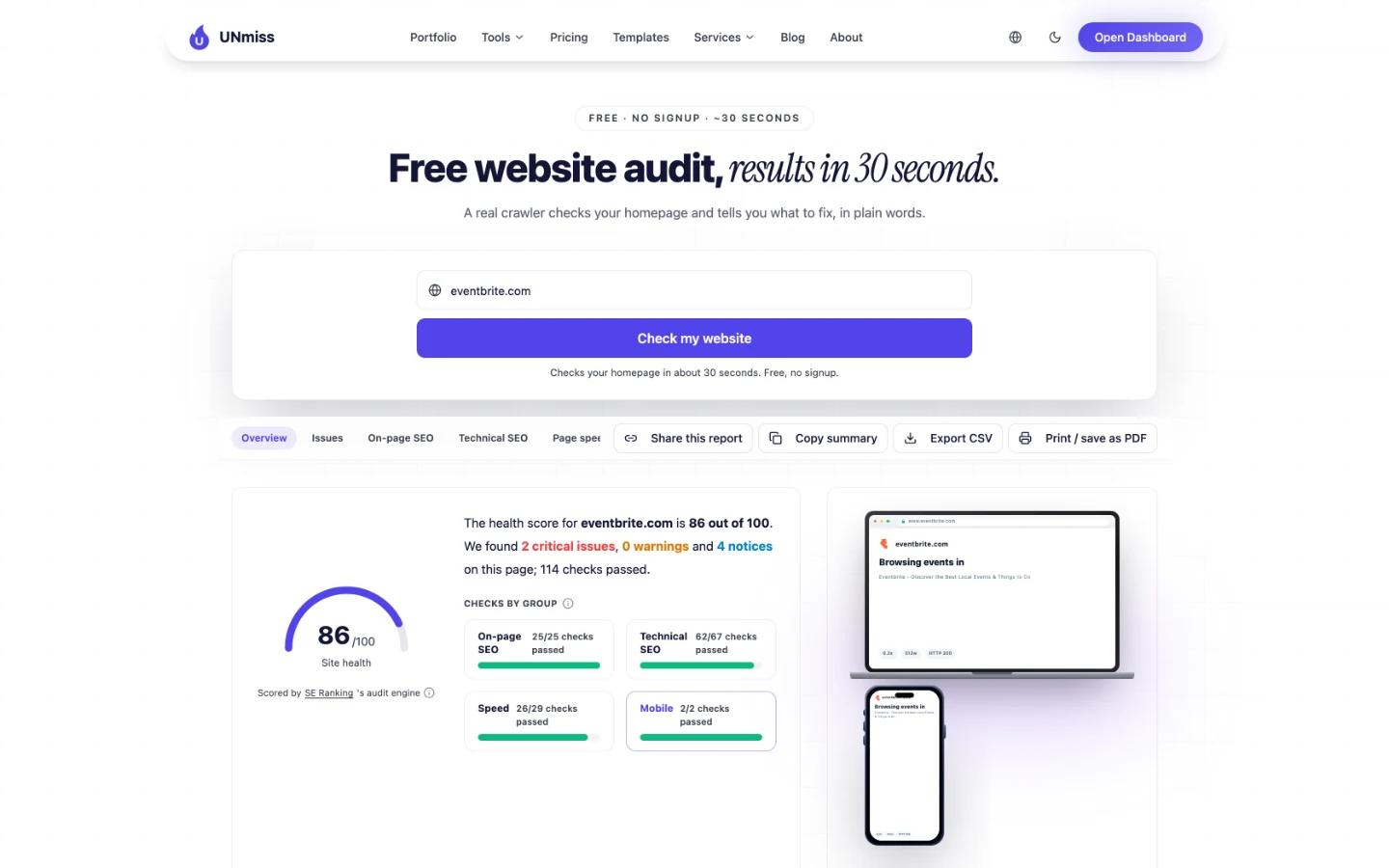
That is the highest critical count in this batch, sitting on the strongest link profile in this batch. Authority does not exempt a site from breaking things.
So read the critical list first and the score second, on your own site as much as anyone else's. A good total hides critical issues, because a hundred passing checks drown out 2 failures in the average — and the 2 are the only ones that cost you anything.
While you are in there, its titles and descriptions are worth a pass with the Meta Tag Generator.
Check what a rival is quietly buying
The Domain Overview shows Eventbrite running 163 paid keywords. Small in absolute terms — but Meetup, same market, measured the same day, ran 8.
Eventbrite is 20 times more active in paid search than its closest comparison, and nothing about its organic performance would have told you that.
Before you assume a rival is beating you on organic, check whether they are quietly buying the terms you are fighting for. It is one free report and most people never run it — which means you can know something about your competitors that they assume nobody has looked up.
Eventbrite's second-biggest anchor text is a sentence inside an embeddable button, repeated 3.1M times. The Backlink Analyzer shows the same anchor breakdown for any domain, so you can see which of your links were placed on purpose and which arrived on their own.
- The same report that found 2.4M referring domains
- Anchor distribution, dofollow split, .edu and .gov counts
- 3 checks a day, no signup, no card
What you cannot copy
And here is what I could not measure, or had to qualify. A couple of the tools I name below are partners of ours — if you buy through those links we earn a commission, and you do not pay a cent more.
Our traffic figures are United States only and modelled from ranking positions and search volume rather than counted; the tool says so on its own screen. Eventbrite is global, so its worldwide traffic is materially larger than the 2.4M here. The keyword and backlink data underneath comes from SE Ranking, and the $970K traffic value is a model on top of a model — an ad-spend equivalent, not revenue.
The year-over-year comparison returned empty, so I have no trend claim. I did not run Keyword Research for this piece: it has an open defect returning implausible volumes, and I would rather leave the gap.
I have also inferred the widget mechanism from anchor text rather than observing it directly. "We teamed up with Eventbrite" and "+ Add your own event" are template phrases at a scale no human campaign produces, which makes the conclusion strong but not proven. I did not audit a sample of the linking pages to confirm each one carries an embed.
And what you cannot copy: being the default ticketing rail. The widget works because organisers need to sell tickets somewhere, and that need existed before Eventbrite did. A widget nobody has a reason to install produces nothing, and the reason is the part that is hard.
Frequently asked questions
How many backlinks does Eventbrite have?
78M backlinks from 2.4M referring domains, measured 4 September 2026, across 710K referring subnets. The split is 74M dofollow to 4M nofollow — about 95% dofollow. Domain Trust is 98 out of 100.
Where do Eventbrite's backlinks come from?
Overwhelmingly from embedded ticket widgets on other people's sites. Its second and third most common anchor texts are "We teamed up with Eventbrite" at 3.1M links and "+ Add your own event" at 2.4M — template phrases that appear inside the embed rather than in editorial copy.
How much is Eventbrite's search traffic worth?
Our Domain Overview prices it at $970K a month, against 3.2M ranking keywords at an average position of 45 and roughly 2.4M estimated US organic visits, measured 4 September 2026. That is an ad-spend equivalent, not revenue.
Does Eventbrite have duplicate content problems?
It appears to. Two near-identical New York listing URLs both rank: /d/ny--new-york/events/ at 66K visits in position 3, and /d/united-states--new-york/events/ at 12K visits in position 23. The "today" variant is duplicated the same way. 4 of its 6 biggest pages are 2 pages of content at 4 URLs.
What is Eventbrite's branded search share?
65% of traffic across the 100 keywords sampled by our Organic Traffic Checker — the highest of the 5 sites measured in this batch. Roughly two thirds of its organic visits are people searching for the brand rather than discovering it.
Which Eventbrite pages get the most search traffic?
Browse and listing pages, not individual events. The homepage leads at 130K visits (6%), followed by a New York events listing at 66K, a "today" listing at 26K and a nightlife category at 23K ranking 4th for "club near me". No individual event page appears in the top 10.
What is Eventbrite's website audit score?
86 out of 100 on our Website Audit, with 2 critical issues, 0 warnings, 4 notices and 114 checks passed on the homepage. That is the highest critical-issue count of the 5 sites in this batch, despite also having the strongest backlink profile.
Does Eventbrite run paid search?
Yes, though modestly in the period measured: 163 paid keywords, 83 paid visits and $28 of paid cost. For comparison, Meetup ran 8 paid keywords and $10 in the same market on the same day.
The one number to take away
2.4M.
That is how many separate websites link to Eventbrite, and it is a number no outreach programme in the world can reach. The only way to get there is to make the link a feature that other people choose to install.
Everything else in this article is downstream of that decision. The 95% dofollow ratio, the 98 trust score, the 750K .edu links — all of them are side-effects of a button that organisers put on their own sites because it helped them sell tickets.
So the question worth taking away is not "how do we get more links". It is "what could we build that people would install?" Answer that once and you stop needing a link building budget at all.
Found something in your own report that surprised you, or measure this differently? I would genuinely like to know — the tools used are all free, so you can check every figure yourself. Measured 4 September 2026. Domain Overview, Organic Traffic Checker, Website Audit and Backlink Analyzer figures are free runs of our own tools, all United States scope, and all modelled rather than counted where the tool says so. No revenue figure for Eventbrite was available to us.