Meetup has 27x more backlinks than GeeksforGeeks and 9x less search traffic.
That is 69M links behind just 378K US organic visits a month. We measured GeeksforGeeks separately, and it earns 9 times the traffic from a fraction of the links.
That comparison is the whole article. I ran both through the same 4 tools on the same afternoon, and Meetup is the clearest proof I have found that authority and traffic are different things you can buy separately. Here is what the numbers actually say, and the 9 lessons you can act on this week.
Check whether links are your constraint
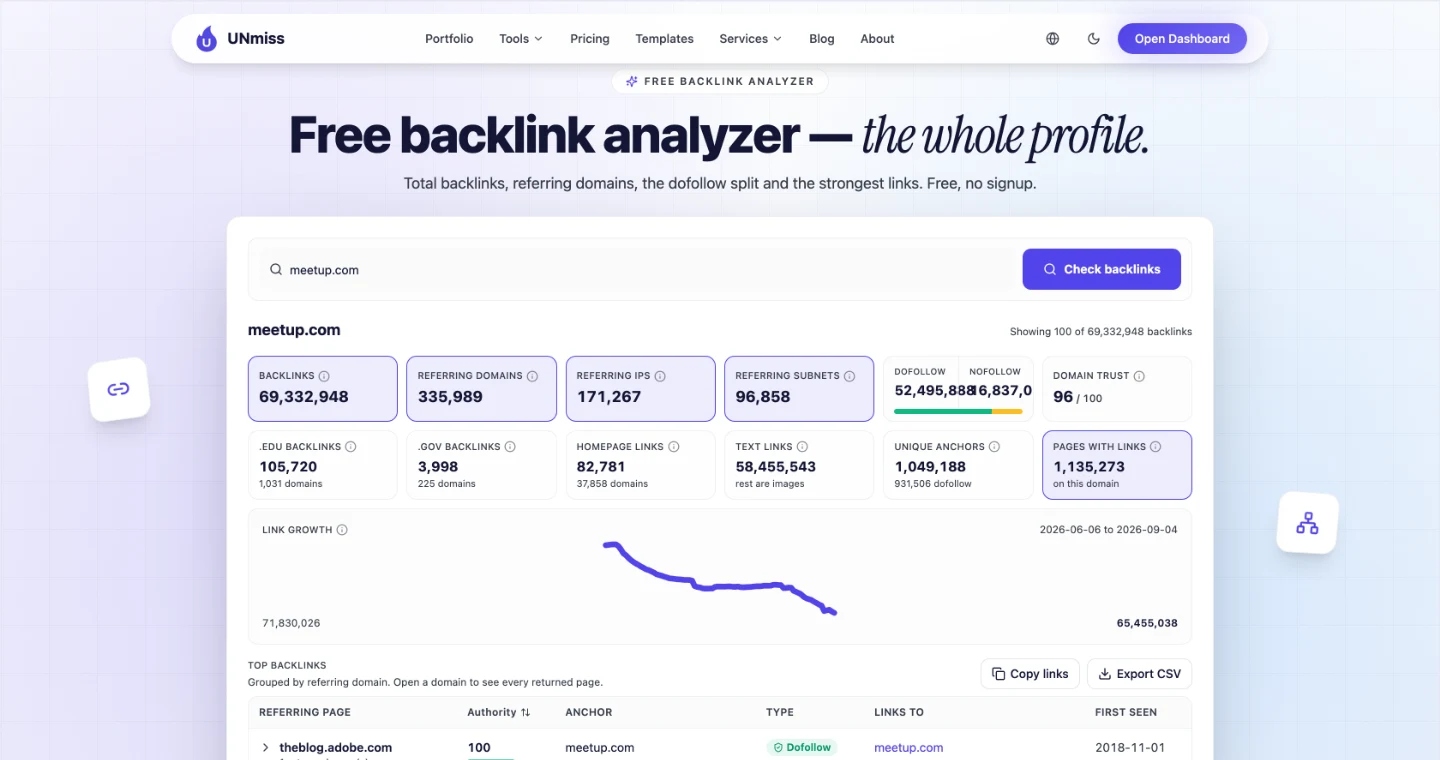
The Backlink Analyzer puts meetup.com at 69M backlinks from 340K referring domains. Three quarters are dofollow, and it scores 96 for trust.
That is one of the strongest profiles you will measure anywhere.
That is a free run. Before you spend anything on links, get the historical view from Semrush or SE Ranking and check whether the last batch moved a single ranking. Usually the answer is in the chart already.
The Organic Traffic Checker puts the same domain at 378K estimated monthly visits.
Hold those two numbers next to each other. Authority is not a currency you can spend on traffic. It is a permission to compete for queries you have pages for — and if the pages are not there, or the queries do not exist, the authority sits idle.
Before you spend another quarter on link building, check whether links are actually your constraint. Run your own domain through both reports. If your trust score is already respectable and your traffic is not, more links will not fix it.
Count what one ranking change would cost
Here is where the traffic that does arrive goes.
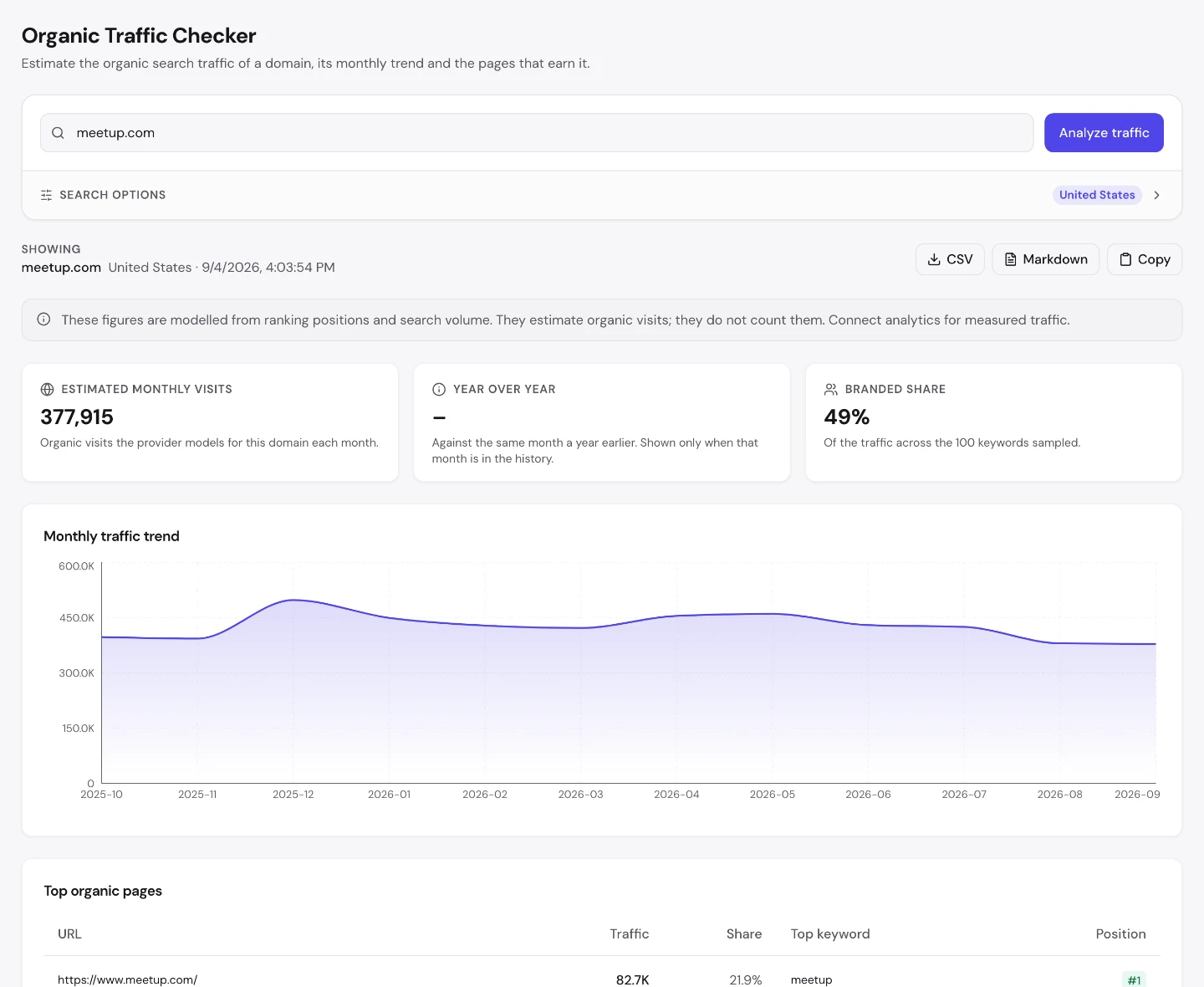
The homepage takes 83K visits — 22% of everything, ranking first for "meetup". The second page takes 2%. Nothing else reaches 1%.
Compare that with Rotten Tomatoes, where the biggest page is 4% and the homepage is 1%. Meetup does not have a content library that happens to include a homepage. It has a homepage, with a very long tail attached.
If your own top-pages report looks like this, you are one ranking change away from losing a fifth of your traffic. That is worth knowing before it happens, not after.
Read a login page in your top results
Read that table again. The third largest organic page on meetup.com is /login/, at 5,200 visits a month, ranking first for "meet up".
A login screen has no content, sells nothing, and answers no question. It is pulling more search traffic than all but 2 pages on the site.
This is a symptom worth recognising in your own data. When a utility page — login, signup, a bare category, a search results page — appears near the top of your organic report, it usually means the pages that should be answering those queries either do not exist or are not indexable. The Website Audit will tell you which of the two you are dealing with, and the XML Sitemap Generator will show you what a crawler can actually reach.
Split branded from the rest before reporting
Branded share: 49%.
Roughly half of Meetup's organic traffic is people who already knew about Meetup and used Google as an address bar. Strip that out and the site earns about 190K visits a month from search discovery — from 69M backlinks.
A high branded share is not a failure. It is the opposite of GeeksforGeeks, which sits at 1% and has no floor at all. Meetup's traffic is durable in a way GeeksforGeeks' is not.
But it does change what a traffic number means. When you report organic growth, split branded from non-branded first, or you will spend a year congratulating yourself for a brand campaign that marketing ran.
Know what an institutional link cannot do
Meetup carries 110K .edu backlinks from about 1,000 universities, plus a few thousand .gov links.
That is 5 times the .edu links Rotten Tomatoes has, on a site with a tiny fraction of its traffic.
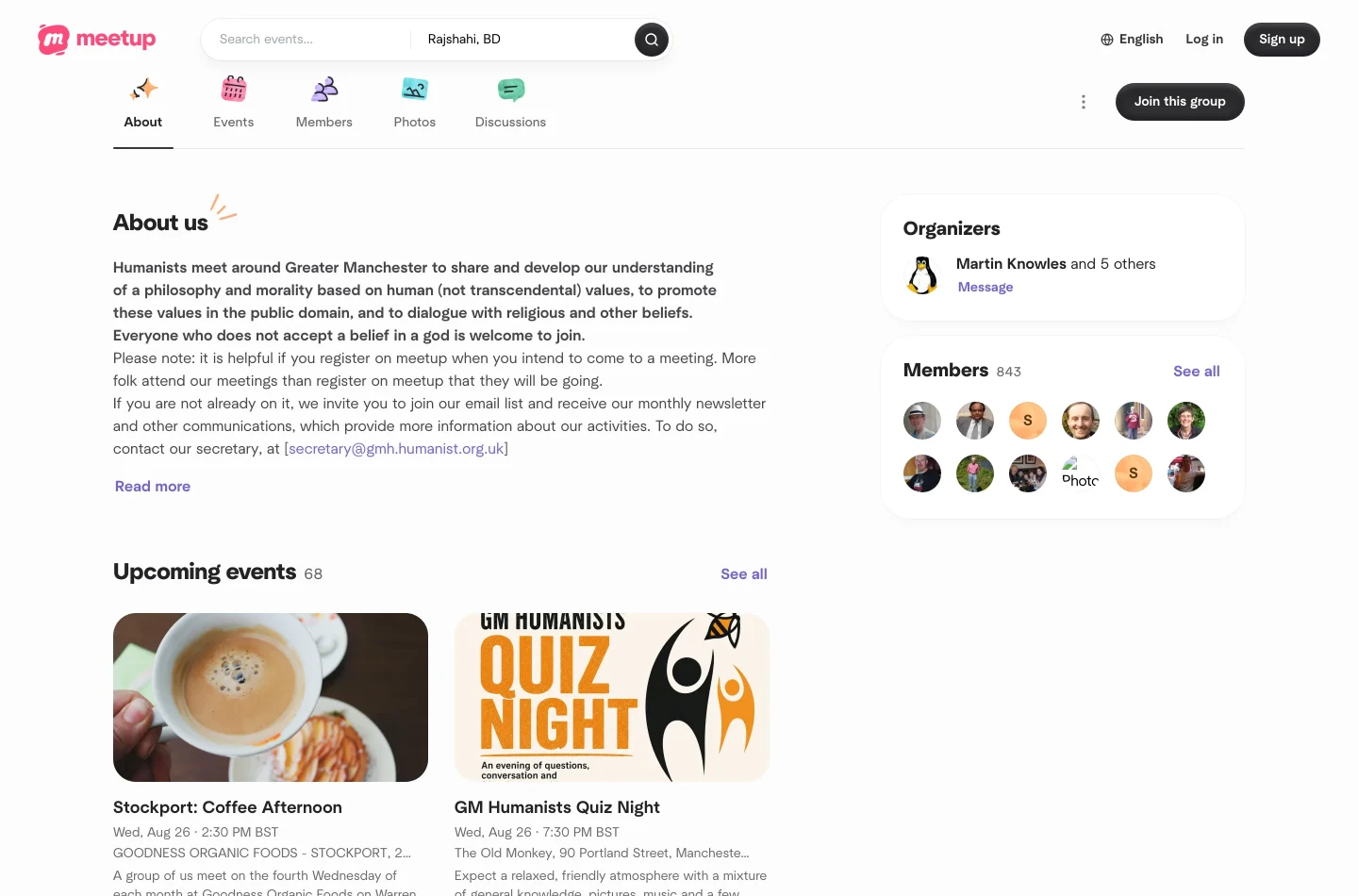
Universities link to Meetup because student groups, departments and societies organise there. It is the most institutionally-endorsed domain in this batch by a wide margin.
And it converts almost none of that into search traffic, because a university linking to your group's page endorses the domain without creating anything for a stranger to search for. Links follow usage. Traffic follows queries. Those are not the same funnel, and this is what it looks like when a site wins the first and loses the second.
Meetup has 69M backlinks and gets 378K visits. Authority without the right pages underneath it earns nothing. We would look at your pages before we ever talked to you about links.
- An honest read on whether links are your problem
- Page and template work where they are not
- Link building where they are
- An honest answer before you spend
Watch the lost column every month
From the Domain Overview: 45K new keywords against 46K lost. Of the ones it kept, 24K improved and 23K declined.
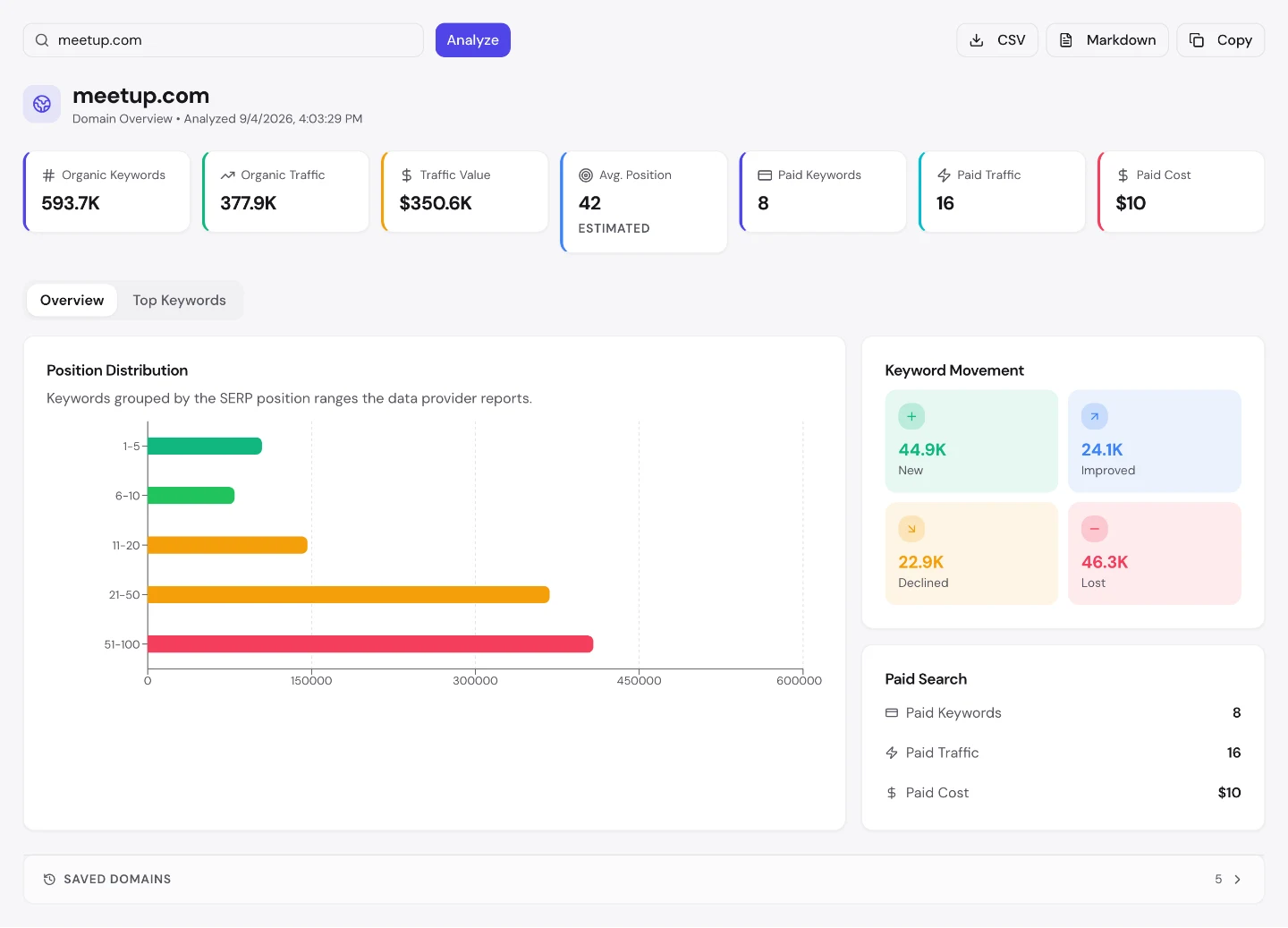
Net negative, on a base of 590K keywords at an average position of 42.
A platform built on user-generated events has an expiry date baked into every page. Events end. Groups go quiet. The pages stay, the queries do not, and the library erodes from the bottom whether or not anybody is paying attention.
If your own site depends on user-generated pages, this is your future too. Watch the lost column monthly, and decide deliberately what happens to a page when the thing it describes is over.
Check demand before you chase a ranking
Look at the positions in Meetup's top pages. Almost every one of its biggest pages already ranks first.
They still only produce 378K visits between them, because the queries are small. "line dancing near me" ranks first and earns 2,900 visits.
This is the mirror image of Rotten Tomatoes, where a page ranking 27th earns 1.3M. Position is not the outcome. Position multiplied by demand is the outcome, and demand is the half you cannot influence with better SEO.
So check demand before you commit. Put your target terms into Keyword Research and be honest about whether first place is worth having. Ranking first for something nobody searches is a very expensive way to feel productive. Cluster the survivors with the Keyword Cluster tool so you are choosing between themes rather than single terms.
Weigh fixes by traffic, not by severity
The Website Audit scores the homepage 85/100. Behind that score: 1 critical issue, 2 warnings and 7 notices. It passed 111 checks.
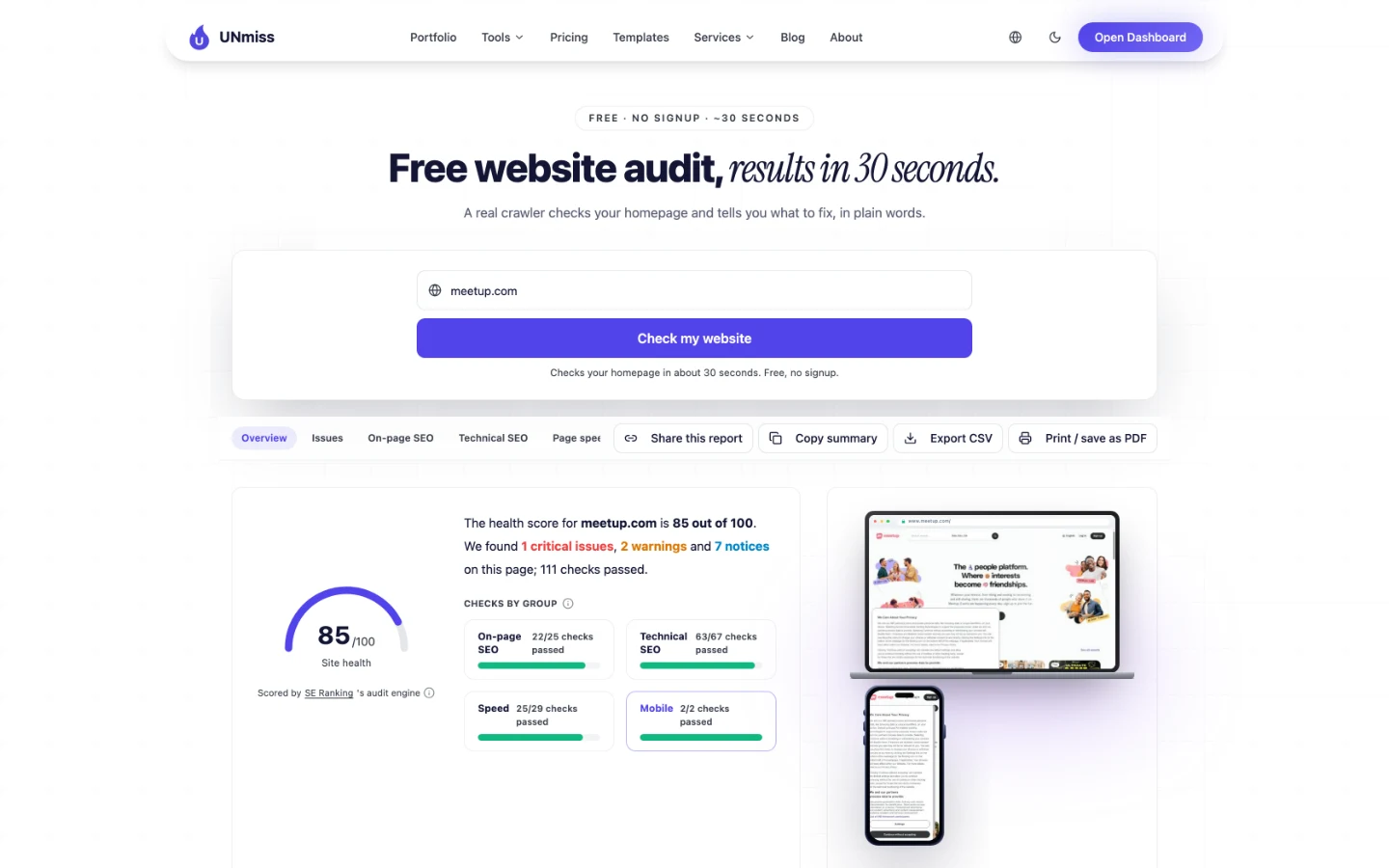
7 notices is the most of any site in this batch, and they are all on the single page carrying a fifth of the traffic. On a normal site that is a low priority. Here, the homepage is the site.
Take the general rule from it: weight your technical fixes by the traffic the page actually carries. Run Site Speed on that one page before you touch anything else. A critical issue on a page nobody visits matters less than a notice on the page that is 22% of your business.
Read a rival's paid columns before you assume
One small thing that says a lot. Meetup runs 8 paid keywords, 16 paid visits, $10 of paid cost in the period measured.
Not zero — but close enough to zero that it is clearly not a channel, on a site with 69M backlinks and a 96 trust score.
Eventbrite, in the same batch and the same market, runs 163 paid keywords. That is a strategic difference you can read straight off the report, and it is worth doing for your own competitors before you assume how they are buying growth.
Meetup has 69M backlinks and 378K monthly visits. Before you spend another quarter on link building, find out which half of that equation is actually holding you back. Run both reports on your own domain and compare them.
- Backlinks, referring domains, the dofollow split and Domain Trust
- Estimated monthly visits, branded share and the pages that earn them
- 3 checks a day each, no signup, no card
What you cannot copy
And here is what I could not measure, or had to qualify. A couple of the tools I name below are partners of ours — if you buy through those links we earn a commission, and you do not pay a cent more.
Our traffic figures are United States only and modelled from ranking positions and search volume rather than counted, which the tool states on its own screen. Meetup is a global platform, so its worldwide traffic is materially larger than the 378K here, and the comparison with GeeksforGeeks holds only because both were measured the same way on the same day. The keyword and backlink data underneath comes from SE Ranking.
The $350K traffic value is a model on top of a model — what those visits would cost as ads at the CPCs the keywords carry. It is not revenue. Meetup earns from subscriptions rather than search, so its search traffic and its business are much less connected than this article's framing implies.
The year-over-year comparison returned empty, so I have no trend claim. I did not run Keyword Research: it has an open defect returning implausible volumes, and a gap is better than a number I do not trust.
And what you cannot copy: 20 years of groups. Meetup's 69M links exist because millions of organisers each linked to their own group page from their own website, mailing list and forum signature over two decades. That is not a campaign. It is a side-effect of being the default place a certain kind of thing happens, and there is no budget line that reproduces it.
Frequently asked questions
How many backlinks does Meetup have?
69M backlinks from 340K referring domains, measured 4 September 2026, across 97K referring subnets. The split is 52M dofollow to 17M nofollow, or roughly 76% to 24%. Domain Trust is 96 out of 100.
How much search traffic does Meetup get?
Roughly 378K estimated US organic visits a month, from 590K ranking keywords at an average position of 42, measured 4 September 2026. Our Domain Overview prices that traffic at $350K a month as an ad-spend equivalent. Both figures are United States only and modelled rather than counted.
Why does Meetup have so many links but so little traffic?
Because links follow usage and traffic follows queries. Millions of organisers link to their own group pages, which builds enormous domain authority, but a group page gives a stranger nothing to search for. Meetup wins the link funnel and loses the discovery funnel.
What is Meetup's biggest organic page?
The homepage, at roughly 83K estimated monthly visits — 22% of the site's organic traffic — ranking first for "meetup". The second largest is the New York city page at 2%, and the third is the login page at 1%. No other page reaches 1%.
What is Meetup's branded search share?
49% of traffic across the 100 keywords sampled by our Organic Traffic Checker. About half its organic traffic is people who already know the brand and are using search to navigate to it, which makes that traffic far more durable than an unbranded equivalent.
How many .edu links does Meetup have?
110K .edu backlinks from 1,000 domains, plus 4,000 .gov links from 225 domains — the highest institutional link count of the 5 sites measured in this batch, and roughly 5 times Rotten Tomatoes' .edu total despite far lower traffic.
Is Meetup gaining or losing keywords?
Losing slightly. Over the measured period it gained 45K keywords and lost 46K, with 24K improved and 23K declined — a small net loss against a base of 590K. Event pages expire by nature, so the library erodes unless it is continually refilled.
Does Meetup run paid search?
Barely. The Domain Overview reports 8 paid keywords, 16 paid visits and $10 of paid cost in the period measured. Eventbrite, in the same market and measured the same day, ran 163 paid keywords.
The one number to take away
27x.
That is how many more backlinks Meetup has than GeeksforGeeks, measured the same way on the same day — and GeeksforGeeks gets 9x more search traffic.
Every link building pitch you will ever read assumes those two numbers move together. They do not. Links buy you the right to compete; pages and queries decide whether you actually do. Meetup bought the first and never needed the second, because its business does not run on search.
So before your next campaign, answer one question honestly: if you doubled your backlinks tomorrow, which specific pages would rank for which specific queries? If you cannot name them, links are not your constraint, and no amount of outreach will make them one.
Found something in your own report that surprised you, or measure this differently? I would genuinely like to know — the tools used are all free, so you can check every figure yourself. Measured 4 September 2026. Domain Overview, Organic Traffic Checker, Website Audit and Backlink Analyzer figures are free runs of our own tools, all United States scope, and all modelled rather than counted where the tool says so. No revenue figure for Meetup was available to us.