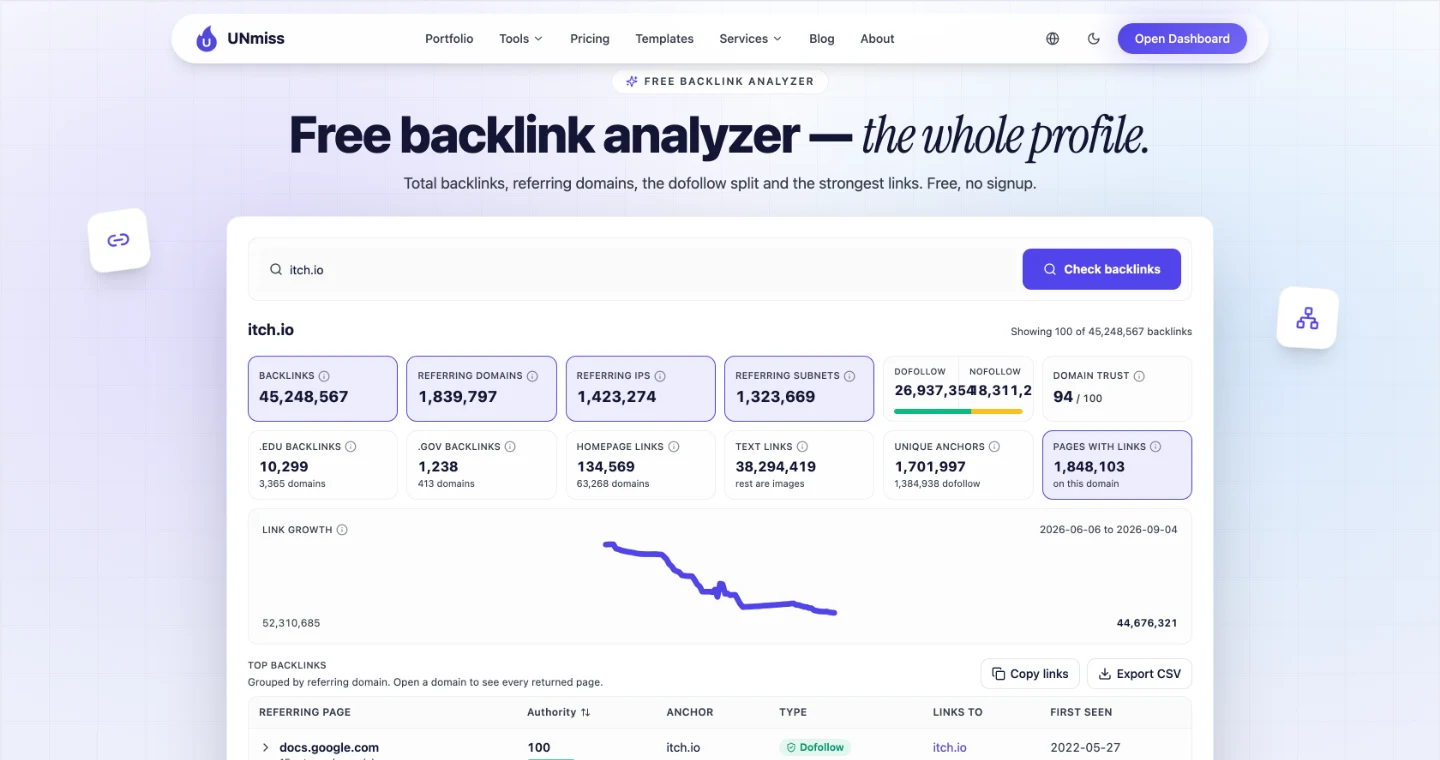
itch.io's most common anchor text is "Buy Now!" — 3M links carrying those 2 words.
More than its own brand name, which comes second at 1.7M.
That is not a marketing campaign. It is the label on a widget that game developers paste onto their own sites to sell their own games, and it has built 45M backlinks from 1.8M domains. I ran itch.io through 4 of our tools, and the traffic side turned out to be even stranger than the link side. Here are 9 things worth taking.
Choose the words on your own button
Our Backlink Analyzer puts itch.io at 45M backlinks from 1.8M referring domains, Domain Trust 94.
That is free. Watching a user-built category layer means tracking hundreds of tag pages at once, and Semrush and SE Ranking will both do that on a schedule instead of by hand.
The anchor list is led by "Buy Now!" at 3M, ahead of "Itch.io" at 1.7M and "itch.io®" at 1.1M.
Every one of those "Buy Now!" links is a developer embedding itch.io's purchase widget on their own game page, portfolio or devlog. The link is a side-effect of the thing the developer actually wanted, which was to take money.
We measured Eventbrite separately and found the identical pattern in different words. Its top anchor is "We teamed up with Eventbrite".
Two platforms in unrelated markets, both with a top-3 anchor that is template copy from an embed.
So if you sell through other people's sites, your link engine is already built. The only question left is what text you ship inside it, and you get to answer that exactly once before it propagates for years.
Build the category layer, not the item layer
Now the traffic side, which is where itch.io stops resembling anything else in this batch.
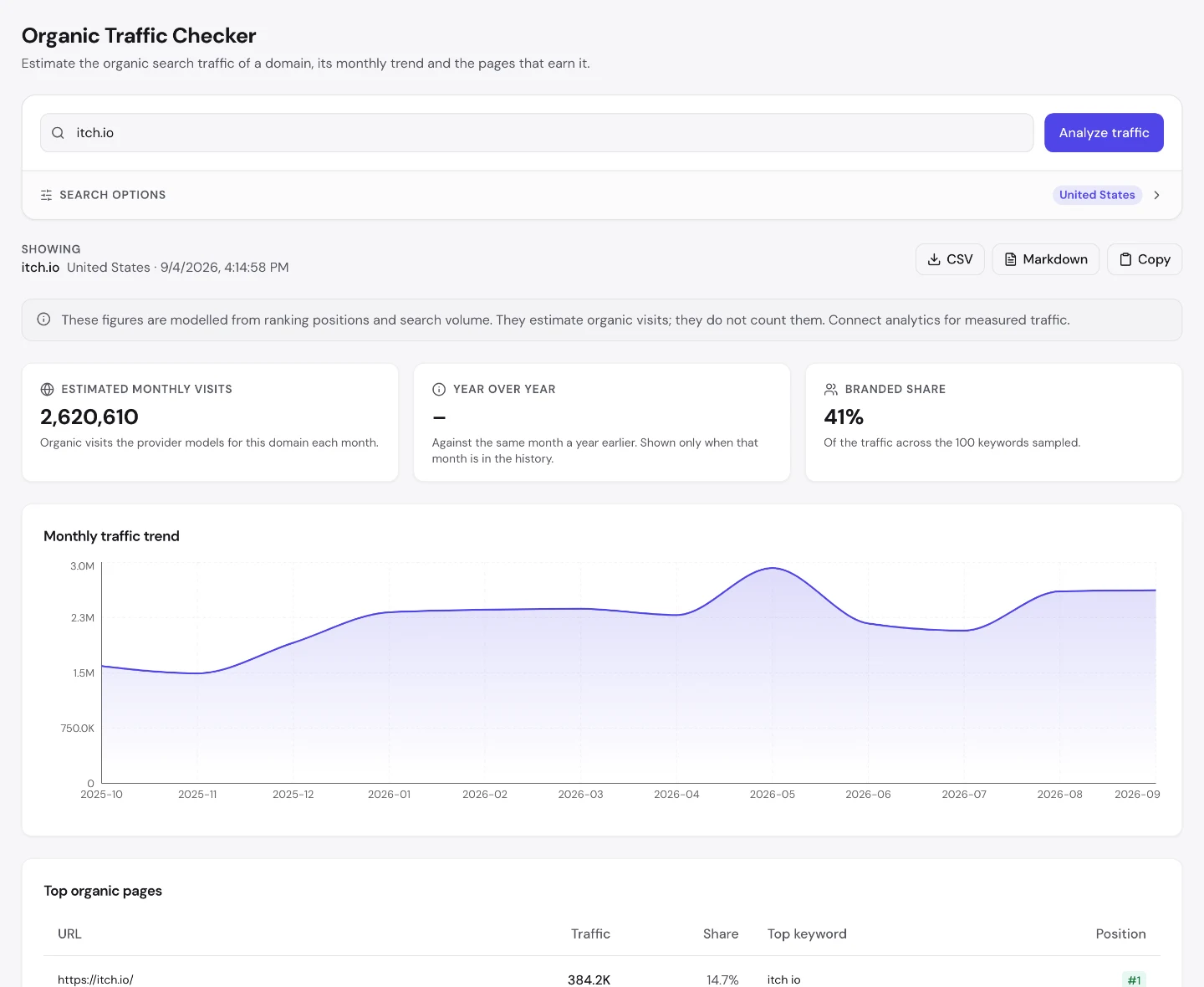
The Organic Traffic Checker puts itch.io at 2.6M estimated monthly visits. The homepage takes 15%. After that, the largest pages are /games/tag-… listings.
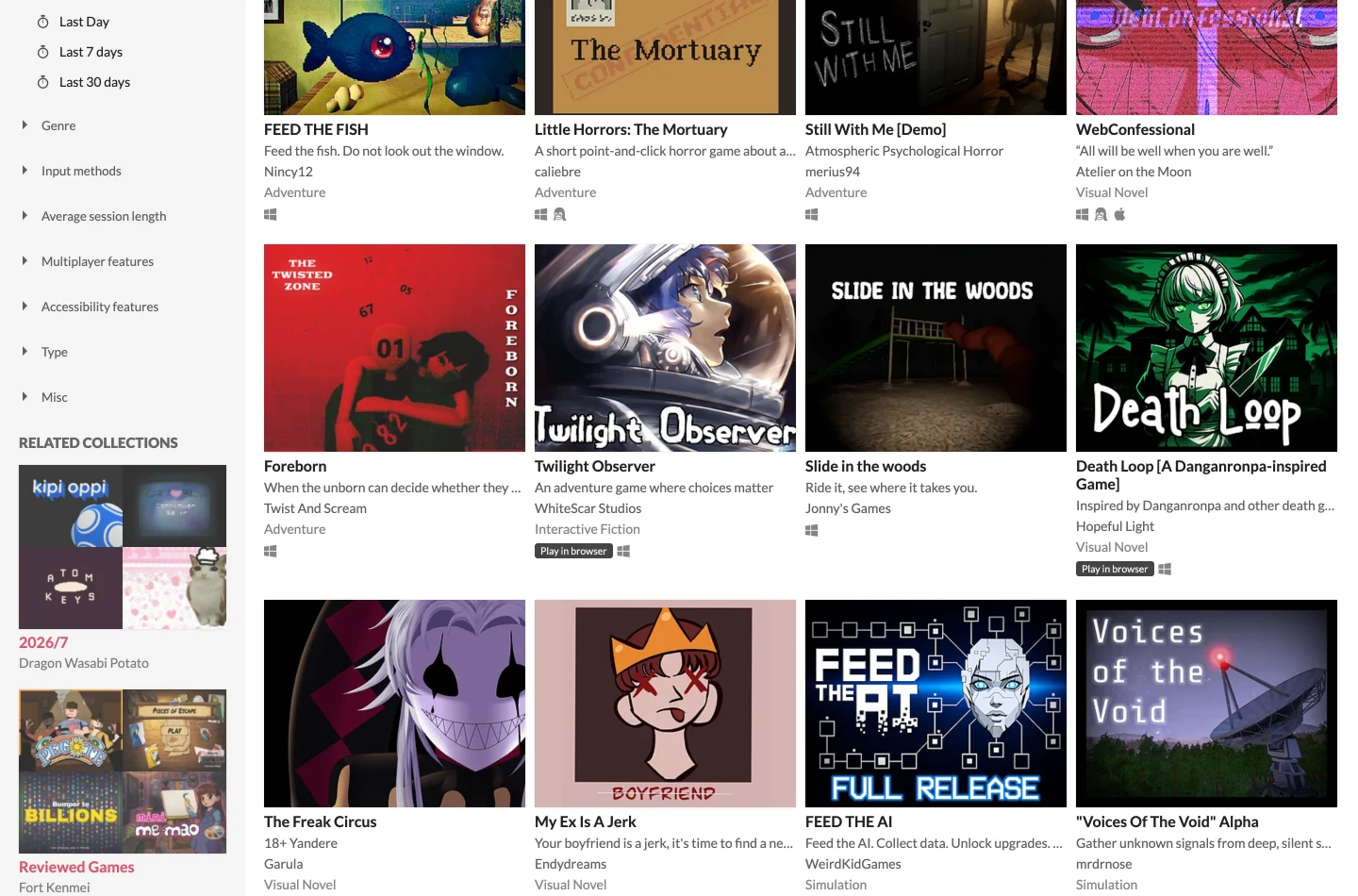
itch.io hosts hundreds of thousands of games. Almost none of them rank. The pages that do are the automatically generated tag directories sitting on top of them.
This is the same lesson Eventbrite's browse pages teach, and it keeps being the most under-built layer on catalogue sites.
Your items are not what people search for. The category of item is. Go and check which of the two your own traffic lands on, because you are probably investing in the wrong one.
If you hold a library of anything, build a page per meaningful tag and let your tags compete with each other. The winners will not be the ones you expected.
Let users name your categories
Here is the part that makes itch.io's version different, and better.
Those tags are not a taxonomy an SEO team wrote in a spreadsheet. Developers tag their own games, and the popular tags become directory pages automatically. The category structure is crowdsourced from the people who actually make the things.
That means the tags match the words real users reach for, including combinations no strategist would think to plan, and the set expands on its own as the market shifts. A hand-built taxonomy is out of date the month it ships; this one is never out of date.
You can copy the mechanism at almost any size: let contributors tag freely, then promote any tag that crosses a threshold into an indexable page. Check the result with Keyword Research before you index everything — the point is to find the tags with real demand, not to publish 40K thin pages. The Keyword Cluster tool will group them into the handful of themes actually worth a directory page.
Expect to rank for what your users publish
Worth stating plainly, because it is a large part of how this site actually performs. Three adult-content tag pages appear in the top 6, and each of them ranks first. Between them they draw about 8% of all organic traffic.
That is more than 5x what the site's single biggest individual game earns.
The SEO lesson is uncomfortable but real: an open platform ranks for whatever its users publish, and the highest-demand, lowest-competition corners of a catalogue are often not the ones the brand would choose for its homepage. If you open your categories to contributors, decide in advance which ones you are willing to have as your public front door — because the search engine will pick based on demand, not on brand fit.
Decide who owns the equity you build
Two of the 6 biggest pages are not on itch.io at all. They are solarim.itch.io and ninja-muffin24.itch.io — individual creator subdomains, at 75K and 50K visits.
One of them ranks 11th for a generic 2-word term and still out-earns most of the platform's own pages. The other ranks first for a game's name.
Giving every creator a subdomain is a real strategic choice, and it costs something. Those pages build their own authority rather than the main domain's.
itch.io accepts that because each creator's audience links to their subdomain, and the platform gets the aggregate.
So if you host user content, decide deliberately between subdomains and subfolders. The subdomain route trades your central authority for creator ownership, and you cannot undo it quietly later.
The Website Audit scores a subdomain on its own, which is the quickest way to see what each of yours is really carrying.
itch.io gets 2.6M visits a month from tag pages its own users named. The item pages barely register. If you run a marketplace, your category layer is probably underbuilt, and it is the fastest thing to fix.
- We rebuild the category and tag layer
- Marketplace and SaaS development
- SEO and GEO across the template
- Free call to scope it
Aim for a blend, not a pure profile
Its links split roughly 60/40 between dofollow and nofollow.
That sits between Eventbrite's 95% dofollow and Rotten Tomatoes' 67% nofollow, and the mix tells you itch.io is earning links from both mechanisms: self-installed widgets on one side, and forum, Reddit and community citations on the other.
A blended profile like this is the healthiest shape in the batch, and it is worth aiming for. Links you install yourself scale but concentrate risk in one template; links people write about you are slower but broader. Read your own split as a diagnosis of which of the two you are actually doing.
Know what equilibrium looks like for you
From the Domain Overview: 36K new keywords against 36K lost. Of the ones it kept, 20K improved and 18K declined.
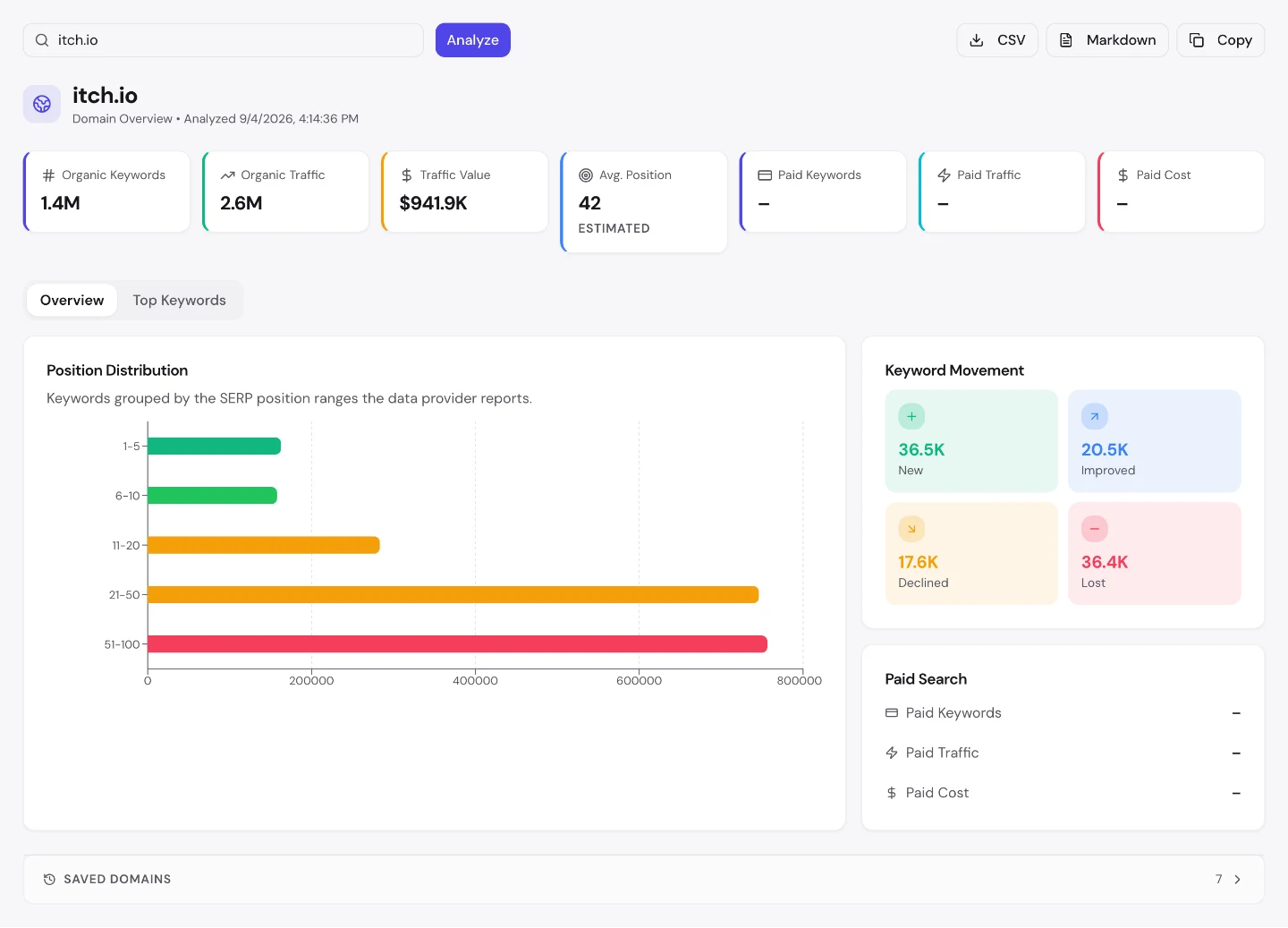
New and lost are within 100 of each other. The library is not growing; it is being replaced.
On a platform where anyone can publish a game and then abandon it, that is what equilibrium looks like. New uploads enter the index at the same rate old ones drop out.
So measure your own churn before you set a growth target. If your catalogue replaces itself every year, flat is the win, and a target built without that number is one nobody can hit.
Treat technical health as a floor
The Website Audit scores itch.io 88/100. Behind that: no critical issues, 2 warnings and 6 notices.
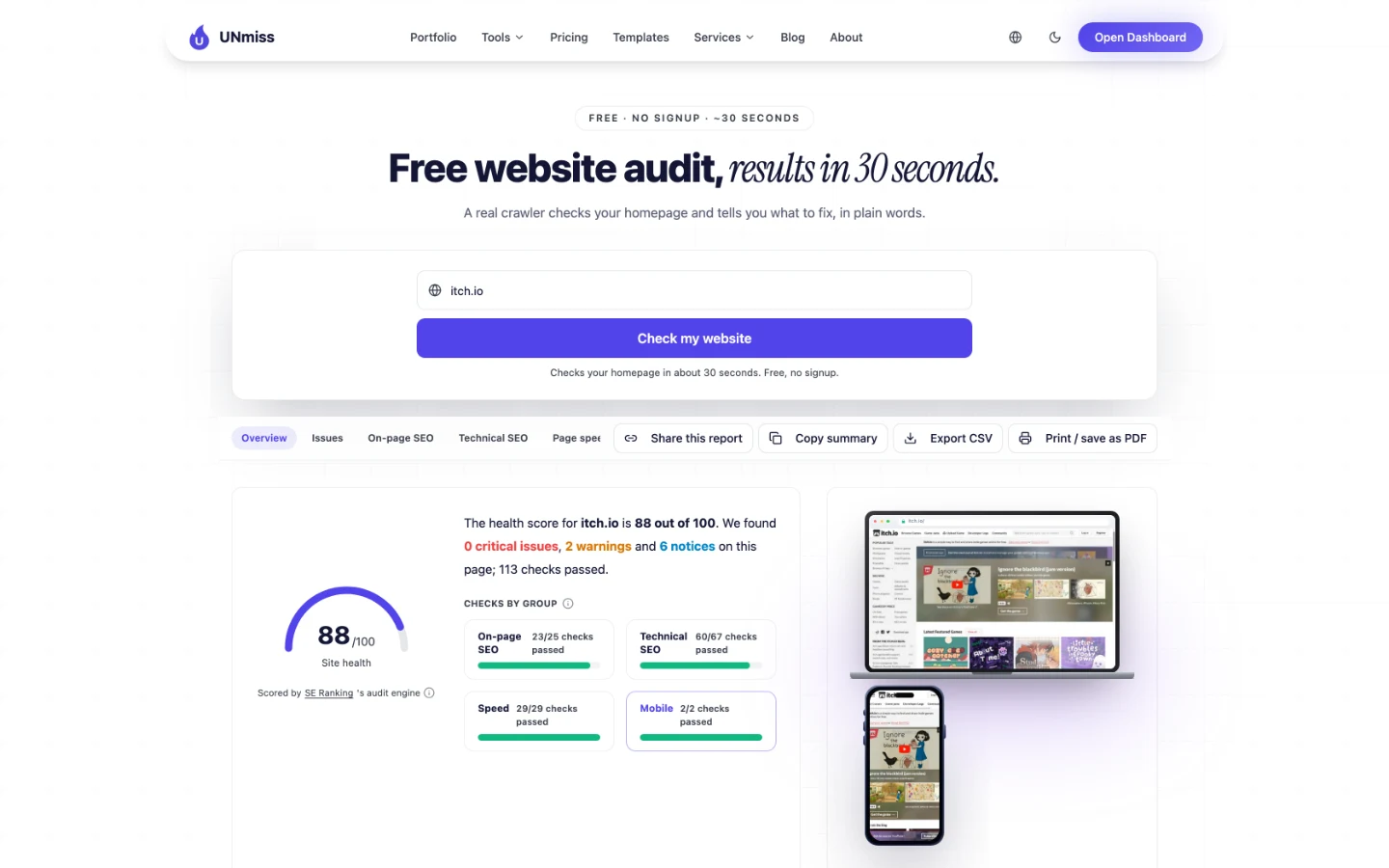
That is the cleanest result in this batch. Eventbrite has 2 critical issues, Rotten Tomatoes and Meetup have 1 each, and all 3 of those have far more traffic value.
Which is the honest note to end the technical section on: itch.io is the most correctly built site here and the fourth most valuable. Technical health is a floor, not a lever. Fix your critical issues because they are cheap — Site Speed and the Meta Tag Generator cover most of what an audit flags — then go and do the thing that actually moves the number.
Check your rival's paid columns
Paid keywords: none. Paid traffic: none. Paid cost: none.
$940K of monthly traffic value, entirely earned. In this batch only Rotten Tomatoes and GeeksforGeeks are also at zero, while Eventbrite runs 163 paid keywords and Meetup 8.
For a platform whose growth comes from creators bringing their own audiences, paid search would be buying back people it already has. Check your competitors' paid columns before assuming you need to match their spend — some of them are not spending anything.
itch.io hosts hundreds of thousands of games, and its traffic comes from tag directories and 2 creator subdomains. The Organic Traffic Checker returns the same top-pages table for any domain, with the share, top keyword and position beside each page.
- The same report that found tag pages beating every individual game
- Estimated monthly visits, branded share and the 12-month trend
- 3 checks a day, no signup, no card
What you cannot copy
And here is what I could not measure, or had to qualify. A couple of the tools I name below are partners of ours — if you buy through those links we earn a commission, and you do not pay a cent more.
Our traffic figures are United States only and modelled from ranking positions and search volume rather than counted, as the tool states on its own screen. itch.io has a large international audience, so its worldwide traffic is materially higher than the 2.6M here. The keyword and backlink data underneath comes from SE Ranking, and the $940K traffic value is an ad-spend equivalent rather than revenue — itch.io's actual income is a revenue share on sales, which no tool of ours can see.
The year-over-year comparison returned empty, so I have no trend claim. I did not run Keyword Research: it has an open defect returning implausible volumes, and I would rather leave the gap than publish a number I do not trust.
As with Eventbrite, I inferred the widget mechanism from anchor text rather than auditing the linking pages. 3M links reading "Buy Now!" is template copy at a scale no campaign produces, which makes the conclusion strong but not proven.
And what you cannot copy: a decade of goodwill with independent developers. The "Buy Now!" widget spreads because creators want itch.io to be the place their game is sold, and that preference was earned by revenue splits and moderation policy rather than by SEO. The button is copyable. The reason people install it is not.
Frequently asked questions
How many backlinks does itch.io have?
45M backlinks from 1.8M referring domains, measured 4 September 2026, across 1.3M referring subnets. The split is 27M dofollow to 18M nofollow, roughly 60% to 40%. Domain Trust is 94 out of 100.
What is itch.io's most common anchor text?
"Buy Now!" with 3M backlinks — more than the brand name itself, which is second at 1.7M. Those links come from itch.io's embeddable purchase widget, which developers install on their own sites to sell their games.
How much search traffic does itch.io get?
Roughly 2.6M estimated US organic visits a month from 1.4M ranking keywords at an average position of 42, measured 4 September 2026. Our Domain Overview prices that traffic at $940K a month as an ad-spend equivalent.
Which itch.io pages get the most traffic?
The homepage leads at 380K visits, or 15% of organic traffic. After that the biggest pages are automatically generated /games/tag-… directory listings rather than individual games, plus 2 creator subdomains at 75K and 50K visits.
Why do tag pages rank better than individual games?
Because people search for a kind of game, not a specific title they have never heard of. The tag directories match that intent, and itch.io generates them from tags the developers themselves apply, so the categories track the words the audience actually uses.
What is itch.io's branded search share?
41% of traffic across the 100 keywords sampled by our Organic Traffic Checker. That sits between GeeksforGeeks at 1% and Eventbrite at 65% — a mix of people navigating to the brand and people discovering it through category searches.
What is itch.io's website audit score?
88 out of 100 on our Website Audit, with 0 critical issues, 2 warnings, 6 notices and 113 checks passed — the cleanest technical result of the 5 sites measured in this batch, despite ranking 4th of the 5 on traffic value.
Does itch.io run paid search?
No. The Domain Overview reports no paid keywords, no paid traffic and no paid cost in the period measured. All $940K of its modelled monthly traffic value is earned.
The one number to take away
3M.
That is how many links say "Buy Now!" — a phrase itch.io chose once, inside a widget, and then never had to write again.
Every platform in this batch that reached millions of referring domains got there the same way. Eventbrite's button says "We teamed up with Eventbrite". itch.io's says "Buy Now!". Neither is a link building strategy in any sense an agency would recognise, and both outperform every campaign in this industry by 2 orders of magnitude.
So the useful question is not what your next outreach list looks like. It is whether there is any part of your product that somebody else would willingly put on their own website — and if there is, what the text inside it says. You get to choose that sentence exactly once, and then a few million people repeat it for you.
Found something in your own report that surprised you, or measure this differently? I would genuinely like to know — the tools used are all free, so you can check every figure yourself. Measured 4 September 2026. Domain Overview, Organic Traffic Checker, Website Audit and Backlink Analyzer figures are free runs of our own tools, all United States scope, and all modelled rather than counted where the tool says so. No revenue figure for itch.io was available to us.