Docker Hub's sitemap has not been rebuilt since January 2024, and it still earns 190K search visits a month.
96% of its entries carry that one date. The file is 2 and a half years stale, and 74M backlinks point at the site anyway.
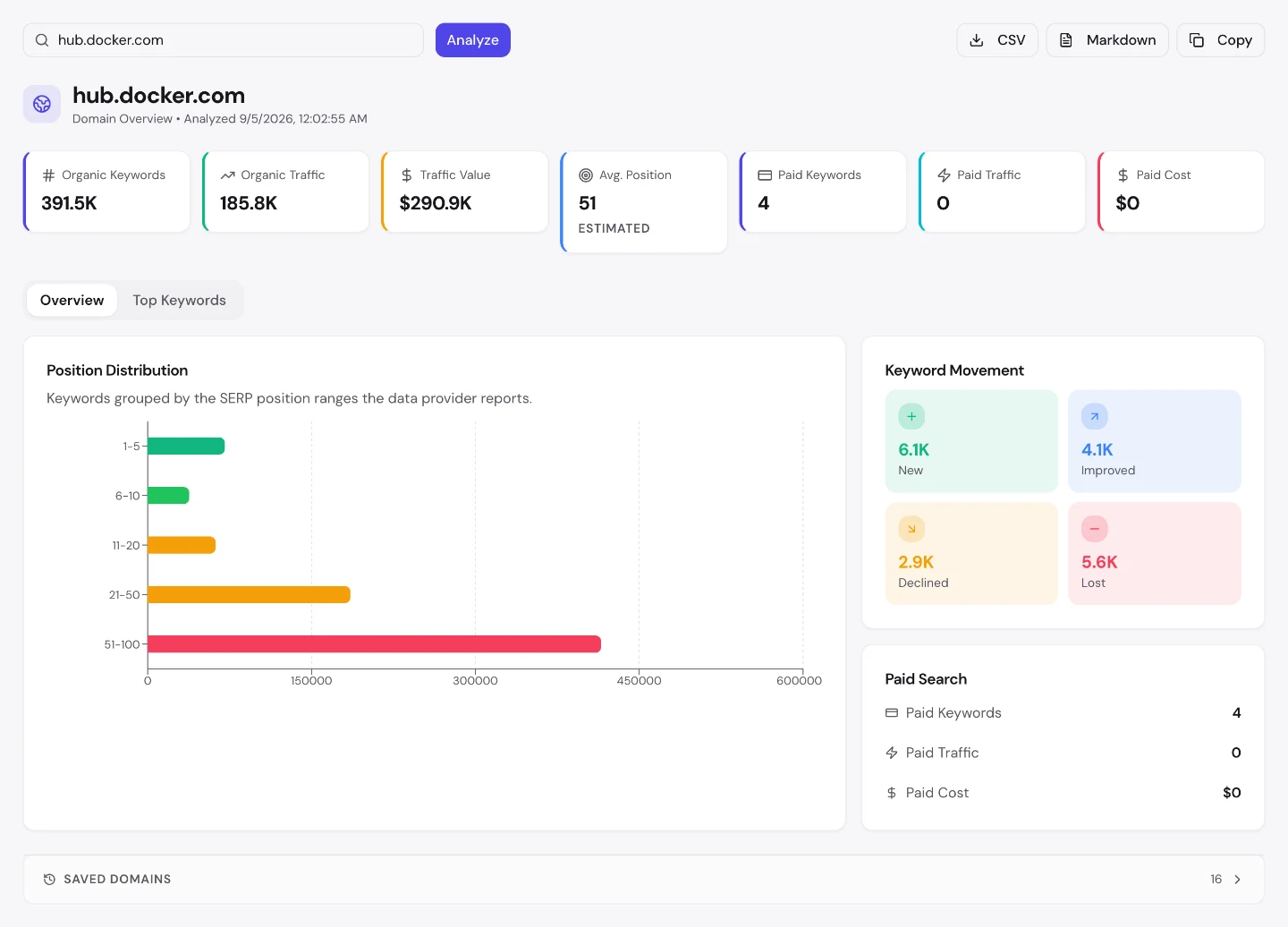
I ran hub.docker.com through 4 of our tools. It has the deepest average ranking position I have measured — 51 — and the finding is not that the stale sitemap is killing it. It is that almost nothing depends on the sitemap at all. Here are the 8 lessons.
Treat your sitemap as a hint, not a gate
An earlier full crawl found the index, every child file and 96% of the individual entries carrying exactly 17 January 2024.
Docker Hub adds repositories every day. None have entered that file in over 2 years — and the site earns its traffic regardless, because Google found the pages by other means: internal links, external links, and the sheer volume of documentation pointing at specific images.
So treat your sitemap as a hint rather than a gate. If your pages are linked from anywhere that gets crawled, they will be found without it.
Sitemaps earn their keep on pages that are genuinely hard to reach — deep, orphaned, or newly published with nothing linking in. If that does not describe your site, the hours you were about to spend on it are better spent elsewhere, and this is your permission to say so.
Stop reading your average position
The Domain Overview puts its average position at 51. Page 6 — the deepest of any site measured here.
That is free and instant. If you want to know whether a technical problem actually cost you anything, you need rankings from before and after it appeared, and Semrush and SE Ranking are where that history lives.
It still converts that into more monthly traffic value than chess.com earns on five times the visits, because "docker image for X" carries commercial intent and "chess" does not.
So stop reading your average position as a health metric. On a large catalogue it is close to meaningless: a few thousand good rankings get buried under a few hundred thousand mediocre ones, and the number tells you nothing about either.
A deep average with real revenue means your value is in the tail, and your work is breadth rather than rank. Sample the terms that matter with Keyword Research and watch them in the Rank Tracker instead.
Look for links your product already earns
Our Backlink Analyzer reports 74M backlinks for hub.docker.com.
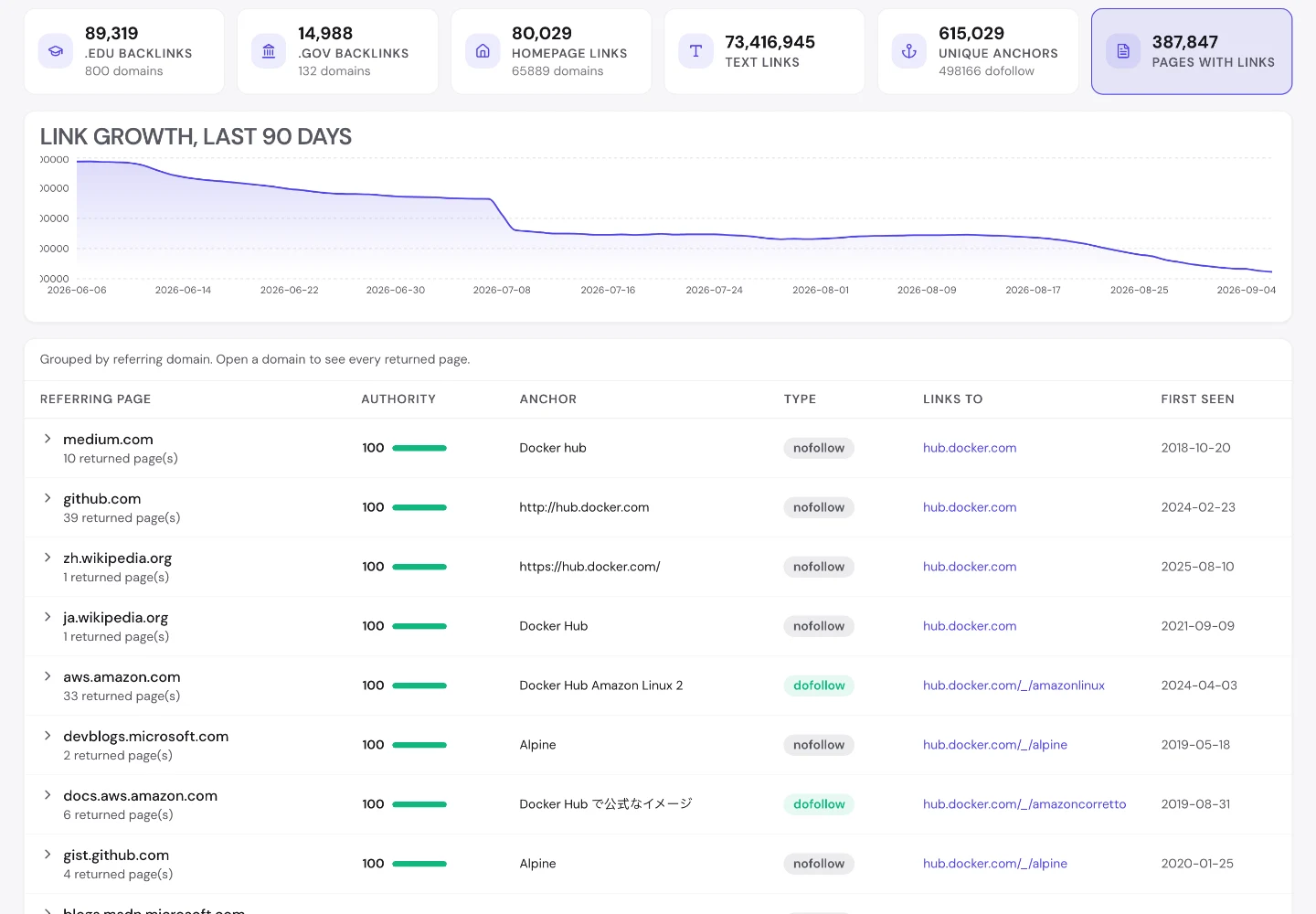
Nobody writes blog posts about Docker Hub. The links come from somewhere else entirely: every project README, every deployment guide, every CI configuration that references an image links to its page.
This is now the seventh site in this series where the link engine is a usage side-effect rather than a campaign — after Eventbrite's widget, itch.io's button, MDN's template, Open Library's integration, PyPI's badges and Dribbble's embeds. The pattern is not an exception any more. It is the rule.
Which means the question worth asking about your own product is not "who can we get to link to us". It is "what do our users already have to reference in order to use us" — a config value, an ID, an endpoint, a badge.
If the answer is nothing, that is the gap. Building one thing people must cite will outperform any outreach programme you can afford.
Design your template for the median case
From the same crawl: 66% of publishers own exactly one repository. The median publisher owns one. At the other end, a single account holds over 2,000.
Two thirds of the publisher base has a single item, and a handful hold thousands. That is the normal shape of every user-generated catalogue, and yours will look the same.
So do not build your templates for the power user. You will design a beautiful profile page around somebody with 2,000 items, and then ship it to 32K people who have one.
Build for the median publisher instead, because that is what most of your pages will actually contain. Run one of those through the Content Optimizer and see how thin your typical page really is — it is usually a shock.
Docker Hub earns $291K a month in traffic value with a sitemap that stopped updating. Most technical worries cost far less traffic than people fear. We will tell you which of yours actually matter.
- An audit that ranks fixes by traffic, not severity
- Developers who can ship the fixes too
- SEO and GEO for technical products
- First call is free
A stale sitemap is survivable
Stated as the lesson, because it contradicts a lot of advice.
Docker Hub's sitemap is 2.5 years old, capped at a fifth of the entries the specification allows, and carries duplicates plus a malformed legacy entry that 404s. By any checklist it is neglected. The site earns $291K a month.
That does not make sitemaps pointless — it makes them conditional. They matter when discovery is genuinely hard.
Here is how to find out which situation you are in. Generate a current sitemap with the XML Sitemap Generator and compare it with what you actually submit.
If the gap is pages nothing links to, fix the file — those pages need it. If the gap is pages everything links to, you have found a job you can safely not do.
Automated checks verify presence, not freshness
The Website Audit scores the homepage 85/100, with nothing critical outstanding.
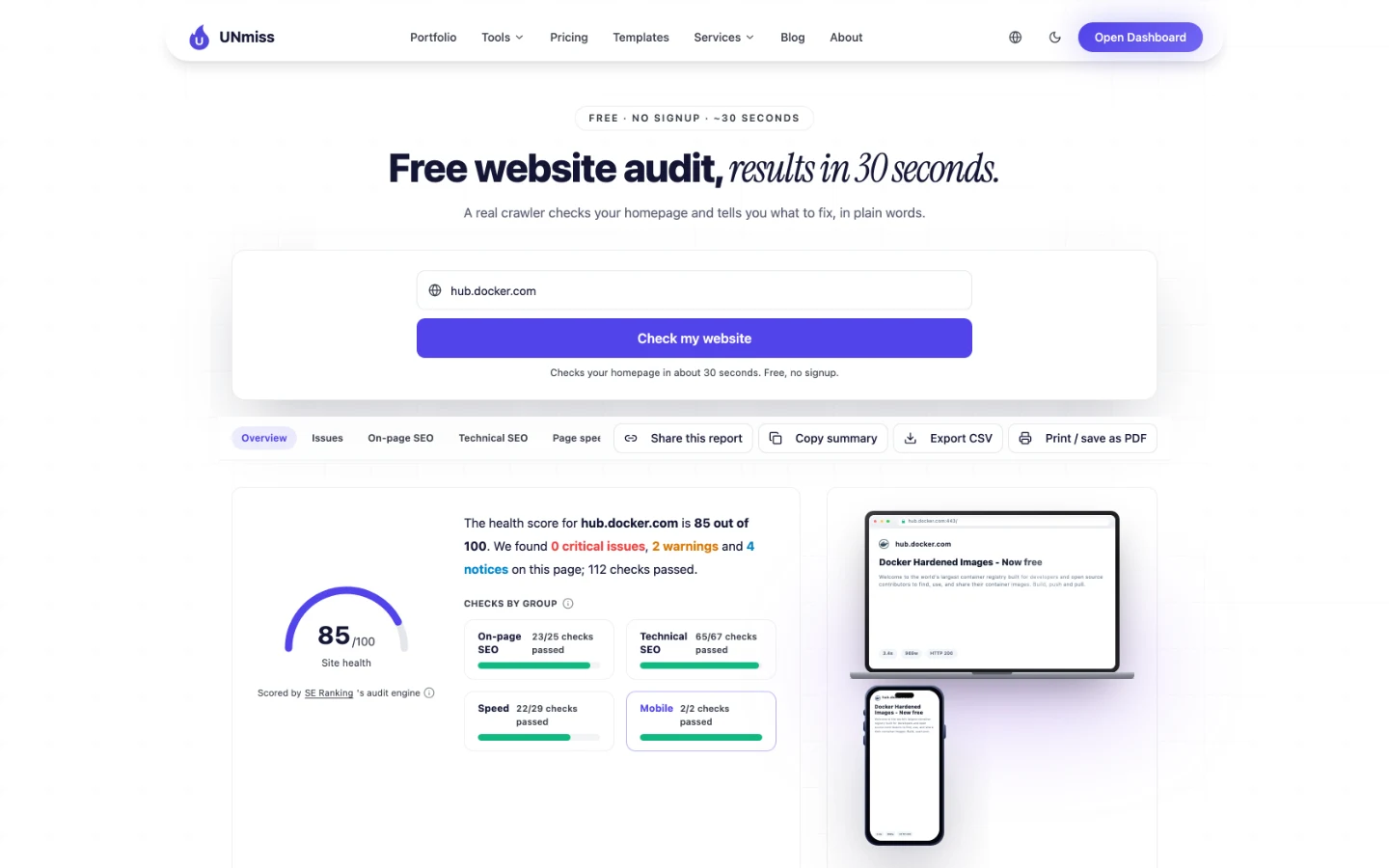
Worth pausing on: the audit passes the sitemap check, because a sitemap exists and is declared in robots.txt. Nothing in an automated audit asks whether it is current.
That is a real gap in how everybody scores a site, ours included, and it is why the manual crawl mattered more than the audit here.
Assume the same of every automated check you run. They verify that a thing is present. They rarely verify that it is true — so the questions worth your own time are the ones no tool is asking on your behalf.
Know whether your traffic is rented
Branded share: 4%. Almost nobody searches "docker hub" — they search for the thing they need to run, and arrive on a repository page.
That puts it at the discovery end, near Dribbble and GeeksforGeeks, and far from chess.com at 92%.
Which means every visit is rented from a ranking, and none of it is protected by habit. A site at the other end of that scale can survive an algorithm change; this one cannot.
Find out which describes you before you decide how much risk you are carrying. If your branded share is low, your traffic is a position you defend every month, and it deserves to be treated as a live risk rather than a stable asset.
Expect equilibrium on a user-built catalogue
Keyword movement is essentially flat — new images enter the index at about the rate old ones fall out of relevance. It is the same equilibrium itch.io shows, on the same kind of user-generated catalogue.
Paid search: 4 keywords and no measurable paid traffic. All of the $291K is earned.
If you run a catalogue your users fill, expect this rather than growth. Flat is the honest baseline once the catalogue is mature, and a plan that promises compounding traffic from more user uploads is promising something this data does not support.
Docker Hub's sitemap has been frozen since January 2024 and the site earns $291K a month regardless. The question is whether yours is doing real discovery work or just passing an audit check. Generate a current one and compare it with what you submit.
- Crawls your site and builds the sitemap it should have
- Shows the pages your current file is missing
- Free, no signup, no card
What you cannot copy
And here is what I could not measure, or had to qualify. A couple of the tools I name below are partners of ours — if you buy through those links we earn a commission, and you do not pay a cent more.
I have no top-pages data for Docker Hub. Our Organic Traffic Checker returned "the provider returned no ranking pages for this domain in this market" for hub.docker.com, as it did for developer.mozilla.org in the last batch — both are subdomains. So unlike most articles in this series I cannot tell you which individual repository pages earn the traffic, and the 190K visits figure is a domain-level estimate with no page-level breakdown behind it.
Our traffic figures are United States only and modelled from ranking positions and search volume rather than counted. Docker's audience is global and heavily technical, so the worldwide number is materially larger. The keyword and backlink data underneath comes from SE Ranking, and the $291K traffic value is an ad-spend equivalent, not revenue.
The backlink total came from the app rather than the marketing tool, which was rate-limited (HTTP 429) at capture time. The app's BACKLINKS tile is a known defect on our side and has returned negative values on other domains, so the total above is the page header figure and the screenshot is cropped below that tile.
The sitemap census comes from a full crawl on 29 August 2026. It found 130K entries and 32K namespaces. Almost all the entries carry the same 2024 date, and two thirds of the namespaces own a single repository. The 17 January 2024 date is what the file declares; I have not verified independently that no page has changed since. I did not run Keyword Research: it has an open defect returning implausible volumes.
And what you cannot copy: being the default registry. docker pull resolves here unless told otherwise, so the READMEs of the entire container ecosystem link here by convention. That is a standard, not a marketing achievement.
Frequently asked questions
How old is Docker Hub's sitemap?
The index, all 14 child files and 96% of individual entries carry a last-modified date of 17 January 2024 — more than 2 and a half years before this measurement. The file has 130K entries, of which 130K are distinct, capped at 10K per child file.
Does a stale sitemap hurt search performance?
Not measurably here. Docker Hub earns roughly 190K estimated US organic visits a month from 390K ranking keywords despite the file being 2.5 years old, because its pages are reachable through internal links and millions of external references. Sitemaps matter most for pages that are otherwise hard to discover.
How much is Docker Hub's search traffic worth?
Our Domain Overview prices it at $291K a month, against 390K ranking keywords at an average position of 51, measured 5 September 2026. That is more than chess.com's $200K from a fifth of the visits, because container queries carry commercial intent.
What is Docker Hub's average ranking position?
51 — the deepest of the 15 sites measured in this series. Healthline and MDN average 41, GOV.UK 42 and TED 47. A deep average on a large catalogue means the value sits in the tail rather than in headline rankings.
How many backlinks does Docker Hub have?
74M backlinks, measured 5 September 2026. An earlier measurement recorded 530K referring domains at 88% dofollow. They come from READMEs, deployment guides and CI configurations referencing images, not from editorial coverage.
How many publishers are on Docker Hub?
The sitemap holds 32K account pages and exactly 32K distinct namespaces owning repositories. Of those, 66% own exactly one repository and the median publisher owns one, while balenalib alone holds 2,100. Counted 29 August 2026, and it counts publishers with at least one listed repository rather than all accounts.
What is Docker Hub's website audit score?
85 out of 100, with 0 critical issues, 2 warnings, 4 notices and 112 checks passed on the homepage. Notably the sitemap check passes, because a sitemap exists and is declared in robots.txt — no automated audit tests whether it is current.
Which Docker Hub pages get the most traffic?
We cannot say. Our Organic Traffic Checker returned no ranking pages for hub.docker.com in the US market, as it did for developer.mozilla.org — both are subdomains. The 190K figure is a domain-level estimate with no page-level breakdown available.
The one number to take away
17 January 2024.
That is the date on 96% of Docker Hub's sitemap, and it is the most liberating fact in this series if you have ever been told your sitemap is the reason something is not ranking.
A file that has not been rebuilt in 2 and a half years sits under a site earning $291K a month, passing its own technical audit, with 74M links pointing at pages the file has never heard of.
The pages are found because things link to them. That is the whole mechanism, and it was always the whole mechanism — the sitemap was only ever a shortcut for pages nothing points at.
So before you spend another sprint on sitemap tooling, find out whether the pages you care about are linked from anywhere a crawler already goes. If they are, fix something that matters instead.
Found something in your own report that surprised you, or measure this differently? I would genuinely like to know — the tools used are all free, so you can check every figure yourself. Measured 5 September 2026 unless stated. Domain Overview, Website Audit and Backlink Analyzer figures are free runs of our own tools, all United States scope, and all modelled rather than counted where the tool says so. The sitemap census comes from Docker Hub's own sitemap, crawled 29 August 2026. No page-level traffic data was available for this subdomain, and no revenue figure for Docker was available to us.