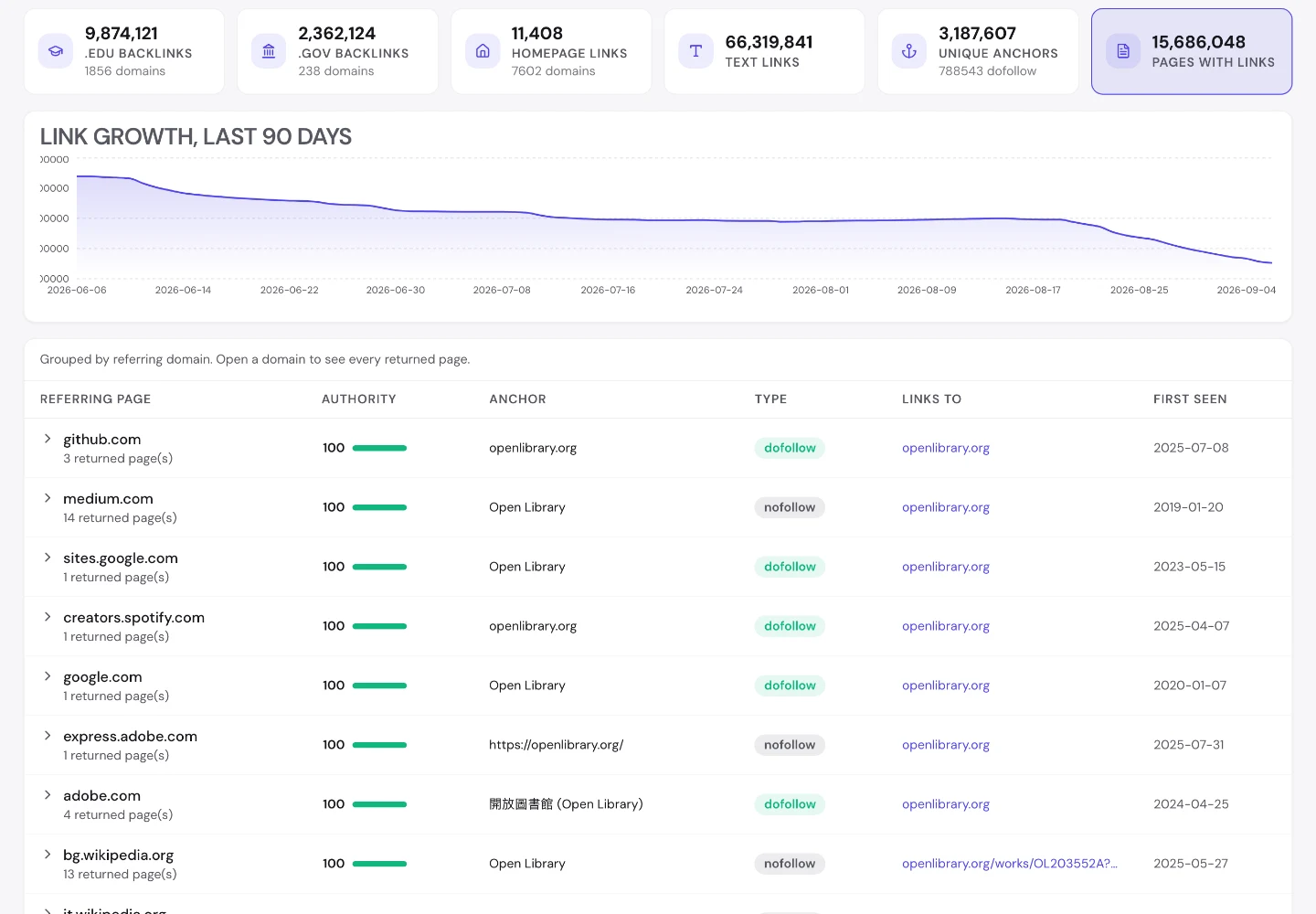
Open Library has 9.9M .edu backlinks from just 1,900 university domains.
That is 5,300 links per institution — the densest academic link profile I have measured, on a site that earns 310K search visits a month.
I ran openlibrary.org through 4 of our tools. It has a huge link profile and the lowest technical score of any site I have measured.
Two of its biggest pages are also the same subject, published at different URLs and competing with each other. Here are the 8 lessons you can use.
Get your link installed in a template
Our Backlink Analyzer reports 69M backlinks at Domain Trust 91. Within that sit 9.9M .edu backlinks from 1,900 university domains.
Free, and it shows the anchors. To watch whether an integration is still producing links this year, you want referring domains plotted over time, which Semrush and SE Ranking both keep.
The ratio is the story: an average of 5,300 links from each institution.
No human links to something 5,300 times. That is a library catalogue system with Open Library wired into its template, generating a link on every record it holds. One integration decision, made once by a systems librarian, produces links forever.
The version you can use is worth thinking about carefully: the highest-leverage link is one that gets installed into somebody else's template. Eventbrite does it with a ticket widget, itch.io with a Buy Now button, Open Library with a catalogue integration. Every one of them beats an outreach programme by orders of magnitude.
So ask which of your customers or partners publish pages in bulk, and what you could give them that belongs on every one of those pages. That is a product question, not a marketing one — which is exactly why your outreach list will never get you there.
Separate machine anchors from human ones
The anchor distribution: "Open Library (openlibrary.org)" carries half the entire profile.
An anchor that includes the bare domain in parentheses is not something a person writes in a sentence. It is a citation format, produced automatically by reference software and catalogue exports.
MDN shows the same shape on a different phrase, and both sites reached enormous authority the same way.
So when you open your own anchor report, split the human anchors from the machine ones before you draw any conclusion. They behave completely differently: machine anchors scale without effort and vanish the day the integration changes, while human anchors grow slowly and stay.
If you do not make that split, your profile will look far more robust than it is. Half of this one rests on a citation format nobody at Open Library controls.
Scan your anchor list for foreign scripts
Second and fourth in that same list: 开放图书馆 and 開放圖書館 — Simplified and Traditional Chinese for "Open Library".
Together they carry more links than the plain English "Open Library" in third place.
This is the third site in these 2 batches where a non-English anchor outranks the English one, and in every case it is a reference resource being cited in a language its own team does not publish in.
So if you run anything reference-shaped, open your anchor list and look for scripts you do not recognise. It is the cheapest signal you will ever get about where your material is actually being used.
It also usually arrives long before anyone on your team proposes a translation — which means the demand is already proven by the time you are arguing about whether to serve it.
Watch how much your homepage takes
Now the weakness. The Organic Traffic Checker puts the site at 310K estimated monthly visits, of which the homepage alone takes almost half.
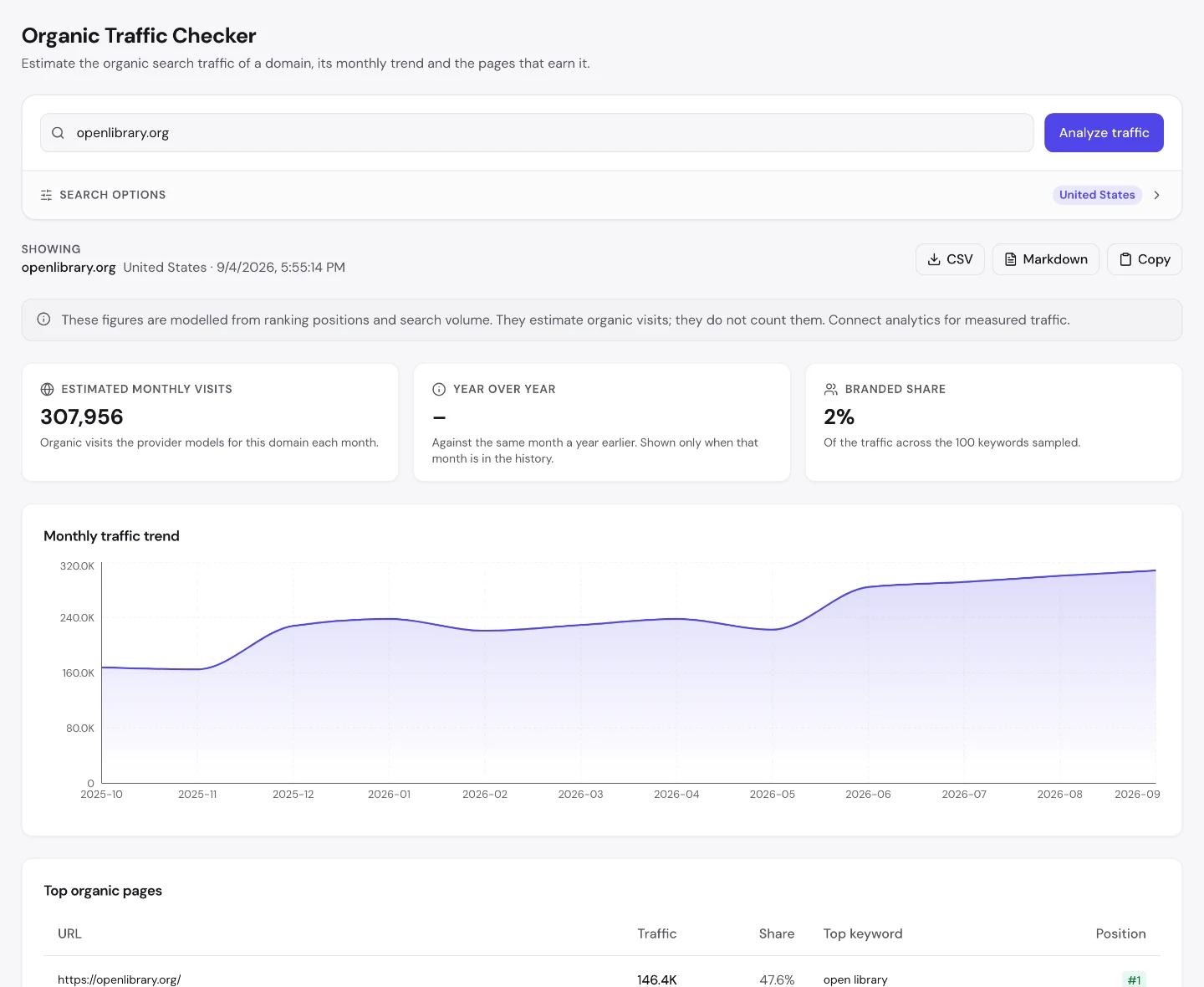
Nearly half the site's search traffic arrives at one page, on a domain holding millions of book records.
Compare Healthline, where the biggest page takes well under 1%. Open Library is the most concentrated site in these 2 batches, and it has authority and ranking keywords that are not converting into page-level traffic.
The diagnosis is the same one PyPI gets: the individual records are eligible to rank and nobody is searching for them by name.
Run the same check on yourself and you will learn how much of your traffic is really a catalogue and how much is a front door. If one page takes a third or more, the pages underneath it are not working, whatever your total says — and a total that keeps rising can hide that for years.
Try the other encoding of your URLs
Which brings us to the single most fixable problem I have found in these 2 batches, and the one most likely to be sitting on your site too.
The 2nd and 3rd biggest pages here are the same subject listing, published at 2 different URLs. One uses underscores where the other uses ampersands and commas — same content, both indexed, both ranking, splitting the visits and the authority between them.
Eventbrite has the identical problem with 2 New York event URLs. It is what happens when a URL scheme changes, or when a template encodes special characters inconsistently and both variants stay crawlable.
Go and check yours today. Take any page with punctuation, spaces or ampersands in the slug, and try the obvious alternative encodings by hand.
If more than one returns a 200 without a canonical pointing home, you are competing with yourself, and no amount of link building will fix it. The Website Audit reports the canonical tag, and the XML Sitemap Generator will show you how many variants you are actually submitting.
Open Library has 9.9M .edu links because it got installed into library systems once and they never stopped linking. Building the thing other people embed beats any outreach list, and it is a product job as much as a marketing one.
- We design the integration people will install
- Built and shipped by our developers
- Link building for everything it cannot cover
- Free consultation, no commitment
Build a page for every subject
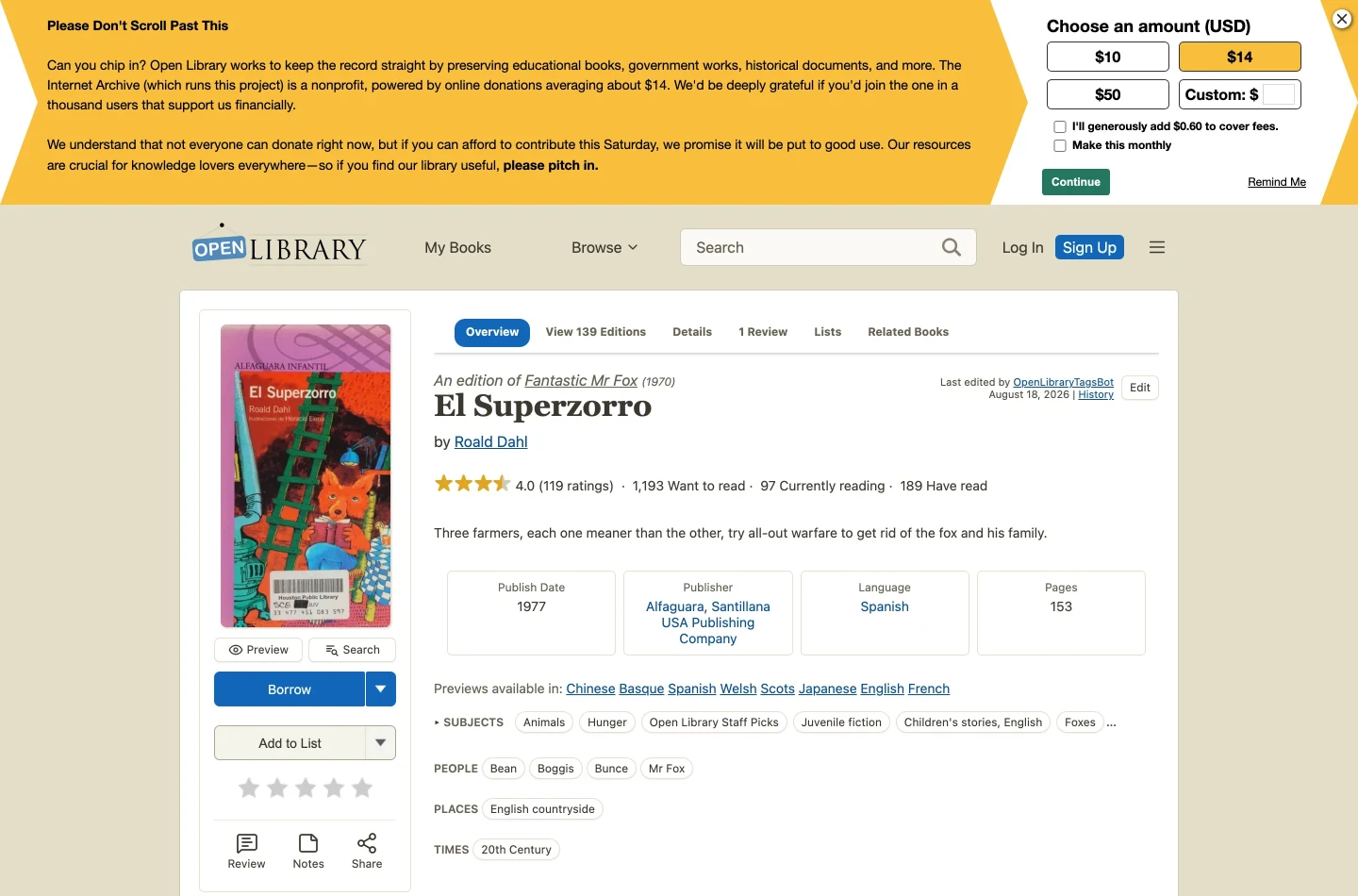
Look past the duplicates and the pattern is clear: after the homepage, every page that ranks is a subject — a generated listing of everything on a theme. Not a single book record appears among the top pages.
An "internet archive" subject page ranks 8th on its own.
This is the same finding itch.io produces with tag directories and Eventbrite with browse pages, and it is now consistent across 4 of the 10 sites I have measured: for a catalogue, the aggregation layer earns the traffic and the item layer does not.
If you hold a library of anything, that is where your work is. Build a page per meaningful subject and make it genuinely useful rather than a bare list — the Content Optimizer will show you what the pages already ranking cover that yours does not.
And check demand per subject with Keyword Research before you index thousands of them. A subject nobody searches for is another item page wearing a different template, and you will have paid to build it.
Read what failed, not the score
The Website Audit scores the homepage 73/100. It has a critical issue and 5 warnings still outstanding.
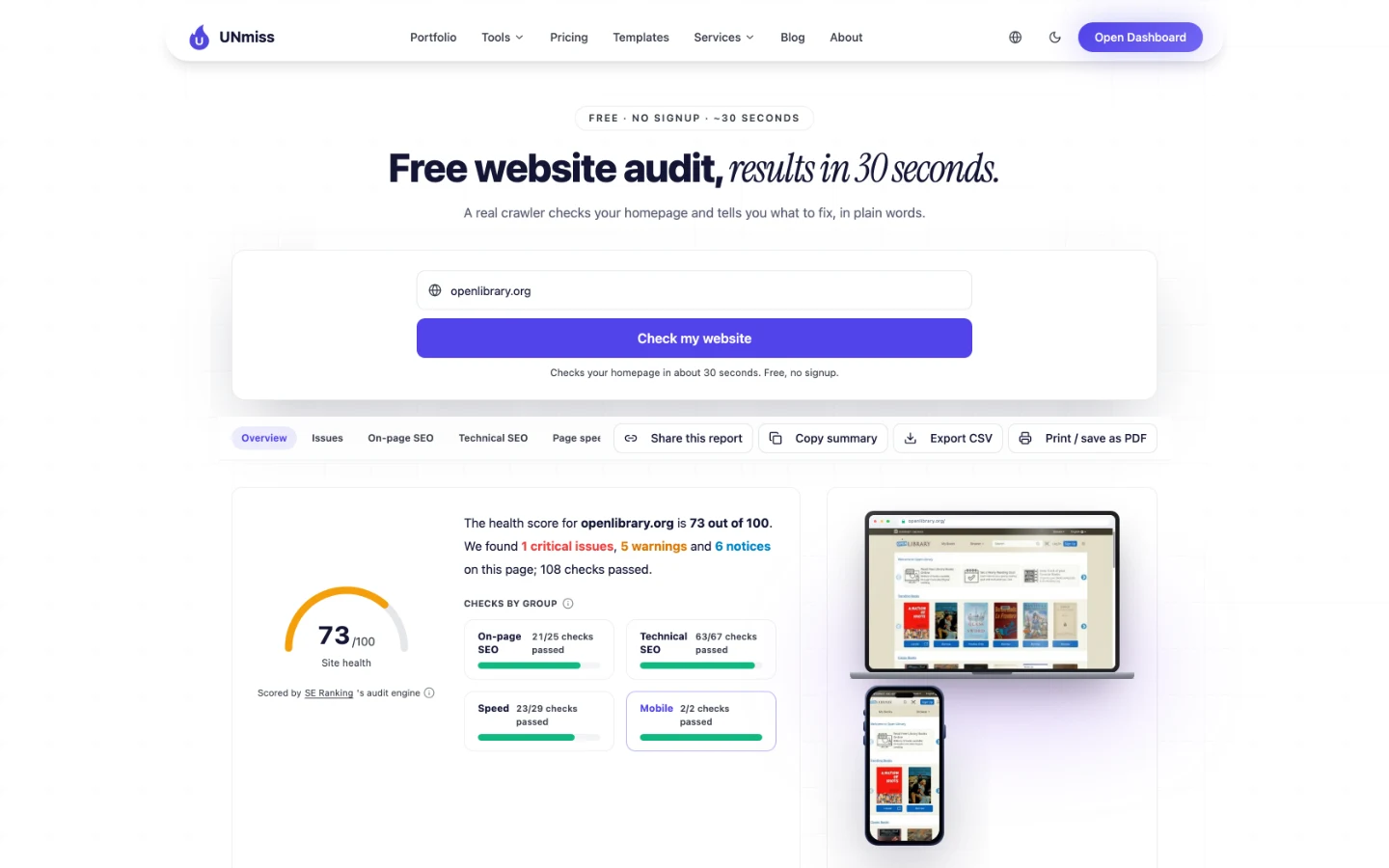
That is the lowest score and the fewest passing checks of the 10 sites across these 2 batches.
And here the technical debt does look connected to the outcome, unlike PyPI. A site with duplicate URL encodings and half its traffic stuck on the homepage — all of which Site Speed and an audit will surface in minutes — is leaving reachable traffic on the table.
Not because the audit score is low, but because those particular failures are the ones that stop pages ranking.
Which is the nuance worth carrying into your own report: the score is not the point, the list is. Read what failed rather than what it added up to.
Two sites can share a score and have nothing in common. Chasing the number gets you a better number, and chasing the list gets you the traffic.
Know whether your catalogue expires
One piece of good news. From the Domain Overview: it gains more keywords than it loses and improves more than it declines, against a base of 760K.
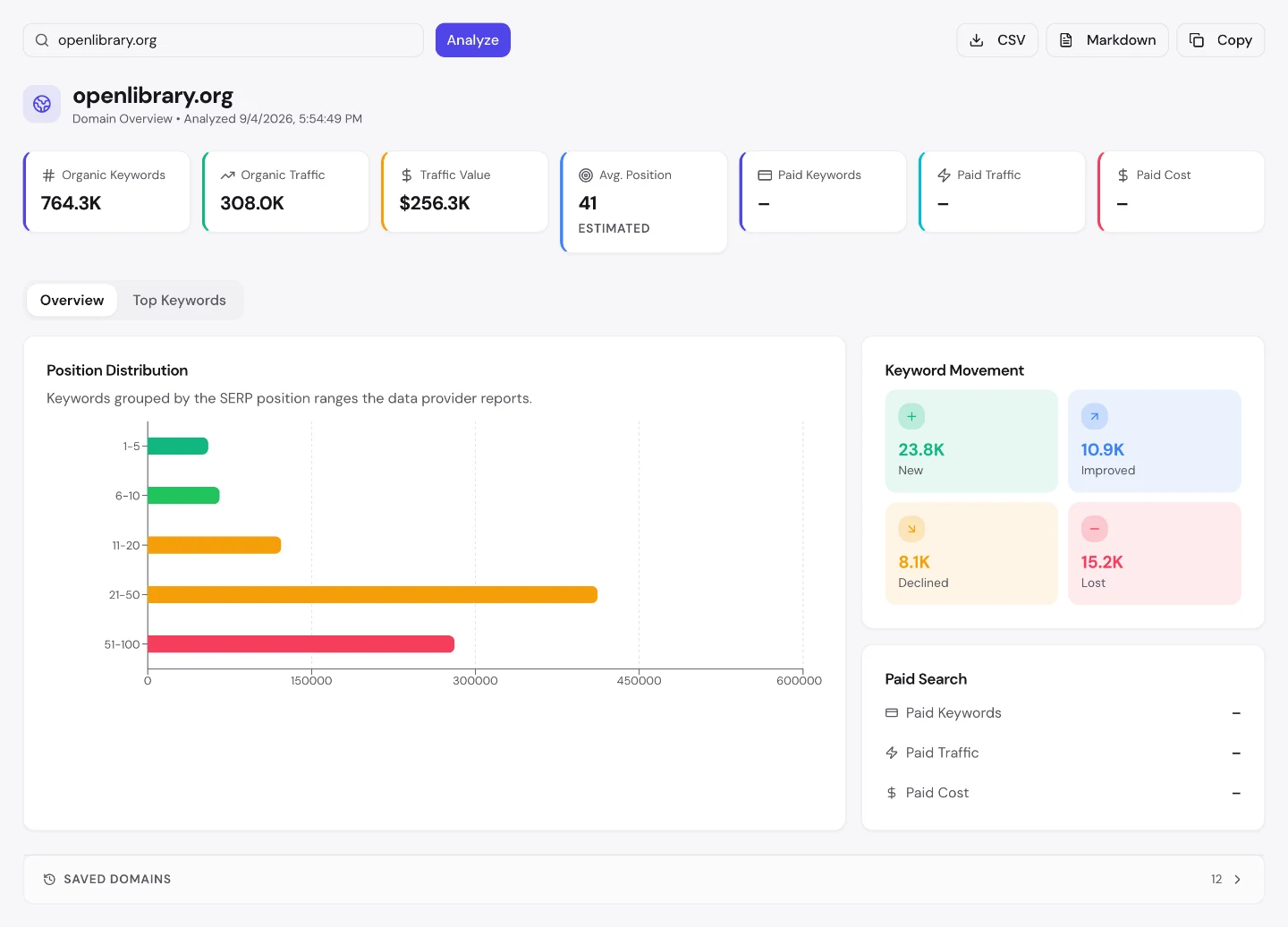
Only 2 of the 10 sites in these batches are positive on both counts. GOV.UK, PyPI, Meetup and Rotten Tomatoes are all shrinking.
A catalogue of books has a structural advantage that a catalogue of events or packages does not: a book from 1954 is exactly as relevant next year as it is today. Nothing expires.
So work out which kind you are running before you budget for next year. If your inventory expires, your traffic is a treadmill and maintenance is most of the job; if it does not, everything you publish compounds and the only real risk is that you stop.
Open Library's 2nd and 3rd biggest pages are the same subject at 2 different encodings, splitting 37K visits between them. The Organic Traffic Checker shows the top-pages table for any domain, which is the fastest way to spot 2 versions of one page competing.
- The same report that found one subject ranking twice at 19th and 21st
- Traffic share, top keyword and position for every page
- 3 checks a day, no signup, no card
What you cannot copy
And here is what I could not measure, or had to qualify. A couple of the tools I name below are partners of ours — if you buy through those links we earn a commission, and you do not pay a cent more.
Our traffic figures are United States only and modelled from ranking positions and search volume rather than counted. Open Library is used worldwide — the Chinese anchor data says so plainly — so its global traffic is materially larger than 310K. The keyword and backlink data underneath comes from SE Ranking, and the $260K traffic value is an ad-spend equivalent, not revenue; Open Library is a non-profit and sells nothing.
The backlink figures were captured through the app rather than the marketing tool, which was rate-limited at the time. The report's own BACKLINKS tile read −670K — a negative backlink count — while the page header and the dofollow/nofollow split both put the total at 69M, and those two reconcile exactly. That is the figure used above. The negative tile is a defect on our side and I am not going to quote it.
I have not verified the catalogue-integration explanation for the .edu links directly. 5,300 links per institution is far beyond human behaviour and template integration is the only mechanism that fits, but I did not audit a sample of linking pages to confirm it.
I did not run Keyword Research: it has an open defect returning implausible volumes. The branded share came back at 2%, which is plausible here and consistent with the homepage ranking first for "open library".
And what you cannot copy: being the Internet Archive's book catalogue. The library integrations exist because Open Library is attached to an institution that librarians already trust and already work with. The template slot was granted, not won.
Frequently asked questions
How many backlinks does Open Library have?
69M backlinks from 160K referring domains, measured 4 September 2026, across 23K referring subnets. The split is 61M dofollow to 8M nofollow, about 88% to 12%. Domain Trust is 91 out of 100.
Why does Open Library have so many .edu links?
9.9M .edu backlinks come from just 1,900 university domains — about 5,300 links per institution. That density indicates library catalogue systems with Open Library wired into their record templates, generating a link per record, rather than individual editorial links.
What is Open Library's most common anchor text?
"Open Library (openlibrary.org)" with 34M links — 50% of the whole profile. Second is the Simplified Chinese 开放图书馆 at 8.3M (12%), then plain "Open Library" at 8M, then Traditional Chinese at 3.3M.
Which Open Library page gets the most traffic?
The homepage, at roughly 150K estimated monthly visits — 48% of all organic traffic. After it, every ranking page is a generated subject listing rather than an individual book record.
Does Open Library have duplicate content problems?
Yes, and visibly. Its 2nd and 3rd biggest pages are the same subject listing at 2 different URL encodings — one using underscores, one using ampersands and commas — ranking 21st and 19th and splitting about 37K monthly visits between them.
How much is Open Library's search traffic worth?
Our Domain Overview prices it at $260K a month, against 760K ranking keywords at an average position of 41 and roughly 310K estimated US organic visits, measured 4 September 2026. That is an ad-spend equivalent, not revenue.
What is Open Library's website audit score?
73 out of 100 on our Website Audit, with 1 critical issue, 5 warnings, 6 notices and 108 checks passed on the homepage — the lowest score and the fewest passing checks of the 10 sites measured across these 2 batches.
Is Open Library gaining or losing keywords?
Gaining. It added 24K keywords and lost 15K, with 11K improved against 8,100 declined — positive on both pairs. Along with Healthline it is one of only 2 sites in these batches growing on both measures, helped by a catalogue where nothing expires.
The one number to take away
5,300.
That is how many links the average linking university has given Open Library — 9.9M links from 1,900 .edu domains.
No campaign produces that. It is what happens when your site becomes a field in somebody else's database, rendered on every record they publish. One systems librarian made one integration decision, and it has been generating links every day since.
Every large link profile in these 2 batches turned out to work this way. Eventbrite's ticket widget. itch.io's Buy Now button. MDN's template phrase repeated 20M times. Open Library's catalogue integration. The links were never the campaign — they were a side-effect of being useful inside somebody else's workflow.
So stop asking who might link to you, and start asking whose system you could become a part of.
Found something in your own report that surprised you, or measure this differently? I would genuinely like to know — the tools used are all free, so you can check every figure yourself. Measured 4 September 2026. Domain Overview, Organic Traffic Checker, Website Audit and Backlink Analyzer figures are free runs of our own tools, all United States scope, and all modelled rather than counted where the tool says so. No revenue figure applies.