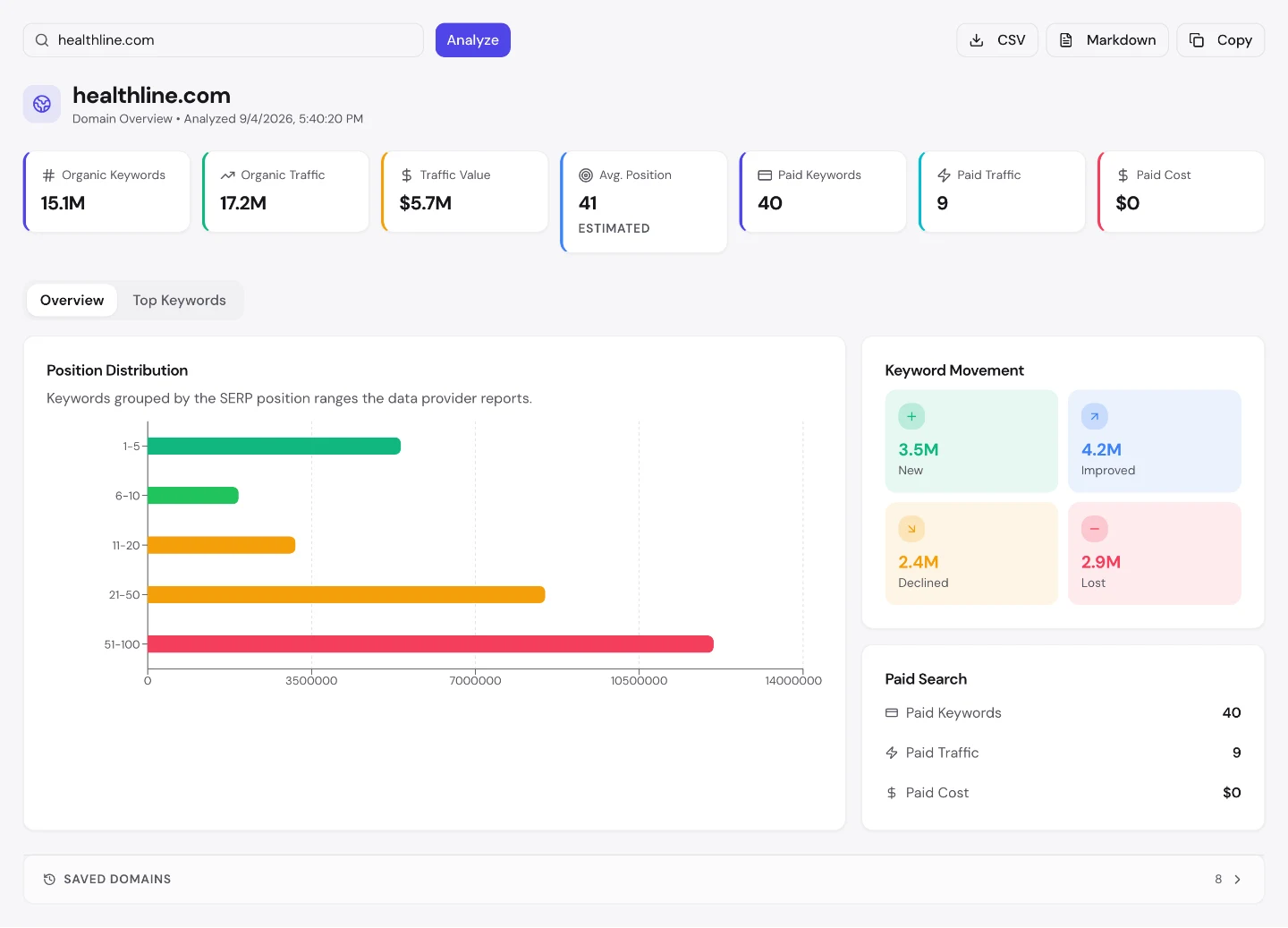
Healthline earns $5.7M of free traffic a month, and not one of its pages carries 1% of it.
17M visits a month across 15M ranking keywords. Its biggest single page takes 0.7%.
I ran healthline.com through 4 of our tools expecting to find a flagship article carrying the site. There isn't one. What I found instead was the most evenly distributed traffic profile I have measured, built on a page type nobody wants to write, and here are the 9 lessons in it.
Check how much one page carries
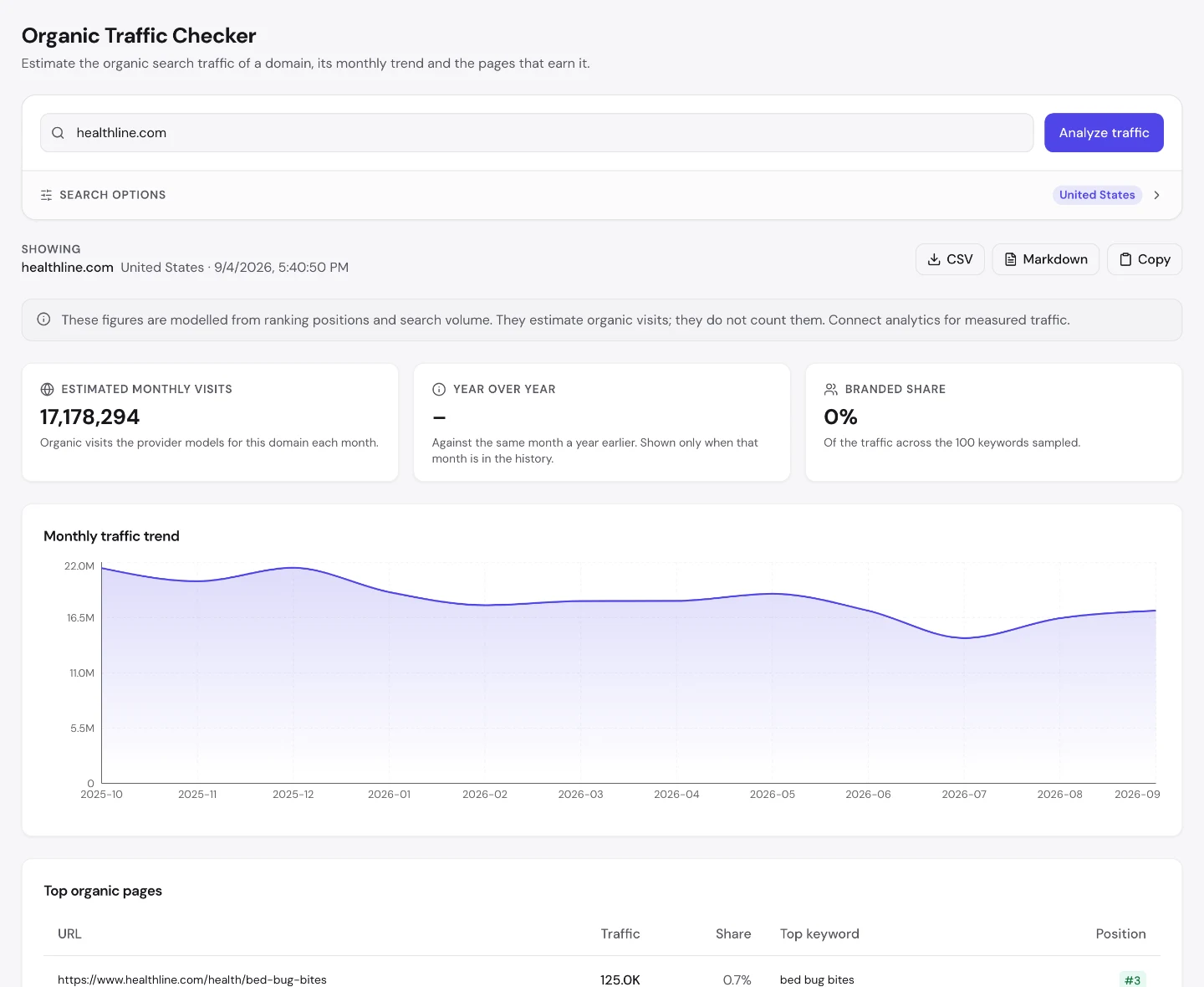
The Organic Traffic Checker puts Healthline at 17M estimated monthly visits, then hands back a top-pages table where the leader takes 120K visits — 0.7%.
That is free. For a library this size the useful view is the whole keyword export, month over month, and Semrush and SE Ranking are the tools that keep it — a snapshot cannot tell you whether the tail is growing or dying.
Second is 0.6%. Third 0.5%. Fourth 0.4%.
Compare that with Meetup, whose homepage alone is 22% of its traffic, or itch.io at 15%. Healthline has no single point of failure anywhere in its top 10. Losing its best page would cost it well under 1% of its traffic.
That is the actual product of publishing at this scale, and it is worth checking on your own site before you assume you have it. Run your top-pages report: if one page is above 20%, you are running a much riskier operation than your traffic total suggests.
Answer the question, not the category
Look at what those pages are about: bed bug bites, artificial insemination, how many calories per day, magnesium glycinate, rashes.
Not "10 ways to sleep better". Not a listicle. A person with a specific thing happening to them, typing the thing.
Those queries are unglamorous, they carry no brand, and they repeat forever because the human body keeps producing them. Bed bug bites will be searched at the same rate in 5 years.
The transferable move: stop planning content by topic and start planning it by the exact state somebody is in when they search. Put your topic into Keyword Research and look for the queries that describe a situation rather than an interest. Those are the ones that recur.
Write for the 2am search
This is the play, and it is mostly a writing instruction rather than a technical one.
Somebody searching "bed bug bites" at 2am wants to know what it is, whether it is dangerous, and what to do tonight — in that order, in the first screen. They are not reading an introduction about the history of bed bugs.
Healthline's pages answer in the first paragraph and expand underneath. That structure is why they hold position 3 on a query with that much competition, and it is the single most copyable thing here.
Draft it with the Content Brief Generator, which builds the outline and the questions from the query itself, then check the finished draft against the pages already ranking with the Content Optimizer. If your answer is below the fold, you have written a magazine article, not a search result.
Put a name on every page
Healthline's other structural choice: every article carries a named medical reviewer with a credential and a review date.
That is expensive. It is also the reason a health site survives updates that flatten its competitors, and it is why its 54K .edu backlinks from 1,600 domains exist at all. Institutions link to something a named clinician has signed.
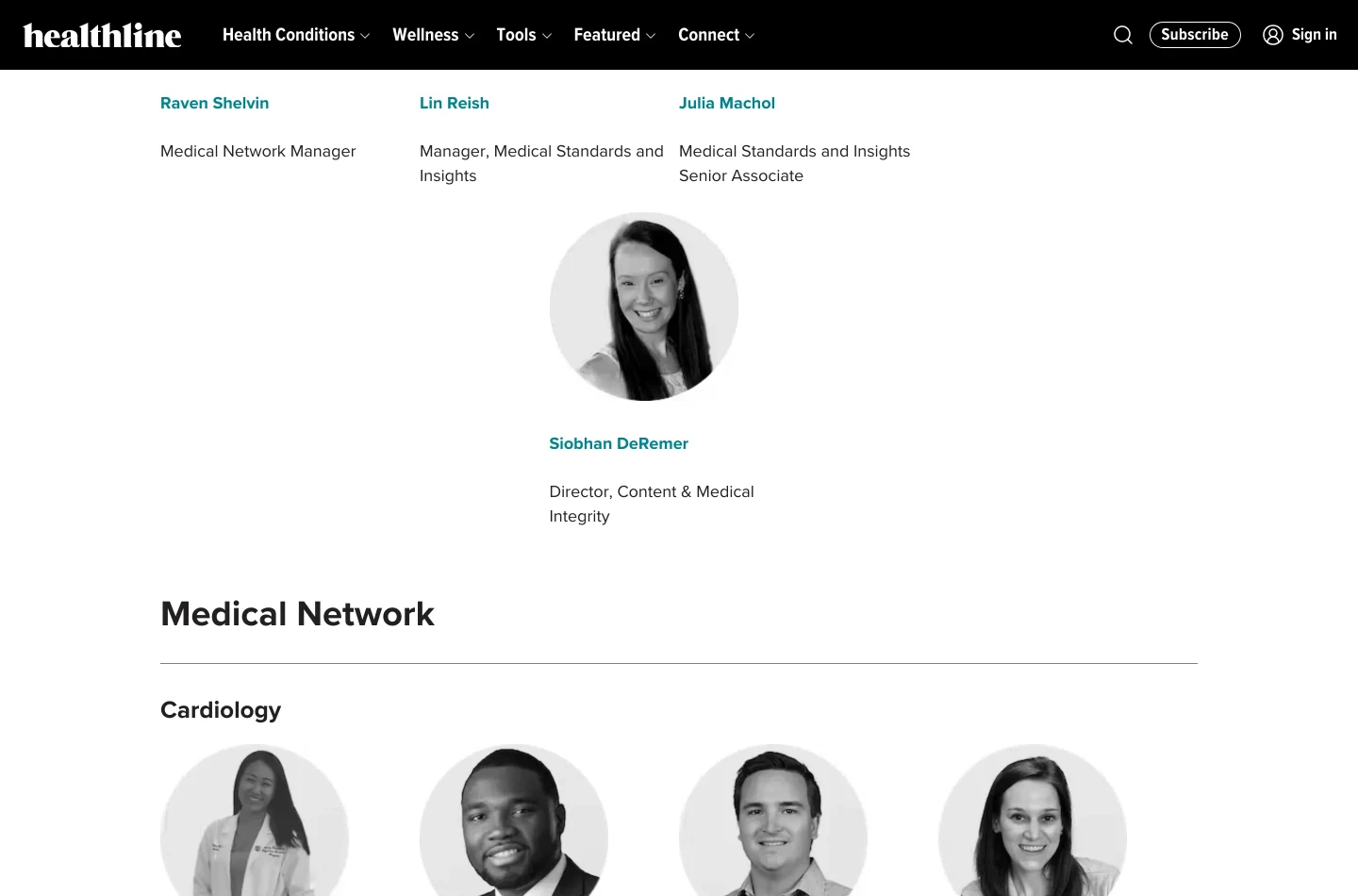
You almost certainly cannot hire clinicians. You can do the cheap version: name a real author with a real reason to be trusted on the subject, show when the page was last checked, and make both visible rather than buried in schema. The credential does not have to be medical — it has to be verifiable. Check how the byline renders to a crawler with the Website Audit.
Publish one thing worth citing
Now the strangest thing in the profile. I ran it through our Backlink Analyzer, and the most common anchor text across 12M backlinks is not the brand.
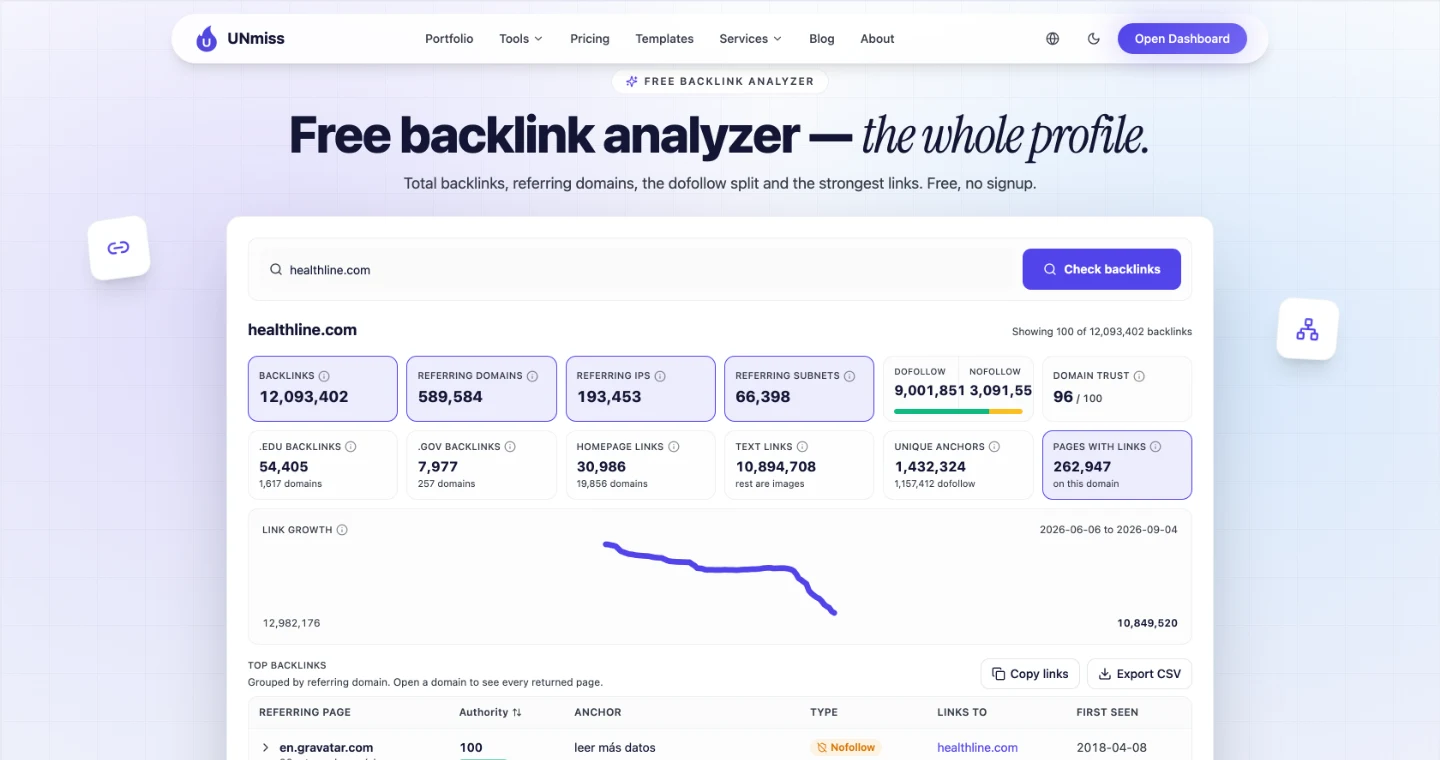
It is a full article headline — "4 Ways to Help Your Partner Love Healthier - Without Starting a Fight" — repeated across 1.2M links. The brand name is second, at 850K.
An anchor that specific, at that volume, is syndication: one article distributed through partner sites and content networks, each copy carrying the headline as the link.
Worth knowing because it changes how you read your own report. A single anchor above a million usually means one distribution deal, not a million editorial decisions — and it means that if the deal ends, so does the anchor. Check whether your biggest anchor is something you earned or something you rented.
No single Healthline page earns 1% of its traffic. The whole thing is thousands of pages each doing a little. That shape is safe and slow to build, and it is exactly the kind of programme we run for clients.
- We plan the topic map, not a page list
- Writers, editors and developers in one team
- Author pages and trust signals handled
- Talk to us free before you budget
Read both movement columns, not one
From the Domain Overview: 3.5M new keywords against 2.9M lost. Of the ones it kept, 4.2M improved and 2.4M declined.
Both columns that matter point the right way. It gained 600K more keywords than it lost, and 1.8M more keywords improved than declined.
Every other site in these 2 batches is flat or shrinking — Rotten Tomatoes is down 62K, Meetup is down slightly, itch.io is level. Healthline is the only one clearly growing, and it is doing it at the largest keyword base of the group.
So read your own 4 columns as 2 pairs. New versus lost tells you whether your library is growing. Improved versus declined tells you whether what you already have is getting stronger.
You need both. Either one on its own will let you tell yourself a story you like. A site can pass the first and fail the second, and that is the one that catches people out.
Expect a long tail to rank deep
The average position across those 15M keywords is 41.
Page 4. On average, Healthline is nowhere — and it collects 17M visits a month anyway, because a tiny share of an enormous number of queries is still an enormous number.
This is the same lesson GeeksforGeeks teaches at a quarter of the scale, and it is the honest description of how large content libraries actually work. The wins are not the average; the average is dragged down by millions of pages that rank at 60 and do nothing. What matters is the shape of the distribution, not its middle.
So when you benchmark, do not chase your average position. Track the count of keywords in the top 10 and watch that number instead — the Rank Tracker will hold the set you care about while the average tells you nothing.
Stop grading yourself on the audit
The Website Audit scores the homepage 74/100. Behind that score: 1 critical issue, 1 warning and 4 notices. It passed 115 checks.
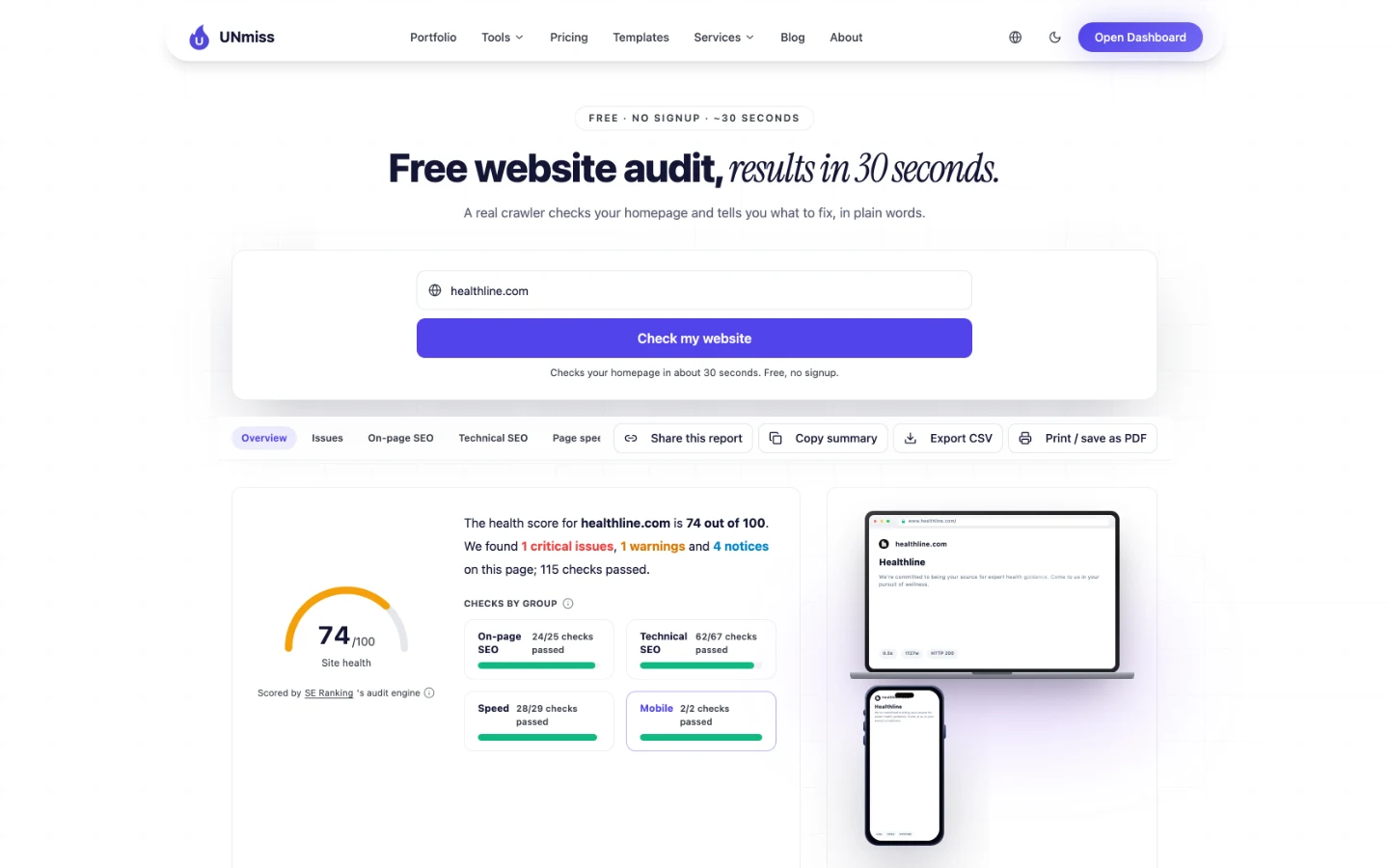
That is the lowest technical score of the 10 sites I have measured across these 2 batches, and the critical issue is images missing alt text. The homepage carries 1,100 words and one 10-character H1.
Put that next to the growth numbers and you get an uncomfortable but useful conclusion. Healthline has the worst audit and the best trajectory of the sites I measured. Technical health is a floor you should not fall through, not the thing that produces 17M visits. Fix the critical issue — it takes an afternoon — and then go back to the writing.
Know whose trust you are borrowing
The last number worth having: 590K referring domains at a Domain Trust of 96. Three quarters are dofollow, and several thousand come from .gov domains.
So work out whose trust you are borrowing before you assume it is yours. Healthline ranks partly because institutions vouch for it, and no amount of content will manufacture that for you.
If your subject is one where being wrong hurts somebody, the institutions are your ceiling. Get them citing you, or accept that you are competing for the queries they do not answer.
Health content is linked defensively. A university health service, a public health page or a clinic explainer links to Healthline because it needs a plain-English explanation it can point a patient at without writing one.
So that is the mechanism to copy if you work in a regulated or technical field: be the page a professional can safely hand to a non-professional. It is a narrow slot, it is dull to write, and almost nobody competes for it.
Healthline's biggest page is 0.7% of its traffic. Meetup's is 22%. One of those is a library and one is a single point of failure. The Organic Traffic Checker returns the same top-pages table for any domain, with the share each page takes.
- The same report that found no Healthline page above 1%
- Estimated monthly visits, branded share and the 12-month trend
- 3 checks a day, no signup, no card
What you cannot copy
And here is what I could not measure, or had to qualify. A couple of the tools I name below are partners of ours — if you buy through those links we earn a commission, and you do not pay a cent more.
Our traffic figures are United States only and modelled from ranking positions and search volume rather than counted, which the tool states on its own screen. Healthline is global, so its worldwide traffic is materially larger than 17M. The keyword and backlink data underneath comes from SE Ranking, and the $5.7M traffic value is an ad-spend equivalent, not revenue.
The year-over-year comparison returned empty, so I have no trend claim beyond the keyword movement columns. I did not run Keyword Research: it has an open defect returning implausible volumes, and a gap is safer than a number I do not trust.
The branded share came back as 0%, and I have left it out. On Rotten Tomatoes the same metric returned 0% while that site's homepage ranked first for its own brand, so I no longer trust the figure without a top-pages table that agrees with it — and Healthline's table shows no branded page either way.
The article count of roughly 43K comes from a full crawl of Healthline's own sitemaps on 25 August 2026, not from this run. The medical-reviewer structure is described from the pages themselves rather than measured.
And what you cannot copy: 15 years of medical review. The credential system that earns those .edu links is a standing editorial cost, paid every month, on every page, before any of it ranks. You can copy the page structure this week. You cannot retroactively have been trustworthy since 2005.
Frequently asked questions
How much is Healthline's search traffic worth?
Our Domain Overview prices it at $5.7M a month, against 15M ranking keywords at an average position of 41 and roughly 17M estimated US organic visits, measured 4 September 2026. That is an ad-spend equivalent — what the same traffic would cost to buy at the CPCs those keywords carry — not revenue.
What is Healthline's biggest page?
An article on bed bug bites, at roughly 120K estimated monthly visits, ranking 3rd. That is 0.7% of the site's organic traffic. The next four are artificial insemination, a calories-per-day calculator, magnesium glycinate and rashes — none above 0.6%.
How many backlinks does Healthline have?
12M backlinks from 590K referring domains, measured 4 September 2026, across 66K referring subnets. The split is 9M dofollow to 3.1M nofollow, about 74% to 26%. Domain Trust is 96 out of 100.
What is Healthline's most common anchor text?
A full article headline — "4 Ways to Help Your Partner Love Healthier - Without Starting a Fight" — carrying 1.2M backlinks, ahead of the brand name at 850K. An anchor that specific at that volume indicates syndication rather than editorial linking.
Is Healthline growing or shrinking in search?
Growing, and it is the only site in these 2 batches clearly doing so. Over the measured period it gained 3.5M keywords and lost 2.9M, with 4.2M improved against 2.4M declined — positive on both pairs, against a base of 15M.
How many .edu links does Healthline have?
54K .edu backlinks from 1,600 domains, plus 8,000 .gov links from 257 domains. Health content attracts institutional links because universities and clinics need a plain-English explanation they can point patients at.
What is Healthline's website audit score?
74 out of 100 on our Website Audit, with 1 critical issue, 1 warning, 4 notices and 115 checks passed on the homepage. The critical issue is images missing alt text. It is the lowest technical score of the 10 sites measured across these 2 batches.
How many articles does Healthline publish?
Roughly 43K unique article URLs across its two article sitemaps, counted in a full crawl on 25 August 2026 — about 39K under /health/ and 3,700 under /nutrition/. That figure was not re-counted in this run.
The one number to take away
0.7%.
That is Healthline's biggest page, as a share of its own traffic, and it is the number that explains the other 8 lessons. A site where nothing is above 1% cannot be disrupted by losing a ranking, cannot be beaten by one better article, and does not need a hit.
It also cannot be built quickly, which is the part people skip. 17M visits spread that thinly is 15M keywords of accumulated coverage, and every one of those pages was written for somebody in a specific situation at 2am.
So go and look at your own concentration. If your top page is 25% of your traffic, your next piece of work is not another article on that topic — it is the 50 unglamorous pages that make the 25% stop mattering.
Found something in your own report that surprised you, or measure this differently? I would genuinely like to know — the tools used are all free, so you can check every figure yourself. Measured 4 September 2026 unless stated. Domain Overview, Organic Traffic Checker, Website Audit and Backlink Analyzer figures are free runs of our own tools, all United States scope, and all modelled rather than counted where the tool says so. The article count comes from Healthline's own sitemaps, crawled 25 August 2026. No revenue figure for Healthline was available to us.