MDN is the only site I have measured with a Domain Trust of 100 out of 100.
That is documentation nobody is paid to promote, earning about $1M a month in free traffic.
I ran developer.mozilla.org through 4 of our tools alongside 9 other large sites. Every other site scored somewhere in the 70s to 90s for trust. MDN scored full marks, and the reason turns out to be one anchor text repeated 20M times. Here are the 8 lessons you can use.
Read trust as quality, not volume
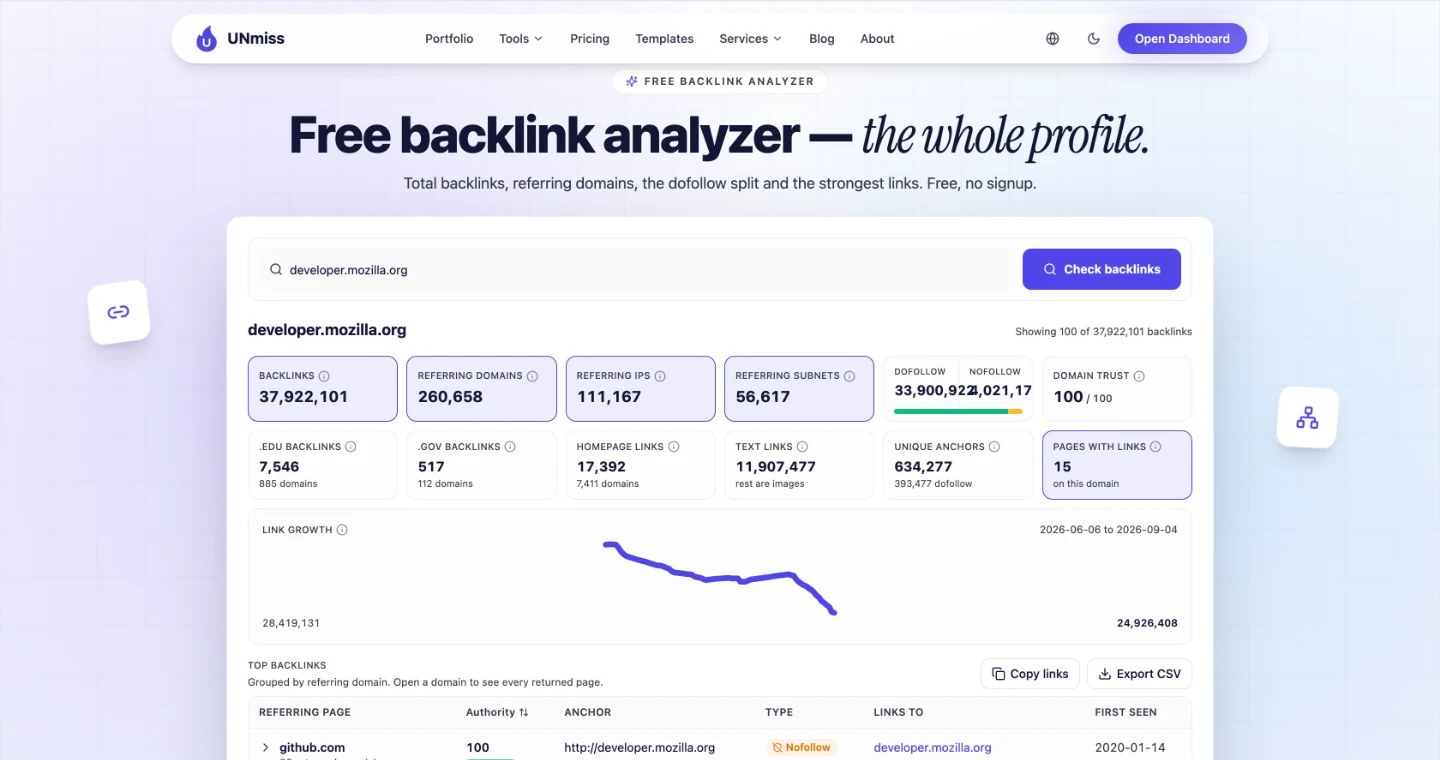
Our Backlink Analyzer returns Domain Trust 100 out of 100. That comes from 38M backlinks, 89% of them dofollow.
Free, and it covers the whole profile. To see which of your translated pages actually rank in their own markets, you need per-country data, and Semrush and SE Ranking both provide it.
For scale, we also measured Eventbrite, which has nearly 10x as many linking domains. It scored 98, and never reached 100.
So trust is not a popularity measure. MDN has fewer linking domains than Eventbrite, Meetup or itch.io, and it outscores all 3.
The reason is who links to it. The sites pointing at MDN are themselves among the most-linked-to on the web. Quality compounds in a way volume does not.
So read your own report this way: if your domain count is rising and your trust score is flat, you are collecting links from places nobody else links to. That is not progress. It is noise, and it will keep looking like a win on the chart.
Check whether one source is your profile
Then the number that explains it. The most common anchor text on the whole profile is "Scripting: Java".
It carries 52% of every link MDN has. The next anchor down is 36 times smaller.
An anchor at that ratio is never editorial. It is a template: one phrase, in one widely-copied navigation or reference block, reproduced across millions of pages. I could not confirm which template from the link report alone, and I am not going to guess at it in an article.
What it does tell you is how a documentation site's authority really builds. Not 20M people choosing to link. A handful of decisions that got copied 20M times.
So open your own anchor list in the Backlink Analyzer and look for the same shape. If one entry dwarfs the next, you are looking at a single source, not a trend.
That matters because a single source can be switched off by one person you have never met.
Read your anchors as market research
Below those two, the anchor list turns multilingual. Next come 자바스크립트 and CSS참고서 — Korean for "JavaScript" and "CSS reference".
Two Korean anchors, almost exactly the same size, each bigger than most sites' entire link profiles.
This is the same pattern Rotten Tomatoes shows with 39M Chinese-language links: a reference resource becomes the default citation in languages its own team does not write in. A developer writing a Korean tutorial links to the canonical definition regardless of what language that definition is in.
So if you publish reference material, treat your anchor list as a map of where you are being taught from. Most people never open it.
It is the cheapest international market research you will ever get, and it arrives before anyone on your team proposes entering the market.
Expect your translation to stay partial
MDN's translation programme is the part most people know it for, and the numbers are more extreme than the reputation suggests.
German is at 99% of the English page count. Japanese reaches about 70%, and French and Chinese sit near half.
Then it falls away. Korean, Russian, Spanish and both Portuguese and Traditional Chinese run from under a quarter down to almost nothing.
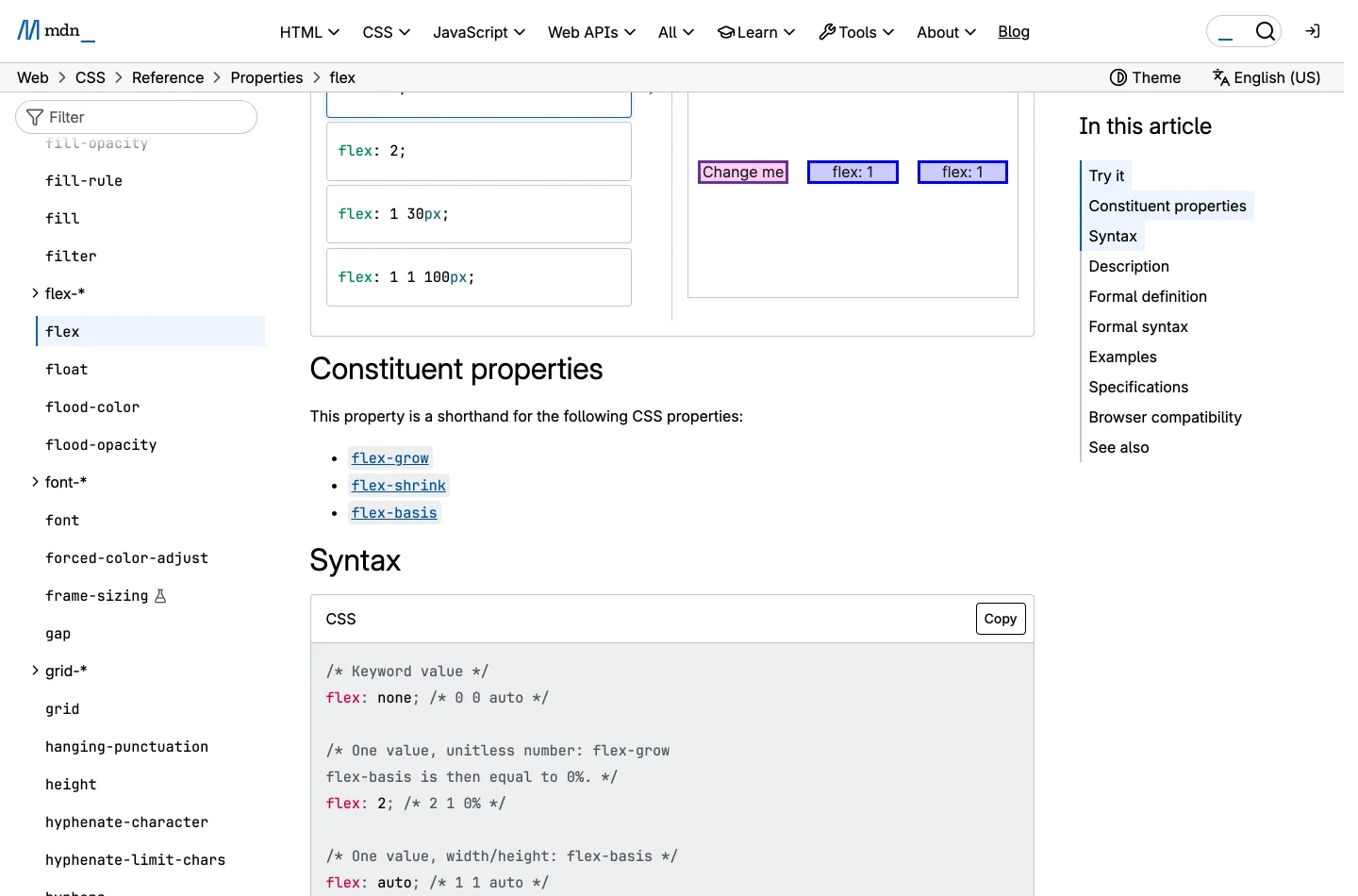
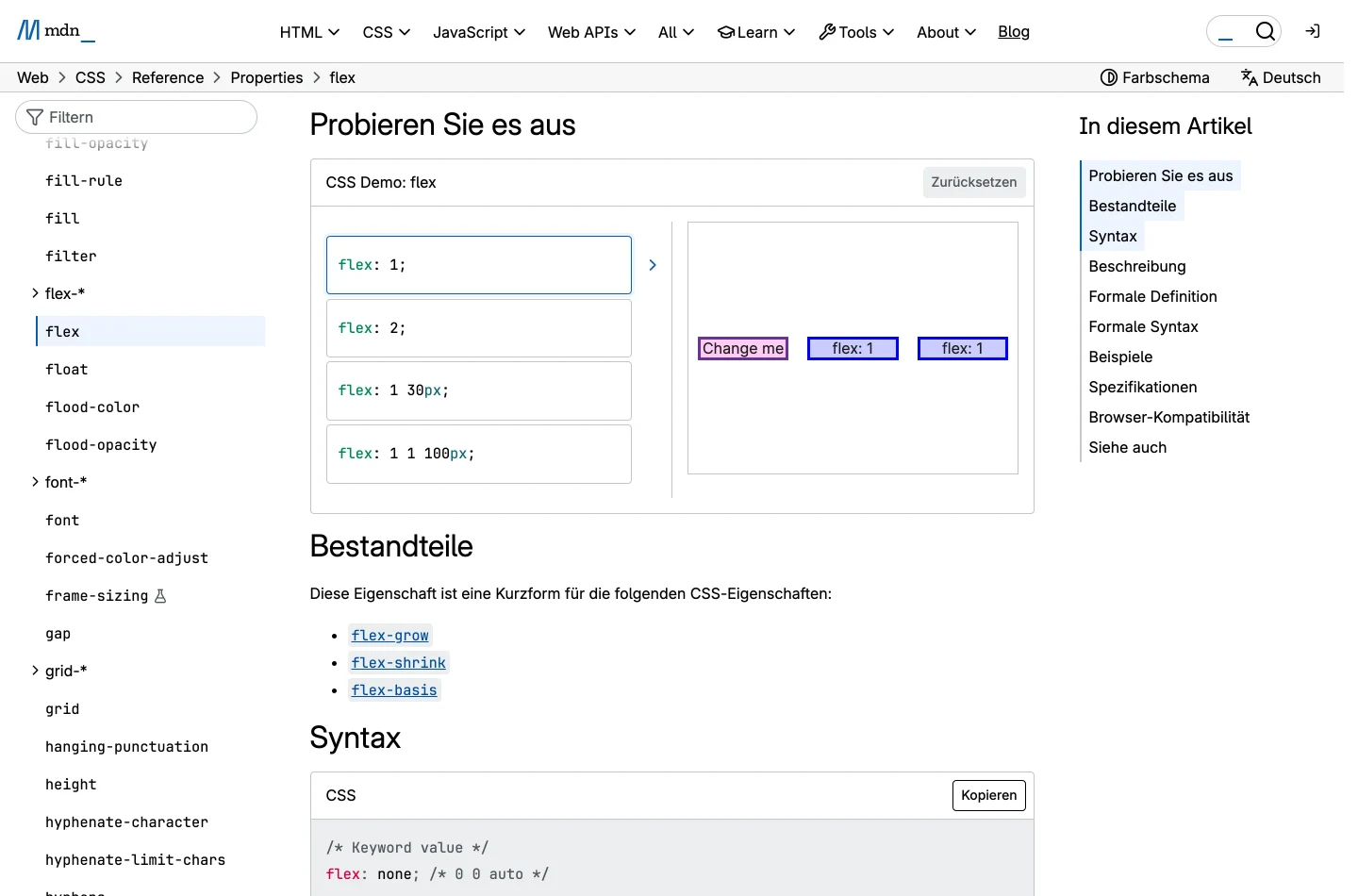
A near-complete second corpus is not a translation project, it is a second site. And notice the shape: one language essentially complete, one at two thirds, two at half, and a long tail that was started and never finished.
That tail is the honest lesson. Even MDN, with a volunteer community most companies would envy, has 5 languages under a quarter covered.
So expect your own translation programme to end up partial. That is the normal outcome, not the failure case. Plan which languages you will actually finish, and say out loud that the rest are experiments.
If you do commit, write each local page from a brief rather than translating the English one word for word — the Content Brief Generator builds one per market.
Translate the reference, not the blog
Here is the rule that makes MDN's version work where most translation programmes die.
Reference documentation is the ideal thing to translate because it does not go stale on a schedule. The definition of a CSS property will read the same in 3 years. A blog post about the state of front-end development in 2026 will not, and every translated copy of it becomes a maintenance liability the day after it ships.
So if you are considering translation, sort your library by how often the page changes before you sort it by traffic. Translate the stable half. Leave the timely half in one language and stop apologising for it.
Check demand before you commit, too — put the translated terms into Keyword Research per market rather than assuming your English keyword mix transfers, and group them with the Keyword Cluster tool so you translate themes rather than scattered pages.
MDN has a perfect trust score because it documents the platform, not the tools on top of it. Content that does not expire compounds. We help you work out which half of your library that is, then build it.
- We sort your library by how fast it rots
- Docs and reference sites built to last
- SEO and GEO for technical audiences
- First consultation is free
Know what your kind of content is worth
From the Domain Overview: 1.5M organic keywords at an average position of 41. They are worth about $1M a month.
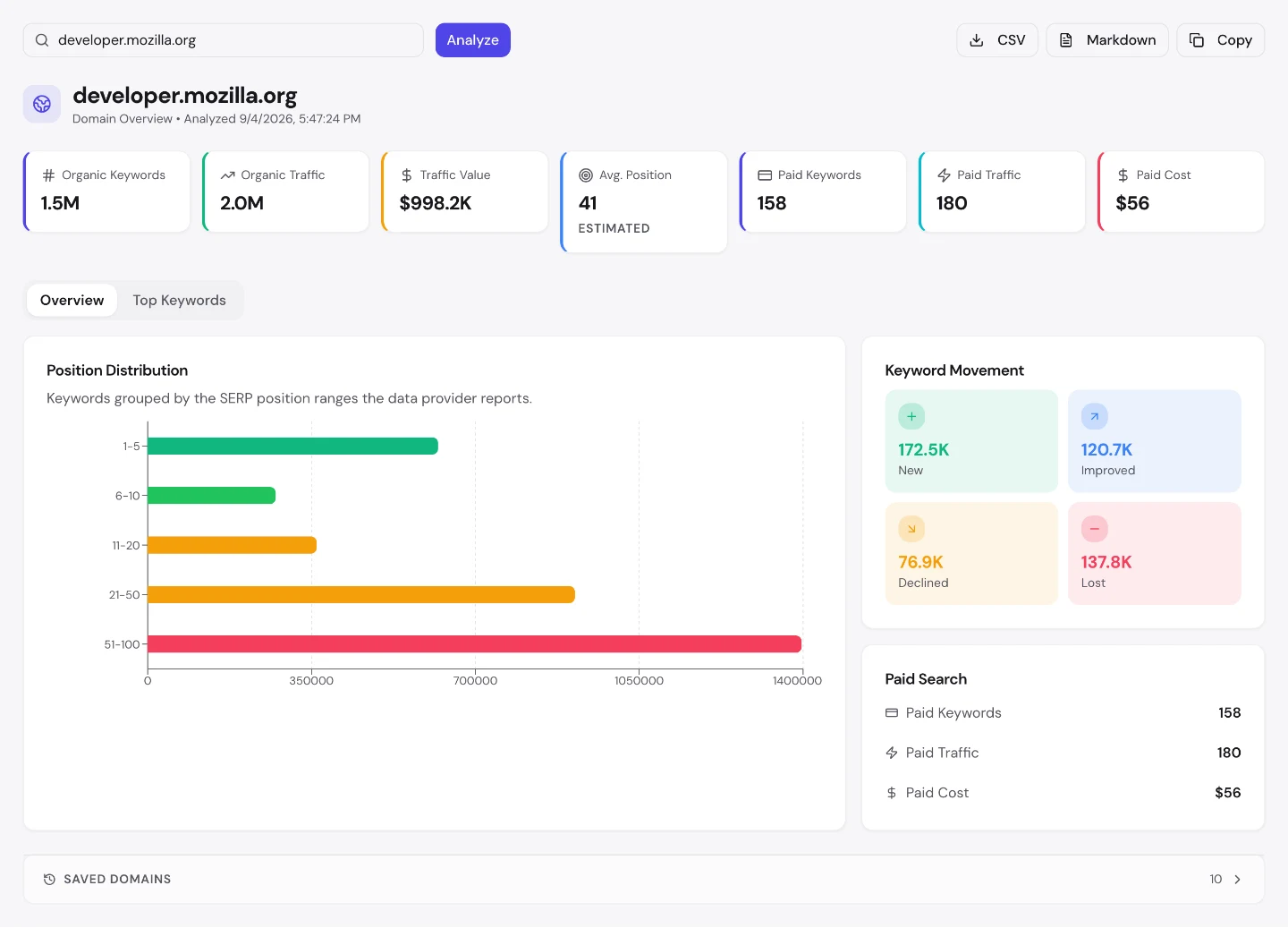
Keyword movement: 170K new keywords against 140K lost. Of the ones it kept, 120K improved and 77K declined.
Notice how modest that value is next to the authority. A perfect trust score converts to under $1M a month, because developer documentation carries almost no advertising demand. Nobody bids on "css grid syntax".
So know what your kind of content is worth before you copy this model. Technical documentation buys you enormous authority and very cheap traffic.
If your business makes money from attention directly, this is the wrong shape and no amount of execution will fix it.
Test your heaviest page on a phone
The Website Audit scores the homepage 88/100. Nothing critical, 1 warning, and 1 clear H1 over about a thousand words.
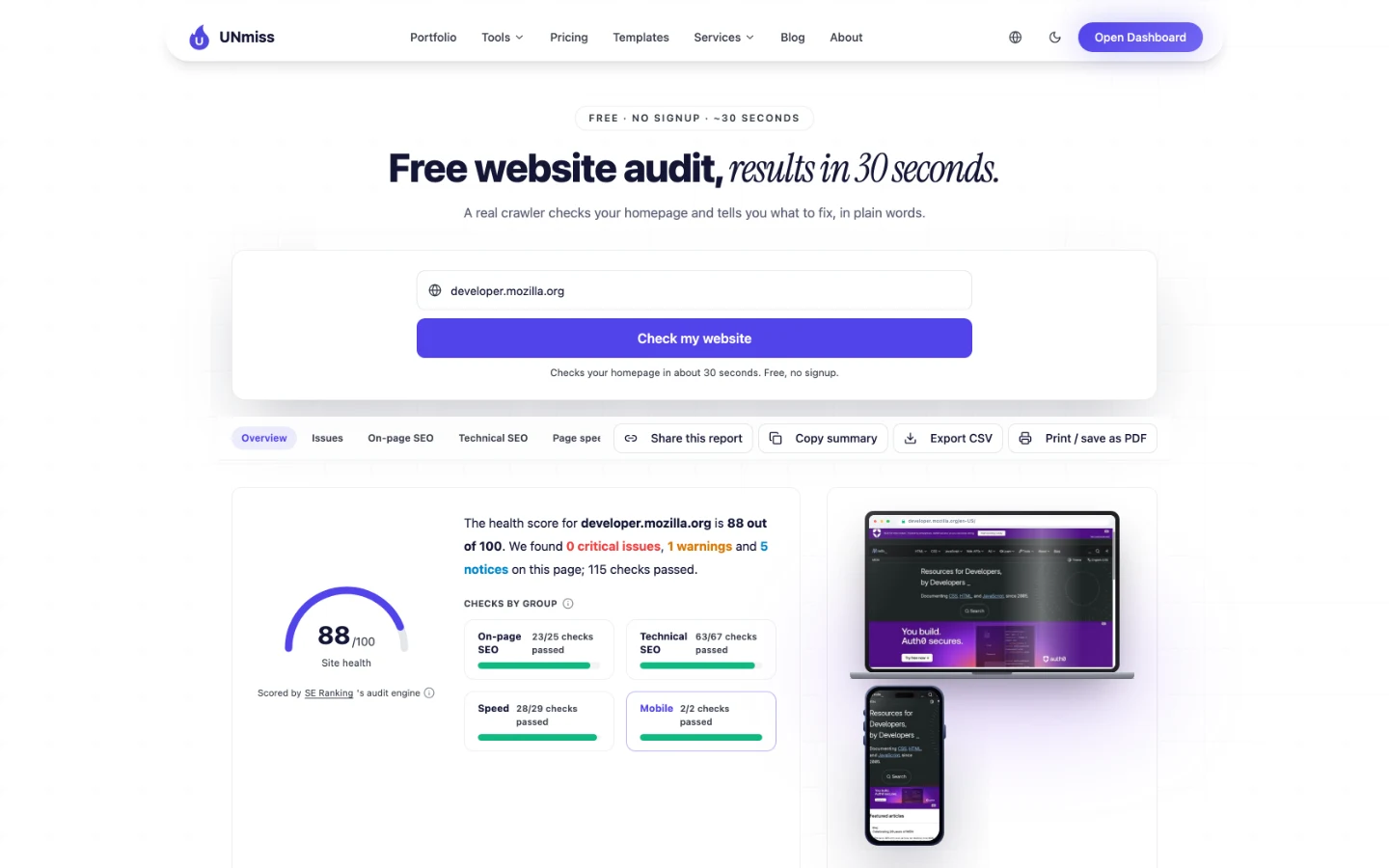
Google PageSpeed rates it 71 on mobile and 96 on desktop.
Clean, and roughly where a well-run documentation site should land. The mobile gap is the only thing worth attention.
A 25-point spread between desktop and phone is common, and it is almost always image and script weight.
So run Site Speed on your own heaviest page and compare the 2 numbers. Your site is not fast because your laptop says so. Your laptop is not what your readers are holding.
Write about the layer that will survive
The last one is strategic rather than measurable, and it is the reason all of the above holds together.
MDN documents the platform — HTML, CSS, JavaScript, the browser APIs — not the tools built on top of it. Frameworks that were unavoidable a decade ago are now historical footnotes, and every tutorial written about them has decayed to nothing. MDN's pages on how a CSS property behaves have not.
That is why 20M links piled onto one anchor and never rotted. The target never moved.
So ask yourself the uncomfortable version: of everything you published last year, how much is about a layer that will still exist in 10 years?
That fraction is the only part building the kind of authority measured here. The rest is rented attention, and the rent comes due quietly.
52% of MDN's backlinks sit on a single anchor text, and its 3rd and 4th are Korean. The Backlink Analyzer returns the same breakdown for any domain, alongside referring domains, the dofollow split and the trust score.
- The same report that found 20M links on one phrase
- Anchor texts, referring TLDs and countries, .edu and .gov counts
- 3 checks a day, no signup, no card
What you cannot copy
And here is what I could not measure, or had to qualify. A couple of the tools I name below are partners of ours — if you buy through those links we earn a commission, and you do not pay a cent more.
Our traffic figures are United States only and modelled from ranking positions and search volume rather than counted. MDN's audience is heavily international — that is half the point of the article — so its worldwide traffic is far larger than the 2M here, and the translation coverage above says nothing about traffic per language.
I have no top-pages data for MDN. The Organic Traffic Checker returned "the provider returned no ranking pages for this domain in this market" for developer.mozilla.org, so unlike every other case study in this batch I cannot tell you which pages earn the traffic. That is a gap in the data, not a finding about MDN.
Two more figures I left out. The branded share came back as 0%, which I no longer trust after Rotten Tomatoes returned the same value while ranking first for its own brand. And the report's "pages with links" field read 15 for a site with 38M backlinks, which is plainly wrong, so it is not cited above.
The per-language page counts come from a crawl of MDN's own sitemaps on an earlier date, not from this run. The keyword and backlink data underneath these reports comes from SE Ranking, and the $1M is an ad-spend equivalent, not revenue — MDN does not sell anything.
And what you cannot copy: being the specification's shopfront. MDN is authoritative because browser vendors treat it as the reference, and that relationship is not a content strategy. You can copy the discipline of documenting the stable layer. You cannot appoint yourself the canonical source.
Frequently asked questions
How many backlinks does MDN have?
38M backlinks from 260K referring domains, measured 4 September 2026, across 57K referring subnets. The split is 34M dofollow to 4M nofollow, about 89% dofollow.
Why does MDN score 100 for domain trust?
Because of who links to it rather than how many do. It has fewer referring domains than Eventbrite, Meetup or itch.io, all of which score lower, but the sites citing it are themselves heavily linked. It was the only perfect score among the 10 sites measured across these 2 batches.
What is MDN's most common anchor text?
"Scripting: Java", with 20M backlinks — about 52% of the entire profile. The second-placed anchor carries 550K, some 36 times fewer. A ratio that extreme indicates a single widely-copied template rather than editorial linking.
How much is MDN's search traffic worth?
Our Domain Overview prices it at $1M a month, against 1.5M ranking keywords at an average position of 41 and roughly 2M estimated US organic visits, measured 4 September 2026. Developer documentation carries very low commercial CPC, so the value is modest relative to the authority.
How complete are MDN's translations?
German is 99% of the English corpus — 15K pages against 15K. Japanese reaches 69%, French 52% and Simplified Chinese 52%. Korean, Russian, Spanish, Brazilian Portuguese and Traditional Chinese run from 23% down to 7.0%. Counted from MDN's own sitemaps on an earlier date.
Which MDN pages get the most traffic?
We cannot say. Our Organic Traffic Checker returned no ranking pages for developer.mozilla.org in the US market, so no page-level breakdown was available for this article. Every other site in this batch returned a full top-pages table.
Is MDN gaining or losing keywords?
Gaining. Over the measured period it added 170K keywords and lost 140K, with 120K improved against 77K declined — positive on both pairs, against a base of 1.5M.
What is MDN's website audit score?
88 out of 100 on our Website Audit, with 0 critical issues, 1 warning, 5 notices and 115 checks passed on the homepage. Google PageSpeed rates the page 71 on mobile and 96 on desktop.
The one number to take away
52%.
That is the share of MDN's 38M backlinks sitting on a single anchor text, and it is the most useful thing in this article because it is so easy to misread.
It looks like a link building triumph. It is closer to an accident of history: a phrase in a template, copied for 2 decades, pointing at documentation that never needed rewriting. Nobody planned it and nobody could repeat it on purpose.
What you can take is the condition that made it possible. MDN wrote about the layer that does not change, so the links it earned in 2006 still point at a correct page today. Every link you earn on a page you will rewrite next year is a link you are renting.
So go and read your own anchor list. If the top entry dwarfs the rest, find out which template it lives in — and then find out whether the page it points at will still be true in 10 years.
Found something in your own report that surprised you, or measure this differently? I would genuinely like to know — the tools used are all free, so you can check every figure yourself. Measured 4 September 2026 unless stated. Domain Overview, Website Audit and Backlink Analyzer figures are free runs of our own tools, all United States scope, and all modelled rather than counted where the tool says so. Per-language page counts come from MDN's own sitemaps on an earlier date. No page-level traffic data was available for this domain.