Chess.com earns twice Dribbble's search traffic from 14 times fewer backlinks.
It is the most link-efficient site in this series by a distance, and almost nothing about how it got there is what you would expect.
I ran chess.com through 4 of our tools. It publishes 830K URLs, 96% of them player profiles, and sends most of its traffic to a single page. Here are the 8 lessons — most of them about how little the things everyone measures actually matter.
Track the one page that carries you
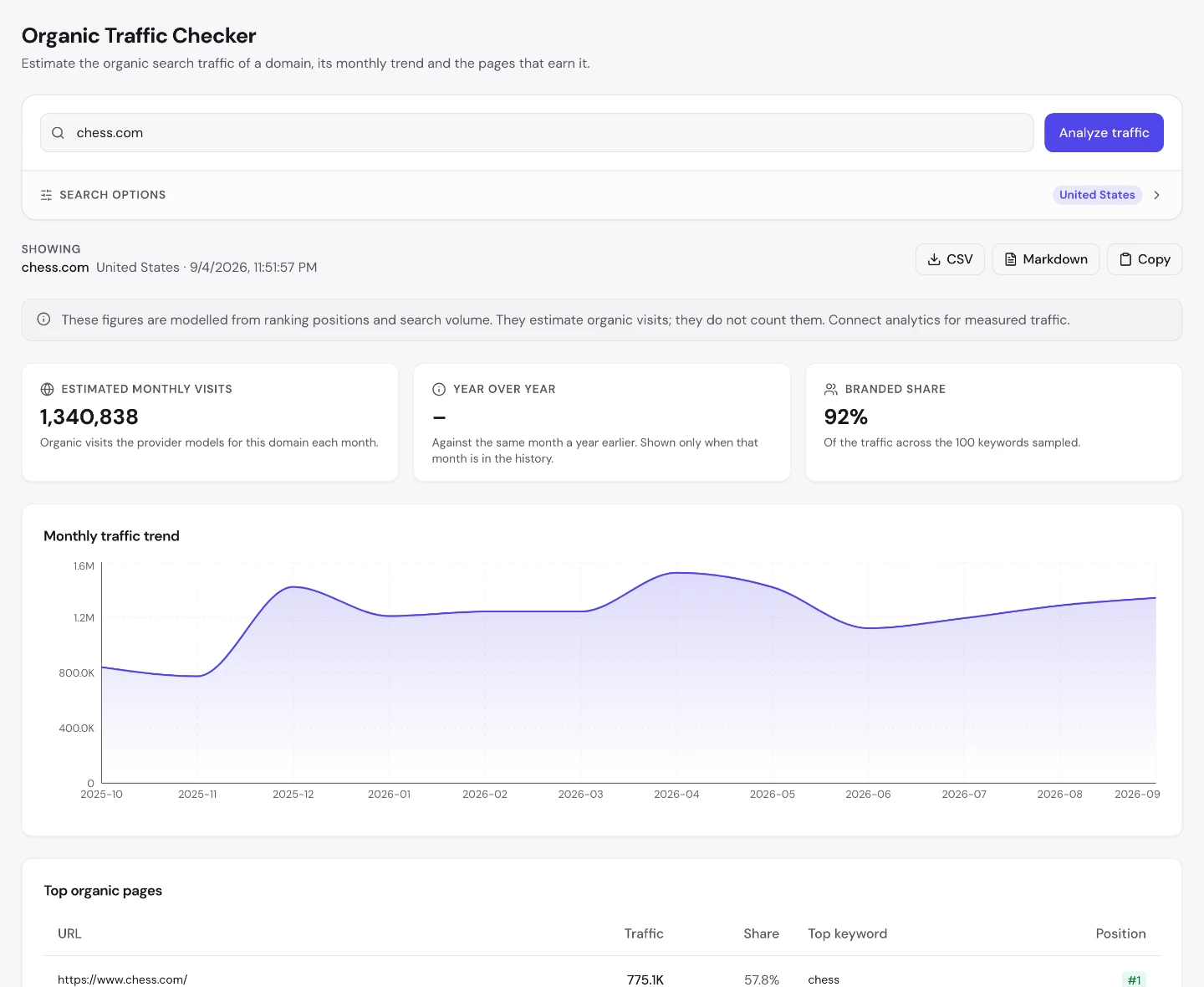
The Organic Traffic Checker puts 58% of chess.com's traffic on the homepage alone, ranking 1st for "chess". Nothing else comes close.
A free run shows you where a site stands. Semrush and SE Ranking will show you how it got there, which matters more when you are trying to work out whether a position like this is defensible or lucky.
On a domain publishing more than 800K pages, that makes it one of the most concentrated sites in the series.
Name the risk plainly: one ranking change on one query would remove more than half this site's search traffic.
If your own top-pages report looks like this, stop watching your traffic total. The number that matters is that single page's position, tracked weekly in the Rank Tracker — because by the time the total moves, you have already lost the quarter.
Know which end of the scale you are on
Branded share: 92% — the highest in this series.
Nine of every ten visits are people who already knew about chess.com, or typed "chess" and meant it. Strip the brand out and only about a tenth of the traffic is genuine discovery.
Dribbble, measured the same week, sits at 1%. Those are the two ends of one metric, and neither is better — they are different businesses.
What matters is knowing which one you are, and you probably have not checked. A heavily branded site is defending a position; an unbranded one is competing for one. The strategies share almost nothing.
Most SEO advice you read is written for the second case. Most established businesses are the first. If that is you, half the tactics in your plan are solving somebody else's problem.
Point links at a name, not at items
Our Backlink Analyzer reports 7.7M backlinks for chess.com — the smallest profile of any site in this series.
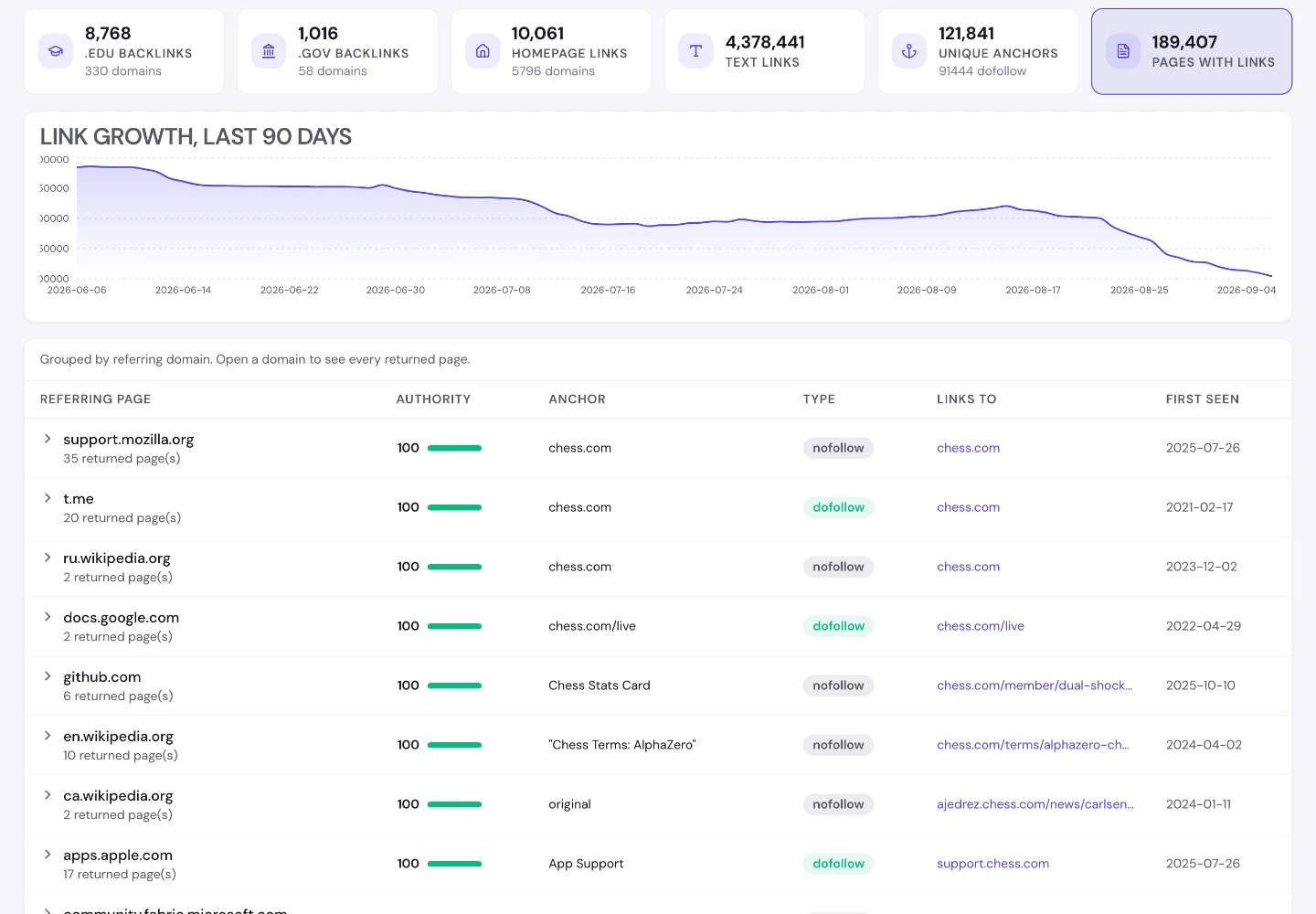
Chess.com converts links into traffic roughly 26 times more efficiently than Dribbble, because its links point at a brand people then search for — not at millions of individual pages that each have to win a query of their own.
The lesson is not that links do not matter. It is that links to a memorable name compound into branded search, and links to individual items do not.
So before your next campaign, ask which of the two you are actually building. If every link you earn points at a different item page, you are buying a lot of small, separate bets. If they point at your name, they add up.
Find the generic term nearest your brand
Four of the five biggest pages hold 1st place — on "chess", "chess game", "online chess" and "chess pieces". Not long-tail terms: the category's head, and chess.com owns it.
That is the branded share working in reverse. A brand that is the category name holds the generic term, because every behavioural signal Google has says people searching "chess" want this site.
You cannot rename your company to your category. But you can work out which generic term your brand sits closest to, and check that the page which should own it is your best page rather than an afterthought.
It usually is not. Run yours through the Content Optimizer against the current top 10 and ask whether it would deserve the slot on merit if your name were removed from it.
Chess.com wins 1.3M visits with very few links, because it owns the word people actually type. Finding the generic term nearest your brand, then taking it, is a specific job with a clear finish line.
- We find the term your buyers type instead of your name
- Content and technical work to take it
- SEO and GEO handled together
- Free consultation to see if it is winnable
96% of its pages earn nothing
An earlier full crawl of chess.com's sitemap found 96% of its URLs sitting under /players — more than 800K profile pages.
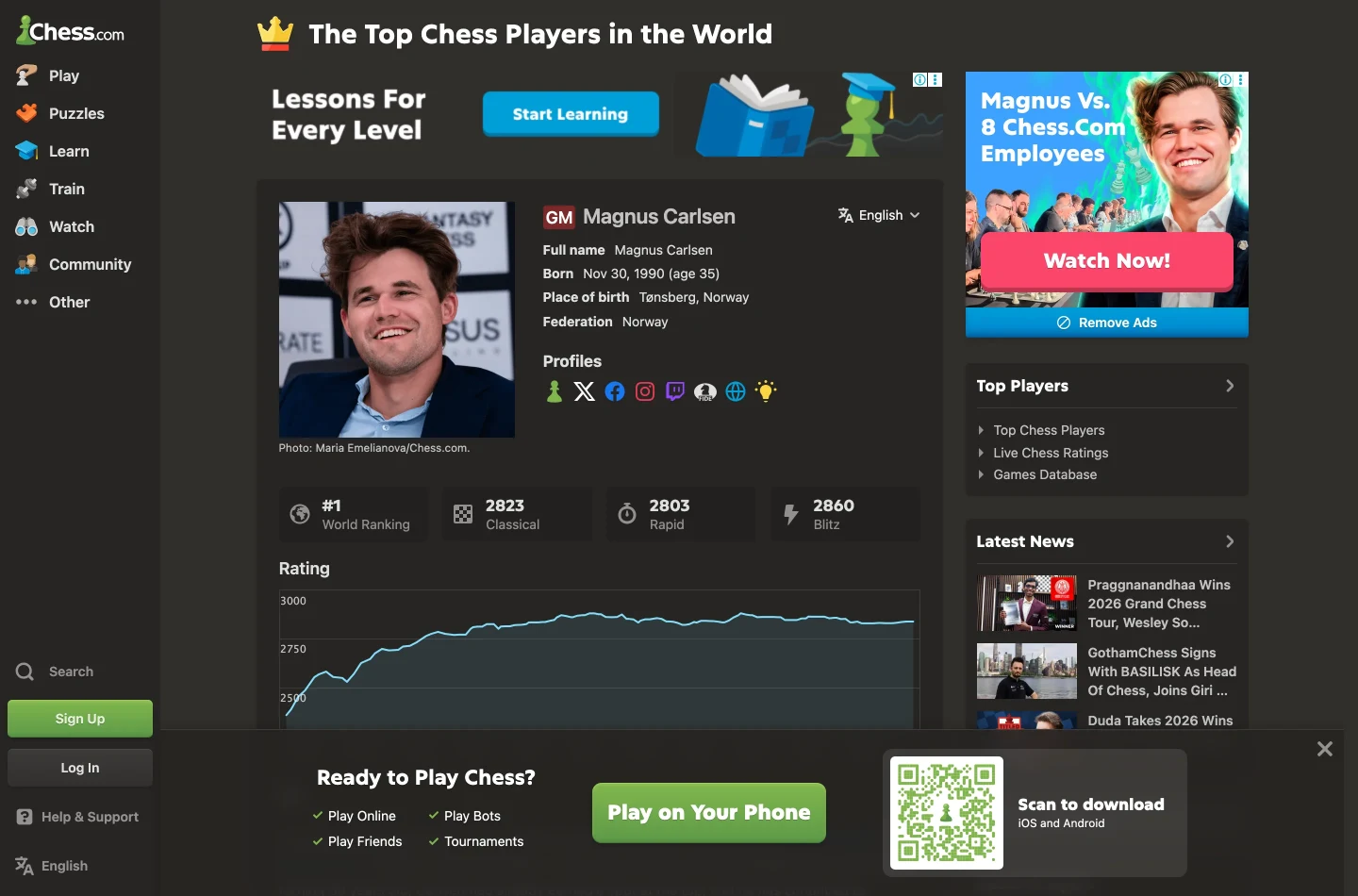
None of them appear in the top pages. Not one. The search traffic comes from the homepage and 4 product pages, while almost everything the site publishes contributes nothing measurable.
This is PyPI's problem exactly, and Dribbble's deliberate avoidance of it. Three sites, one decision, three different answers — and only one of them thought about it in advance.
Do not publish your user list
Stated as the instruction, because it keeps recurring.
A profile page for a user whose name nobody searches cannot rank for anything. It is eligible for a query that does not exist. Publishing 800K of them adds crawl surface, dilutes internal linking, and produces no traffic.
The test takes 5 minutes and you can run it today. Take 20 usernames from your own database, put them into Keyword Research, and count how many return meaningful volume. If fewer than 3 do, that page type belongs behind noindex and out of your sitemap.
Then check what you are actually submitting with the XML Sitemap Generator, because the sitemap and the intention usually stopped matching some years ago.
Weight fixes by traffic, not severity
The Website Audit scores the homepage 85/100 — but with 3 critical issues outstanding.
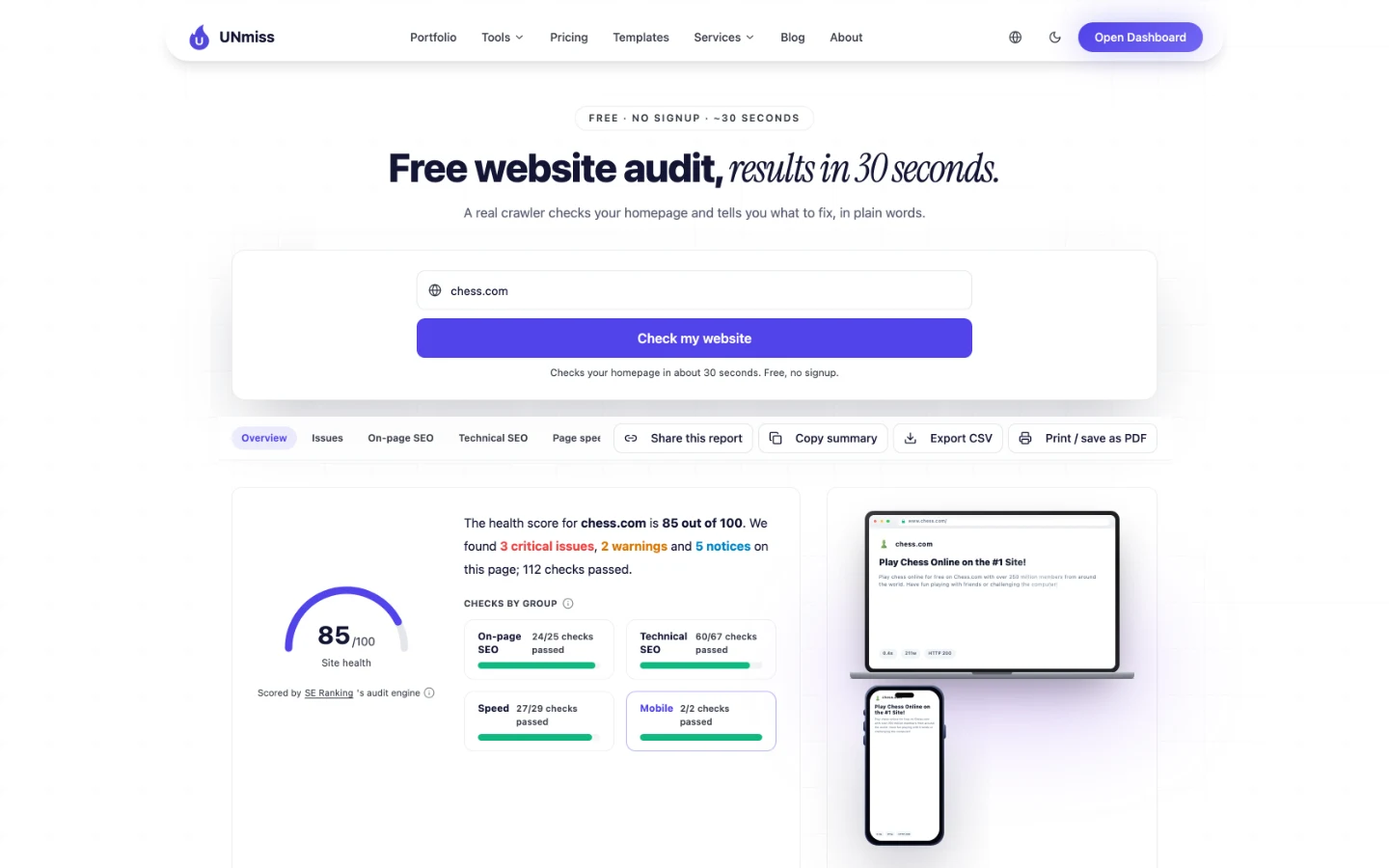
The highest critical count measured here — and Dribbble scored a clean 100 the same week while losing keywords. The site with 3 critical issues is growing; the site with a perfect audit is shrinking.
But notice where these 3 sit: on the homepage, which carries most of the traffic. That is the one page where a critical issue is genuinely worth your afternoon.
So weight your fixes by the traffic behind the page, not by the severity label your tool printed. A critical issue on a page nobody reaches is a tidy-up. A warning on the page carrying half your traffic is not.
Do not trust traffic value as worth
From the Domain Overview: it is gaining more keywords than it loses, modestly.
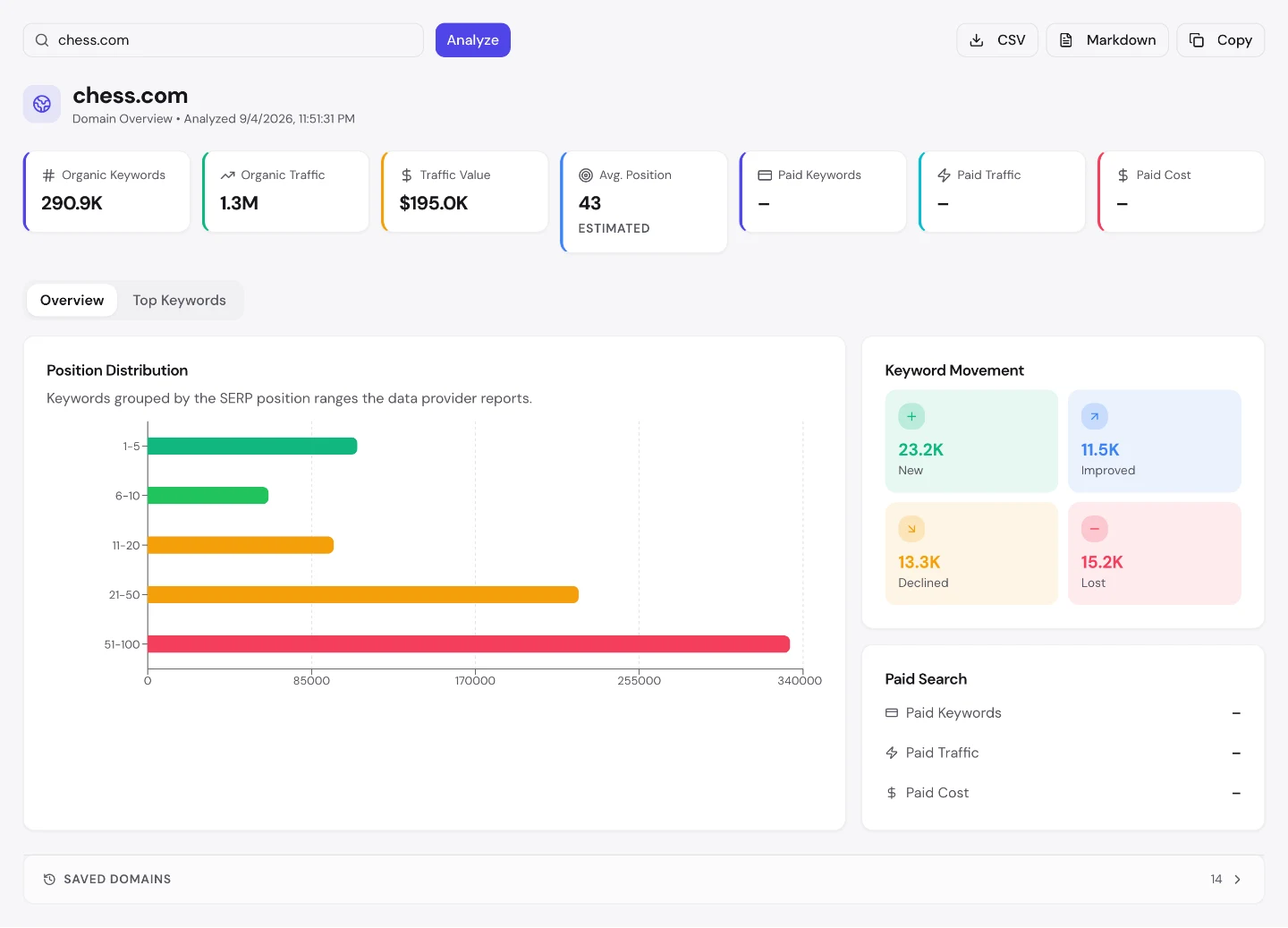
Now notice the traffic value: $195K, on 1.3M visits. Dribbble earns four times that from half the visits, because "logo" and "web design" carry commercial CPC and "chess" does not.
That is the correction to make every time you see a traffic-value figure, including in these articles. It measures what the traffic would cost to buy, not what it is worth to the business.
For a subscription game platform, a visitor searching "chess" is worth far more than the 14 cents an advertiser would bid for them. If your own number looks small, check whether you are in a cheap keyword market before you conclude your traffic is worthless.
Chess.com is 92% branded. Dribbble is 1%. Those two numbers demand completely different strategies, and most people have never measured which one they are. The Organic Traffic Checker returns branded share for any domain, alongside the pages that earn the traffic.
- The same report that found one page carrying 58% of a site
- Branded share, estimated monthly visits and the 12-month trend
- 3 checks a day, no signup, no card
What you cannot copy
And here is what I could not measure, or had to qualify. A couple of the tools I name below are partners of ours — if you buy through those links we earn a commission, and you do not pay a cent more.
Our traffic figures are United States only and modelled from ranking positions and search volume rather than counted. Chess.com is global, so its worldwide traffic is materially larger than 1.3M. The keyword and backlink data underneath comes from SE Ranking, and the $200K traffic value is an ad-spend equivalent — for a subscription business it understates the value of the traffic considerably.
The backlink total came from the app rather than the marketing tool, which was rate-limited (HTTP 429) at capture time. The app's BACKLINKS tile is a known defect on our side and has returned negative values on other domains, so the figure above is the page header total, and the screenshot is cropped below that tile deliberately. An earlier measurement of this domain recorded 66K referring domains and a domain rank of 90.
The sitemap census comes from a full crawl on 29 August 2026, not from this run. It found 830K URLs and 800K under /players. I did not run Keyword Research: it has an open defect returning implausible volumes.
And what you cannot copy: owning the category's name. "Chess" is a 1,500-year-old word and chess.com bought the matching domain. Every advantage in this article flows from that, and no amount of SEO reproduces it.
Frequently asked questions
How much search traffic does chess.com get?
Roughly 1.3M estimated US organic visits a month from 290K ranking keywords at an average position of 43, measured 5 September 2026. Our Domain Overview prices that at $200K a month as an ad-spend equivalent.
Which chess.com page gets the most traffic?
The homepage, at roughly 780K estimated monthly visits — 58% of all organic traffic — ranking first for "chess". The next largest are /play/computer at 7% and /play at 5%, both also ranking first.
What is chess.com's branded search share?
92% of traffic across the 100 keywords sampled — the highest measured in this series, with Canva second at 87%. Against 1.3M monthly visits and 290K ranking keywords, that leaves roughly 110K visits a month of genuine discovery. For contrast, Dribbble measured 1% in the same week.
How many backlinks does chess.com have?
7.7M backlinks, measured 5 September 2026 — the smallest profile in this series, converting to 1.3M visits where Dribbble's 106M convert to 680K, against Dribbble's 106M and GOV.UK's 112M. An earlier measurement recorded 66K referring domains and a domain rank of 90.
Why does chess.com get more traffic than sites with far more links?
Because its links build a brand people then search for, rather than pointing at individual pages that each have to win a query. It converts links to visits about 26 times more efficiently than Dribbble, which has 14 times more links and half the traffic.
How many pages does chess.com publish?
830K unique URLs across 46 child sitemap files, counted in a full crawl on 29 August 2026. Of those, 800K — about 96% — are player profiles under /players, and none appear among the site's top organic pages.
What is chess.com's website audit score?
85 out of 100 on our Website Audit, with 3 critical issues, 2 warnings, 5 notices and 112 checks passed on the homepage. That is the highest critical-issue count of the 15 sites measured, and it sits on the page carrying 58% of the traffic.
Is chess.com gaining or losing keywords?
Gaining modestly. It added 23K keywords and lost 15K — a net gain of about 8,000 against a base of 290K — though 13K declined against 12K improved, so the existing library is slightly weaker.
The one number to take away
26x.
That is how much more efficiently chess.com turns backlinks into search visits than Dribbble does — 7.7M links to 1.3M visits, against 106M links to 680K.
Every link building pitch is priced per link, and this is the number that should make you suspicious of that. The links are not the asset. What the links point at is the asset, and a link to a name people will later type is worth many multiples of a link to a page that has to win a query on its own.
Chess.com's 7.7M links built a brand. Dribbble's 106M built a catalogue. Both are legitimate, and only one of them produces traffic that arrives whether or not you rank.
So run your own branded share before your next campaign. If it is climbing, your links are doing the compounding kind of work. If it is flat while your link count grows, you are buying eligibility and not much else.
Found something in your own report that surprised you, or measure this differently? I would genuinely like to know — the tools used are all free, so you can check every figure yourself. Measured 5 September 2026 unless stated. Domain Overview, Organic Traffic Checker, Website Audit and Backlink Analyzer figures are free runs of our own tools, all United States scope, and all modelled rather than counted where the tool says so. The sitemap census comes from chess.com's own sitemap, crawled 29 August 2026. No revenue figure for chess.com was available to us.