Dribbble's biggest organic page is its own internal search results page.
18K visits a month to /search/logo, ranking 7th for "logo". That is more than its homepage earns, and more than any of the design shots it hosts.
I ran dribbble.com through 4 of our tools. It publishes 11M URLs, earns 683K search visits, and scored the first perfect technical audit in this entire series. Here are the 8 lessons, and the first one is the one most sites get backwards.
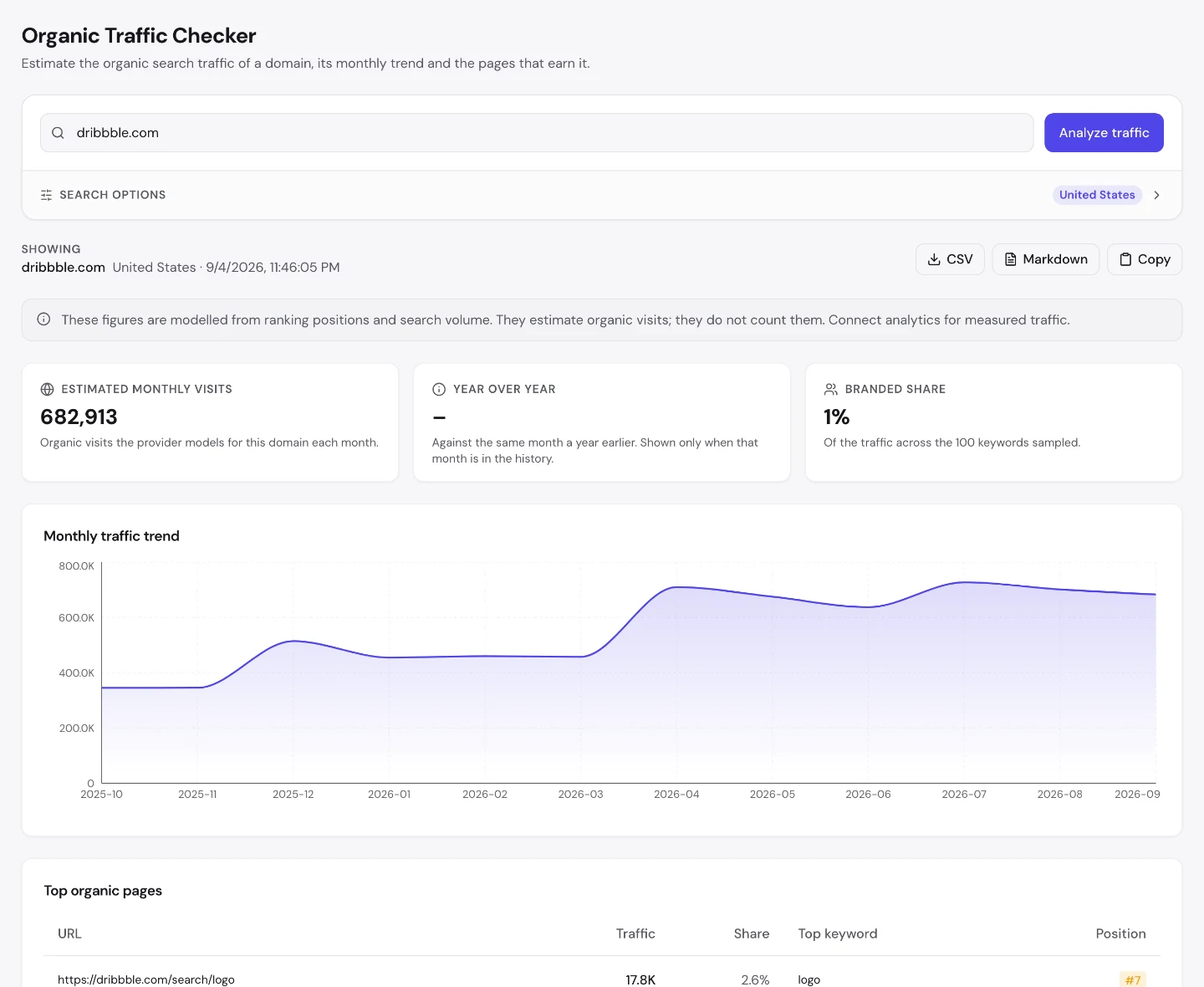
Its top page is a search
The Organic Traffic Checker puts /search/logo at 3% of the site, ranking 7th for "logo". The homepage is second.
You get that free. To see which of your page types has been quietly growing and which has stalled, you want the same view over 2 years, which is what Semrush and SE Ranking add on top.
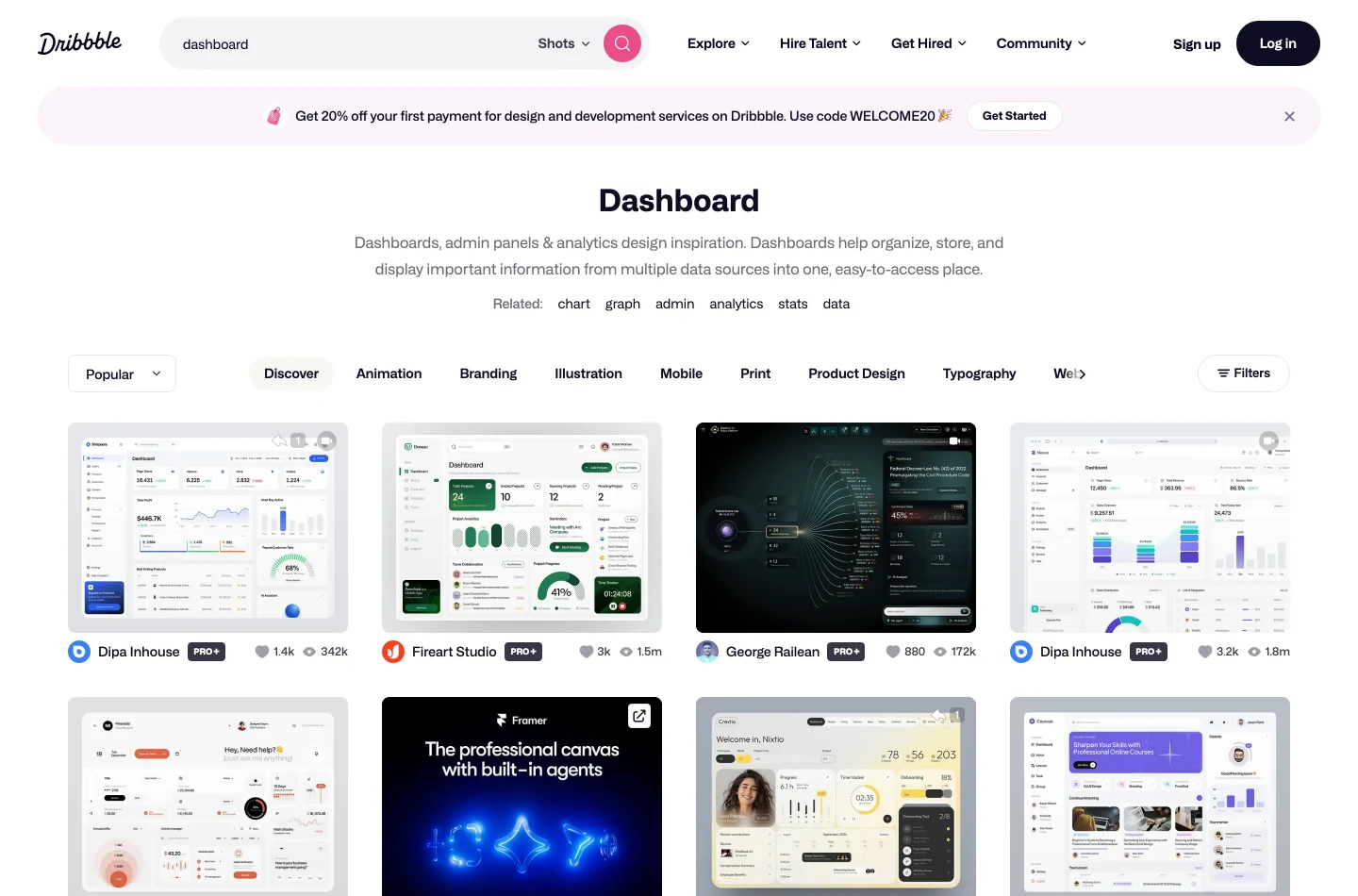
Most SEO advice tells you to block internal search from the index, and for most sites that advice is right — a search page with no results is a thin page with a query string.
Dribbble's is different because the results are the content. A search for "logo" returns a wall of finished logo work, which is exactly what the person searching wanted. The page is not a search box, it is a curated gallery that happens to be generated.
The rule to take from it is not "index your search pages". It is: a generated page earns its place when the generated output is the thing people came for. If your search results are a list of links to real content, they may qualify. If they are a list of links to other lists, they do not.
Build the tag layer, not the item layer
Look at the rest of that table. /tags/gaming-website ranks 1st, and /tags/web-design ranks 8th.
Most of the biggest pages are tag archives. One is a search page, one is the homepage, and none of them is a design shot.
This is now the fifth site in this series where the aggregation layer beats the item layer — after itch.io, Eventbrite, Open Library and PyPI. It is the most consistent finding across every catalogue measured here, and it is almost certainly true of yours.
So put your effort into the tag and category layer, not the items. You have probably been doing the reverse, because items are what your team produces and tags feel like plumbing.
Do not index all of them, though. Check demand per tag with Keyword Research, then group them with the Keyword Cluster tool so you build the 200 that people search for rather than the 20K your database can generate.
Count your URLs by template
From a full crawl of Dribbble's own sitemap: design shots are 87% of everything it publishes. Tag archives and search pages together are 12%.
The 87% produces one entry in the top 5. The 12% produces three.
Do this on your own site before your next content plan. Count your URLs by template, then count your traffic by template. It takes an afternoon.
The two lists are almost never in the same order, and the gap between them is your roadmap — it will tell you which template to stop feeding and which one you have been neglecting. Then run a Website Audit to check the underperforming template is even indexable, because sometimes the answer is that you have been blocking it.
Name the query each page type wins
Designer profiles are under half a percent of Dribbble's sitemap — on a site whose entire value is its designers.
Compare PyPI, which publishes 1.1M user profiles, more than half its estate, and earns almost nothing from them. Somebody at Dribbble decided a profile is a destination for people who already know the designer, not a search asset. That was the right call.
Here is the test, and you can apply it to any page type you are about to generate: name the query it wins. Say it out loud.
"Designer portfolio for a person whose name I already know" is not a search, it is a bookmark. If your answer sounds like that, you are about to publish inventory rather than pages, and no amount of technical work will rescue it.
Dribbble's tag pages earn the visits and its 10M item pages mostly do not. That is true of nearly every catalogue site we look at, and rebuilding the browse layer is usually the cheapest win available.
- We find which layer of your site earns
- We design and build the browse pages
- SEO and GEO across the template
- Free consultation to review your structure
A perfect 100 audit
The Website Audit returns 100 out of 100, with nothing flagged anywhere.
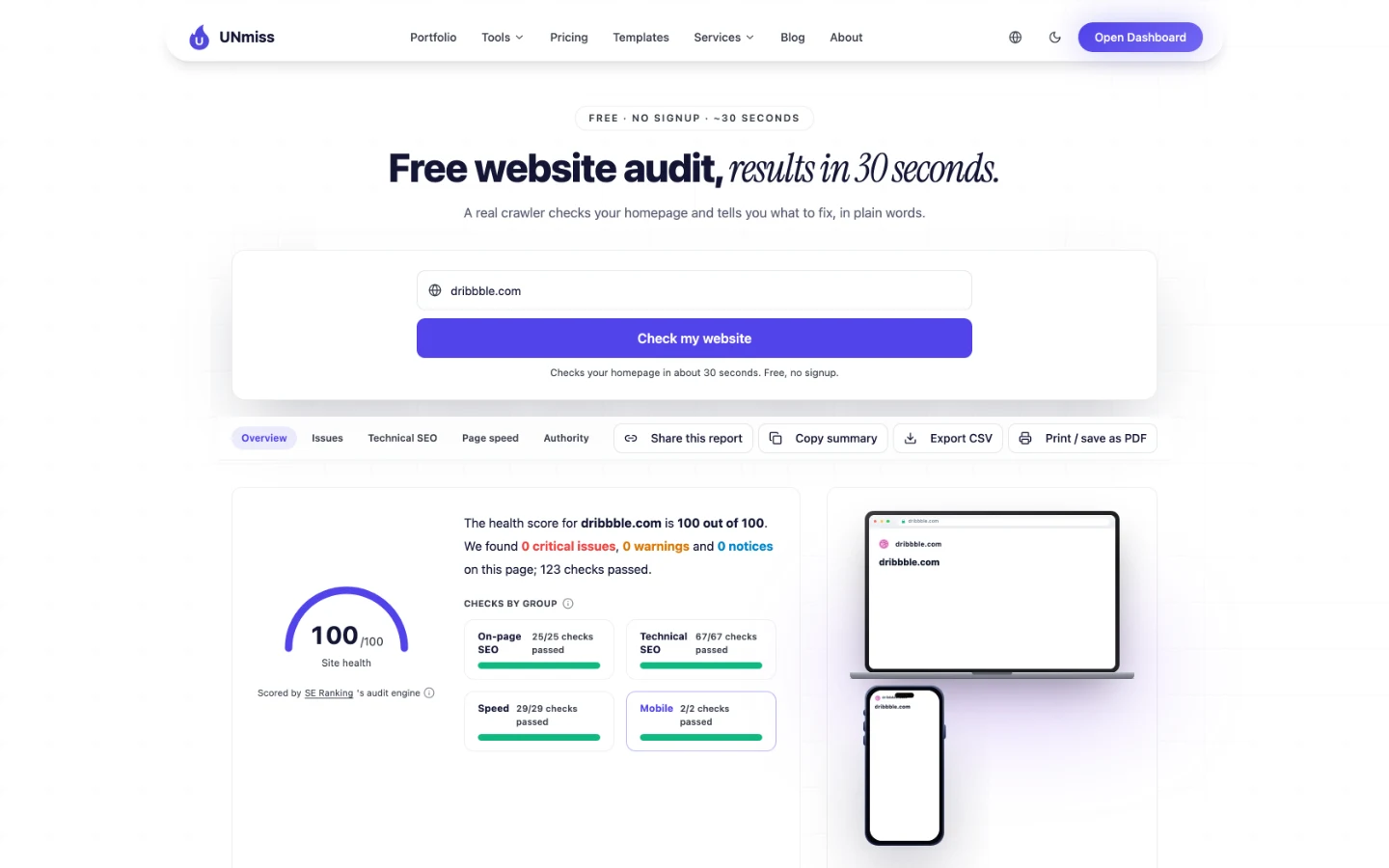
And here is the honest reading. Dribbble has the perfect audit and is losing keywords. PyPI had one of the best audits and the worst traffic-per-page ratio in the series.
A clean audit means nothing is broken. It does not mean anything is working. If yours is green and your traffic is flat, stop looking at it — the problem is not technical, and another month of fixes will not move anything.
Check your branded share before copying anyone
Branded share: 1%. Essentially nobody searches "dribbble" — they search "logo", "gaming website", "website designing", and land on a tag or search page.
Set that against chess.com in this same batch at 92% branded, and you have the two extremes of one measurement. Chess.com's visitors had already decided to come. Dribbble's did not know it existed.
Neither is better, but they need opposite playbooks — Dribbble has to keep winning generic queries, chess.com has to protect a name.
So check your own number before you copy anybody's tactics. Most of the advice you read was written by someone at one end of that scale, and if you are at the other end it will actively mislead you.
Do not mistake links for traffic
Our Backlink Analyzer reports 106M backlinks for dribbble.com.
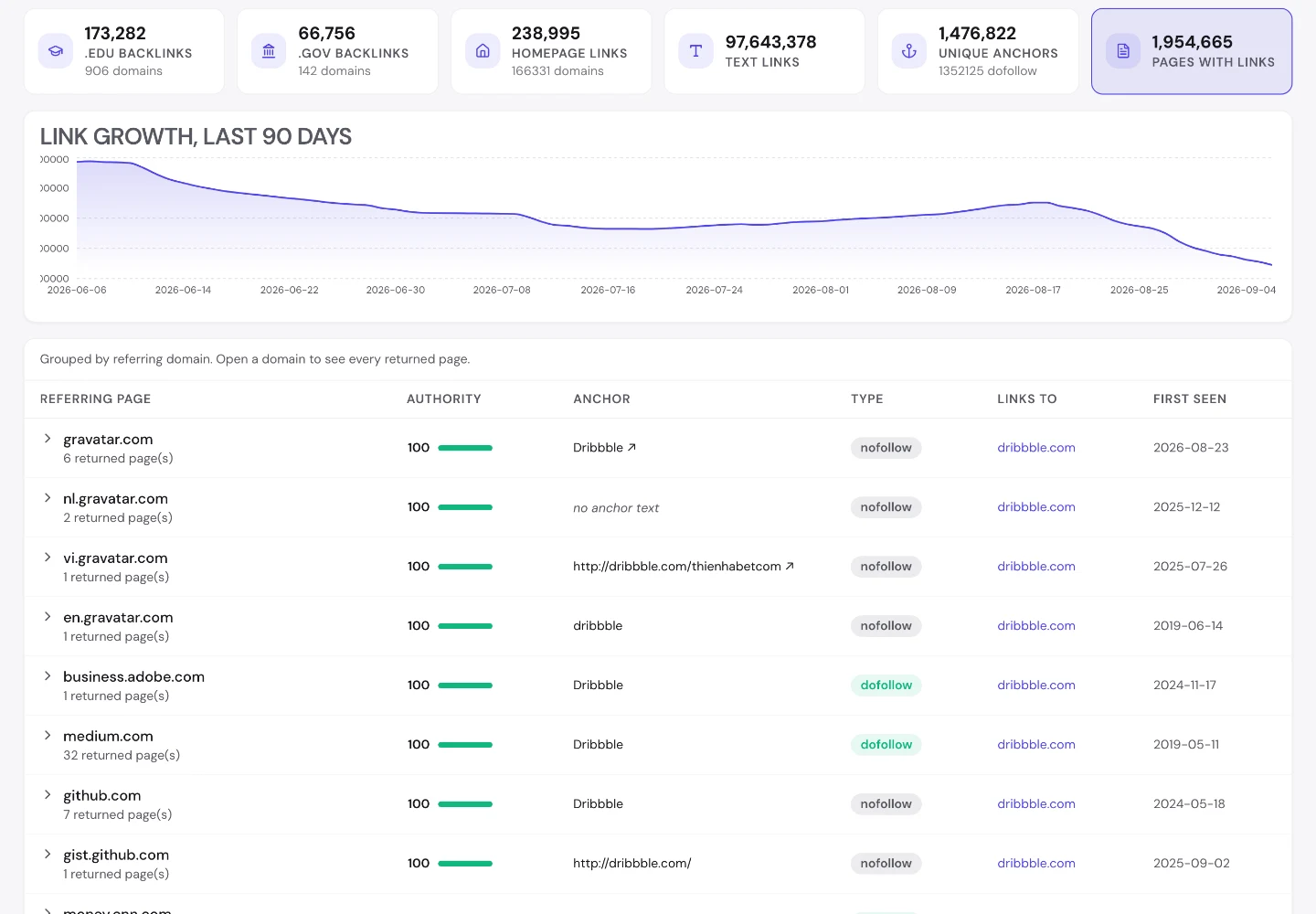
That is the second-largest profile in this series, behind only GOV.UK — which earns 12 times the traffic from a similar number of links.
Designers embed their shots in portfolios, articles and job applications, and every embed carries a link. It is the same mechanism as Eventbrite's ticket widget and itch.io's "Buy Now!" button: the sixth site here where the link engine is a product feature rather than a campaign.
The links are real. They are just not, on their own, traffic.
Which is worth remembering the next time link count is on your dashboard. If you are being judged on it, ask what it converted into — because you can grow that number for a year without a single extra visitor.
Watch for categories that quietly died
From the Domain Overview: it is losing more keywords than it gains, despite that perfect audit.
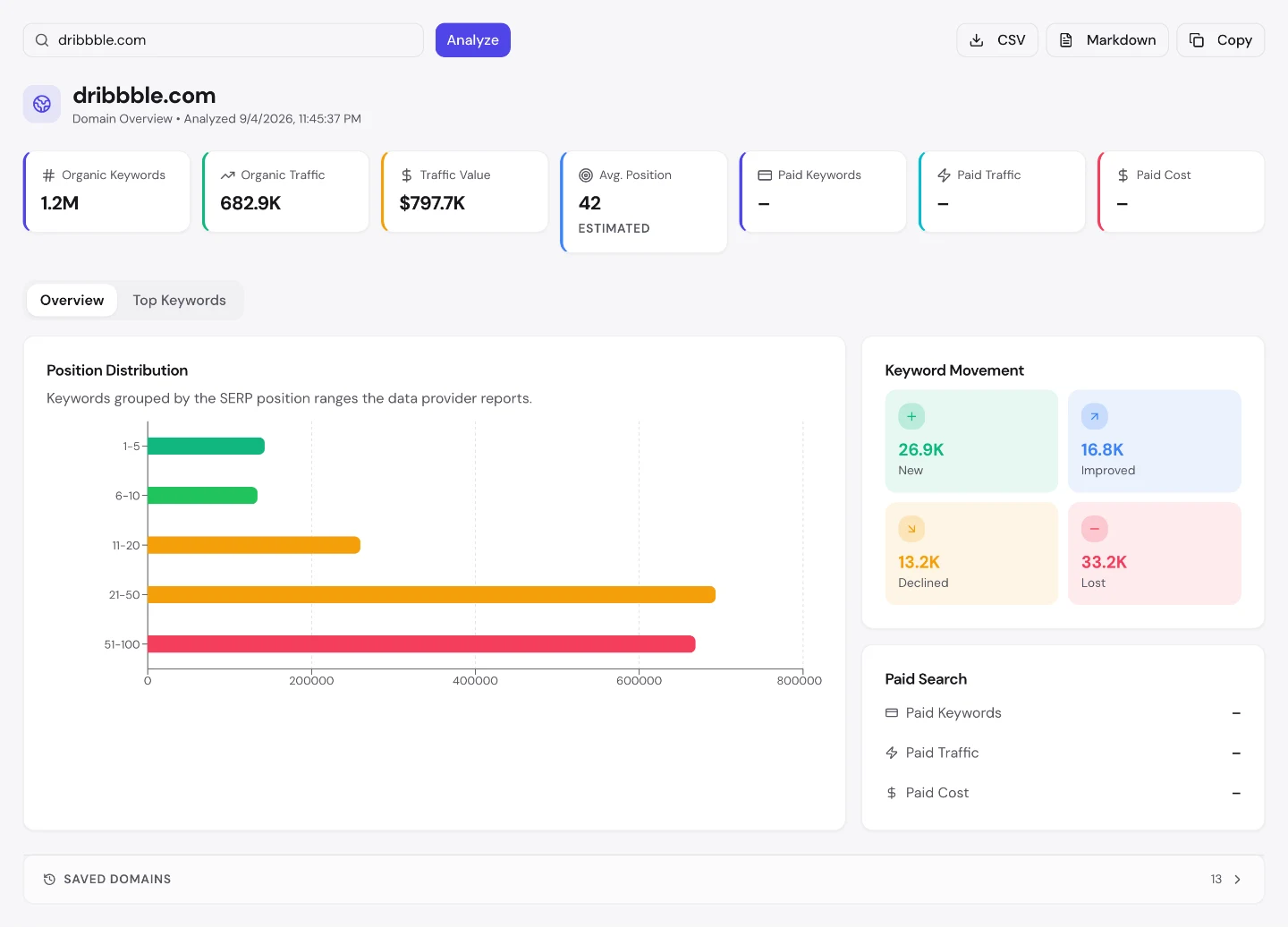
The reason is that design trends expire. A shot tagged for a visual style that was current in 2022 stops matching what anyone searches in 2026, and the tag page for that style quietly stops ranking. The library ages even though nothing was deleted.
If your catalogue is fashion-shaped — design, media, anything with a trend cycle — expect the same, and plan for it as a job rather than a surprise.
Put your top tags in the Rank Tracker and the decline reaches you months before the traffic does. Then your work is not only publishing: it is noticing which categories died and building the ones that replaced them.
87% of Dribbble's sitemap is design shots. 3 of its 5 biggest pages are tag archives. The Organic Traffic Checker returns the top-pages table for any domain, which is the fastest way to see whether your traffic and your page counts are in the same order.
- The same report that found an internal search page beating the homepage
- Traffic share, top keyword and position for every page
- 3 checks a day, no signup, no card
What you cannot copy
And here is what I could not measure, or had to qualify. A couple of the tools I name below are partners of ours — if you buy through those links we earn a commission, and you do not pay a cent more.
Our traffic figures are United States only and modelled from ranking positions and search volume rather than counted, which the tool states on its own screen. Dribbble's audience is global, so its worldwide traffic is larger than 683K. The keyword and backlink data underneath comes from SE Ranking, and the $800K traffic value is an ad-spend equivalent, not revenue.
The backlink figures came from the app rather than the marketing tool, which was rate-limited (HTTP 429) at capture time. The app's BACKLINKS tile is a known defect on our side — it has returned negative numbers on other domains — so the total above is taken from the page header, which reconciles with the dofollow and nofollow halves. The figure shown in the screenshot is cropped below that faulty tile deliberately.
The sitemap census comes from a full crawl of Dribbble's own sitemap on 29 August 2026, not from this run. It found 11M entries, 87% shots and 0.44% profiles. I did not run Keyword Research: it has an open defect returning implausible volumes.
And what you cannot copy: 15 years of designers uploading work for free. Dribbble's 9.4M shots are user-generated, and the reason designers post there is professional visibility that predates any of this. The tag architecture is copyable. The supply is not.
Frequently asked questions
What is Dribbble's most visited page?
Its internal search results page for "logo", at roughly 18K estimated monthly visits — 3% of the site's organic traffic — ranking 7th. The homepage is second at 11K. Measured 5 September 2026, United States scope.
How many pages does Dribbble publish?
11M URL entries across 226 child sitemap files, or 11M after removing duplicates, counted in a full crawl on 29 August 2026. Design shots are 87%, tag and search pages 12%, and designer profiles 0.44%.
How much is Dribbble's search traffic worth?
Our Domain Overview prices it at $800K a month, against 1.2M ranking keywords at an average position of 42 and roughly 683K estimated US organic visits, measured 5 September 2026. That is an ad-spend equivalent, not revenue.
What is Dribbble's website audit score?
100 out of 100 — 0 critical issues, 0 warnings, 0 notices and 123 checks passed on the homepage. It is the first perfect score across the 15 sites measured in this series.
How many backlinks does Dribbble have?
106M backlinks converting to 683K visits and $800K of traffic value, measured 5 September 2026 — the second-largest profile in this series behind GOV.UK's 112M. An earlier measurement recorded 530K referring domains and a domain rank of 97.
Should I let Google index my internal search pages?
Usually no. Dribbble is an exception because its search results are galleries of finished work — the generated output is the thing the searcher wanted. If your search results are a list of links to other lists, they are thin pages and should stay out of the index.
What is Dribbble's branded search share?
1% of traffic across the 100 keywords sampled. Almost all its traffic arrives on generic design queries such as "logo" and "website designing" rather than on the brand name — the opposite of chess.com, measured the same week at 92%.
Is Dribbble gaining or losing keywords?
Losing. It gained 27K keywords and lost 33K — a net loss of about 6,300 against a base of 1.2M — while 17K improved and 13K declined. Design trends expire, so tag pages for dated styles stop matching current searches.
The one number to take away
0.44%.
That is the share of Dribbble's sitemap given to designer profiles — on a site whose entire product is designers.
It is a deliberate decision, and it is the opposite of what almost everyone does. PyPI publishes 1.1M user profiles and earns nothing from them. Meetup's third-biggest organic page is its login screen. Both are the same mistake: publishing a page because the record exists rather than because a search does.
Dribbble spent its index on tags and searches, which is where the queries actually are, and on shots, which are the supply that makes those tags worth visiting. Profiles got half a percent.
So go and count your own URLs by template, then your traffic by template. If the biggest template is not the biggest earner, you already know what next quarter is for.
Found something in your own report that surprised you, or measure this differently? I would genuinely like to know — the tools used are all free, so you can check every figure yourself. Measured 5 September 2026 unless stated. Domain Overview, Organic Traffic Checker, Website Audit and Backlink Analyzer figures are free runs of our own tools, all United States scope, and all modelled rather than counted where the tool says so. The sitemap census comes from Dribbble's own sitemap, crawled 29 August 2026. No revenue figure for Dribbble was available to us.