Booking.com declares 354 sitemaps, and roughly 20% of its US search traffic is one city.
1 city, out of every city on earth that has a hotel.
I ran booking.com through 3 of our tools to measure what is probably the largest programmatic catalogue on the consumer web. The catalogue is real, the engineering is exceptional, and the traffic is concentrated in a way nobody who cites this site ever mentions. Here are the 8 lessons.
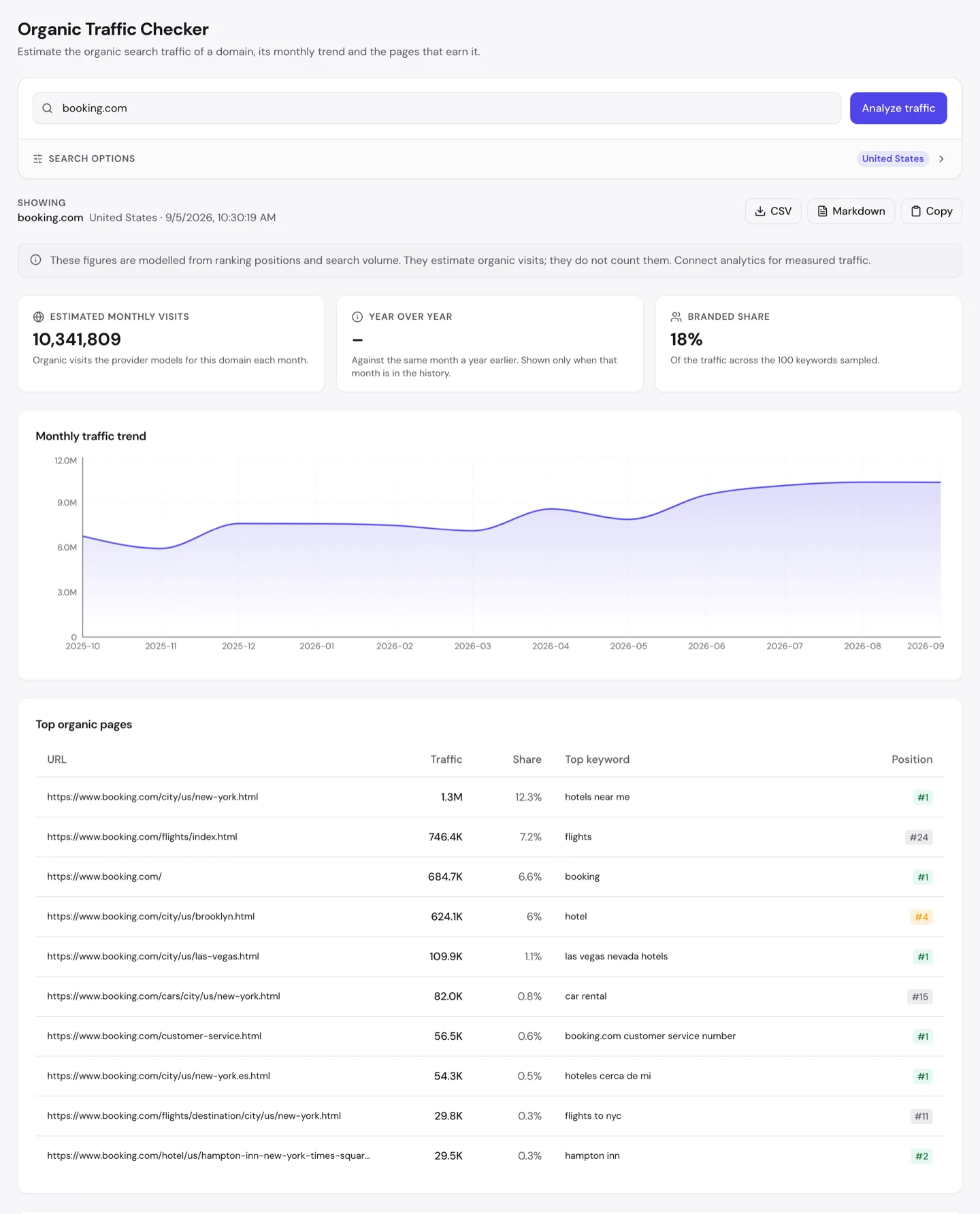
New York is 20% of traffic
The Organic Traffic Checker puts booking.com at about 10M estimated monthly visits, and the New York city page alone takes 12% of them.
A free run gives you today's picture. Travel is seasonal, so the useful question is what these pages did last August — and for that you need a tool that stores history, which is what Semrush and SE Ranking are for.
Add Brooklyn, the Spanish-language New York page, the car rental page, the flights page and a Times Square hotel, and New York is roughly a fifth of everything. One city out-earns the homepage by nearly 3 to 1.
Expect this on your own site, whatever you catalogue. If you publish pages for places, products or people, a handful of them carry you and the rest are inventory — and you probably already know which handful, but you have never checked what share they actually hold.
Go and find out before you plan another quarter of pages. If your top 5 URLs are a fifth of your traffic, you are not running a catalogue; you are running 5 pages with a catalogue attached, and that changes where your next month goes.
Publish themes only where inventory exists
This is the transferable lesson, and it is a good one.
Booking slices its catalogue by theme — glamping, all-inclusive, capsule hotel, casino, farmhouses — crossed with city. In English alone, the size of one theme's sitemap varies enormously:
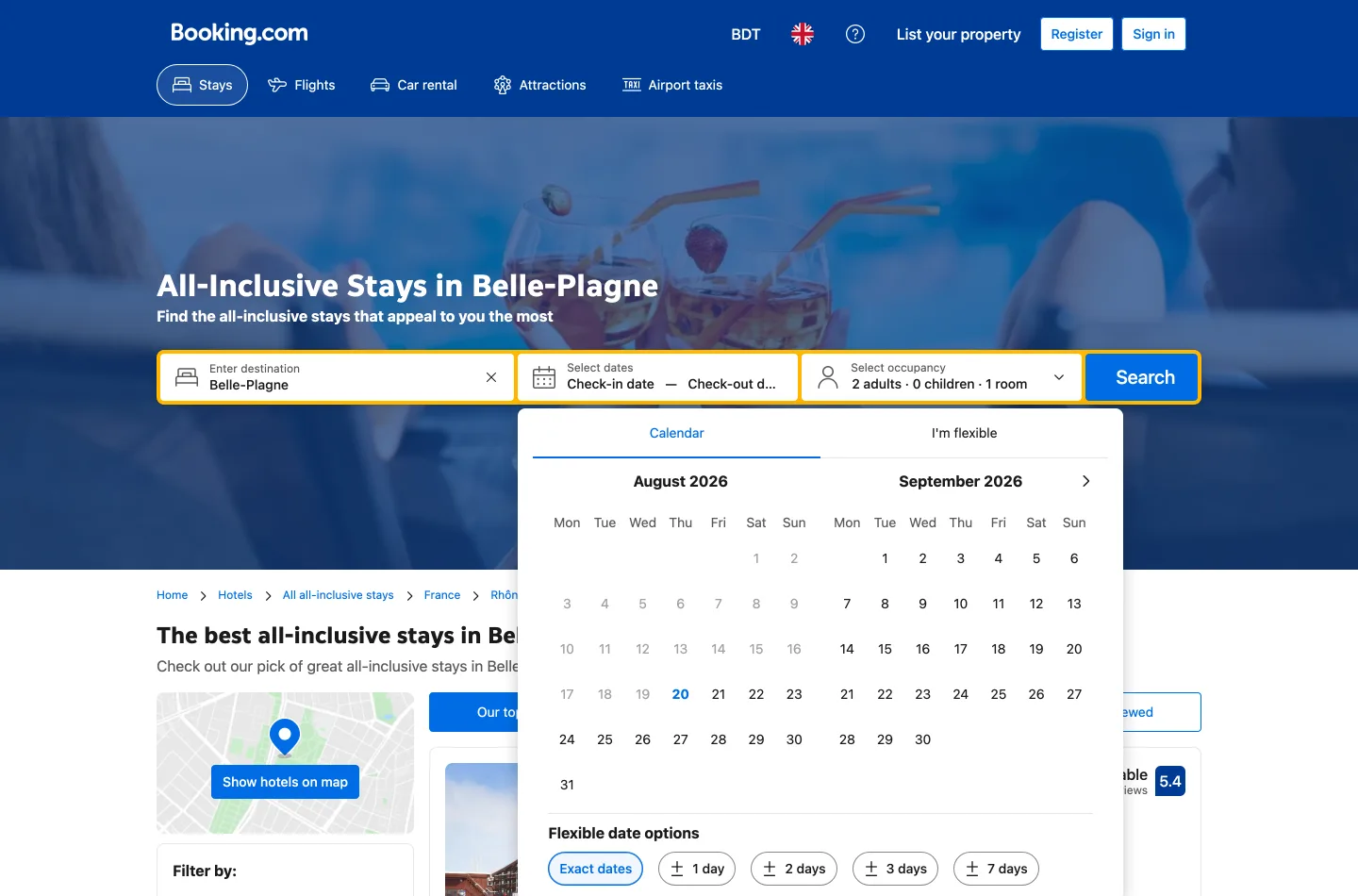
Farmhouses get 12K pages. Casino gets 310. Same template, same language, a 38x spread.
Casino is small because roughly that many cities have a hotel with a casino in it. Booking does not publish the other thirty-odd thousand empty ones, and it easily could.
That is the constraint to copy, and it is the one people drop first. The failure mode of every catalogue is publishing every category in every location, because the loop is trivial to write and nobody wants to argue for fewer pages.
So write the check into the generator itself. If a combination has nothing behind it, do not emit the page. You will ship a smaller catalogue and you will not spend the next year explaining a pile of thin URLs to somebody.
Name your sitemaps after their contents
Its robots.txt declares 354 sitemap lines, and every one is an index of indexes — named for exactly what it holds. off-market. recently-sold. glamping. alberghi.
You can read the taxonomy before you fetch a single file, and so can a crawler. That is the point, and it costs you nothing but a naming convention.
Notice what is in those names, too. bestwestern is a hotel brand. alberghi and gites are Italian and French for lodging — local vocabulary published as its own axis rather than translated away. If your catalogue serves more than one market, that is worth a morning of your time.
Look at your own robots.txt now. If it points at one file called sitemap.xml, you are giving a crawler no information at all before it starts downloading. The XML Sitemap Generator will walk a competitor's indexes so you can see the shape you are aiming at.
Chase the head term you cannot win
The second-biggest page on the site is its flights page, and it sits at position 24. Page 3 of the results, earning more than the homepage does.
Compare that with Las Vegas, which ranks 1st and earns a fraction of it. "Flights" is searched so heavily that a bad position on it beats a good position on almost anything else.
So stop discarding terms because you cannot reach the top 3. You have probably written off your category's biggest query, and page 3 of that query may be worth more than page 1 of the long tail you chose instead.
Price it before you decide. Put the term you gave up on into Keyword Research, then use the SERP Analyzer to see who is actually holding those positions. If page 3 clears your target, you have a project.
Booking.com only publishes a page where it has real inventory to show. That single rule is why its city pages work and why most copies of them do not. We build these programmes with that rule baked in.
- We check demand before a single page is built
- Templates that stay useful at scale
- Ecommerce and marketplace builds
- Free call to size the project
100 out of 100, with a caveat
The Website Audit scores booking.com 100/100, with nothing flagged in any group.
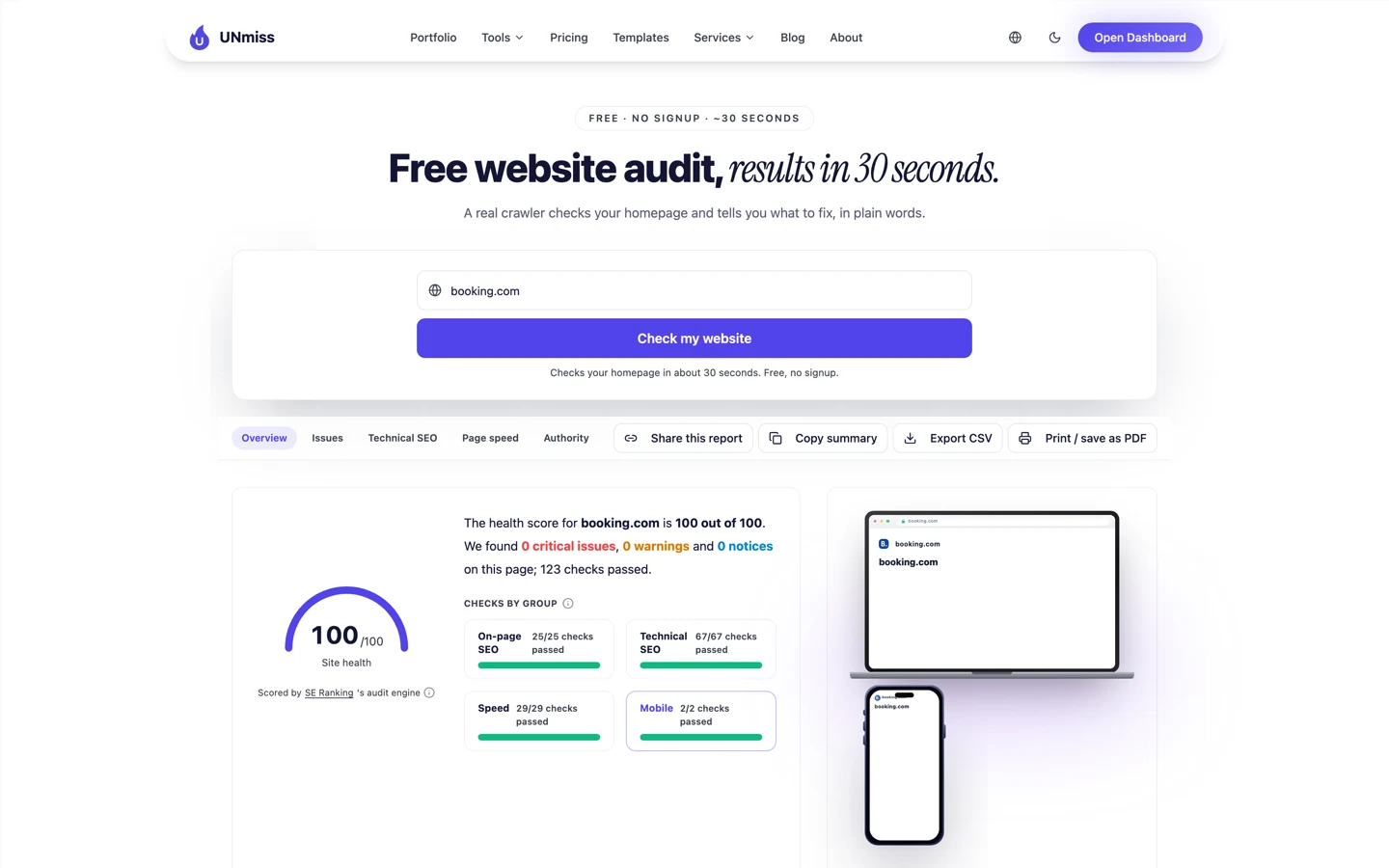
It is the 3rd perfect score in this series, after Dribbble and ClinicalTrials.gov — and both of those are losing keywords while Booking is gaining. So a clean sheet tells you what is not broken, not whether you are winning.
Now the caveat, and it is our own tool I am criticising. Scroll into the detailed technical list on that same report and structured data is flagged as missing or invalid — while the summary above it counts zero issues. Both cannot be right. A perfect score is a summary of the checks that feed it, not a promise that nothing is wrong, and we have a reconciliation bug to fix.
Read the detail on any audit you run, ours included. The headline number is the least informative thing on the page, and if you report it upwards without opening the list underneath, you will eventually be wrong in a meeting.
Check what your example is buying
The Domain Overview records 96K paid keywords sitting beside the organic ones.
For scale, NerdWallet — a company whose entire model is search — runs about 3,800 of them. Booking runs 25 times that.
Booking buys ads on terms it already ranks for, and no write-up of this site mentions it. When somebody tells you a company "won at SEO", that is the number to ask for, because you are usually being shown one channel of a business that is quietly running two.
It applies to you in reverse as well. If you are being measured against a competitor's organic performance, find out what they are spending first — you may be losing to a budget rather than to a strategy.
Never compare links across industries
Measured 20 August 2026, our Backlink Analyzer put booking.com at Domain Rank 97, from 1.4M referring domains. Only 56% of those links are dofollow.
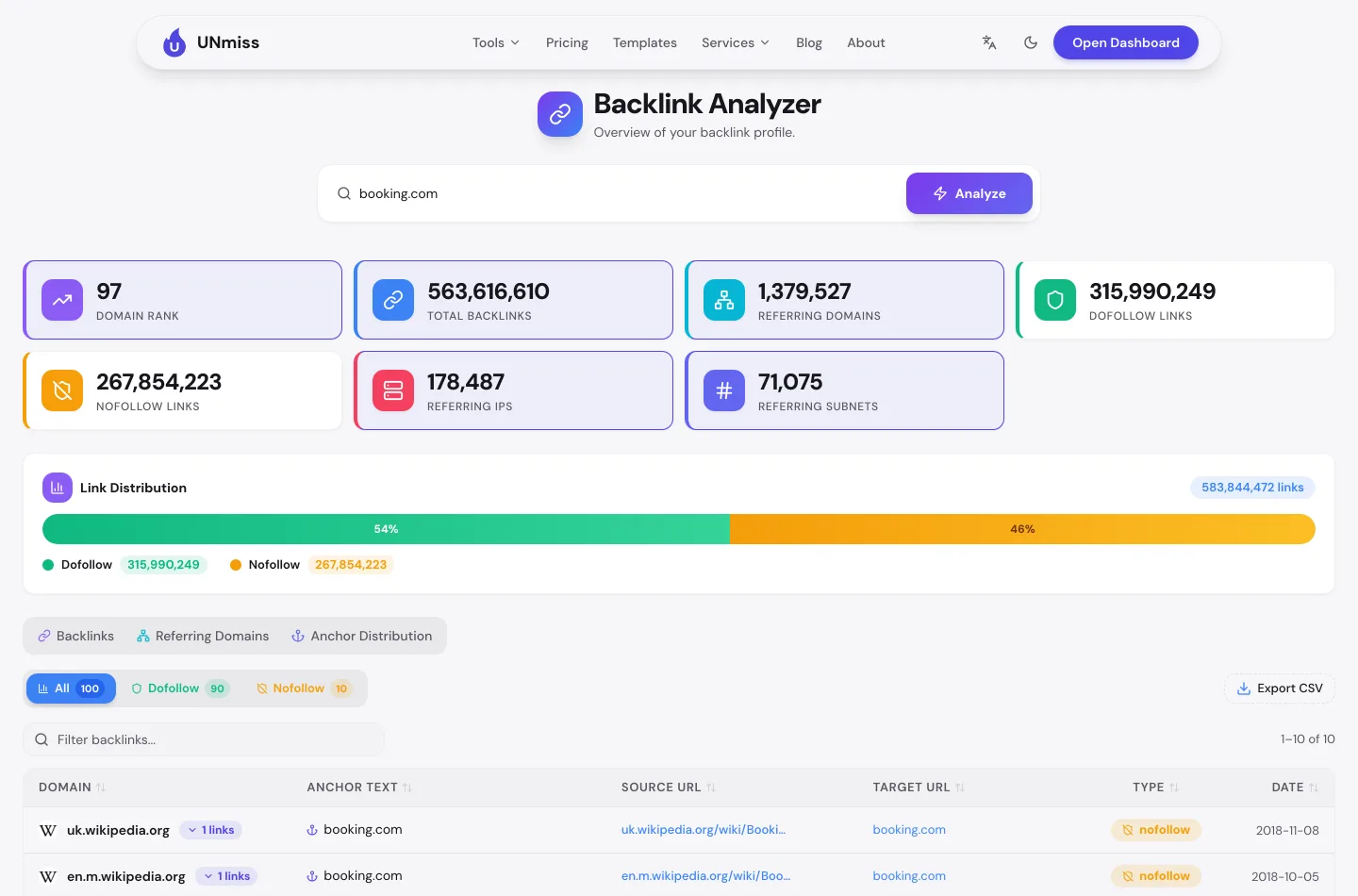
Canva, measured the same week, has far fewer referring domains at 93% dofollow. Booking has more than twice as many at 56%.
That is normal for travel. Links land in forums, itineraries, price aggregators and comment threads, and every one of those nofollows by default. Nearly half of Booking's link profile passes nothing at all.
So never benchmark your referring domains against a company in a different industry. If you sell software and you are comparing yourself to a marketplace, you are comparing a number that means two different things — and you will either panic or relax for no reason.
It gains more than it loses
From the same report: 9.4M organic keywords, $8.6M of monthly traffic value, average position 39.
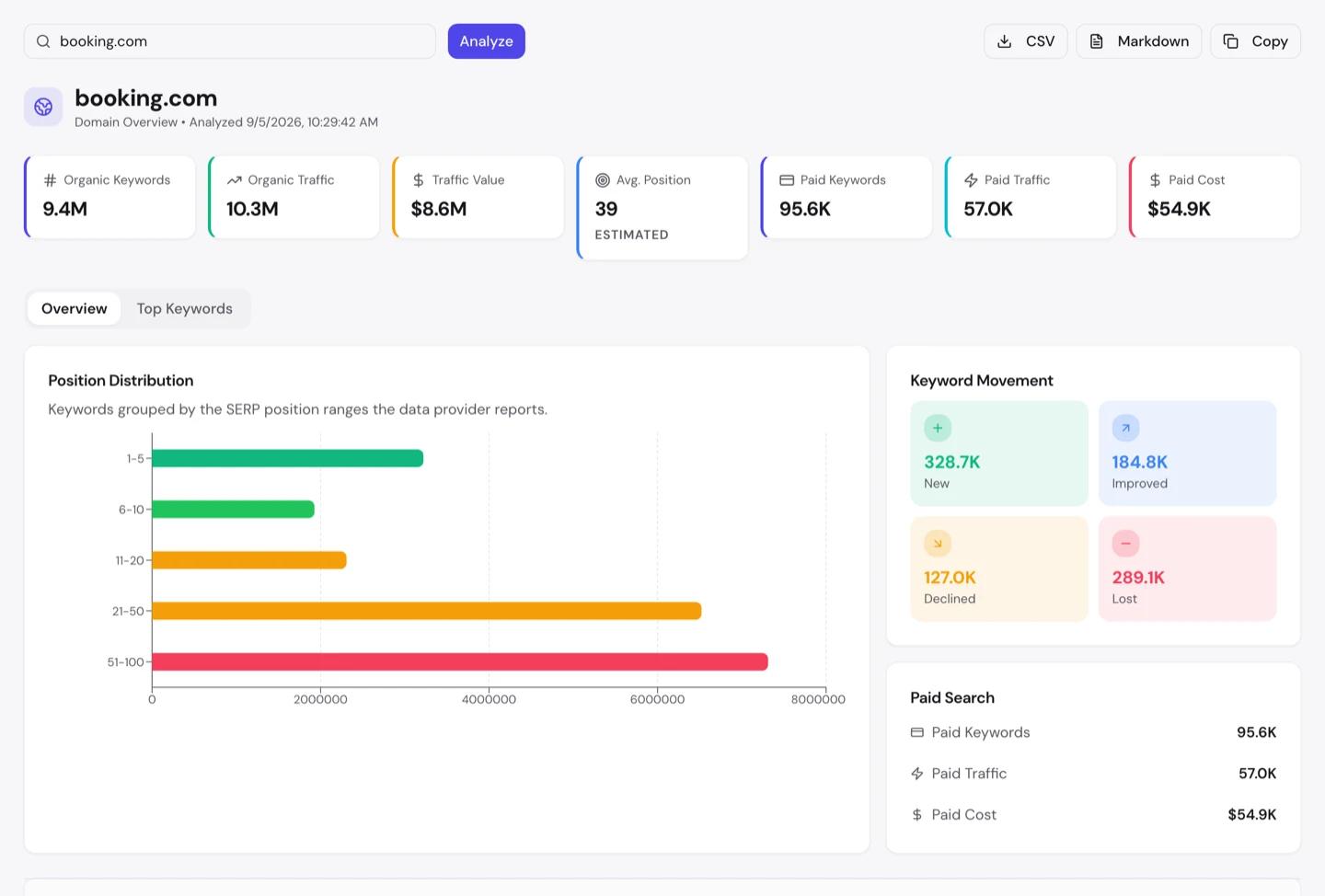
It gains slightly more keywords than it loses, and improves more than it declines. A catalogue this size is never still, and net-positive is the realistic target rather than growth.
Note the ratio, though. Booking has 62% more keywords than Canva and less than half the traffic value, because most of them sit near position 39 on a page listing hotels in a town nobody searches for.
That is the number to watch on your own catalogue. Keyword count goes up whether or not anything is working; value per keyword tells you whether the pages you added were worth adding.
Booking.com publishes hundreds of thousands of pages and roughly a fifth of its US traffic is one city. The top-pages report takes thirty seconds and it usually finds the same concentration on much smaller sites.
- The report that found New York at 12% of all traffic
- Traffic share, top keyword and position for every page
- 3 checks a day, no signup, no card
What you cannot copy
And here is what I could not measure, or had to qualify. A couple of the tools I name below are partners of ours — if you buy through those links we earn a commission, and you do not pay a cent more.
You cannot copy the inventory. Every page in this catalogue exists because Booking has contracts with the properties on it. The template is trivial; the supply behind it is 30 years of commercial work. A site without inventory that copies this structure publishes empty pages, which is the failure mode described above.
Our traffic figures are United States only and modelled from ranking positions and search volume rather than counted. That US scope is why New York dominates so completely — a UK or Japanese sample would look nothing like this, and I have no evidence about how concentrated Booking's worldwide traffic is.
The theme sizes come from a small sample: 6 themes in one language, out of hundreds of themes across dozens of languages. I am not claiming a site-wide page total, because any number I gave you would be a guess. I also cannot see which theme-and-city combinations Booking chose not to publish, only that the counts vary by 38x.
The backlink figures were measured on 20 August 2026 — our Backlink Analyzer returned "Daily backlink check limit reached" on 5 September, so the older dated measurement is quoted rather than a fresh one. The sitemap census is from 20 August too.
The audit covers the homepage, not the themed pages behind it, and as noted above its perfect score contradicts its own structured-data check. I did not run Keyword Research: it has an open defect returning implausible volumes.
Frequently asked questions
Which Booking.com page gets the most search traffic?
The New York city page, at roughly 1.3M estimated monthly visits — 12% of the site's US organic traffic — ranking 1st for "hotels near me". Counting Brooklyn, the Spanish-language New York page, the New York car and flight pages and a Times Square hotel, New York is about 20% of everything.
How many sitemaps does Booking.com have?
Its robots.txt declares 354 sitemap lines, each an index of indexes. 312 are themed-city indexes and 42 cover other page types. One theme index expands to 45 language children, so the themed layer alone is roughly 14K sitemap files, rebuilt daily.
How many pages does each Booking.com theme have?
It varies by 38x in English alone: farmhouses 12K, glamping 11K, all-inclusive 4,900, Best Western 719, capsule hotel 458, casino 310. Each theme is published only where the inventory exists, which is the discipline most worth copying.
What is Booking.com's website audit score?
100 out of 100 — 0 critical issues, 0 warnings, 0 notices and 123 checks passed, scoring 25/25 on-page, 67/67 technical, 29/29 speed and 2/2 mobile. It is the 3rd perfect score in this series after Dribbble and ClinicalTrials.gov. With one caveat: the detailed technical list on the same report still flags structured data as missing or invalid, which is a reconciliation bug in our summary rather than a clean bill of health.
How many keywords does Booking.com pay for?
96K paid keywords, at 57K paid visits and $55K of paid cost, alongside 9.4M organic keywords and 10M estimated monthly visits. For comparison, NerdWallet runs about 3,800, Canva 1,400 and Zapier 203.
How many backlinks does Booking.com have?
564M backlinks from 1.4M referring domains at Domain Rank 97, measured 20 August 2026 — but only 56% are dofollow. Canva has 620K referring domains, 2.2x fewer, at 93% dofollow, which is why cross-industry link counts are not comparable.
How much is Booking.com's search traffic worth?
Our Domain Overview prices it at $8.6M a month, against 9.4M ranking keywords at an average position of 39 and roughly 10M estimated US organic visits, measured 5 September 2026. That is an ad-spend equivalent, not revenue.
Is Booking.com gaining or losing keywords?
Gaining. It added 330K keywords and lost 290K — net up about 40K — with 180K improved against 130K declined. Its flights page earns 750K visits at position 24, the Brooklyn page 620K at position 4, and Las Vegas 110K at position 1.
The one number to take away
310.
That is how many casino-hotel pages Booking publishes in English, against 12K farmhouse pages built from the identical template.
Everyone who cites this site cites the scale. The scale is not the lesson — the scale is a consequence of having inventory in a lot of places. The lesson is the 310. Booking could generate a casino page for every city on earth in an afternoon, and it does not, because roughly 310 cities have a hotel with a casino in them.
Every programmatic catalogue that has failed in this series failed the same way: it published a page because a record existed, not because inventory or demand did. PyPI has 1.1M user profiles. Chess.com has 800K player pages. Neither earns anything.
Before you generate the next 10K URLs, ask what is on them. If the answer is "whatever the database returned", Booking.com is not the example you are following.
Found something different in your own report? I would genuinely like to know — the tools used are all free, so you can check every figure yourself. Domain Overview, Organic Traffic Checker and Website Audit figures were measured on 5 September 2026, United States scope, and are modelled rather than counted where the tool says so. Backlink figures, the sitemap census and the theme counts were measured on 20 August 2026. No revenue figure for Booking.com was available to us.