Canva publishes 100K URLs, and 87% of its search traffic is people typing its name.
Only chess.com measures higher, and people go there to play, not to search.
I ran canva.com through 3 of our tools expecting to measure the template catalogue everyone points at. What came back is a site whose search performance is almost entirely a brand, with 1 quiet exception that is worth more than the catalogue. Here are the 7 lessons.
Measure your branded share before benchmarking
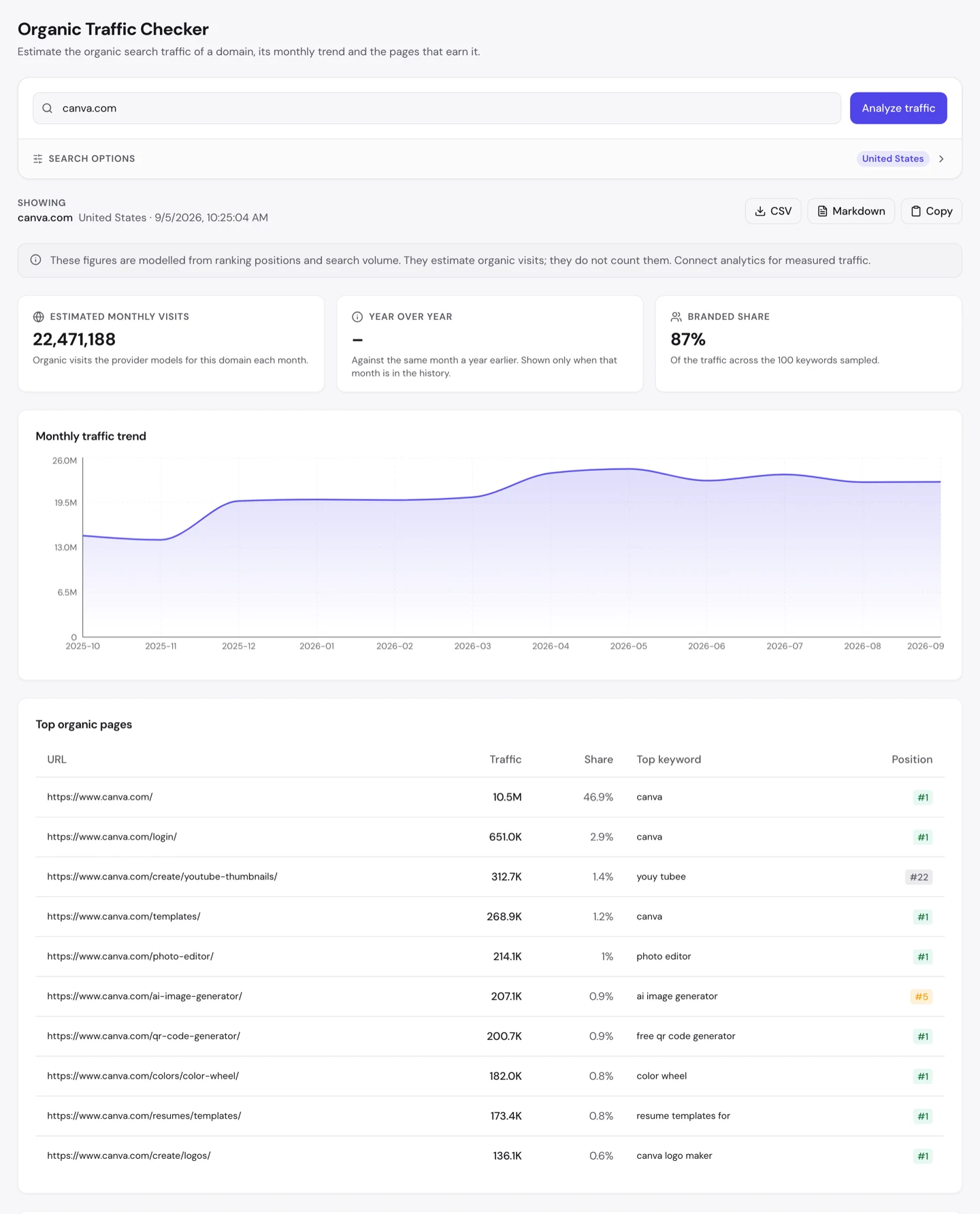
The Organic Traffic Checker puts canva.com at about 22M estimated monthly visits, with a branded share of 87%.
You can run that check on any competitor for free. To see how long it took them to get there, you need historical data — Semrush and SE Ranking both hold years of it, and the shape of the climb tells you more than the total does.
Only chess.com is higher in this series, and that is a destination people open rather than a page they find. Everything else sits far below — Booking.com at 18%, Zapier at 2%, Wise at 1%.
Canva is not really winning search. It is winning a name that people then search for, and search is delivering them. Those are different achievements and only one of them is a strategy you can copy.
So run your own domain through the same report before you benchmark yourself against a site like this. If your branded share is low, your unbranded machine is already doing more work than Canva's — and you should stop measuring yourself against a company whose advantage you cannot buy.
Its login page out-earns its templates
The homepage takes 47% of everything, ranking 1st for "canva". Second is the login page. Fourth is the templates hub — which also ranks for "canva", not for any template query.
The login page earns 2.4 times what the entire templates hub earns.
Sit with that for a moment. The front door to a 100K-page programmatic catalogue is out-performed by the form where existing customers type their password, and both are winning the same brand term.
If you have a big catalogue, go and find where its hub page actually ranks. You may discover, as Canva has, that it is being carried by your name rather than by anything in it.
Count a competitor's pages from its sitemap
A crawl of Canva's sitemap index on 20 August 2026 counted 100K URLs across 4 shards. More than 12K of those were template pages in a single shard, heavily localised and mostly Japanese.
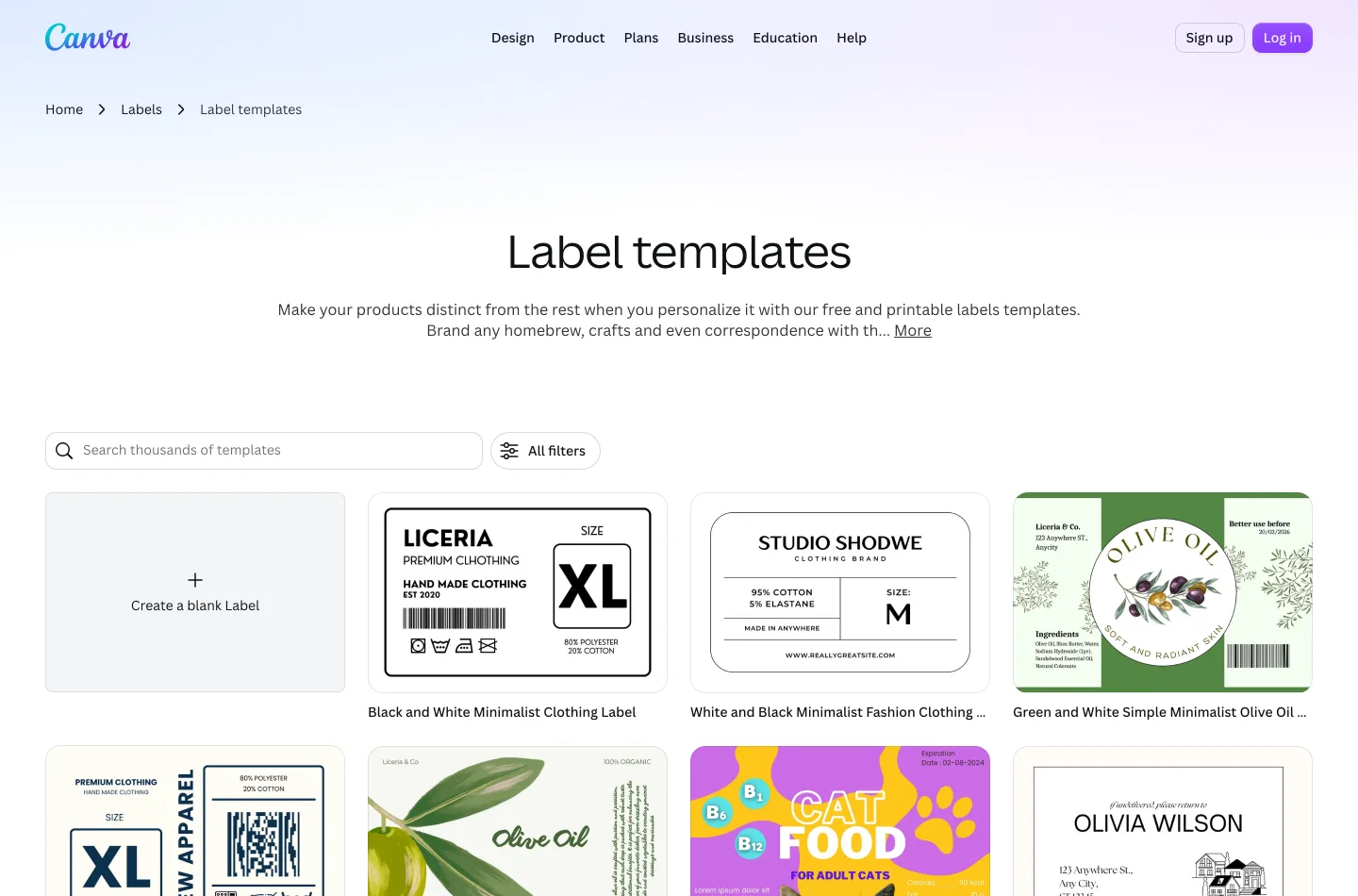
Not one individual template page appears in the site's top pages. Only the hub does, and the hub ranks for the brand.
State the limit honestly: this report returns top pages, not a full inventory. Template pages could earn real traffic across a very long tail without any one of them surfacing here. What is established is that none is large enough to reach the top of the site.
Two of the 4 shards sit at exactly 50K URLs — the protocol's per-file cap — so the real catalogue is probably larger than the count.
That is the trap to watch for when you size up a competitor. If you count a feed and every shard lands on a round 50K, you have measured the ceiling rather than the catalogue, and your estimate is a floor. The XML Sitemap Generator will show you where a feed hits it.
Ship free tools, not more templates
Here is the exception, and it is the only genuinely transferable lesson on this page.
Behind the brand pages, every unbranded winner Canva has is a free single-purpose tool.
Not a template gallery, and not a landing page. A tool that does one thing.
A photo editor ranking 1st for "photo editor". A QR code generator, a colour wheel and an AI image generator, all near the top for their own plain terms.
So look at your own product and ask which single job you could give away as a free page. You almost certainly have one, and it will out-rank everything you write about yourself.
The tool does not have to be your best work. It has to be the thing somebody types into a search box at the moment they need it.
4 pages. Each does 1 thing, immediately, without an account. Each ranks at or near the top of a generic term with real demand.
That is the pattern you can take, and it is not the catalogue. A tool page earns its ranking because it answers the query the moment it loads. A template page asks the visitor to start browsing.
You almost certainly have a candidate already — something your support team explains repeatedly, or a spreadsheet your customers rebuild every quarter. Price the term through Keyword Research, then use the SERP Analyzer to see whether whatever ranks there now is beatable. "Color wheel" was, and Canva took it.
Canva gives away small tools and they pull in millions of visits a month. You do not need Canva's budget to copy this. You need one tool your customers would use, and someone to build it properly.
- We pick the tool with real search demand
- Built, branded and hosted on your site
- SEO and GEO so people and AI both find it
- One free call to see if it fits you
90 out of 100, and 1 critical
The Website Audit scores the homepage 90/100. Behind that score: 1 critical issue, 0 warnings and 2 notices. It passed 117 checks.
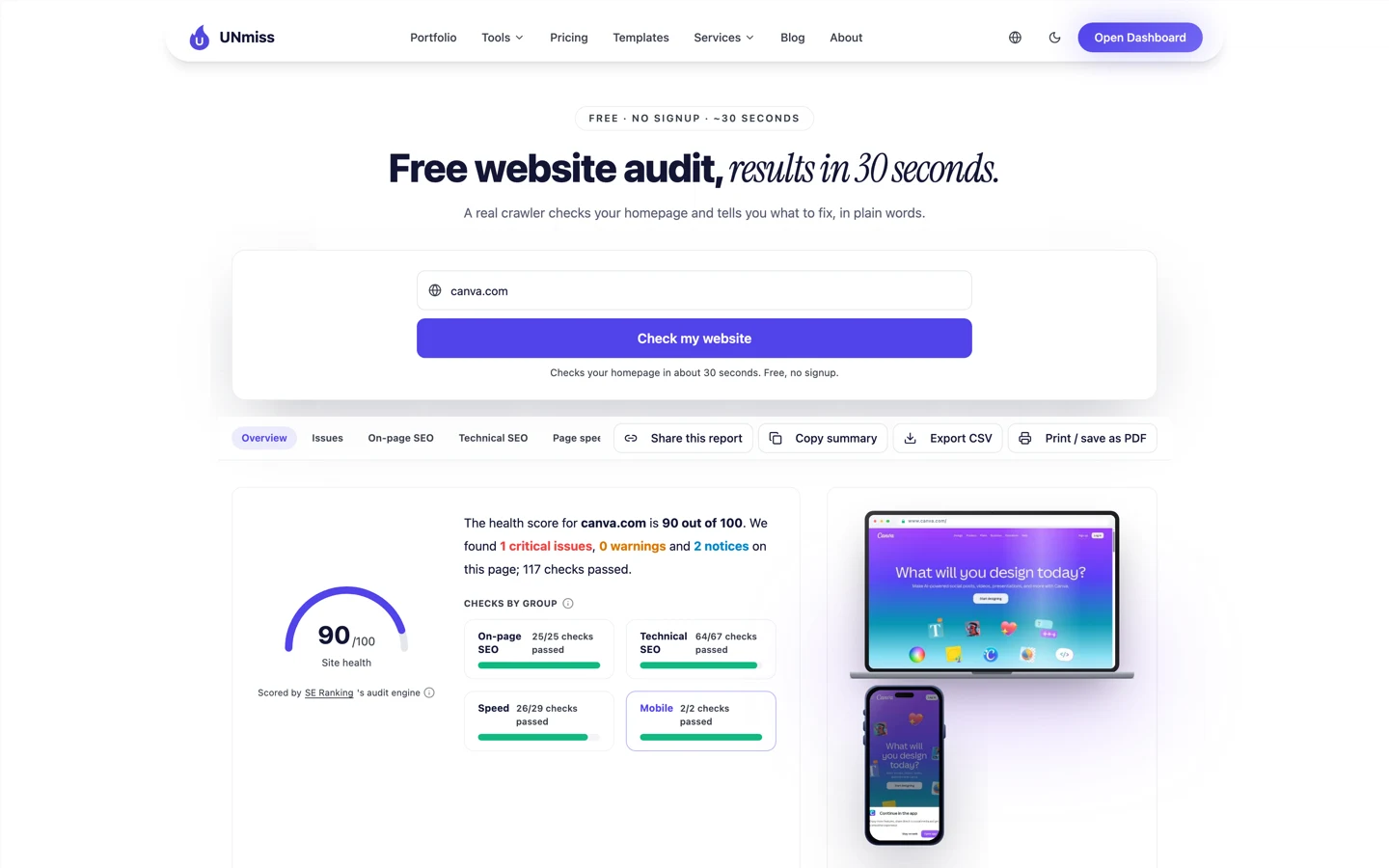
The critical issue is "Noindex pages in XML sitemap". Canva is submitting URLs for indexing that carry a tag telling Google not to index them.
On a small site that is a tidy-up. On a feed this size it is a signal problem — you are spending crawl budget asking for pages you have already declined.
It is the most common failure I see in large programmatic catalogues, and it stays invisible until something crawls the feed against the pages. If you generate your sitemap from a database rather than from what is actually indexable, assume you have it.
One more thing the audit is honest about: the homepage carries 54 words of text and ranks 1st anyway, because the query is the brand. Do not take that as licence for your own thin pages — it works here and almost nowhere else.
Build something worth sharing, not placing
Measured on 20 August 2026, our Backlink Analyzer put canva.com at Domain Rank 97, from 620K referring domains. 93% of those links are dofollow.
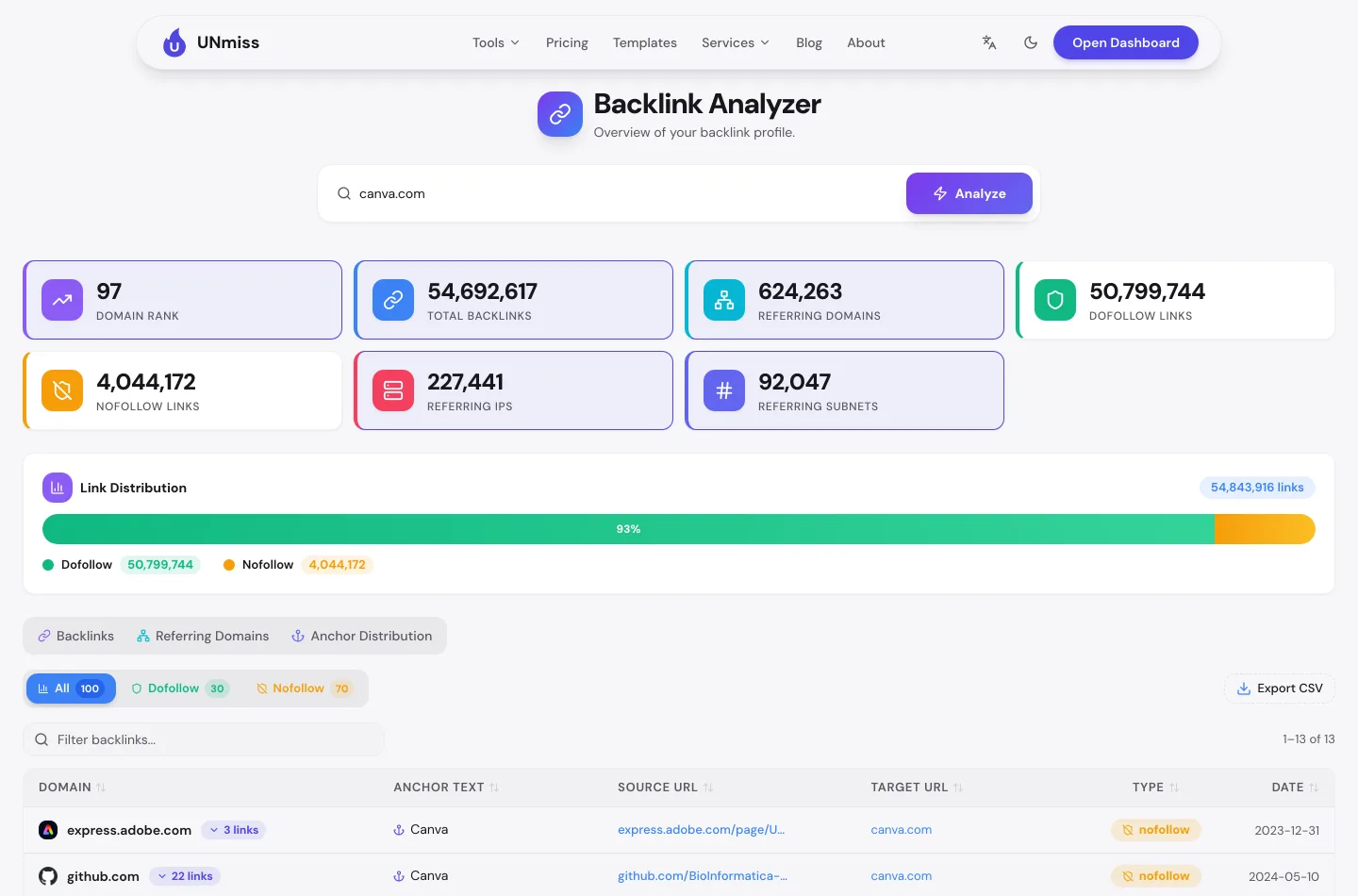
93% dofollow is unusually clean at that scale. Booking.com, measured the same week, has more than twice the referring domains at 56%.
The sample of referring pages explains the ratio: profiles, support threads, video descriptions, resource lists, an App Store developer field, a community answer on a competitor's own domain. These are links from a product being shared, not links being placed.
I want to be careful — that is a 13-row sample, a reading rather than a census, and we have no evidence either way about Canva's outreach.
But the lesson survives the caveat: the cleanest link profiles belong to products people want to show other people. If your links are mostly placed, that ratio is where it shows up, and no amount of outreach converts one kind into the other.
Expect a big catalogue to shed its tail
From the Domain Overview: 5.8M organic keywords, $20M of monthly traffic value, average position 38.
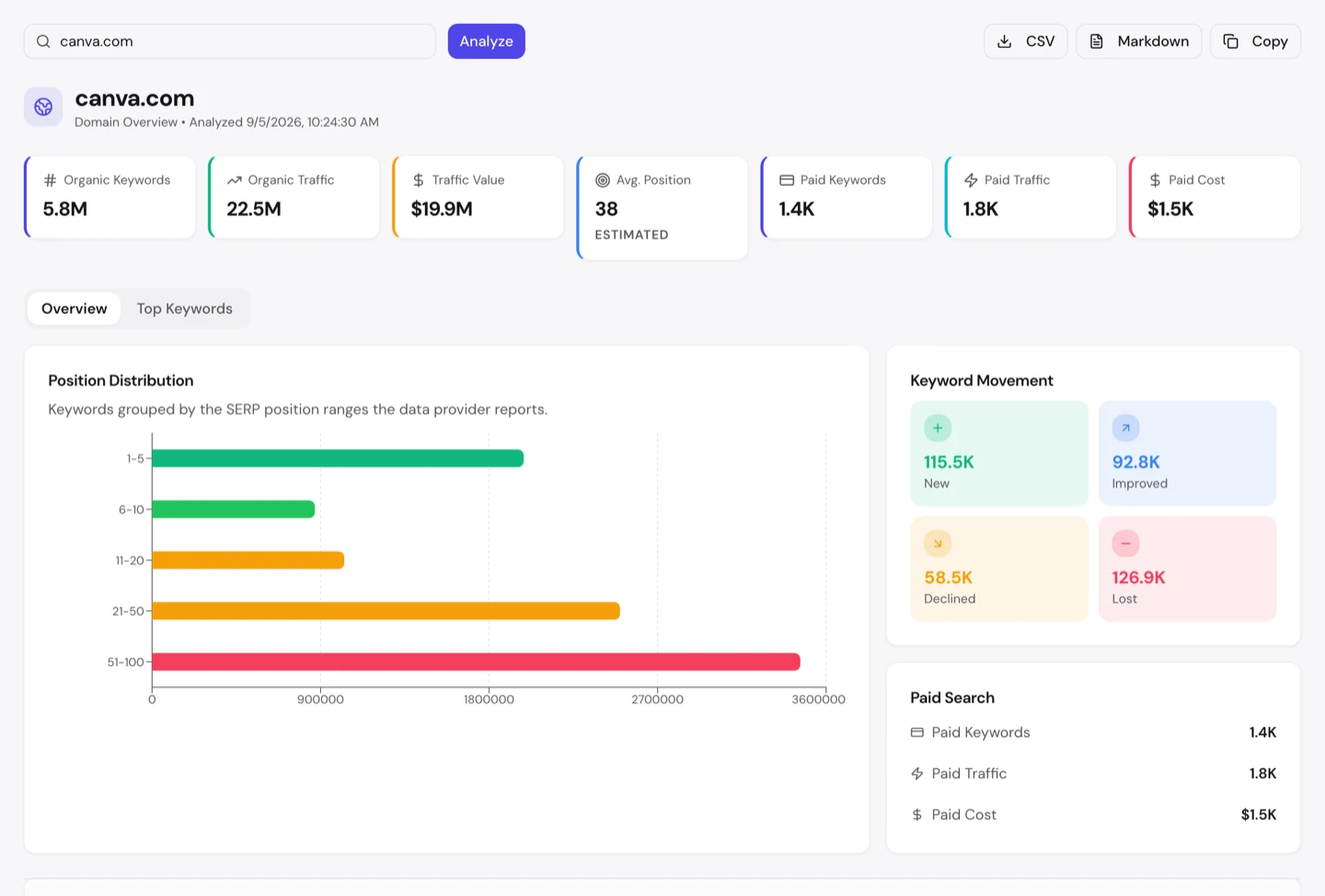
$20M a month is the second-largest traffic value in this series, behind NerdWallet. It is an ad-spend equivalent rather than revenue — what you would pay to buy those clicks.
The movement underneath it is negative: it loses more keywords than it gains, while quality improves. So the losses are concentrated in the long tail, exactly where a templated catalogue is thinnest.
That is what a very large catalogue looks like as it ages. Pages get published faster than they earn, and the ones that never earned quietly drop out.
Expect the same and do not panic when it starts. A shrinking keyword count with rising quality is a catalogue shedding pages that were never working — which is healthy, and looks alarming on a dashboard that only counts keywords.
Canva's branded share is 87%. Most teams have never measured their own, and it changes what your SEO numbers mean — growth on your brand is a marketing result, not a search result.
- Branded share across the keywords your site ranks for
- Traffic, share, top keyword and position for every top page
- 3 checks a day, no signup, no card
What you cannot copy
And here is what I could not measure, or had to qualify. A couple of the tools I name below are partners of ours — if you buy through those links we earn a commission, and you do not pay a cent more.
You cannot copy 87% branded. That number is the output of a decade of product, pricing and word of mouth, and it is the reason most of Canva's search performance exists. Nothing in this article gets you there. The free tools do transfer; the brand does not.
Our traffic figures are United States only and modelled from ranking positions and search volume rather than counted. Canva is global, so its worldwide traffic is far larger than 22M. The keyword data comes from SE Ranking, and $20M is an ad-spend equivalent.
The backlink figures were measured on 20 August 2026, not in this run — our Backlink Analyzer returned "Daily backlink check limit reached" on 5 September, so the older dated measurement is quoted rather than a fresh one. The 13 referring pages are the free tier's sample, not the full profile.
The sitemap census is from 20 August 2026 as well. Sitemap URLs are declarations, not indexed pages and not traffic, and canva.com/templates/ returns 403 to our crawler, so the catalogue was counted through sitemaps rather than by crawling it. We did not verify who authored the templates.
I did not run Keyword Research: it has an open defect returning implausible volumes, and a broken number is worse than a missing one.
One curiosity I am deliberately not building a lesson on. The YouTube thumbnail page's highest-volume ranking term is recorded as "youy tubee", a misspelling, at position 22 for 310K visits. That is more likely a quirk of how the provider labels a page's top keyword than a strategy, and I have no way to confirm it from the outside.
Frequently asked questions
How much of Canva's search traffic is branded?
87%, across the 100 keywords sampled — the second-highest in this series, behind chess.com's 92%, against roughly 22M estimated monthly visits. For comparison, Wise is 1%, Zapier 2%, Booking.com 18% and Goodreads 29%. Most of Canva's measured search performance is people typing its name.
Which Canva page gets the most search traffic?
The homepage, at roughly 10M estimated monthly visits — 47% of the site's organic traffic — ranking 1st for "canva". Second is the login page at 650K, also ranking 1st for "canva".
Do Canva's template pages get search traffic?
No individual template page reaches the site's top pages. Only the /templates/ hub appears, at 270K visits against the homepage's 10M and the login page's 650K, and it ranks 1st for "canva" rather than for any template query. Our report returns top pages, not a full inventory, so this shows none is large enough to reach the top — not that they earn nothing collectively.
How many pages does Canva publish?
At least 100K URLs across 4 sitemap shards, counted on 20 August 2026, including 12K /templates/ pages in a single shard. Two shards sit at exactly 50K URLs — the sitemap protocol's per-file cap — so the true figure may be higher.
What is Canva's website audit score?
90 out of 100, with 1 critical issue, 0 warnings, 2 notices and 117 checks passed. The critical issue is "Noindex pages in XML sitemap" — the feed submits URLs that are marked not to be indexed.
How many backlinks does Canva have?
55M backlinks from 620K referring domains at Domain Rank 97, measured 20 August 2026, with 93% of them dofollow. Booking.com has 2.2x more referring domains at 56% dofollow.
Is Canva gaining or losing keywords?
Losing, on balance. It gained 120K keywords and lost 130K — a net loss of roughly 11K against a base of 5.8M. Quality moved the other way: 93K improved against 58K declined.
How much is Canva's search traffic worth?
Our Domain Overview prices it at $20M a month, against 5.8M ranking keywords at an average position of 38 and roughly 22M estimated US organic visits, measured 5 September 2026. That is an ad-spend equivalent, not revenue.
The one number to take away
87%.
Canva has 100K URLs and $20M of monthly traffic value, and 87% of the traffic is its own name.
The catalogue is not what you should be looking at. The 4 free tools underneath it are — a photo editor, a QR code generator, a colour wheel, an image generator, each ranking 1st or near it on a generic term, each doing 1 thing without an account.
Build the tool, not the template. That is a lesson that transfers to a site with no brand at all, which is where most of us are starting from.
And if you take one habit rather than one tactic: measure your own branded share before you compare yourself to anybody. A site whose traffic is 87% its own name is not doing the thing you are trying to do, however impressive the total looks.
Found something different in your own report? I would genuinely like to know — the tools used are all free, so you can check every figure yourself. Domain Overview, Organic Traffic Checker and Website Audit figures were measured on 5 September 2026, United States scope, and are modelled rather than counted where the tool says so. Backlink figures and the sitemap census were measured on 20 August 2026. No revenue figure for Canva was available to us.