Zapier is the case study everyone cites for programmatic SEO, and 62% of its search traffic is one blog post about ChatGPT.
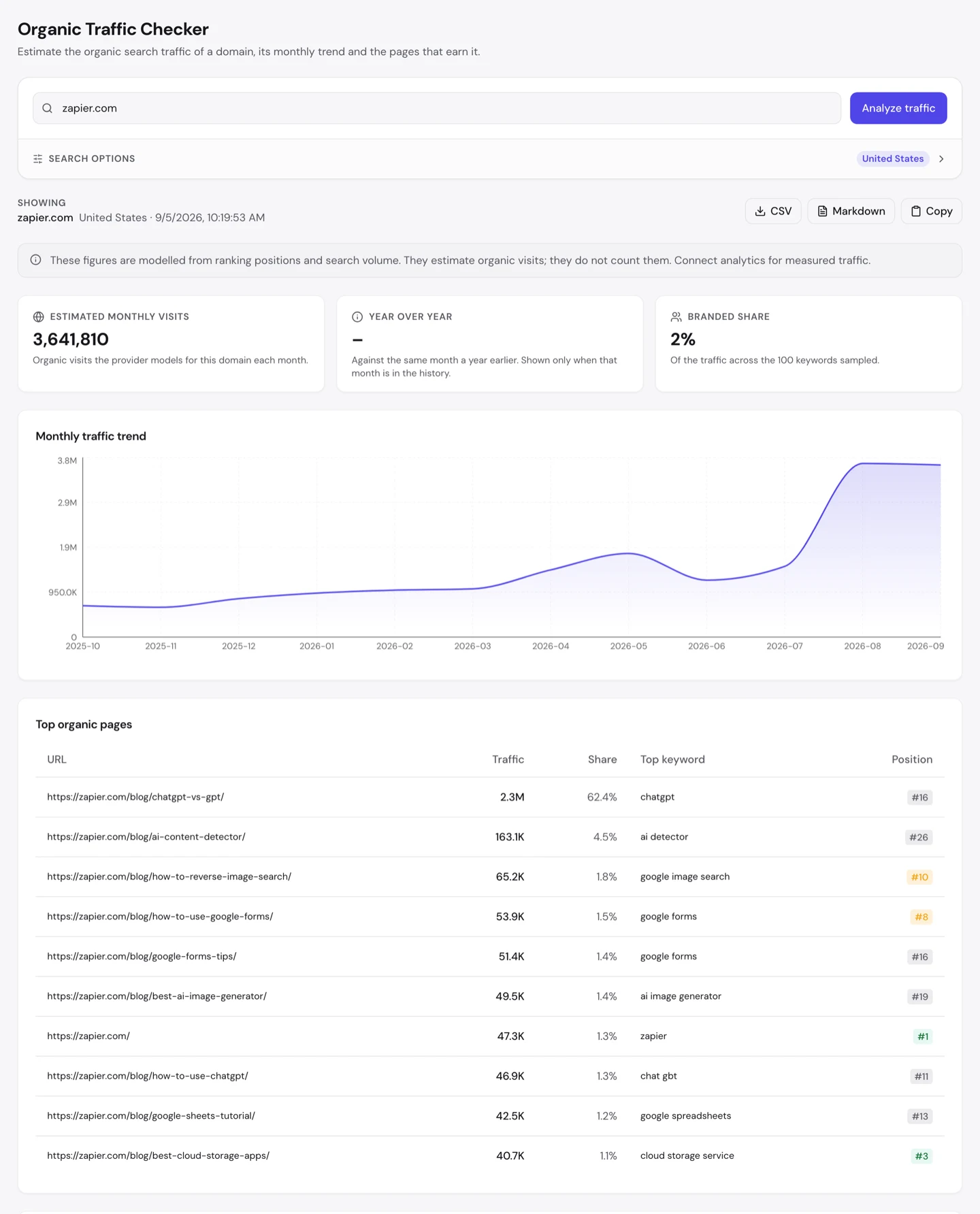
That is 2.3M visits a month to one article, ranking 16th. Not one of its 140K integration pages comes anywhere near it.
I ran zapier.com through 4 of our tools expecting to measure the most famous programmatic catalogue on the web. The traffic report shows something else entirely, and it is worth being careful about. Here are the 8 lessons you can use.
Find out where your traffic really sits
The Organic Traffic Checker puts zapier.com at 3.6M estimated monthly visits. One post, /blog/chatgpt-vs-gpt/, takes 62% of that while ranking 16th for "chatgpt".
That is free. Before you generate 100K pages, check the volume on 20 of them in Semrush or SE Ranking. It takes an afternoon and it is the cheapest way to avoid a very expensive year.
Position 16, on page 2, for one of the biggest queries on the internet. That is the entire story of this site's measured traffic.
Which should tell you something about your own targets. You do not always need the top 3. On a large enough query, page 2 pays better than first place on a small one.
That is the most concentrated single page I have measured. I found homepages taking about half the traffic in separate case studies on chess.com, Open Library and Canva, and this beats all 3.
Unlike those, Zapier's big page is not the homepage, and it does not rank first.
One editorial decision, made when a new term was exploding and nobody had claimed it, is now worth more than the whole programmatic catalogue underneath it.
So run the same report on yourself before your next planning meeting. The page carrying your business is often not the one your roadmap is about.
Read your top pages before you believe anyone
Behind the ChatGPT article sit an AI content detector guide, a reverse image search guide and two Google Forms guides. The largest of them takes 160K visits while ranking 26th.
That is 5 blog posts. No app pages, no integration pages, no product pages.
One caveat, and I want to be precise about it. This report gives you a site's top pages, not a full inventory.
The integration pages could still earn real traffic between them, spread across a very long tail, without any single one showing up here. What you can see is that no one integration page is big enough to reach the top of the site. Not that they earn nothing.
Even stated that carefully, it is a striking result for the catalogue most often held up as proof that programmatic pages carry a business.
So read your own top pages before you believe anybody's story about your site, including your own. It takes 30 seconds and it regularly contradicts what a team has believed for years.
Know that a page inherits its subject's demand
An earlier full crawl of Zapier's sitemaps found about 140K app-pair pages and 9,600 app pages. None of them reaches the top of the site.
The reason is demand, not quality. "chatgpt" is searched millions of times a month. "Trello to Slack integration" is searched by a handful of people with a very specific problem.
That makes it a great page to have when they arrive, and a poor thing to build your traffic forecast on. If you are planning a catalogue, that distinction is the whole decision.
This is the same finding ClinicalTrials.gov and Goodreads produce from the other direction: entity pages inherit the demand of the entity, and most entities have almost none.
So the catalogue is real and the engineering behind it is serious. The claim that it is what produces the traffic is the part this measurement does not support.
Know that before you plan your own. A page about a thing can only capture the demand that thing already has, and most things have almost none.
Count it yourself before you copy it
Nearly every write-up of Zapier repeats the same line: "Zapier built 50K integration pages."
That number is years out of date. Ahrefs measured roughly 63K templated pages in 2023, and our own crawl found about 140K pair pages — the catalogue has more than doubled since the figure everyone quotes.
Two things follow. Aiming to "match Zapier at 50K pages" is aiming at a target that moved years ago.
And a number repeated confidently across a whole industry for 5 years turned out to be wrong by nearly 3 times, because almost nobody re-counted it.
So count it yourself before you copy anyone. The XML Sitemap Generator shows you what a site actually declares, and it takes minutes rather than a meeting.
Zapier has 140K programmatic pages and one blog post brings most of its traffic. Scale is not the answer on its own. We would rather help you win 20 real queries than generate another 100K pages nobody wants.
- We find the queries with genuine demand
- Content and programmatic pages together
- SEO and GEO in one package
- Free consultation before you commit
Write about what people search
The instruction, and it is almost embarrassingly plain.
Zapier's most valuable SEO asset is an article explaining the difference between 2 things people were confused about. It was published while they were still confused, on a term with enormous volume.
You almost certainly have a version of that available right now, and it is probably not on your roadmap.
That is not a programmatic tactic. It is editorial judgement about timing and demand, and it beat the catalogue by a margin no amount of templating closes.
Do both, but size them honestly. Put your candidate topics into Keyword Research and compare the head term against the sum of all your entity pages before you decide where your quarter goes.
Then write the head-term piece properly, with the Content Brief Generator. On this evidence, ranking 16th on a giant query beats ranking 1st on a hundred small ones.
Stop reading the audit score as progress
The Website Audit scores the homepage 91/100. Behind that score: 1 critical issue, 1 warning and 4 notices. It passed 116 checks.
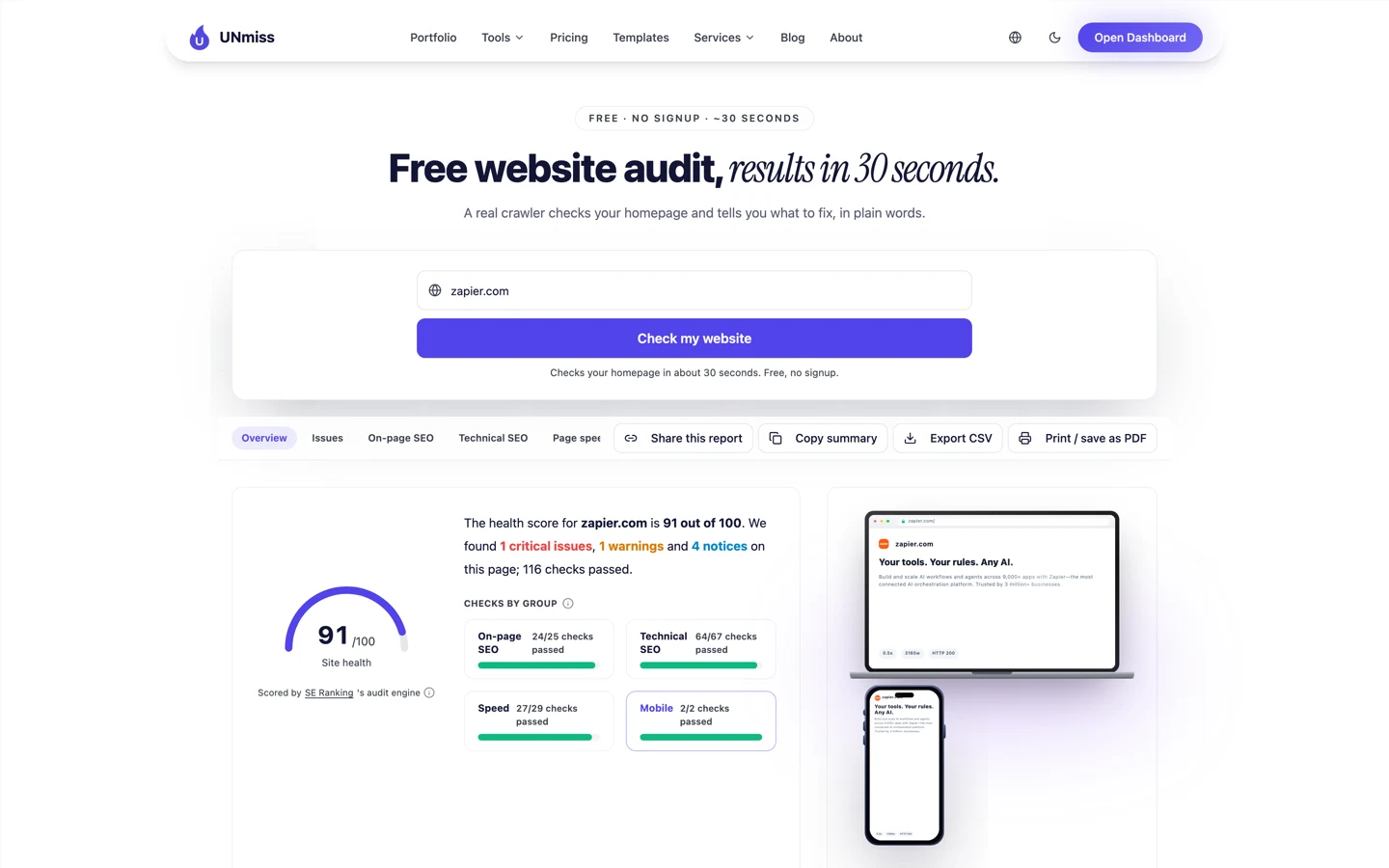
A strong score, and by now a familiar irrelevance.
We measured Booking.com separately and it scores a perfect 100. Wise scores 83 and has the best average ranking position of anything I have measured.
So stop reporting your audit score as progress. Across every site in this work it has predicted nothing, in either direction.
Look for the risk inside a flat chart
From the Domain Overview: 1.2M organic keywords at an average position of 36, worth about $2.7M a month.
It gains 49K new keywords against 47K lost. Of the ones it keeps, 48K improved and 29K declined.
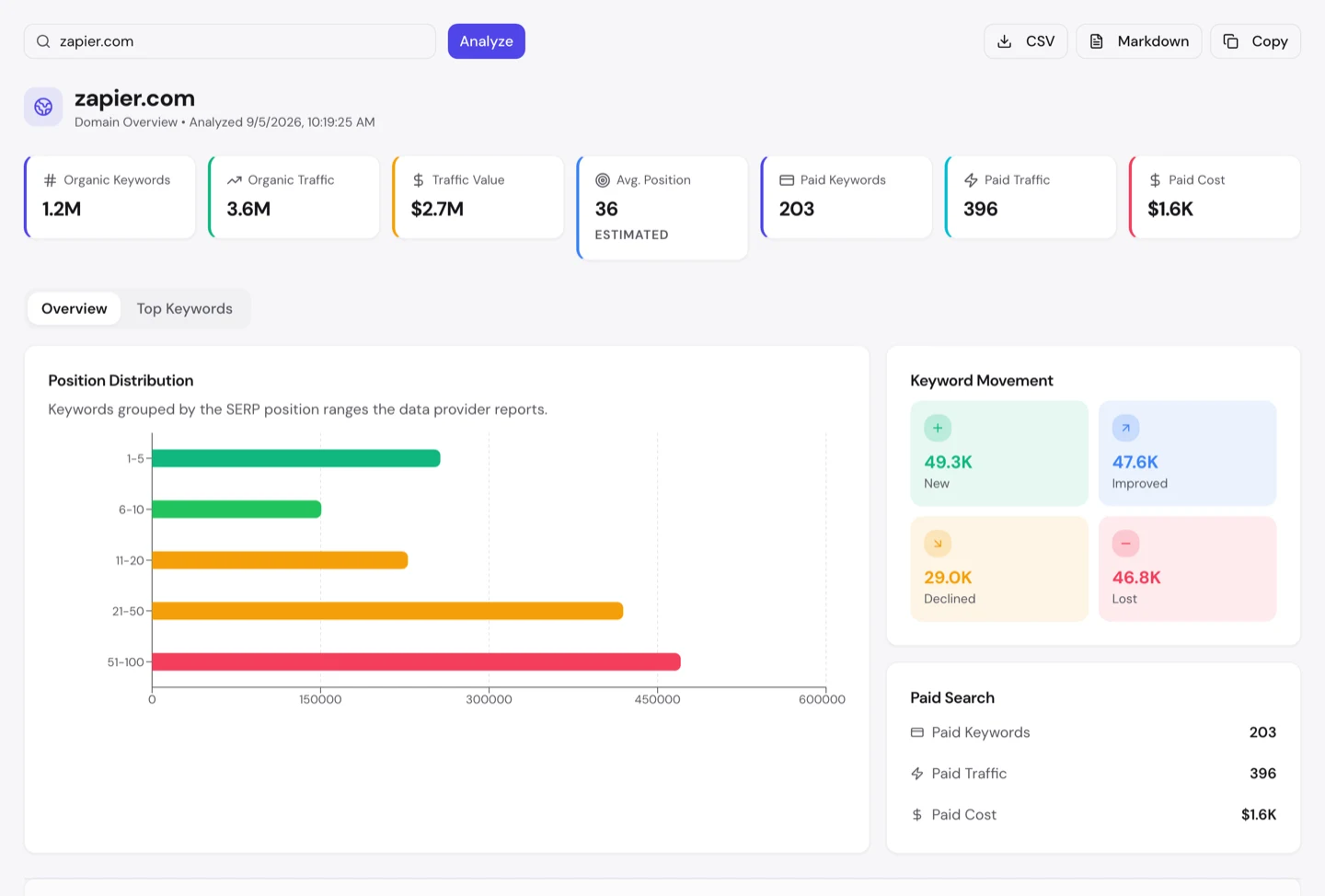
Net up about 2,500 keywords and clearly positive on quality. Average position 36 is second only to Wise's 34 in this batch.
Note the risk hiding inside that stability, though.
Most of this site's traffic sits on one page, ranking on page 2, for a term whose popularity is itself a moment in time. That is not a stable asset. It is a very good bet that is currently paying.
So look for the same shape in your own flat chart. Flat can mean steady, and it can equally mean one thing rising while everything else quietly falls.
Skip the combinations nobody wants
The part of Zapier worth copying is not the 140K pages it built. It is the millions it chose not to build.
Every possible pairing of its apps would come to about 46M URLs. Zapier publishes well under 1% of them — the combinations people actually connect — and leaves the rest alone.
Set that against the 2 sites I measured that did the opposite. PyPI publishes a profile page for every user, and chess.com a page for every player. Both were generated because the records existed. Both earn nothing.
Zapier had exactly the same chance to flood the index and turned it down.
The discipline is the part you can copy. Build the combinations that have demand, skip the rest, and never mistake your page count for the achievement.
Your catalogue is not a scoreboard. It is a cost you carry every month, and the pages nobody searches for are the ones you pay for twice.
Zapier is the industry's standard programmatic example, and 62% of its measured traffic is one blog post. The top-pages report takes thirty seconds and it regularly contradicts what a team believes about its own site.
- The same report that found 5 blog posts and 0 integration pages
- Traffic share, top keyword and position for every page
- 3 checks a day, no signup, no card
What you cannot copy
And here is what I could not measure, or had to qualify. A couple of the tools I name below are partners of ours — if you buy through those links we earn a commission, and you do not pay a cent more.
The central claim in this article needs its limits stated plainly. Our Organic Traffic Checker returns a site's top pages, not a full inventory. That no integration page appears in Zapier's top pages is a real and surprising result, but it does not establish that the 140K pair pages earn nothing in aggregate. A long tail of small pages can be commercially important and still never surface in a top-10 report. I have written the finding as what it is — an absence from the top — rather than as proof of zero.
There are no backlink figures here. Our Backlink Analyzer returned "Daily backlink check limit reached", and we have no earlier measurement of our own for zapier.com to quote with a date, so the section is absent rather than filled with an unverified number.
Our traffic figures are United States only and modelled from ranking positions and search volume rather than counted. Zapier is global, so its worldwide traffic is larger than 3.6M. The keyword data comes from SE Ranking, and the $2.7M traffic value is an ad-spend equivalent, not revenue.
The 140K pair pages and the app pages come from a crawl of Zapier's own sitemaps on 18 August 2026, not from this run. The 2023 comparison of roughly 63K templated pages is Ahrefs' published figure and was not re-verified by us. I did not run Keyword Research: it has an open defect returning implausible volumes.
And what you cannot copy: being early to "ChatGPT". That article works because it was published into a demand spike nobody had claimed yet. You cannot plan that, and a site betting on repeating it is betting on judgement rather than process.
Frequently asked questions
Which Zapier page gets the most search traffic?
A blog post comparing ChatGPT and GPT, at roughly 2.3M estimated monthly visits — 62% of the site's organic traffic — ranking 16th for "chatgpt". The next four are also blog posts: an AI content detector guide, a reverse image search guide and two Google Forms guides.
Do Zapier's integration pages get search traffic?
None appears among the site's top pages. That is a genuine and surprising result, but our report returns top pages rather than a full inventory, so it shows that no single integration page is large enough to reach the top of the site — not that the 140K of them earn nothing collectively.
How many programmatic pages does Zapier actually have?
About 140K app-pair pages plus roughly 9,600 app pages, from a crawl of its own sitemaps on 18 August 2026. The commonly repeated "50K integration pages" is years out of date — Ahrefs measured about 63K in 2023 and the catalogue has more than doubled since.
How much is Zapier's search traffic worth?
Our Domain Overview prices it at $2.7M a month, against 1.2M ranking keywords at an average position of 36 and roughly 3.6M estimated US organic visits, measured 5 September 2026. That is an ad-spend equivalent, not revenue.
Why does Zapier not publish every app pair?
With about 9,600 apps there are 45.7 million possible pairs, and Zapier publishes roughly 0.3% of them — the combinations people actually connect. That restraint is the part of the model most worth copying, and the opposite of what the site is usually cited to justify.
What is Zapier's website audit score?
91 out of 100, with 1 critical issue, 1 warning, 4 notices and 116 checks passed on the homepage. For comparison in the same batch, Booking.com scores a perfect 100 and Wise scores 83 while holding the best average ranking position in the series.
Is Zapier gaining or losing keywords?
Roughly flat, tilting positive. It gained 49K keywords and lost 47K, with 48K improved against 29K declined — net up about 2,500 against a base of 1.2M.
How many backlinks does Zapier have?
We do not report one. The Backlink Analyzer returned a daily check limit when we ran it, and we have no earlier measurement of our own to quote with a date, so no backlink figure appears rather than an unverified one.
The one number to take away
62%.
That is how much of Zapier's measured search traffic sits on one blog post — on the site the entire industry cites when it wants permission to generate 50K pages.
The catalogue is real, the restraint behind it is genuinely admirable, and 140K pages is a serious engineering achievement. But the traffic everyone points at is not obviously coming from there, and almost nobody has checked.
That is the habit worth taking from this article, more than any tactic. The examples our industry repeats are mostly unverified. "Zapier built 50K pages" has been quoted for years and the real number is nearly 3 times higher. "The programmatic pages drive the traffic" is quoted just as confidently, and the top-pages report says a blog post does.
Go and measure the case study you are about to copy. It takes thirty seconds, and it is frequently not what you were told.
Found something in your own report that surprised you, or measure this differently? I would genuinely like to know — the tools used are all free, so you can check every figure yourself. Measured 5 September 2026 unless stated. Domain Overview, Organic Traffic Checker and Website Audit figures are free runs of our own tools, all United States scope, and all modelled rather than counted where the tool says so. Sitemap counts come from a crawl of Zapier's own sitemaps on 18 August 2026, and the 2023 comparison is Ahrefs' published figure. No backlink measurement was obtainable, and no revenue figure for Zapier was available to us.