Goodreads ranks 11.1M keywords and earns 11.1M visits — almost exactly one visit per keyword.
No single page carries even 3% of it. The homepage takes 3%, and everything after that is under 1%.
I ran goodreads.com through 4 of our tools. It is the flattest large site in this series, its individual book pages genuinely rank — which almost no entity page in these 19 sites does — and its quote pages are doing something nobody plans for. Here are the 8 lessons.
Read your concentration as a risk measure
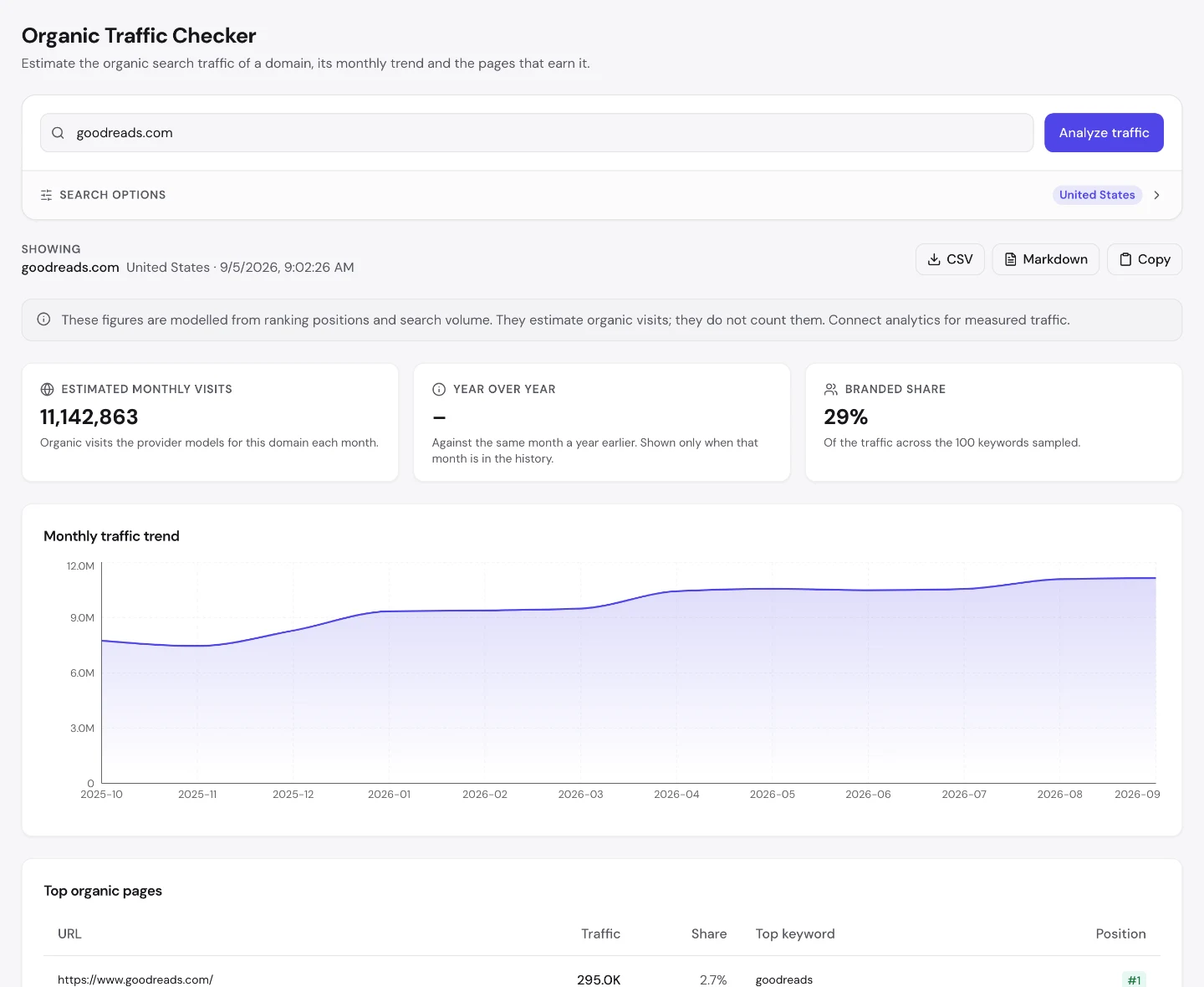
The Organic Traffic Checker puts Goodreads at about 11.1M estimated monthly visits, with the homepage taking just 3%. Everything after it sits under 1%.
Free, and it shows you the shape. Finding the page type nobody planned takes a full export of everything you rank for, which is what Semrush and SE Ranking are genuinely good at.
Only Healthline and NHS.uk are flatter, and both have the same structural advantage you may or may not share: an enormous set of small permanent queries where nothing dominates.
Now compare chess.com, whose homepage is 58% of its traffic. Both are catalogue sites. One survives losing a ranking and the other does not.
So read your own concentration as a risk measure, not a vanity one. Open your top-pages report and add up the first three. If they clear half your traffic, you are one algorithm update away from a bad quarter — and that is worth knowing before it happens rather than after.
Test 20 entity names before generating any
This is the important one, and it settles an argument that has run through this whole series.
To Kill a Mockingbird ranks 2nd. What Is the What ranks 1st. Individual entity pages, in the top 5 of a site earning 11M visits.
Across 19 sites, entity pages have almost never worked. PyPI's package pages earn nothing. chess.com's player profiles earn nothing. freeCodeCamp's author pages earn nothing.
The only exceptions are Goodreads' books and ClinicalTrials.gov's trial records, and both work for one reason. A book title is something people already search. A username and a package name are not.
So run the test before you commit, because it takes 5 minutes and it will save you a quarter. Take 20 entity names out of your own database and put them into Keyword Research.
If most come back with no volume, you are about to generate inventory. Nothing you do to the template will fix that, and you will spend a year wondering why the pages never took.
Look for the layer nobody specced
The second-biggest page on Goodreads is /quotes, ranking 2nd for the bare word "quotes".
Not "book quotes". Not "literary quotes". The single generic word — one of the highest-volume terms on the internet — held by a books site.
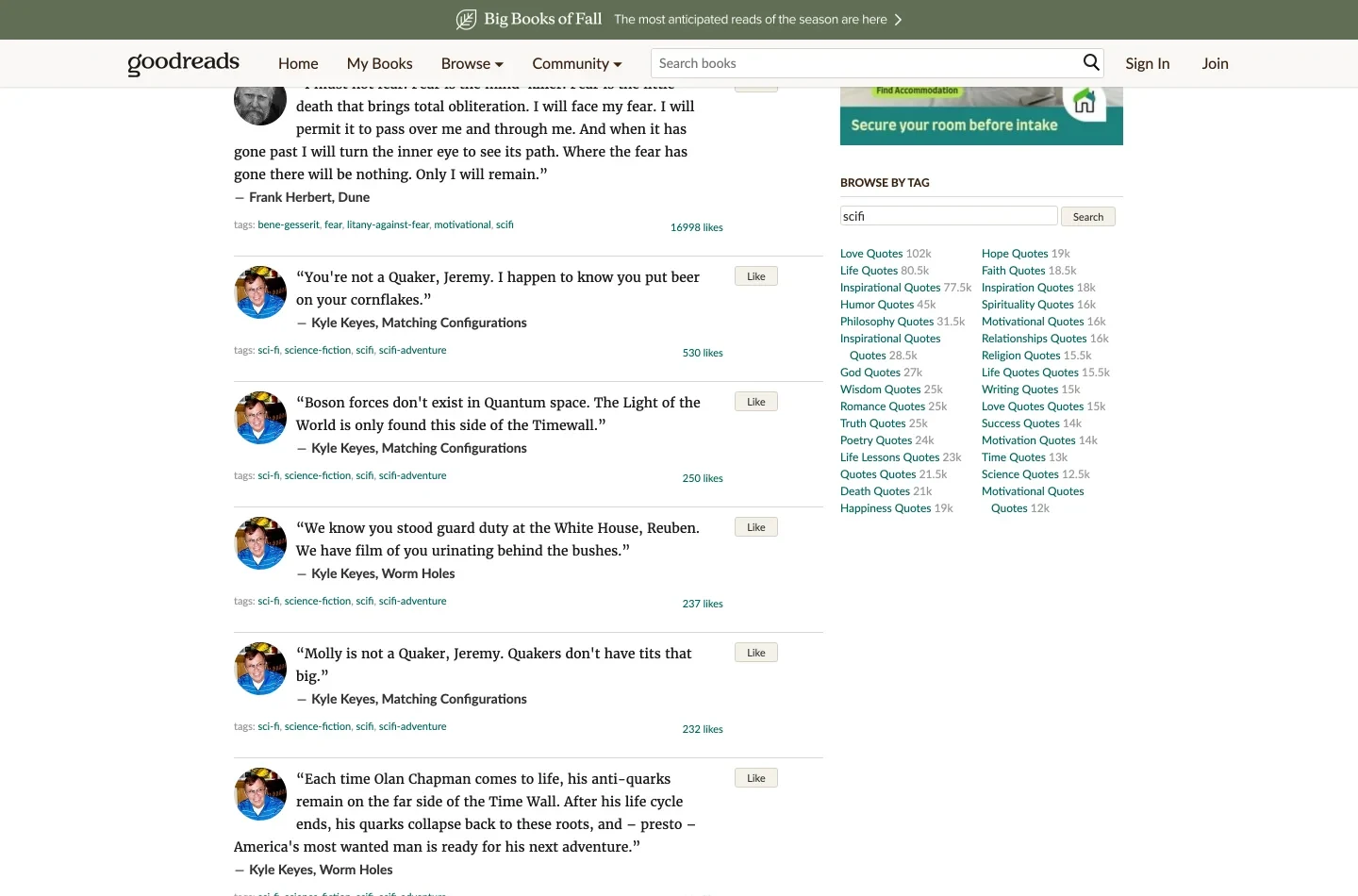
Behind it sits an enormous quote archive, each entry carrying tags that link to more quote pages — an aggregation layer with nothing to do with reviewing books.
This is the pattern the series keeps producing: the layer nobody would put in a product spec is the layer that ranks. itch.io's tag directories, Eventbrite's browse pages, Dribbble's tag archives, TED's year buckets, now Goodreads' quotes.
So go and look at what your site generates as a side-effect — the filters, the archives, the by-product pages nobody owns. One of them is probably closer to a high-volume query than anything on your roadmap, and nobody has noticed because it was never anyone's project.
Tag every quote you publish
The copyable mechanism, and it is cheap.
Every Goodreads quote carries 3 or 4 tags, and every tag links to a page of more quotes on that theme. The love quotes collection alone holds over 100K entries.
So the archive builds its own internal link graph and its own category pages, out of metadata contributors add for their own reasons. Nobody planned a keyword-mapped taxonomy.
You can copy this with any content that has natural attributes. Let people tag, promote any tag that crosses a threshold into an indexable page, and let the taxonomy grow itself.
The one discipline you need is a threshold. Check which tags have real demand with the Keyword Cluster tool before you index them, or you will publish thousands of pages holding 2 items each and undo the whole benefit.
Goodreads gets a large share of its traffic from quote pages nobody planned as a growth channel. Most sites are sitting on one of these. Finding it is a week of analysis, not a year of guessing.
- We find the page type already quietly working
- We build it out properly and at scale
- SEO and GEO to hold the gains
- Free consultation, no commitment
Expect a trickle from each page
From the Domain Overview: 11.1M organic keywords against 11.1M visits, at an average position of 37.
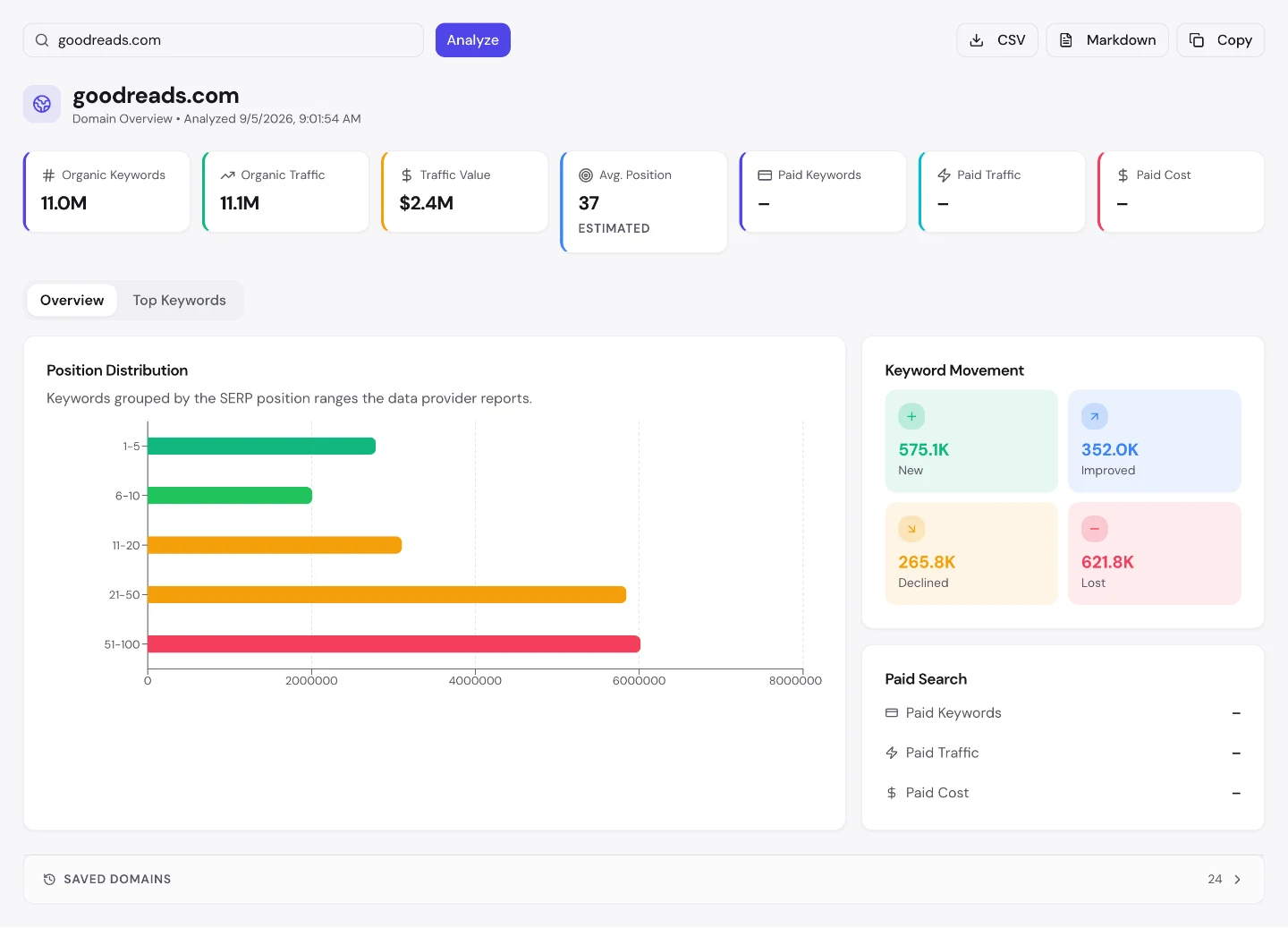
One visit per ranking keyword. That describes the shape precisely: millions of pages, each ranking for a handful of terms, each earning a trickle.
Position 37 is joint second-best in this series, which is high for a catalogue this size, because book titles are specific enough to win outright.
If you run something similar, set your expectations to a trickle per page and plan the volume accordingly. A page that earns 3 visits a month is not a failure in this model — it is the unit. What matters is whether you can produce enough of them cheaply, and whether anybody searches the thing each one is about.
Watch the lost column, not the total
It is losing more keywords than it gains, while improving on quality — the third catalogue in this series shrinking despite adding records.
Books do not expire the way events or packages do, so the churn is more likely obscure editions and duplicate records slipping out of the index than anything about relevance. Your own catalogue will have an equivalent — the records you would not miss, quietly leaving.
Which is why you should watch the lost column every month, not the total. On a base of 11M keywords, losing 620K disappears inside a headline that still reads "11 million" — and you can shrink for a year without the number you report ever moving.
Fix the critical, ignore the score
The Website Audit scores the homepage 74/100, with 1 critical issue outstanding.
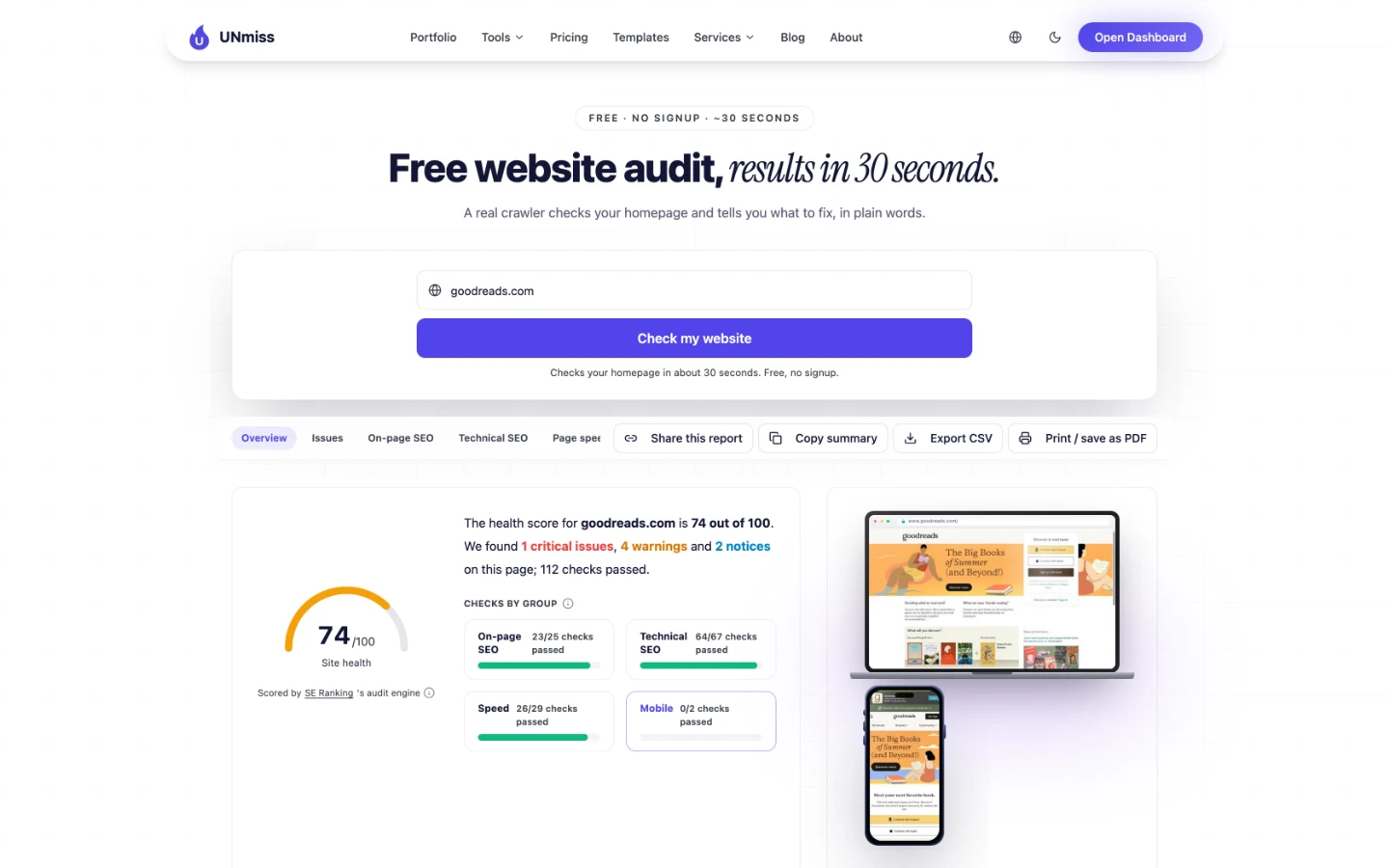
Joint-lowest in this series — on a site earning 11.1M monthly visits.
Meanwhile Dribbble and ClinicalTrials.gov both scored a perfect 100 and are both shrinking. Nineteen sites in, the audit score has predicted nothing.
So fix your critical issues, because they are specific and cheap, then stop looking at the total. If your score is low and your traffic is fine, you are not in trouble. If it is perfect and your traffic is flat, the score was never going to tell you why.
Date every backlink figure you publish
On 23 August 2026 our Backlink Analyzer measured Goodreads at Domain Rank 97, from 290K referring domains. That is one of the strongest profiles in this work.
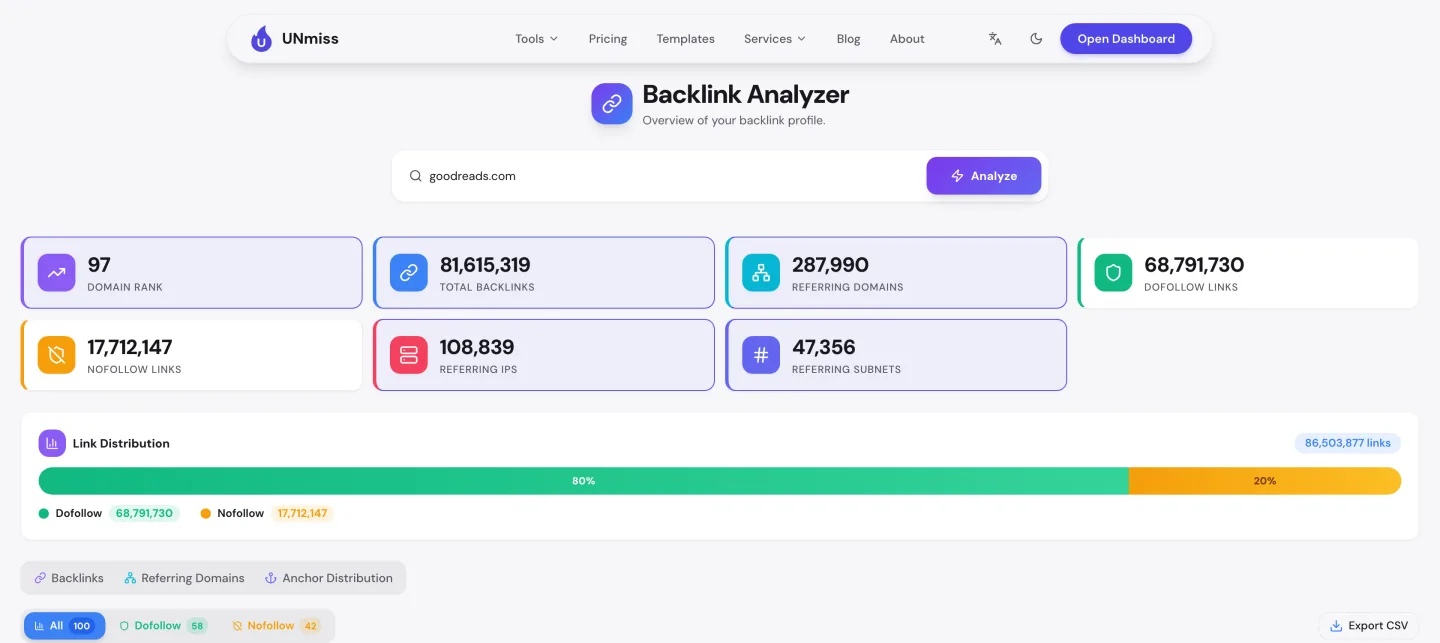
Only 2 other sites we have measured match that rank.
The date is there deliberately. When I tried to refresh the check the tool returned "Daily backlink check limit reached", so rather than pass a stale number off as current, the August measurement is quoted with its date.
Adopt the same habit, because a backlink count is a snapshot of a moving thing. RTINGS, measured twice 2 weeks apart in this series, moved by 43K links.
Put a date next to every figure you publish or report internally. It costs you nothing, and it stops somebody quoting your number back at you a year later as though it were still true.
Goodreads' biggest page is 3% of its traffic. chess.com's is 58%. One of those sites survives losing a ranking and the other does not. The Organic Traffic Checker returns the top-pages table for any domain, with the share each page takes.
- The same report that found no Goodreads page above 3%
- Traffic share, top keyword and position for every page
- 3 checks a day, no signup, no card
What you cannot copy
And here is what I could not measure, or had to qualify. A couple of the tools I name below are partners of ours — if you buy through those links we earn a commission, and you do not pay a cent more.
The backlink figures in this article are from 23 August 2026, not from this run. The tool returned "Daily backlink check limit reached" when I tried to refresh them, so they are quoted with their date rather than presented as current. Everything else — traffic, keywords, traffic value, the audit — was measured on 5 September 2026.
Our traffic figures are United States only and modelled from ranking positions and search volume rather than counted. Goodreads has a large international readership, so the worldwide number is materially higher than 11.1M. The keyword and backlink data underneath comes from SE Ranking, and the $2.4M traffic value is an ad-spend equivalent, not revenue — Goodreads monetises through advertising and its parent company's retail, neither of which any tool of ours can see.
The quote-archive description comes from reading the pages rather than from a crawl, so treat the scale as illustrative rather than counted. It recorded 3 to 4 tags per quote and tag pages in the hundreds of thousands. I did not run Keyword Research: it has an open defect returning implausible volumes.
And what you cannot copy: being where readers already log their books. The quote archive, the tags and the lists are all user-generated, and they exist because millions of people were already using Goodreads to track their reading. The tagging mechanism is copyable; the supply of contributors is not.
Frequently asked questions
How much search traffic does Goodreads get?
Roughly 11.1M estimated US organic visits a month from 11.1M ranking keywords at an average position of 37, measured 5 September 2026 — about one visit per ranking keyword. Our Domain Overview prices that at $2.4M a month as an ad-spend equivalent.
Which Goodreads page gets the most traffic?
The homepage, at roughly 300K visits — only 3% of the site. The quotes index is second at 0.9%, ranking 2nd for the bare word "quotes", followed by individual book pages at around 0.4% each.
Do individual book pages rank?
Yes, and that is unusual. Two appear in the site's top 5: What Is the What at roughly 48K visits ranking 1st, and To Kill a Mockingbird at 41K ranking 2nd. They work because book titles are things people already search — unlike usernames or package names, which do not rank anywhere in this series.
What is Goodreads' backlink profile?
On 23 August 2026 our Backlink Analyzer measured Domain Rank 97, 290K referring domains, 69M dofollow and 18M nofollow links, 110K referring IPs and 47K subnets. A refresh for this article was blocked by a daily check limit, so those figures are quoted with their original date.
How do Goodreads' quote pages work?
Every quote carries 3 or 4 tags, and each tag is a link to a page collecting more quotes on that theme. That produces a large internal link graph and a set of category pages from metadata contributors add for their own reasons, rather than from a planned taxonomy.
Is Goodreads gaining or losing keywords?
Losing on balance. It gained 580K keywords and lost 620K — a net loss of about 47K against a base of 11.1M — while 350K improved against 270K declined, so surviving pages are strengthening.
What is Goodreads' website audit score?
74 out of 100, with 1 critical issue, 4 warnings, 2 notices and 112 checks passed on the homepage — joint-lowest in this series with Healthline and freeCodeCamp, on a site earning 11.1M monthly visits.
What is Goodreads' branded search share?
29% of traffic across the 100 keywords sampled. That places it between the pure-discovery sites such as Dribbble at 1% and the brand-dependent ones such as chess.com at 92% — a real brand, with most of its traffic still arriving on book titles and generic terms.
The one number to take away
3%.
That is Goodreads' biggest page as a share of its own traffic, and it is the number that makes an 11M-visit site genuinely difficult to disrupt.
There is no page to lose. No ranking change removes a meaningful slice. The traffic is spread across millions of book pages, quote pages and tag pages, each earning a trickle, each answering a query somebody types for reasons that will not change.
Compare chess.com, where 58% arrives at one URL, or Open Library at 48%. Those are larger single wins and much shorter falls.
So run the top-pages report on your own domain and look at the first row as a percentage rather than a number. If it is above 20%, your next piece of work is not more of what is already winning — it is the unglamorous breadth that makes the 20% stop mattering.
Found something in your own report that surprised you, or measure this differently? I would genuinely like to know — the tools used are all free, so you can check every figure yourself. Traffic, keyword, traffic value and audit figures were measured 5 September 2026; the backlink figures are from 23 August 2026 and are dated as such in the text. All are free runs of our own tools, United States scope, and modelled rather than counted where the tool says so. No revenue figure for Goodreads was available to us.