NHS.uk earns $4.2M of free traffic a month, and its health encyclopedia is 7% of what it publishes.
4,000 health guides against 52K provider listings — GPs, dentists, pharmacies and clinics, one page each.
I ran nhs.uk through 4 of our tools. No page carries more than 1% of its traffic, and the part you think of as "the NHS website" is the small part. Here are the 8 lessons, and most of them apply to any organisation with a list of real places.
Ask whether your page type has demand
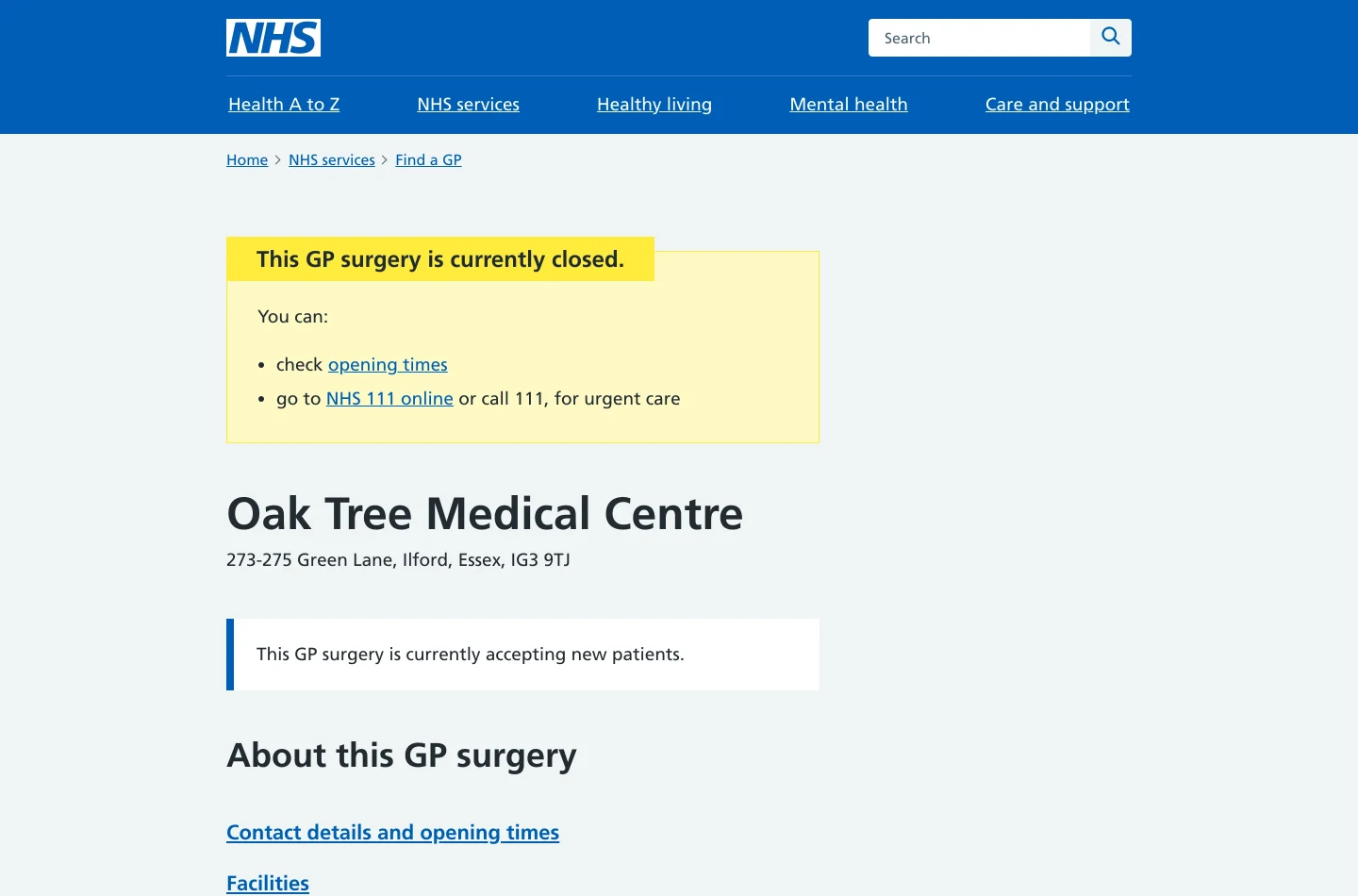
An earlier full crawl of the sitemap found that 91% of nhs.uk is provider profiles — GPs, dentists, pharmacies, clinics — and only 7% is health information.
The encyclopedia everybody pictures when they think of this site is a fourteenth of it.
Dribbble has the same imbalance — one page type dominating everything — and the opposite outcome. The difference is that a directory entry answers a real query: "dentist near me", "pharmacy open now". Dribbble's dominant type is an item nobody searches by name.
Same ratio, opposite result, and the only variable is whether the page type has demand behind it.
So before you scale any template, say the query it wins out loud. If you cannot, the ratio will look like Dribbble's rather than this one, and you will have built the wrong 90% of your site.
Aim for a shape nothing can knock over
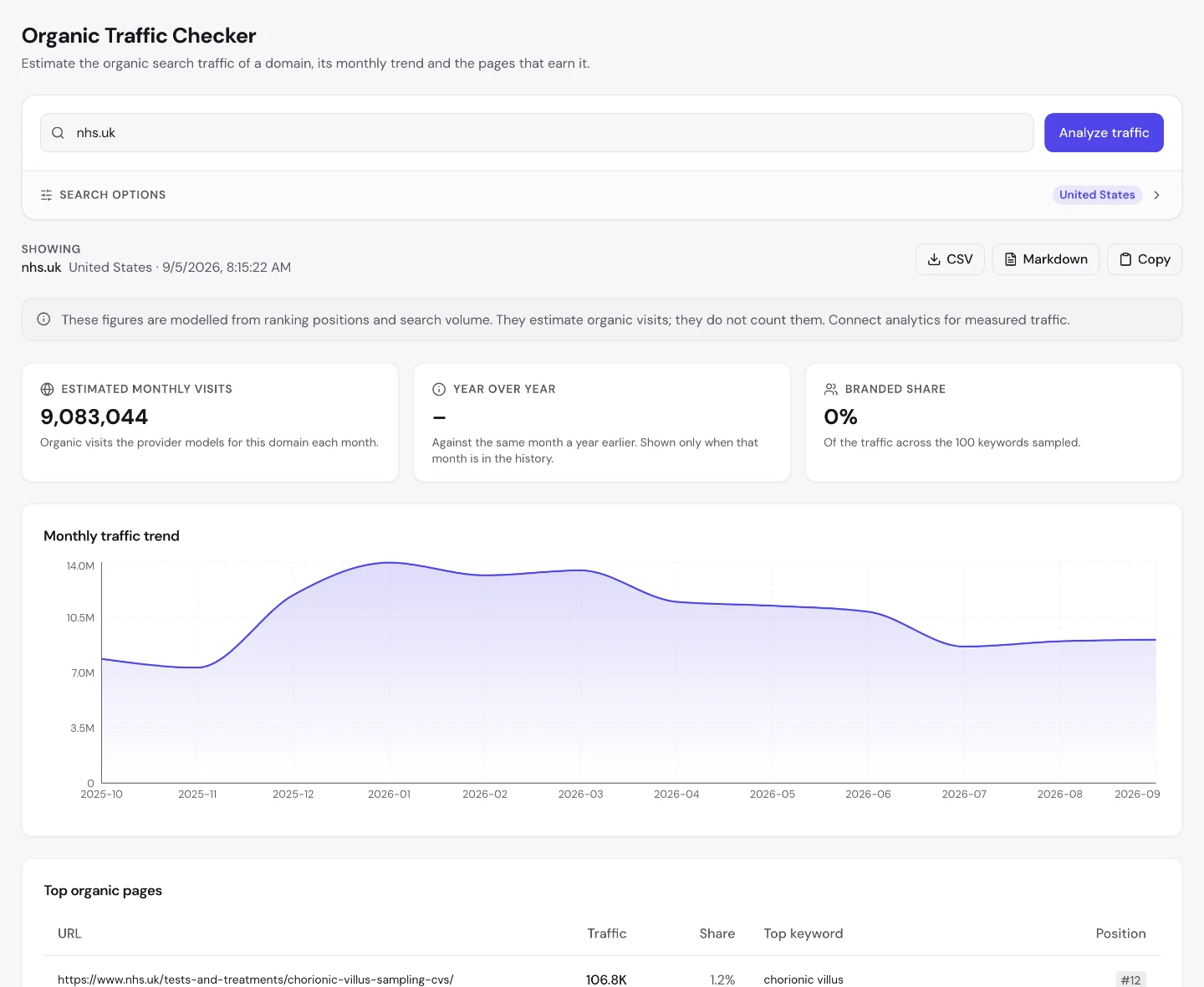
The Organic Traffic Checker puts nhs.uk at about 9M estimated monthly visits, and the biggest single page takes 1%.
That is free. A directory needs watching town by town rather than in aggregate, and Semrush and SE Ranking both track local results at that granularity.
Compare chess.com, whose homepage is 58% of its traffic. Only Healthline is flatter than the NHS, and both are health sites for the same reason: symptoms and conditions are an enormous set of small permanent queries, and none of them dominates.
That is the shape to aim for if you want traffic that survives a bad month. It cannot be knocked over by one ranking change, and it does not depend on any page you would be sad to lose.
Check where you sit. Add up your top 3 pages as a share of the total — if they clear half, you have a concentration problem you have probably been describing as a strength.
Sort by difficulty, not by volume
Look at what actually leads: chorionic villus sampling, ranking 12th. Then a BMI calculator, urinary tract infections, doing a pregnancy test, tips to lose weight.
A prenatal diagnostic procedure most people have never heard of out-earns everything on a site serving 67 million people — because when somebody is offered that test, they search that exact phrase, and nothing else is competing for it.
So sort your keyword research by difficulty, not by volume. You have been doing the opposite, because volume is the column that looks like opportunity.
Put your own field's obscure procedures, part numbers and edge cases into Keyword Research and read the difficulty column first. The terms nobody thought worth writing about are the ones still available to you.
Give locals something local to link to
Our Backlink Analyzer reports 290K referring domains and 97K .gov backlinks.
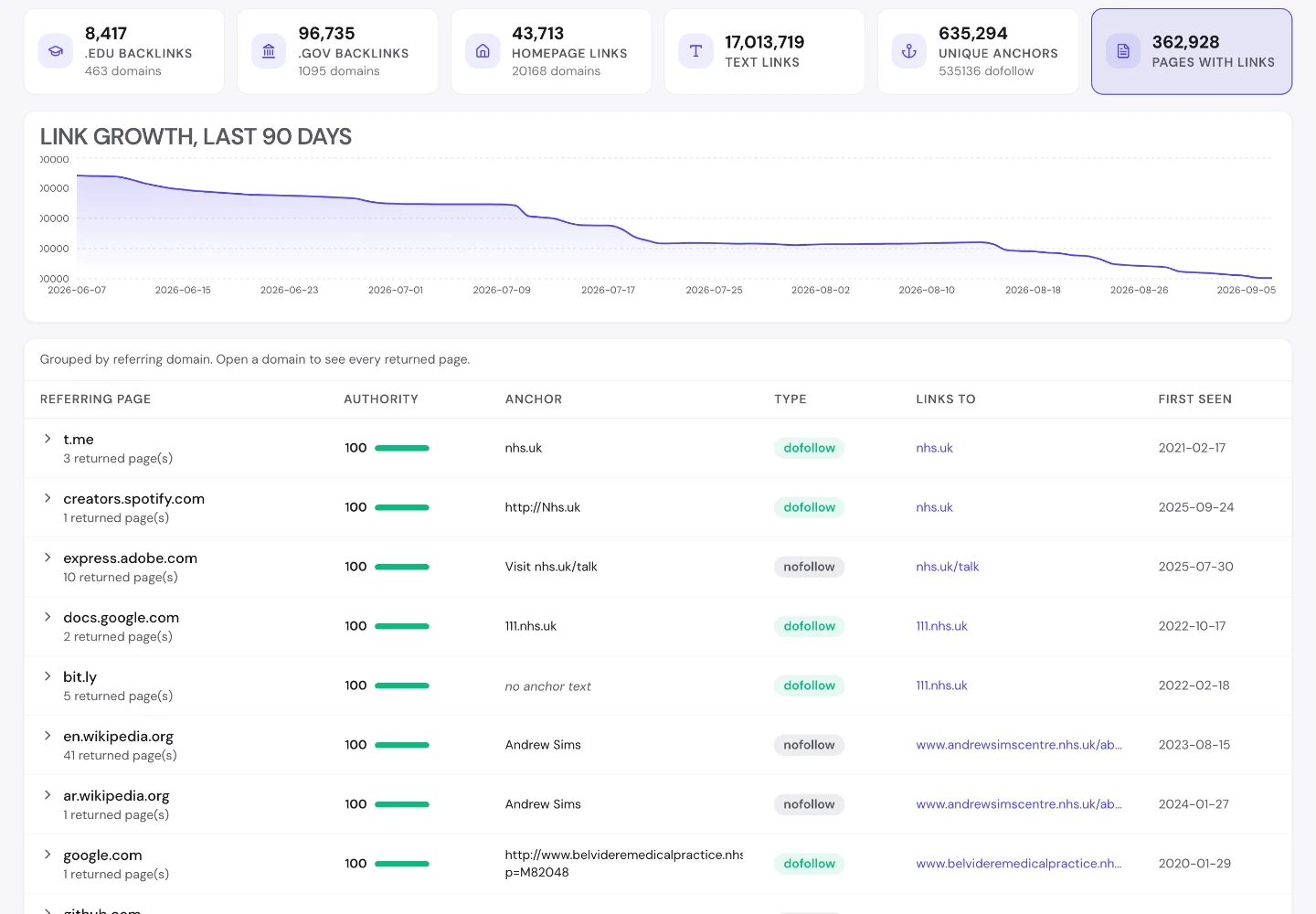
That is the third-highest referring-domain count in this series, and it accumulated one link at a time: a council linking to the local surgery, a school linking to a vaccination page, a charity linking to a condition guide.
Individually tiny, collectively enormous, impossible to buy — because there are 52K different listings for somebody local to link to, and you cannot outreach your way to that.
Which is the part you can copy without a budget. If you publish one page per location, stockist or practitioner, you have given every local organisation something specific to point at — and local links are the only kind still earned by simply existing usefully.
The NHS gets 9M visits from listing pages. Directories work, and they need someone to keep them accurate forever. We build them and we maintain them, which is the half most agencies skip.
- Directory and listing sites built to scale
- A maintenance plan, not just a launch
- Local SEO where location matters
- Free consultation to review your setup
Read your anchors for slogans you forgot
The anchor distribution has a genuine oddity in it. The brand name leads, and second is "QUIT SMOKING" — more than half the brand's own anchor total.
A single public-health campaign produced over a million links carrying its slogan. Somebody put a badge or a footer link into a template, and it propagated across the health and employer web.
It is the same mechanism as PHP's "Powered by PHP" and Eventbrite's ticket widget, arriving from an unexpected direction: a campaign asset becomes a link engine the moment you give people something to embed.
So read your own anchor list past the first few rows, looking for slogans rather than brand terms. If a campaign of yours ever shipped a badge, it is still working, and nobody in your company is counting it.
Budget for a directory that decays
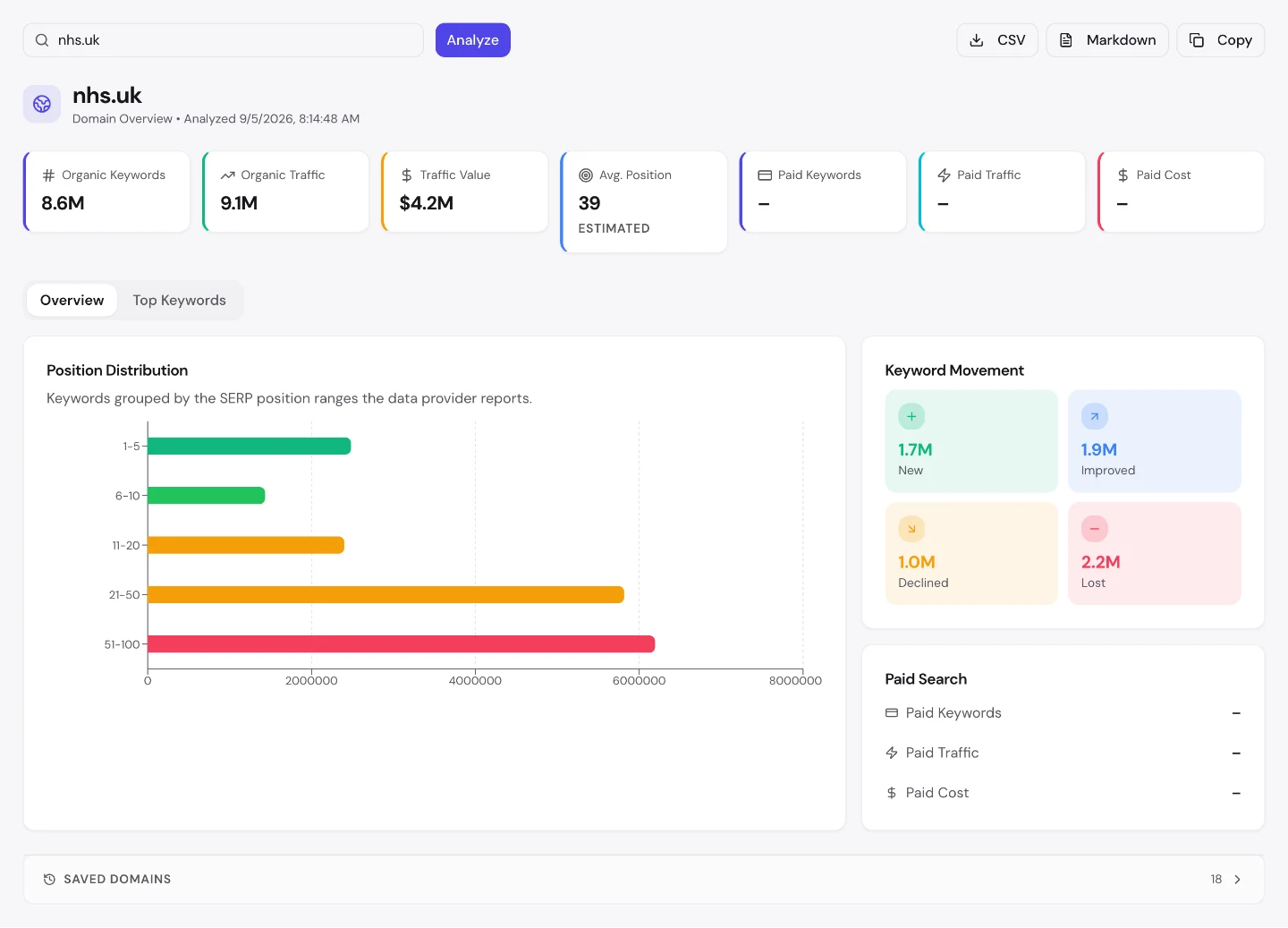
From the Domain Overview: it loses more keywords than it gains, while the surviving pages get stronger.
Provider listings are the likely explanation. Practices close, merge and rename constantly, and each one takes its page's queries with it.
A directory of real-world places decays whether or not anybody edits it, which is the difference between this and an archive of articles.
So if your catalogue describes physical things — shops, venues, staff, stockists — put the maintenance in the budget before you build it. With articles you can neglect the archive for a year; with a directory, a year of neglect is a year of wrong information under your name.
Build to accessibility and pass the audit
The Website Audit scores the homepage 87/100, with nothing critical outstanding.
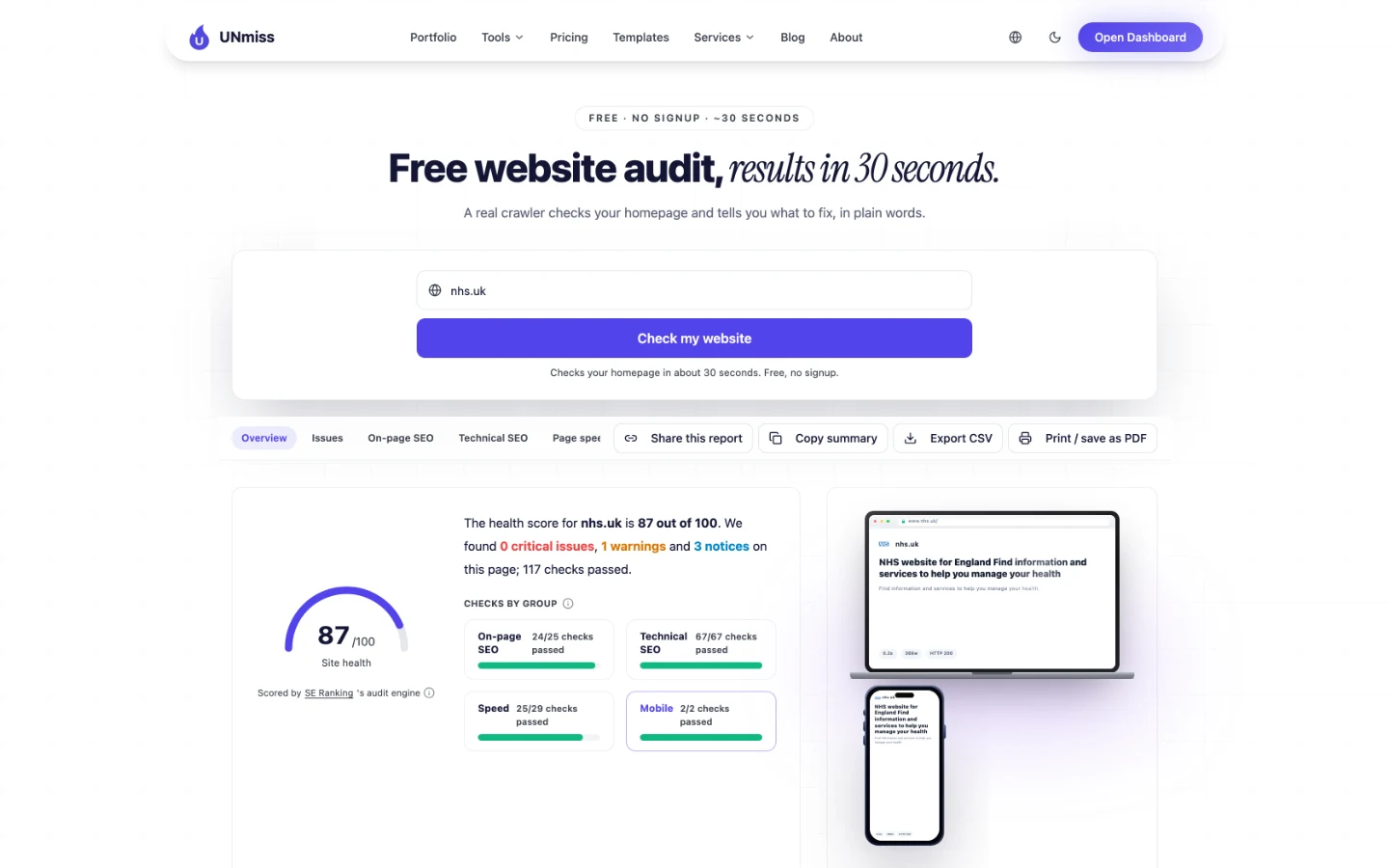
Its passing-check count is identical to GOV.UK's, which is not a coincidence. Both are built to the same public-sector accessibility standard, and that standard happens to cover most of what a technical audit tests.
Which is the cheapest route to a clean audit you will ever be offered: build to an accessibility standard and the SEO checklist mostly falls out of it.
It is also far easier to get accessibility work approved than SEO work, in most organisations. If you have been losing that argument, this is the version of it that wins.
Publish the directory, not the brochure
The instruction, and it is the same one GOV.UK gives from a different angle.
NHS.uk could have built a large, well-written health encyclopedia and stopped. It has one, and it is excellent. But nine tenths of the site is a directory of real places, and that directory earns the links and the local queries that never stop being searched.
Almost every organisation has a directory it has not published. Locations, stockists, practitioners, compatible products, service areas, accredited partners. Each entry answers "near me" for somebody.
You probably have the data already, in a spreadsheet somebody maintains for internal use.
Build it, make each entry genuinely useful rather than a stub, and check the template renders to a crawler with the Website Audit before you generate 50K of them.
NHS.uk's biggest page is about chorionic villus sampling — a procedure most people have never heard of, ranking 12th and earning 110K visits a month. The queries worth having are usually the ones nobody thought worth writing about.
- Volume, difficulty and intent for any term
- Sort by difficulty rather than volume to find the gaps
- 3 checks a day, no signup, no card
What you cannot copy
And here is what I could not measure, or had to qualify. A couple of the tools I name below are partners of ours — if you buy through those links we earn a commission, and you do not pay a cent more.
Our traffic figures are United States only and modelled from ranking positions rather than counted. For a UK health service that is a real limitation you should hold in mind — most of this site's actual audience is not in the sample — so treat the figure as one market's slice of a much larger whole. The keyword and backlink data underneath comes from SE Ranking, and the $4.2M traffic value is an ad-spend equivalent, not revenue; the NHS sells nothing.
Two figures are left out on purpose. The report returned a Domain Trust of 0 out of 100 for a domain with 19M backlinks, which is plainly wrong.
It is also the second time we have seen it, after GOV.UK returned the same 0. Both are .uk domains, which is the pattern we have reported internally. The branded share also came back as 0%, which we stopped trusting after Rotten Tomatoes returned it while ranking first for its own brand.
The backlink figures came from the app rather than the marketing tool, which has been returning HTTP 429 consistently. The app's BACKLINKS tile is a known defect and has returned negative values elsewhere, so the total above is the page header figure, which reconciles with dofollow plus nofollow, and the screenshot is cropped below that tile.
The sitemap census comes from a full crawl on 29 August 2026. It found 57K entries, 52K provider profiles and 4,000 health pages. We checked 150 pharmacy URLs, not all 11K. I did not run Keyword Research: it has an open defect returning implausible volumes.
And what you cannot copy: being the health service. Every GP surgery in England has an NHS.uk profile because the NHS runs the surgeries — the directory filled itself. Yours will not, and the work of collecting the data is the part you should budget for, not the templating.
Frequently asked questions
How many pages does NHS.uk publish?
57K sitemap entries, of which 57K are distinct URLs, counted in a full crawl on 29 August 2026. 52K are provider profiles — 91% of the site — and 4,000 are health-information pages spread across 30 topics.
How much is NHS.uk's search traffic worth?
Our Domain Overview prices it at $4.2M a month, against 8.6M ranking keywords at an average position of 39 and roughly 9M estimated US organic visits, measured 5 September 2026. That is an ad-spend equivalent, not revenue, and the US-only scope badly understates a UK health service.
Which NHS.uk page gets the most traffic?
A guide to chorionic villus sampling, at roughly 110K estimated monthly visits — 1% of the site — ranking 12th. Then a BMI calculator at 95K, urinary tract infections at 94K and a pregnancy test guide at 72K. No page exceeds 1%.
How many backlinks does NHS.uk have?
19M backlinks from 290K referring domains, 84% dofollow, with 97K .gov and 8,400 .edu links, and "QUIT SMOKING" as the second anchor at 1.2M, measured 5 September 2026, split 16M dofollow to 3.1M nofollow. Within that, 97K .gov backlinks and 8,400 .edu — second only to GOV.UK for government links in this series.
What is NHS.uk's most common anchor text?
"NHS" at 2M links (10%), followed by "QUIT SMOKING" at 1.2M (6%) — a single public-health campaign producing more than half the brand's own anchor total, almost certainly from an embeddable badge or template footer.
Is NHS.uk gaining or losing keywords?
Losing on balance. It gained 1.7M keywords and lost 2.2M — a net loss of about 500K against a base of 8.6M — though 1.9M improved against 1M declined, so surviving pages are strengthening. Practices close, merge and rename, taking their listings' queries with them.
What is NHS.uk's website audit score?
87 out of 100, with 0 critical issues, 1 warning, 3 notices and 117 checks passed on the homepage — the same passing-check count as GOV.UK, since both are built to the same public-sector accessibility standard.
Why does a directory earn more links than an encyclopedia?
Because there are more things to link to and more people with a local reason to link. 52K provider listings give every council, school and charity in the country a specific page to point at, while 4,000 health guides give the whole country the same 4,000 targets.
The one number to take away
91%.
That is the share of NHS.uk given to provider listings, and it is the number that reframes the whole site. The health encyclopedia is the famous part, the beloved part, and the small part.
The directory is what produces 290K referring domains and a distribution so flat that no page carries more than 1% of 9M visits. It is unglamorous, it is mostly addresses and opening hours, and it is the asset.
So look at what your organisation already knows that could be published one row at a time — locations, practitioners, stockists, compatible parts, coverage areas. That list is probably sitting in a database being used for exactly one internal purpose.
Found something in your own report that surprised you, or measure this differently? I would genuinely like to know — the tools used are all free, so you can check every figure yourself. Measured 5 September 2026 unless stated. Domain Overview, Organic Traffic Checker, Website Audit and Backlink Analyzer figures are free runs of our own tools, all United States scope, and all modelled rather than counted where the tool says so. The sitemap census comes from NHS.uk's own sitemap, crawled 29 August 2026. No revenue figure applies.