ClinicalTrials.gov's individual trial records rank for drug names — "retratrutide" at position 27, "ivermectin" at 22.
They are the only entity pages in this entire 15-site series that earn traffic. PyPI's 870K package pages do not. Chess.com's 800K player profiles do not.
I ran clinicaltrials.gov through 4 of our tools. It publishes 600K trial records, earns 100K search visits, and scored a perfect technical audit. Here are the 8 lessons, and the first explains why almost every programmatic page type fails.
Test the entity before you generate it
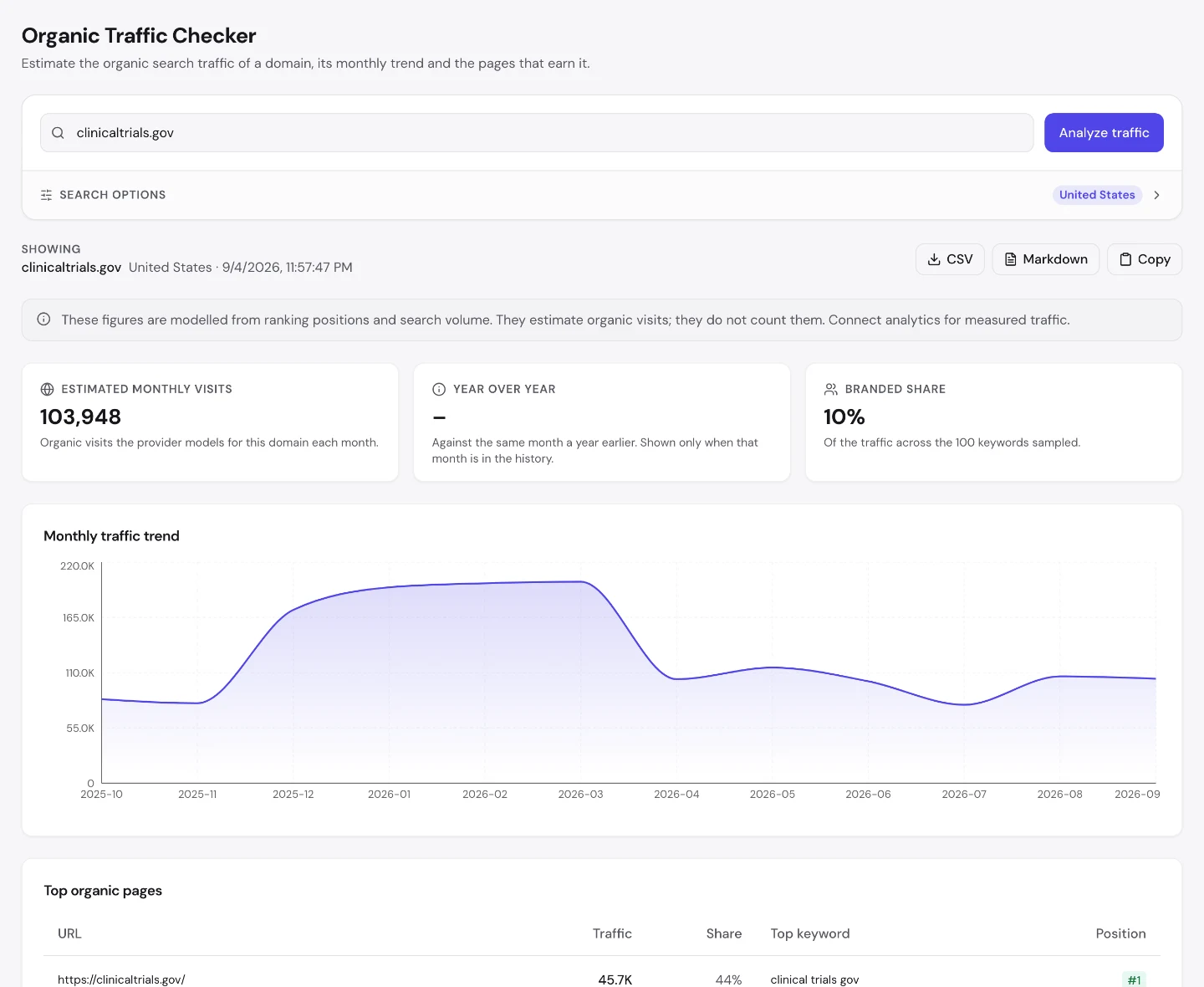
The Organic Traffic Checker shows one trial record ranking 27th for "retratrutide" and another 22nd for "ivermectin".
Our free check gives you the current numbers. Before you commit to generating a page per record, get the search volumes for a real sample from Semrush or SE Ranking — that is the number the whole plan rests on.
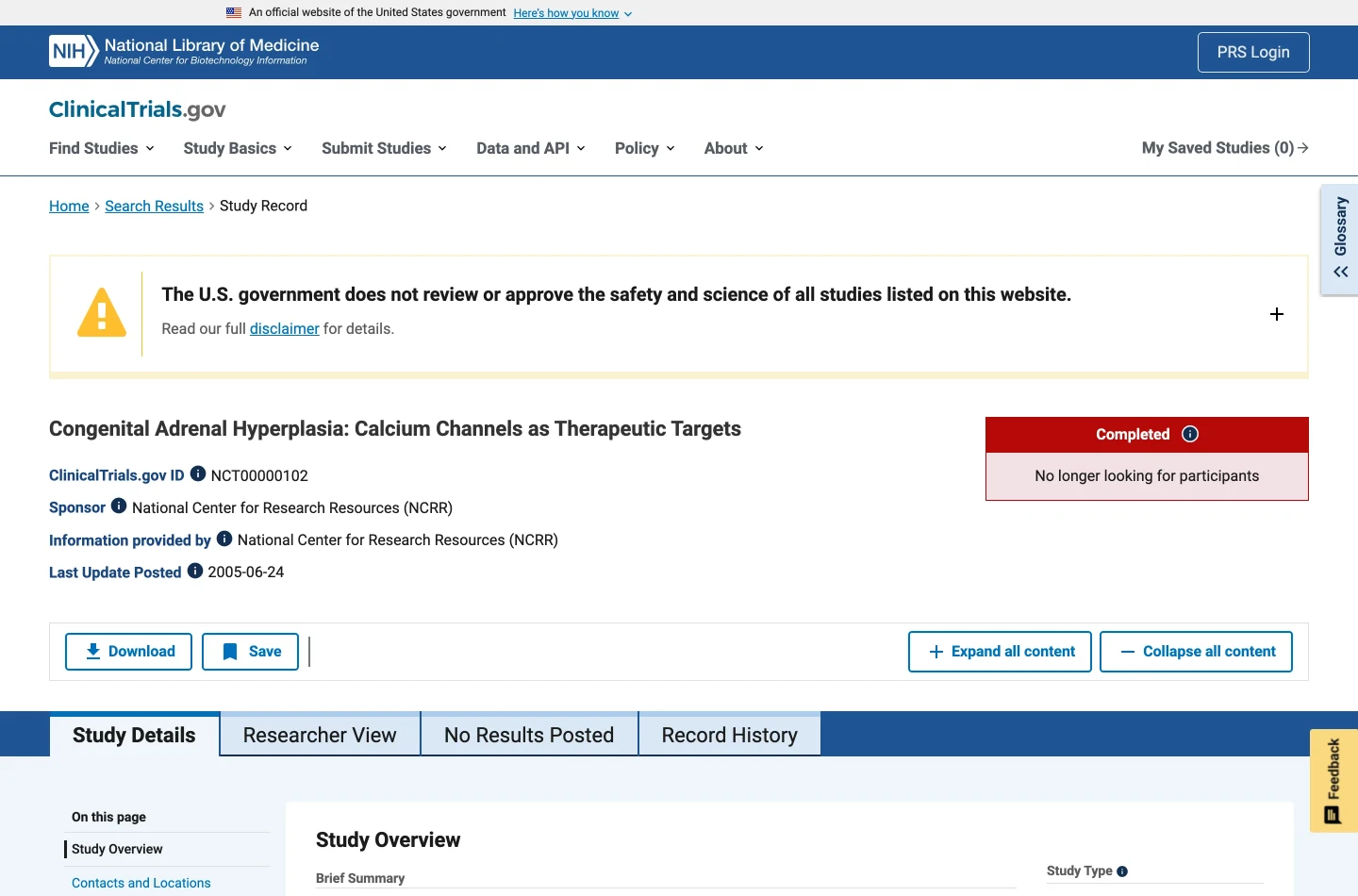
Notice what those pages are ranking for. Not "NCT07232719" — nobody types a trial identifier. They rank for the name of the drug being tested.
That is the whole mechanism, and it is why this page type works where others fail. A trial record is about a substance people search by name, so the page inherits real demand from the entity it describes. A PyPI package page is about a library nobody searches, and a chess.com profile is about a username nobody searches.
Entity pages rank when the entity is already searched. That is the whole rule, and you can test it before you write a line of code.
Take 20 records at random from your own database, put their subjects into Keyword Research, and count how many return real demand. Not the record IDs — the things the records are about.
That 20-minute test has predicted the outcome better than anything else in this series. If most of your subjects come back empty, you are about to build inventory, and no template will save it.
Plan the page type on the head
An earlier crawl counted 600K trial records, against about 100K monthly visits — roughly one visit per 6 records.
Thin, but twice as good as PyPI, and for the reason above. A minority of trials study something people are talking about; the rest study things nobody has heard of and earn nothing.
That is the realistic expectation for any entity catalogue, including yours. A small head of records with searchable subjects carries the whole thing, and the long tail is inventory.
So plan the page type on the head, not the total. If the head justifies the build, ship it and let the tail exist. If it does not, the tail will never rescue it — and you will have spent a quarter finding that out.
Judge your catalogue on the right job
The homepage takes 44% of traffic, ranking 1st for "clinical trials gov". So 600K records produce less between them than the front door does.
It is the third site in this batch with that shape, after chess.com and Open Library. A very large catalogue sitting behind a very small number of pages that actually get found.
If that is your shape too, your catalogue is doing a job other than acquisition. It is the reason people trust you once they arrive, and the reason your homepage converts at all.
So measure it that way and stop being disappointed by it. Reporting a 600K-page catalogue as an SEO asset will make you look like you are failing at something you are not actually attempting.
Write fewer explanatory pages than you think
The detail I find hardest to look away from: only 69 of those URLs are not trial records.
69 pages of navigation, help, submission documentation and search, for a register of 600K studies — roughly 8,700 records for every page that explains anything.
Most content operations have the opposite ratio and worse results. If you run a catalogue, you almost certainly need far fewer explanatory pages than your plan says.
And the ones you do write should answer the question that brings a stranger in, not document your interface. Check what you are actually submitting with the XML Sitemap Generator — the ratio usually surprises people.
ClinicalTrials.gov earns well because its head pages do the work, not its 600K records. Before you build a page per item, someone should check that people search for the items. That check takes days and saves quarters.
- Demand testing on a real sample first
- We build only the page types that can rank
- Database-driven sites built properly
- Fixed scope, agreed before we start
Fix criticals, but expect nothing from the score
The Website Audit returns 100 out of 100, with nothing flagged anywhere.
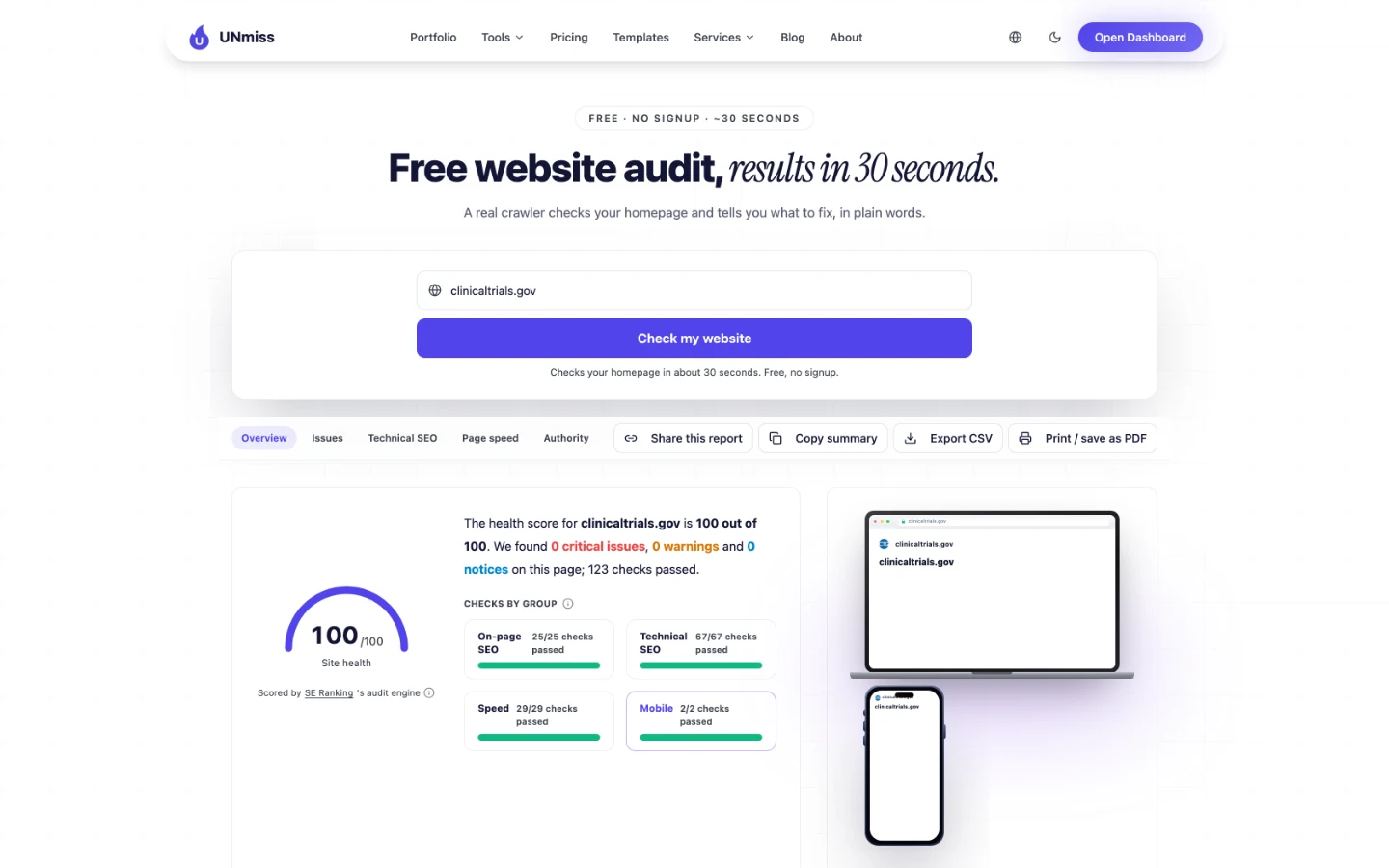
The second perfect score in this batch, after Dribbble — and those two are the only sites here losing keywords faster than they gain them.
Across 15 sites, technical score and search performance have shown no relationship at all. Healthline scores 74 and grows fastest. PyPI scores 91 with the worst traffic-per-page here. Both perfect 100s are in decline.
So fix your critical issues, because they are cheap and they break specific pages. Then stop looking at the score.
If your audit is green and your traffic is flat, another month of technical work will not change anything, and you will have spent it proving that.
You are renting the entity's attention
From the Domain Overview: it is losing more keywords than it gains.
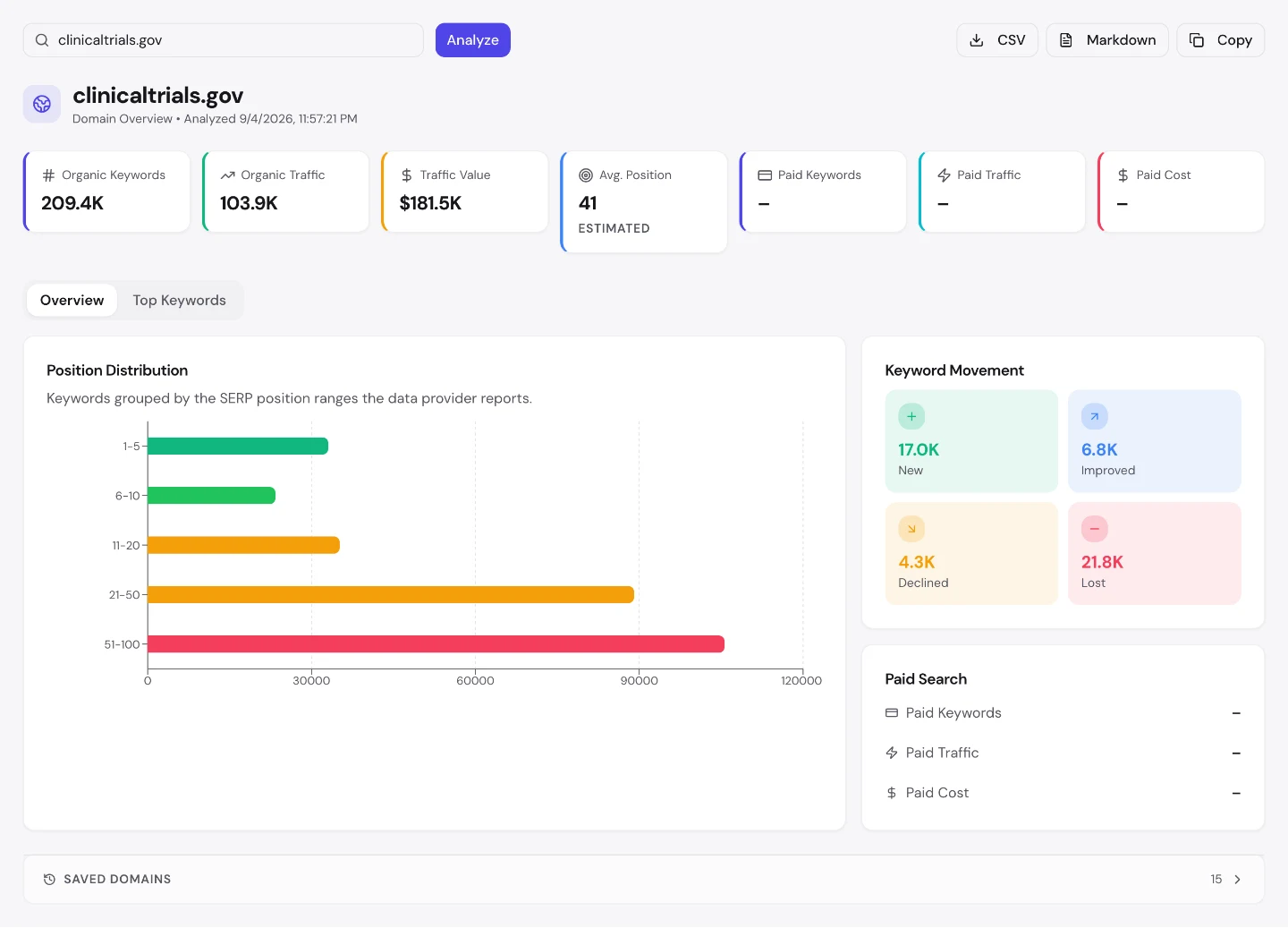
That is the drug-name mechanism running in reverse, on a register that only ever grows. A trial ranks while its compound is in the news and falls out when attention moves elsewhere. The page did not change; the demand did.
If your traffic depends on named entities, you are renting attention from somebody else's news cycle — and when it declines, that is not a failure of your SEO.
Which matters mostly for how you report it. Keep the terms in the Rank Tracker so you can see the fall coming, and so you can show it is demand rather than something you broke.
Know whether habit or ranking protects you
Branded share: 10% — even though the homepage takes 44% of traffic and ranks 1st for "clinical trials gov".
Both are true because the brand query is itself small. People search the drug, the condition, or the phrase "clinical trials", and the site absorbs that demand without anyone looking for the institution by name.
That distinction decides how exposed you are. Chess.com, at 92% branded, is protected by habit — an algorithm change cannot stop people typing its name. ClinicalTrials.gov is protected by rankings, which can move next month.
Work out which one you are relying on. If it is rankings, your traffic is a position you have to keep defending rather than an asset you own.
Publish the record, name the thing
The instruction, drawn from all of the above.
GOV.UK's lesson in the last batch was to publish the record — the tribunal decisions, the manuals, the statistics. ClinicalTrials.gov adds the second half: make sure each record names something people search for, in the title and the first line.
A trial record that leads with "NCT07232719" is invisible. One that leads with the compound under test is findable. Same data, different surface.
Apply it to whatever your records are — cases, incidents, products, specifications. Extract the named entity from the record and put it where a search engine and a human both meet it first. Draft that surface once with the Content Brief Generator and template it across the set, then check the result with the Website Audit.
ClinicalTrials.gov's trial records rank because they are about drugs people search by name. PyPI's package pages do not rank because nobody searches package names. Keyword Research answers which of those you are about to build, in about a minute.
- Volume, difficulty and intent for the entity names you would generate
- Run 20 samples before committing to 600K pages
- 3 checks a day, no signup, no card
What you cannot copy
And here is what I could not measure, or had to qualify. A couple of the tools I name below are partners of ours — if you buy through those links we earn a commission, and you do not pay a cent more.
Our traffic figures are United States only and modelled from ranking positions and search volume rather than counted. For a US federal register that scope is more representative than usual, but it is still an estimate. The keyword and backlink data underneath comes from SE Ranking, and the $181K traffic value is an ad-spend equivalent, not revenue — the site sells nothing.
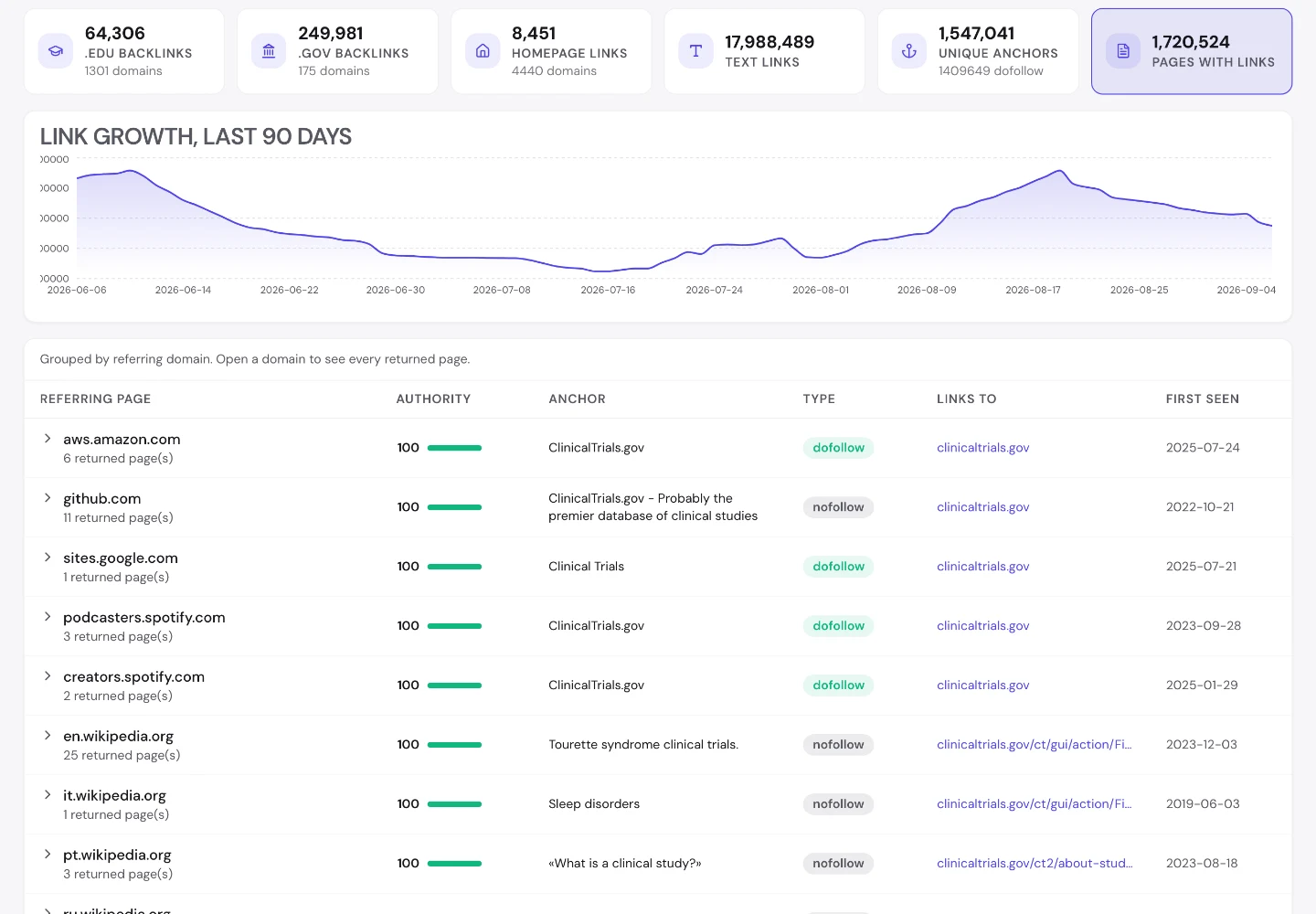
The backlink total of 18M came from the app rather than the marketing tool, which was rate-limited (HTTP 429) at capture time. The app's BACKLINKS tile is a known defect on our side and has returned negative values on other domains, so the figure above is the page header total and the screenshot is cropped below that tile. An earlier measurement recorded 120K referring domains and a domain rank of 93.
The sitemap census comes from a full crawl on 29 August 2026, not from this run. It found 600K trial records, 69 non-trial URLs and identifiers running NCT00000102 to NCT07793721. I did not run Keyword Research against the trial set: it has an open defect returning implausible volumes, which is why the drug-name finding above is read from the traffic report's own top-keyword column rather than from a volume lookup.
And what you cannot copy: a legal mandate. US law requires many trials to be registered here, so the catalogue fills itself and the institutional links follow the obligation. No commercial site gets its inventory delivered by statute.
Frequently asked questions
How many pages does ClinicalTrials.gov publish?
600K URLs in its sitemap — 600K individual trial records and 69 non-trial pages covering navigation, help, submission documentation and search — counted in a full crawl on 29 August 2026. That is about 8,700 records for every explanatory page.
Do individual trial records get search traffic?
Some do. Two appear in the site's top 5 pages: one at roughly 1,500 monthly visits ranking 27th for "retratrutide", another at 1,300 ranking 22nd for "ivermectin". They rank for the drug being studied, never for the trial identifier.
How much search traffic does ClinicalTrials.gov get?
Roughly 100K estimated US organic visits a month from 210K ranking keywords at an average position of 41, measured 5 September 2026. Our Domain Overview prices that at $181K a month as an ad-spend equivalent.
Which ClinicalTrials.gov page gets the most traffic?
The homepage, at roughly 46K visits — 44% of all organic traffic — ranking first for "clinical trials gov". The find-studies page is second at 4%. The 600K trial records together produce less than the front door.
What is ClinicalTrials.gov's website audit score?
100 out of 100 — 0 critical issues, 0 warnings, 0 notices and 123 checks passed on the homepage. It is one of only 2 perfect scores across the 15 sites measured, alongside Dribbble, and both are losing keywords.
Is ClinicalTrials.gov gaining or losing keywords?
Losing. It gained 17K keywords and lost 22K — a net loss of about 4,800 against a base of 210K — even though records are added and never deleted. Trials rank while their compound is in the news and fall out when attention moves on.
How many backlinks does ClinicalTrials.gov have?
18M backlinks, measured 5 September 2026. An earlier measurement recorded 120K referring domains and a domain rank of 93. Medical, academic and news citations accumulate without any outreach, because the register is the canonical record.
Why do PyPI's and chess.com's entity pages fail where these succeed?
Because the entity has to be something people already search. A trial record is about a named drug with public demand behind it. A PyPI package page is about a library developers install by command, and a chess.com profile is about a username nobody types into Google.
The one number to take away
27.
That is the position at which a single trial record ranks for "retratrutide", and it is the most useful number in this series for anyone planning a programmatic page type.
Position 27 is page 3. It is not a win by any normal reading. And it still puts that page in the site's top 5, because the query behind it has real demand — while 600K sibling pages built on the identical template earn nothing at all.
The template was never the variable. The demand behind each record was.
So before you generate anything, take 20 of your records, look up what each one is about, and check whether anybody searches for it. If the answer is no for 18 of them, you are about to build inventory and call it content.
Found something in your own report that surprised you, or measure this differently? I would genuinely like to know — the tools used are all free, so you can check every figure yourself. Measured 5 September 2026 unless stated. Domain Overview, Organic Traffic Checker, Website Audit and Backlink Analyzer figures are free runs of our own tools, all United States scope, and all modelled rather than counted where the tool says so. The sitemap census comes from the site's own sitemap, crawled 29 August 2026. No revenue figure applies.