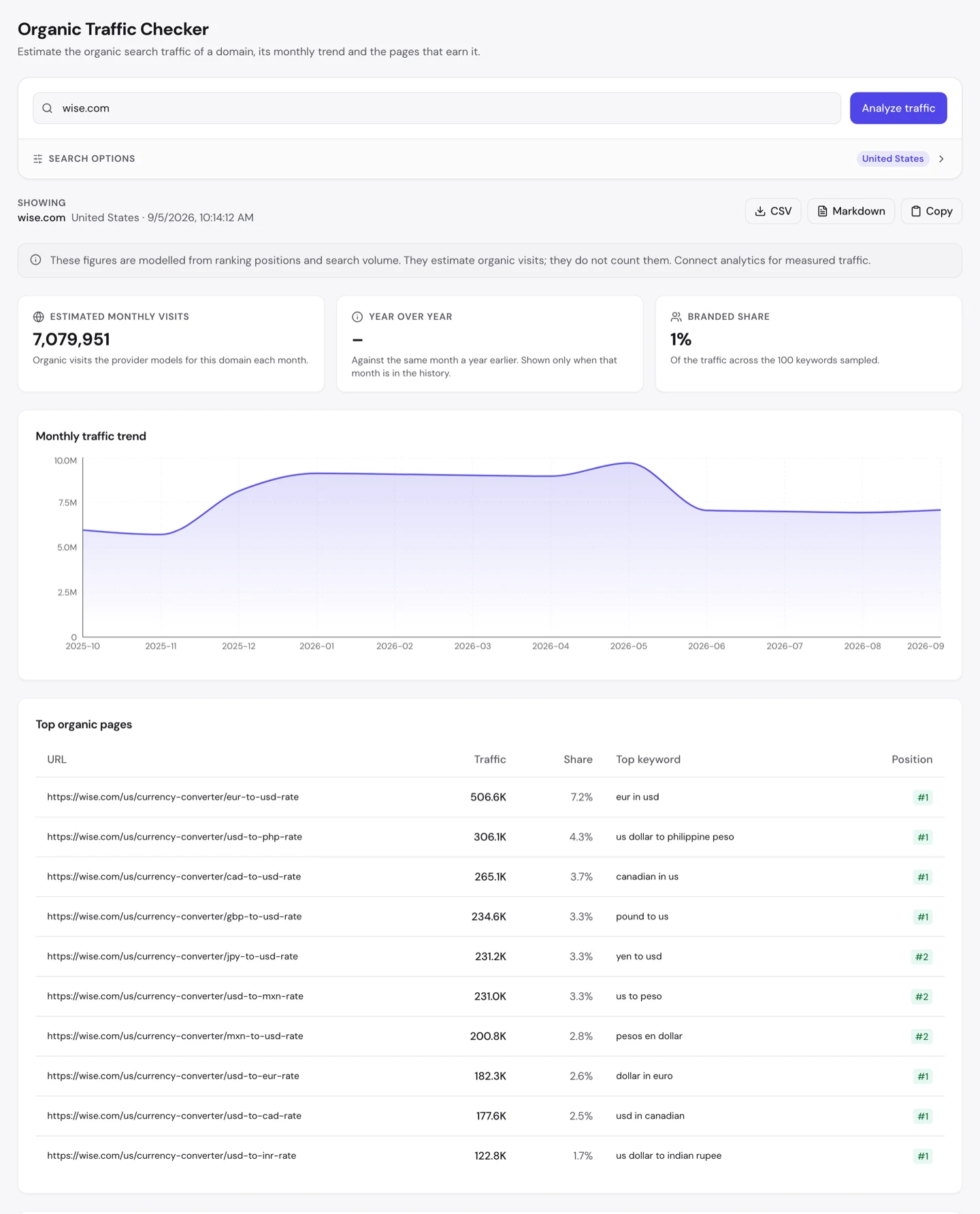
All 5 of Wise's biggest pages are currency converters, and 4 of them rank first.
EUR to USD alone earns 510K visits a month — 7% of the entire site.
The currency converter is the most copied programmatic template on the internet and almost every copy earns nothing. Wise's version has the best average ranking position of the 24 sites I have measured. Here are the 8 lessons, including the one about what its 50K-URL sitemap actually contains.
Check which page type actually earns
The Organic Traffic Checker puts wise.com at 7.1M estimated monthly visits, led by:
EUR to USD at 510K ranking 1st. USD to PHP at 310K ranking 1st. CAD to USD at 270K ranking 1st. GBP to USD at 230K ranking 1st. JPY to USD at 230K ranking 2nd.
Free, and it shows the top pages. To count the real demand behind a converter catalogue you need volumes for every pair, and Semrush and SE Ranking both have a keyword database deep enough to give you that.
The homepage does not appear. The pricing page does not appear. The product Wise actually sells, moving money, does not appear anywhere in that list.
Your own report will probably surprise you the same way.
Those 5 pages alone are 22% of the site's traffic, and every one answers a question with a number rather than a paragraph.
So run the same report on yourself and find out which page type is really earning. On most sites it is not the one the company talks about, and the gap between those two is where your next quarter should go.
Be the answer, not a page about it
From the Domain Overview: 2M organic keywords at an average position of 34, worth $2.7M a month.
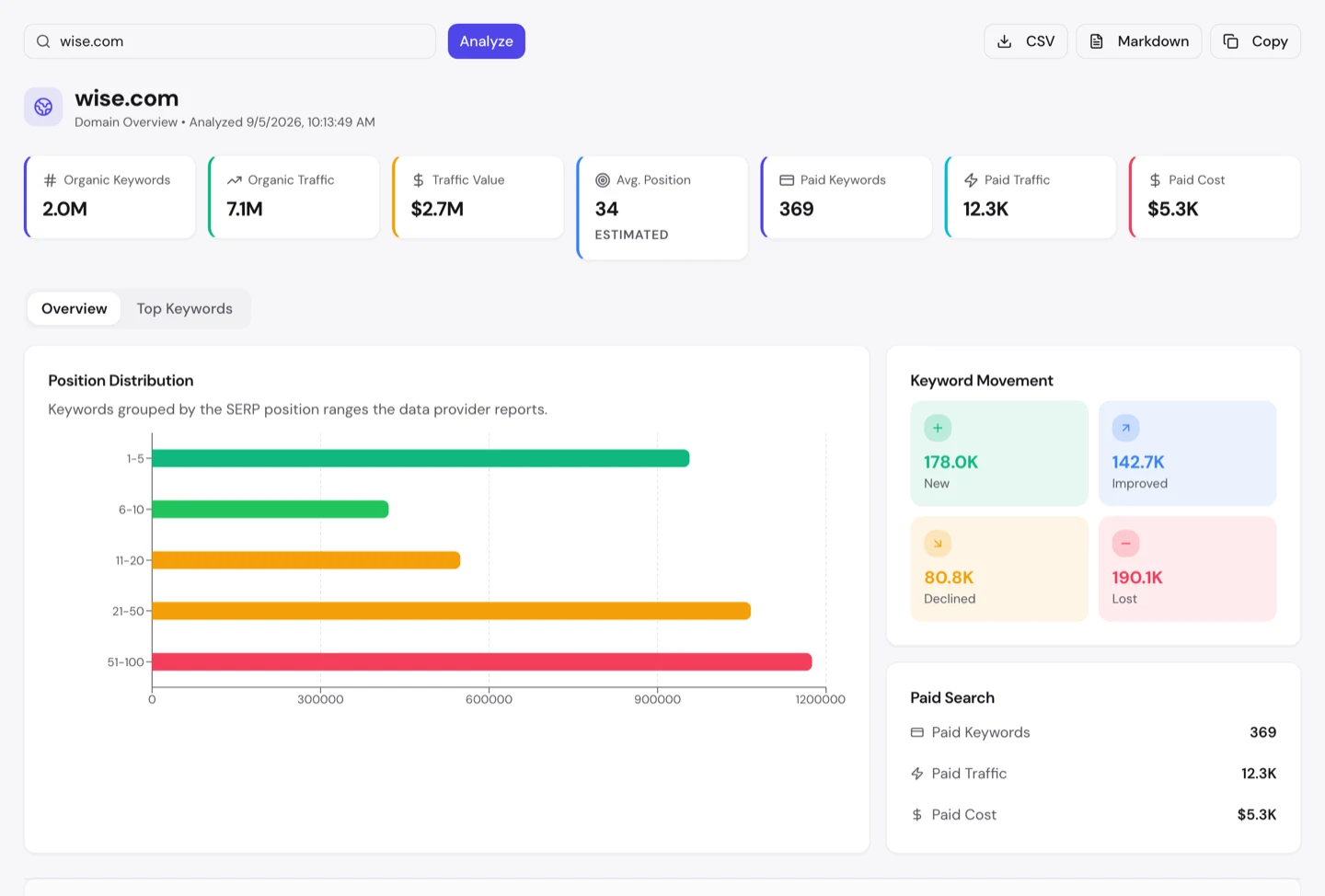
34 is the best average in this entire series. NerdWallet is 36, RTINGS 37, Docker Hub 51.
That is remarkable at 2M keywords, and it happens because a converter page is competitive by construction.
It is not an article hoping to be relevant. It is the literal answer, updated continuously, to a question with one correct response. Nothing you write can outrank the thing itself.
Build a page that is the answer and the ranking follows. Build a page that describes the answer and you are competing on prose.
Count your entities, not your URLs
Now the part that matters if you are planning to copy this.
An earlier crawl of Wise's sitemap found a 50K-URL shard — and inside it, only about 3,800 distinct currency pairs. The rest are the same pages with amount parameters and chart variants appended: ?amount=1,000 is the converter's own input field, pre-set, submitted to Google as a separate URL.
So the honest unit is 3,800 pages, not 50K. The catalogue is an order of magnitude smaller than the URL count suggests.
This is worth checking before you commit to a number. If your 500K-page plan is really 40K pages and a query string, you want to know that at the planning stage. Run your own template through the XML Sitemap Generator and count the distinct entities rather than the URLs.
Build the answer, not the article
Stated as the instruction, because it is the transferable half.
Somebody searching "eur in usd" wants a number. Wise gives them the number, live, above everything else, and puts the explanation beneath it. That is the same decision calculator.net makes with 222 pages and 11M visits, and the same one GeeksforGeeks stumbled into with unit converters.
Four sites in this series are carried by pages that answer instantly rather than explain at length. Not one is carried by a long-form guide.
Find the questions in your field that have a single correct answer that changes — rates, prices, availability, status, conversions — and publish the answer as the page. Then check what the ranking pages include with the Content Optimizer, without letting it push the answer below the fold.
Wise ranks first because its page IS the answer, not an article about the answer. If your market has a question with one live, changing answer, that page is worth more than 50 blog posts.
- We find the repeated question in your market
- We build the live tool that answers it
- Programmatic pages done without the bloat
- Fixed scope, agreed up front
Know where your visitors come from
Branded share: 1%, on 7.1M monthly visits.
Essentially nobody arrives searching "wise". They search "pound to us" and "yen to usd", and meet a money-transfer company at the exact moment they are thinking about currency.
That is worth holding against your own funnel. Your buyers have a moment like that too, and it is almost never the moment they think of your name.
That is the strategic point of the whole converter programme, and it is worth separating from the SEO.
The pages are not there to rank. They are there to put the product in front of somebody who has just proved they have a currency problem.
So when you plan yours, name the problem your buyer has already demonstrated before you decide what page to build. The ranking is a means, not the point.
A 1% branded share would be alarming for a media site. For an acquisition channel it is the design.
So work out which of the two you are running before you set a target. If your visitors are strangers who found a useful page, your job is to keep making useful pages, and brand spend will not protect a single one of them.
Budget for the tail you will lose
Keyword movement: 180K new keywords against 190K lost. Of the ones it kept, 140K improved and 81K declined — net down about 12K.
Slightly negative on the library, strongly positive on quality: improvements run nearly 2x declines.
For a converter catalogue that shape makes sense. The pairs people care about are stable, so the pages that matter keep strengthening, while the long tail of obscure pairs and parameter variants drifts in and out of the index.
Wise also runs a few hundred paid keywords. Small, but not zero, on a site whose organic pages already rank first.
And budget for the tail you are going to lose. A catalogue this size sheds obscure pages constantly, so plan the maintenance alongside the build or your page count will quietly start working against you.
Do not expect the audit score to pay
The Website Audit scores the homepage 83/100. Behind that score: 1 critical issue, 3 warnings and 7 notices. It passed 111 checks.
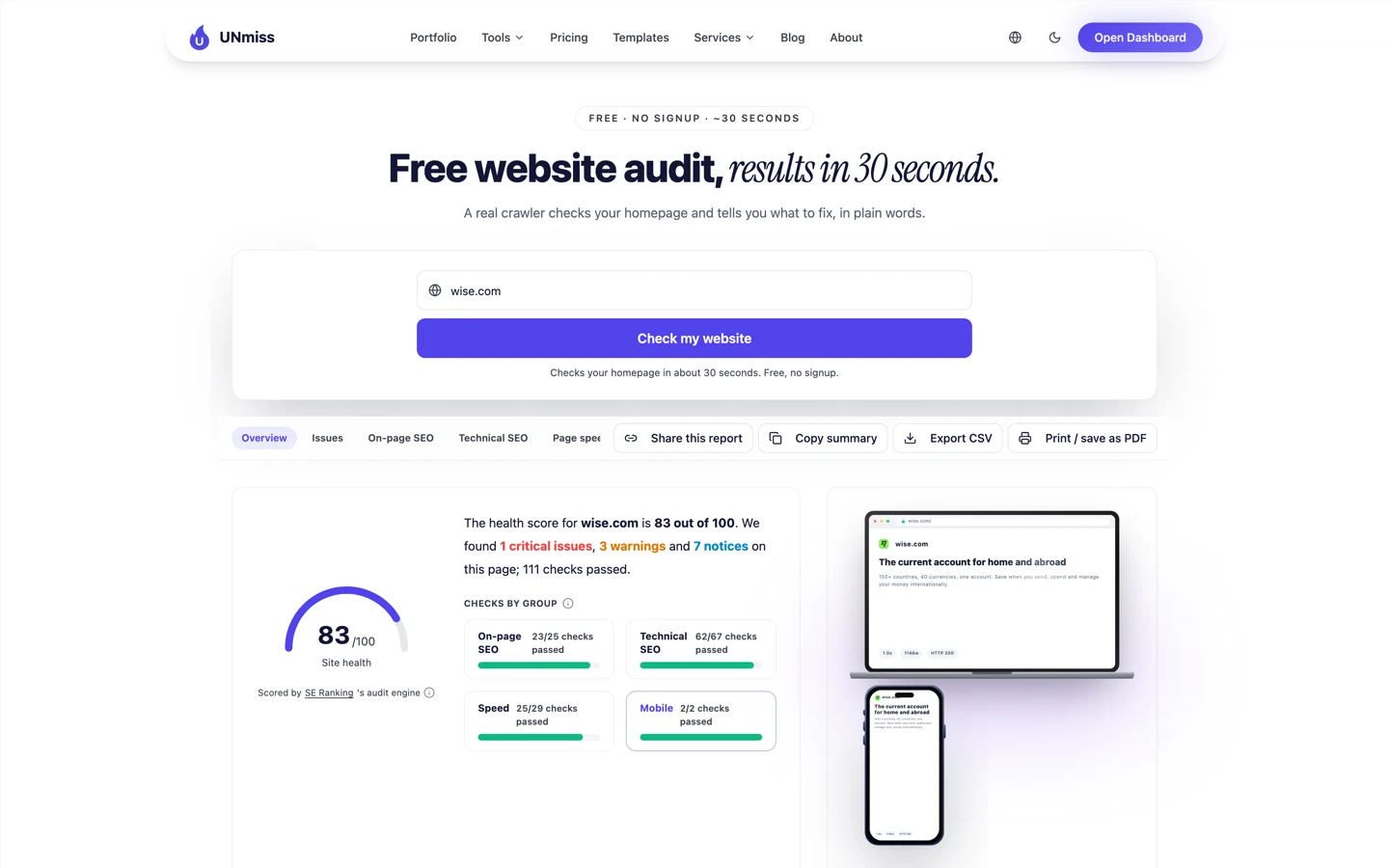
That is a below-average technical score attached to the best ranking performance measured here. Booking.com, in this same batch, scores a perfect 100.
Twenty-four sites in, the audit score has still predicted nothing.
It is a floor, not a lever. So fix your critical issue because it is specific and cheap, and expect no traffic movement from having done it. Telling your team that in advance is worth more than the fix.
Pick one query and win it properly
The last observation, and it is the one I would take into a planning meeting.
Wise does not have 5 strategies. It has 1 page type, repeated across 3,800 currency pairs.
4 of its 5 biggest pages hold first place on that one template.
Compare Zapier in this same batch: 140K programmatic integration pages, and not one of them appears in its top 5. Same discipline, same scale of ambition, completely different outcome — because a currency pair is a query and an app-pair mostly is not.
One page type that answers a real repeated query beats 5 page types that answer none.
The hard part is not the templating. It is choosing the one query, and that is a decision you can make this week without writing any code.
Wise's 50K-URL shard is about 3,800 real pages and a lot of query strings. Before you commit to a programmatic page count, find out how many distinct things you actually have — and whether anybody searches for them.
- Volume, difficulty and intent for your entity names
- Test 20 samples before generating 50K URLs
- 3 checks a day, no signup, no card
What you cannot copy
And here is what I could not measure, or had to qualify. A couple of the tools I name below are partners of ours — if you buy through those links we earn a commission, and you do not pay a cent more.
There are no backlink figures in this article. Our Backlink Analyzer returned "Daily backlink check limit reached" when I ran it, and unlike some others in this series Wise has no earlier measurement of ours on record to quote with a date. Rather than borrow a third-party number or leave the impression the profile was measured, the section is absent.
Our traffic figures are United States only and modelled from ranking positions and search volume rather than counted, which the tool states on its own screen. Wise is a global business, so its worldwide traffic is far larger than 7.1M. The keyword data underneath comes from SE Ranking, and the $2.7M traffic value is an ad-spend equivalent, not revenue — Wise earns on transfer fees, which no tool of ours can see.
The 3,800-currency-pair figure comes from an earlier crawl of one 50K-URL shard, not from this run, and it is a count within that shard rather than the whole catalogue. I did not run Keyword Research: it has an open defect returning implausible volumes.
And what you cannot copy: a live rate feed with a business behind it. Wise's converter is trustworthy because Wise moves the money at that rate. A converter that quotes somebody else's feed is a commodity page, and the internet already has thousands of them earning nothing.
Frequently asked questions
Which Wise pages get the most search traffic?
All 5 of its biggest pages are currency converters. EUR to USD leads at roughly 510K estimated monthly visits (7% of the site) ranking 1st, followed by USD to PHP at 310K, CAD to USD at 270K, GBP to USD at 230K — all ranking 1st — and JPY to USD at 230K ranking 2nd.
How much is Wise's search traffic worth?
Our Domain Overview prices it at $2.7M a month, against 2M ranking keywords at an average position of 34 and roughly 7.1M estimated US organic visits, measured 5 September 2026. That is an ad-spend equivalent, not revenue.
How many currency converter pages does Wise really have?
About 3,800 distinct currency pairs, within a sitemap shard of 50K URLs. The remaining URLs are the same pages with amount parameters and chart variants appended — the converter's own input field, pre-set and submitted as separate URLs. Counted in an earlier crawl.
Why does Wise rank so well on average?
Its average position of 34 across 2M keywords is the best of the 24 sites measured in this series. A converter page is competitive by construction: it is the literal answer to a query with one correct response, updated continuously, rather than an article describing the answer.
What is Wise's branded search share?
1% of traffic across the 100 keywords sampled. Almost nobody arrives searching the brand — they search currency pairs and meet a money-transfer company at the moment they have a currency problem, which is the point of the programme.
What is Wise's website audit score?
83 out of 100, with 1 critical issue, 3 warnings, 7 notices and 111 checks passed on the homepage — a below-average technical score attached to the best average ranking position in the series.
Is Wise gaining or losing keywords?
Losing slightly. It gained 180K keywords and lost 190K — a net loss of about 12K against a base of 2M — while 140K improved against 81K declined, so the pages that matter are strengthening.
How many backlinks does Wise have?
We do not report one. The Backlink Analyzer returned a daily check limit when we ran it for this article, and we have no earlier measurement of our own to quote with a date, so no backlink figure appears rather than an unverified one.
The one number to take away
3,800.
That is how many real pages sit inside a 50K-URL sitemap shard, and it is the number that should change how you plan a programmatic project.
The gap is not deception. It is what happens when a form field becomes a URL: one converter, thousands of amounts, and a page count that looks like an achievement in a spreadsheet.
What actually produced 7.1M visits was 3,800 pages answering 3,800 questions people ask constantly, 4 of the top 5 at position 1, on the best average ranking in this entire series.
So count entities, not URLs. Then check whether anybody searches for them. A programmatic plan that survives both questions is worth building; one that only survives the first is a sitemap.
Found something in your own report that surprised you, or measure this differently? I would genuinely like to know — the tools used are all free, so you can check every figure yourself. Measured 5 September 2026 unless stated. Domain Overview, Organic Traffic Checker and Website Audit figures are free runs of our own tools, all United States scope, and all modelled rather than counted where the tool says so. The currency-pair count comes from an earlier crawl of Wise's own sitemap. No backlink measurement was obtainable, and no revenue figure for Wise was available to us.