Calculator.net earns 11M search visits a month from 222 pages.
That is roughly 52K visits per page. PyPI publishes 2M pages and gets one visit per 13 of them.
Across 19 sites measured in this series, nothing else is close. I ran calculator.net through 4 of our tools to find out what a 222-page site does that a 2-million-page site cannot, and the answer is almost embarrassingly simple. Here are the 8 lessons.
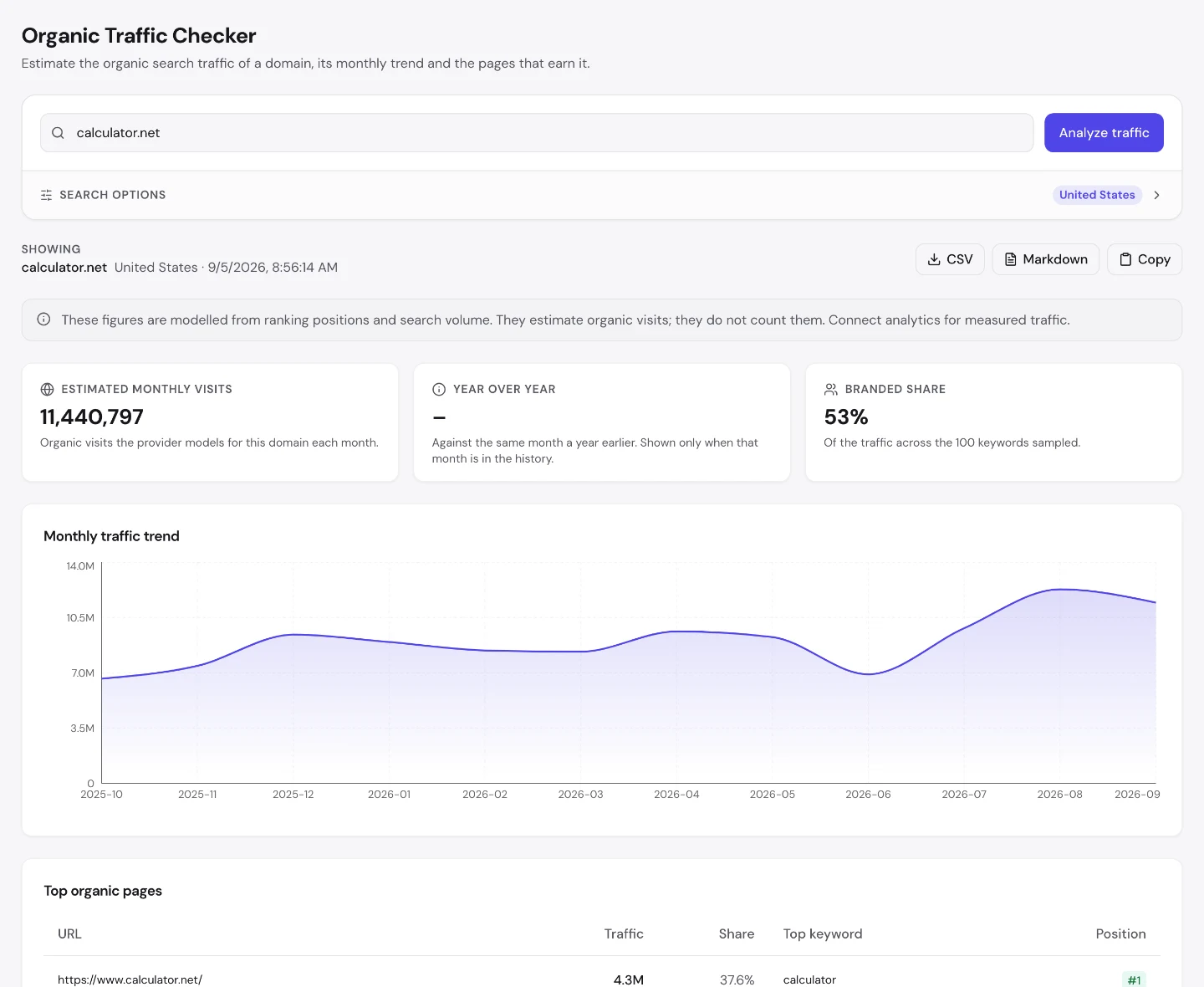
222 pages, 11M visits
The Organic Traffic Checker puts calculator.net at about 11M estimated monthly visits, from roughly 222 pages.
That is a free check, and it is a snapshot. If you want to watch a tool page climb week by week after you ship it, Semrush and SE Ranking both track that properly, and it is worth having before you build rather than after.
Set that against the rest of this series. Dribbble publishes 11M pages and earns a fifteenth of the traffic. PyPI publishes nearly 2M and earns a seventy-fourth. Goodreads earns about the same as calculator.net, from millions of pages instead of hundreds.
Page count has been the least predictive number in this entire series. If you are reporting yours as a metric, stop — it tells you and your board nothing about whether anything is working.
The number you want instead is visits per page, and you can have it in a minute. Divide your organic traffic by the URLs you publish. If it is small, you do not have a content problem, you have a demand problem, and adding pages will make it worse.
Every top page is a calculator
The top 5 are the homepage, then an auto loan calculator, a calorie calculator, a BMI calculator and a mortgage calculator. Four of them rank 1st or 2nd.
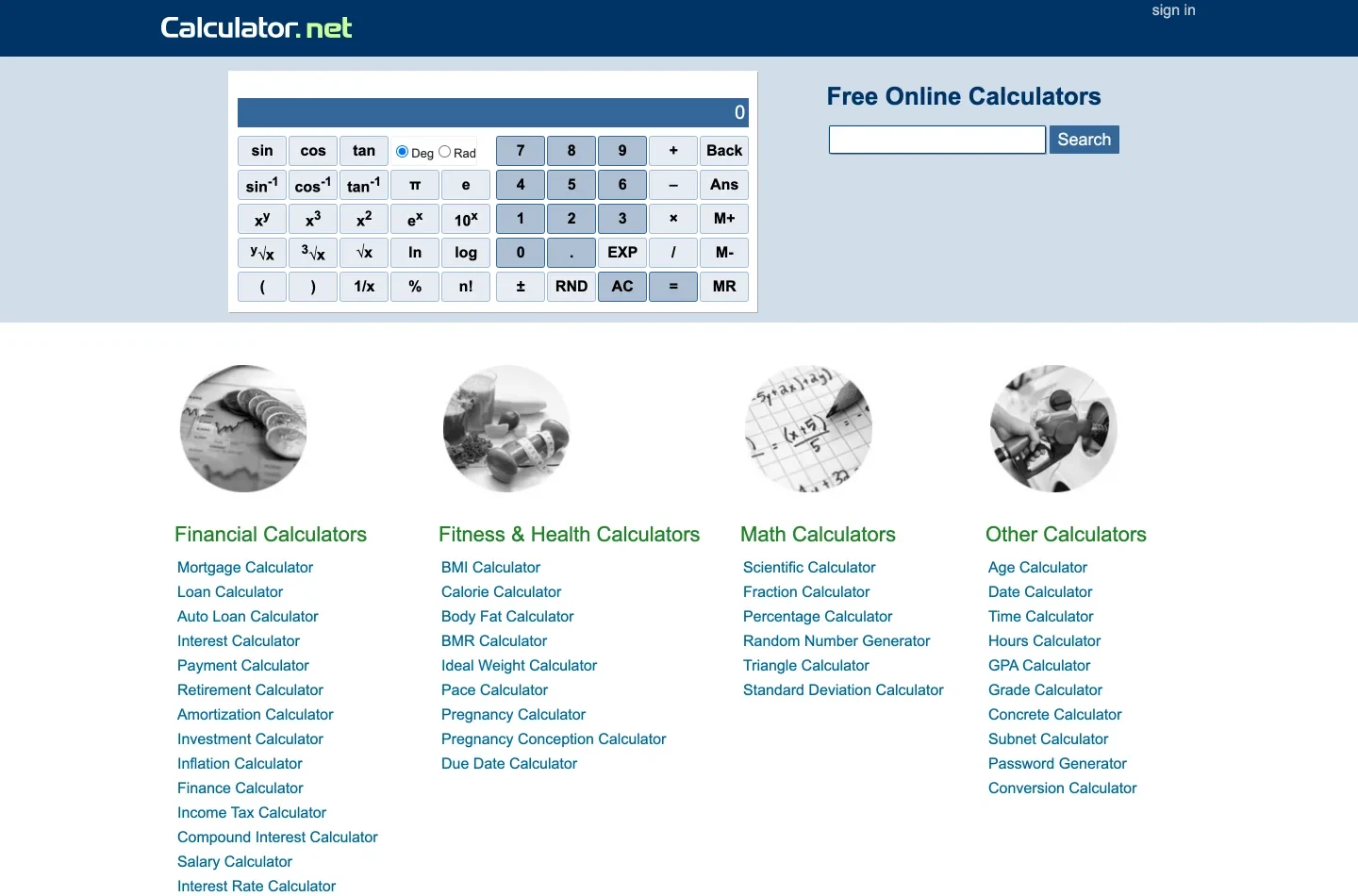
No articles. No guides. No blog. Every single one is a tool that does one arithmetic job.
These queries have three properties almost nothing else has: they repeat forever, their intent is unambiguous, and the best possible answer is a working input box rather than prose. Nobody wants to read about BMI. They want the number.
The model is available to you today. Find the calculations your audience does by hand, and build the page that does them. You already know several — the ones people email you about, or rebuild in a spreadsheet every quarter.
Check the volume before you build, with Keyword Research. The good candidates look boring in a keyword list, which is exactly why they are still available to you.
Build the tool, not the article
Stated as the instruction, because most people do the opposite.
Faced with a high-volume term like "mortgage calculator", you will be advised to write a 2,000-word explainer with a calculator embedded two thirds down. Calculator.net's page is the calculator, with the explanation underneath for anyone who wants it.
The ordering is the entire difference. A page that answers instantly satisfies the search; a page that makes somebody scroll past your introduction sends them back to Google, and you never find out.
Two other sites in this series reached the same place from opposite directions: 4 of GeeksforGeeks' top 10 pages are unit converters, and freeCodeCamp's second-biggest page is an emoji table. None of the three planned it as a strategy.
When you build yours, run it through the Content Optimizer to see what the ranking pages cover — then ignore any advice it gives you to bury the tool under prose.
Calculator.net proves the point better than any argument could: 222 small tools beat a huge blog. Building one good tool is a week of work. Knowing which tool to build is the hard part, and that is the part we do first.
- We find the tool your buyers already search for
- We design, build and host it on your domain
- We do the SEO so it actually ranks
- Fixed price, agreed before we start
Watch which phrase is carrying you
Our Backlink Analyzer reports 3M backlinks from 31K referring domains, at Domain Trust 89 — and the anchor distribution is the most concentrated in this series.
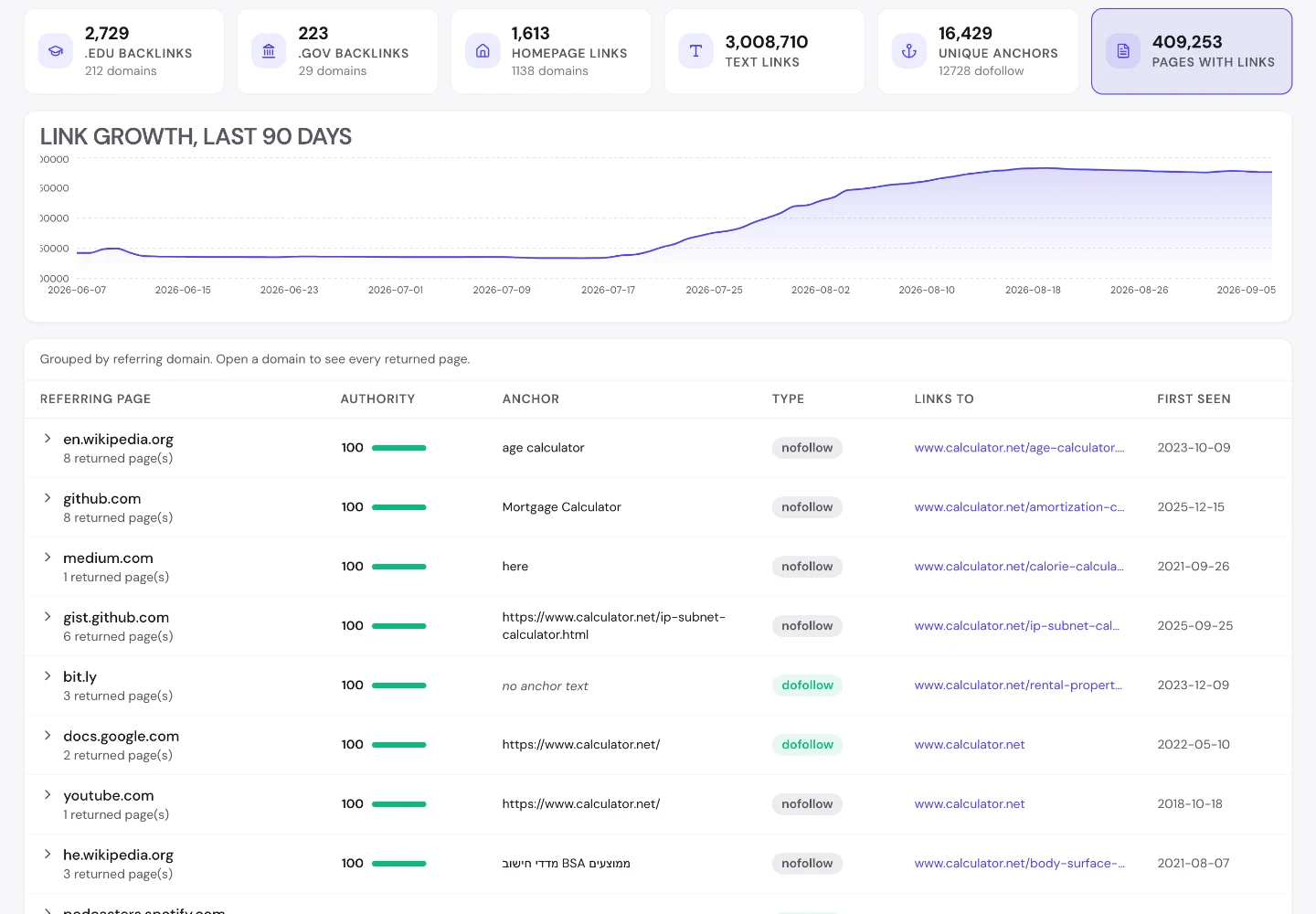
"advanced calculator" carries 74% of the entire profile. The brand name carries under 4%.
Three quarters of a 3M-link profile sits on one phrase that is not the company's name. It is the template mechanism again — the ninth site here where the link engine is a repeated string rather than a campaign — and this time the string is descriptive rather than branded, which is unusual and probably accidental.
Go and look at your own top anchor. If one phrase carries most of your links, you have a single point of failure you did not choose, and you should know what it is before somebody changes a template and you find out the hard way.
Read your dofollow share as a diagnosis
That is the second-highest share measured here, behind only php.net, and it confirms what the anchor data implies. These links sit in templates and footers, not in editorial copy — nobody adds a nofollow attribute to their own template.
A very high dofollow share means your links were installed. A low one means they were written. Neither is better; they are different businesses, and they need different link strategies.
So check yours before you plan any outreach. If your share is high, your links come from integrations and embeds, and more outreach is the wrong spend. If it is low, you are being cited by writers, and an embeddable widget will do nothing for you.
Discount your branded share honestly
The homepage alone takes 38% of everything, ranking 1st for the word "calculator". One ranking change on one query would remove more than a third of this site.
It also explains a branded share of 53%, which is high for a company doing no brand marketing at all. When your domain is the category word, "calculator" and "calculator.net" are nearly the same search, and the tool counts much of it as branded.
So discount your own branded number if your domain describes what you sell. An exact-match domain inflates it, and the traffic underneath is far more contestable than a real brand's — a competitor can take a category word off you, but they cannot take your name.
95 out of 100, and 0 critical
The Website Audit scores the homepage 95/100. Behind that: no critical issues, no warnings and 3 notices. It passed 119 checks.
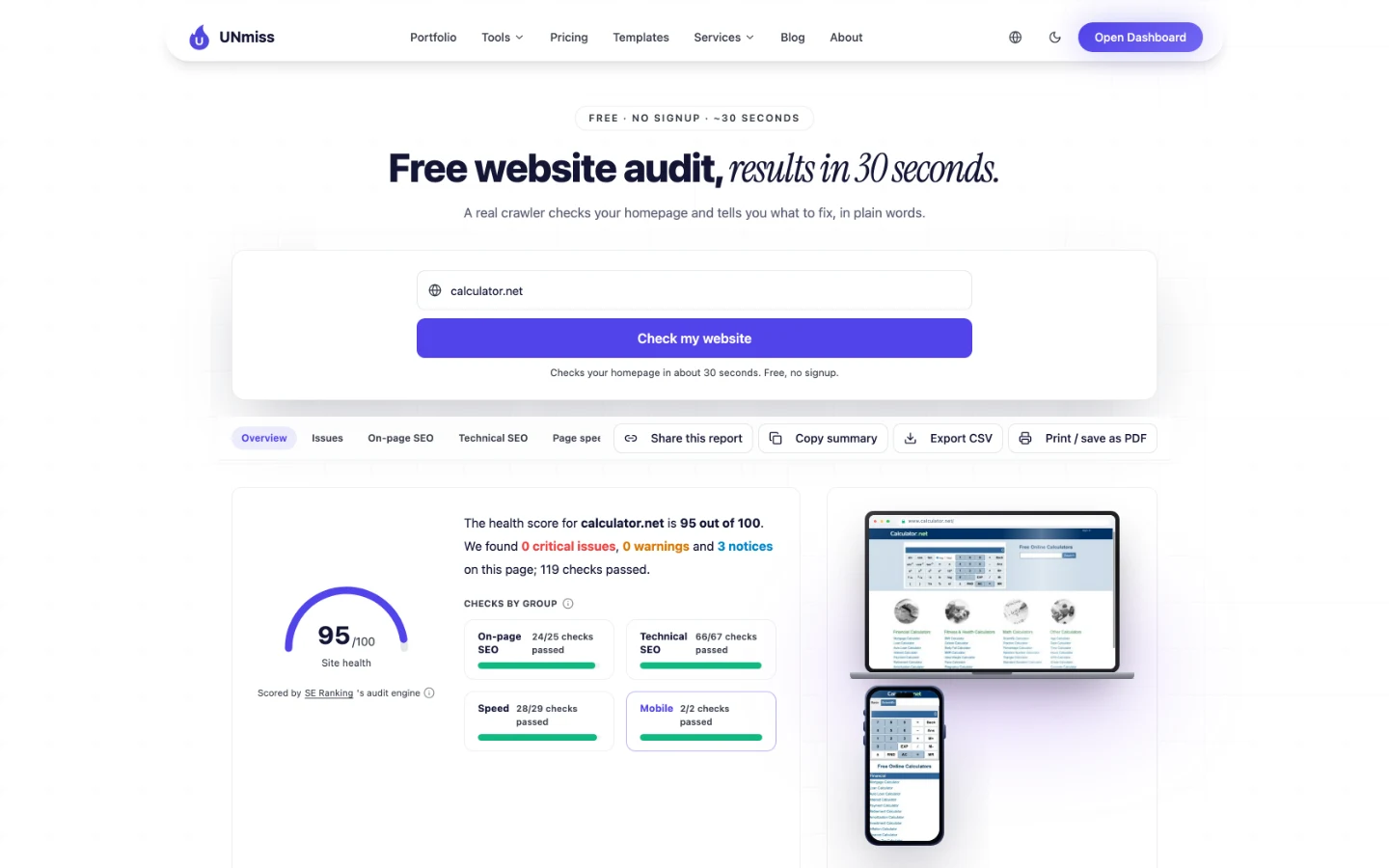
Nothing critical outstanding, on a site that is visually about as plain as the web gets.
That is not a coincidence. Most of what an audit flags comes from things a simple site never added: heavy scripts, layout frameworks, tracking, image galleries. Build less and there is less to fail — which is the cheapest technical SEO advice you will ever get, and the hardest to sell internally.
Build pages that never need updating
From the Domain Overview: improvements are running at twice the declines, while almost every other site in this series is flat or shrinking.
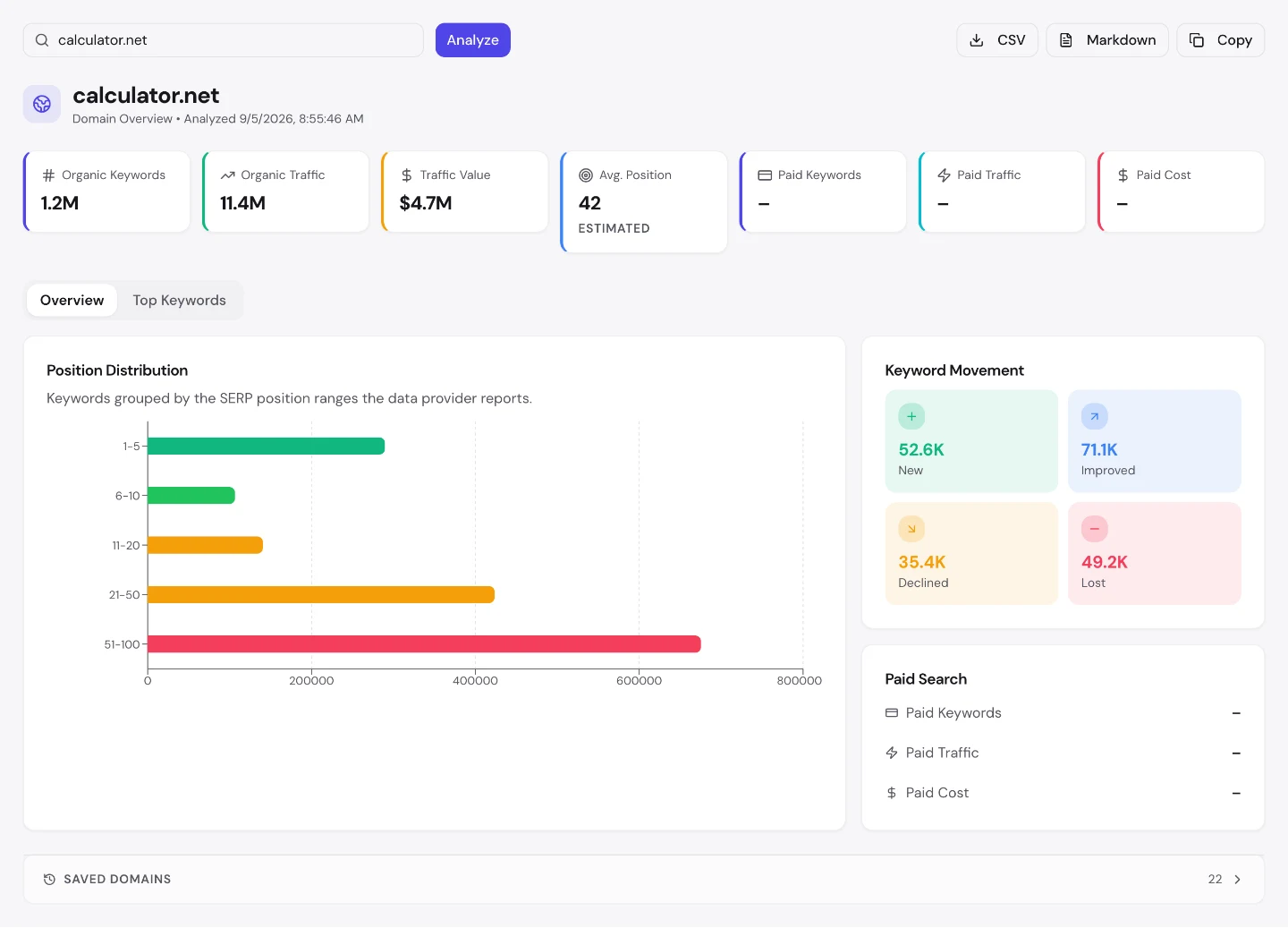
$4.7M of monthly traffic value, from a site a single person could maintain.
The reason is that a calculator does not expire. "Mortgage calculator" will be searched at the same rate in 10 years, the arithmetic will not change, and nobody has to refresh the page.
Compare that with whatever you are publishing now. If your pages need a yearly update to stay accurate, you are not building an asset, you are taking on a maintenance liability — and every page you add makes next year's bill larger.
Calculator.net gets 52K visits per page from 222 pages. The queries behind them are dull, permanent and unambiguous — the kind that look unpromising in a keyword list and never stop being searched.
- Volume, difficulty and intent for any term
- Look for calculations and conversions, not topics
- 3 checks a day, no signup, no card
What you cannot copy
And here is what I could not measure, or had to qualify. A couple of the tools I name below are partners of ours — if you buy through those links we earn a commission, and you do not pay a cent more.
Our traffic figures are United States only and modelled from ranking positions and search volume rather than counted. The keyword and backlink data underneath comes from SE Ranking, and the $4.7M traffic value is an ad-spend equivalent, not revenue — calculator.net runs display advertising, so what it actually earns depends on rates no tool of ours can see.
The backlink figures came from the app rather than the marketing tool, which has been returning HTTP 429 for several batches. The app's BACKLINKS tile is a known defect on our side and has returned negative values elsewhere, so the total above is the page header figure, which reconciles with dofollow plus nofollow, and the screenshot is cropped below that tile.
The 222-page count comes from an earlier crawl rather than this run, and it is the figure this article's headline ratio depends on — treat it as approximate. Our own earlier measurement on 22 August 2026 recorded 32K referring domains, against 31K today. I did not run Keyword Research: it has an open defect returning implausible volumes.
And what you cannot copy: 20 years of holding the word "calculator". The homepage ranks first for the bare category term, which is 38% of the traffic and is not a page anybody can build their way to now.
Frequently asked questions
How many pages does calculator.net have?
Roughly 222, from an earlier crawl. The homepage takes 4.3M visits, then an auto loan calculator at 690K, a calorie calculator at 420K, a BMI calculator at 330K and a mortgage calculator at 290K. Against 11M estimated monthly US organic visits that works out at about 52K visits per page — by far the highest ratio of the 19 sites measured in this series.
How much is calculator.net's search traffic worth?
Our Domain Overview prices it at $4.7M a month, against 1.2M ranking keywords at an average position of 42, measured 5 September 2026. That is the fifth-highest traffic value in this series, behind NerdWallet's $27M, Canva's $20M, Rotten Tomatoes' $13M and Booking.com's $8.6M.
Which calculator.net page gets the most traffic?
The homepage, at roughly 4.3M estimated monthly visits — 38% of everything — ranking first for "calculator". Behind it are an auto loan calculator at 690K, a calorie calculator at 420K, a BMI calculator at 330K and a mortgage calculator at 290K.
What is calculator.net's most common anchor text?
"advanced calculator" with 2.2M backlinks — 74% of the entire profile, the most concentrated anchor distribution measured in this series. "Other Financial Calculators" is second at 240K and the brand name third at 120K.
How many backlinks does calculator.net have?
3M backlinks from 31K referring domains, measured 5 September 2026, split 2.8M dofollow to 170K nofollow — about 94% dofollow, the second-highest share in this series. Domain Trust is 89 out of 100.
What is calculator.net's website audit score?
95 out of 100, with 0 critical issues, 0 warnings, 3 notices and 119 checks passed on the homepage, against a ceiling of 123. A plain site simply has less that can fail.
Why is calculator.net's branded share 53%?
Largely because its domain is the category word. When the site is called calculator.net and the query is "calculator", the two are nearly the same search, so an exact-match domain inflates the branded figure. The traffic behind it is more contestable than a real brand's.
Is calculator.net gaining or losing keywords?
Gaining, and strengthening. It added 53K keywords and lost 49K, with 71K improved against 35K declined — improvements running about twice declines. Arithmetic does not expire, so the pages do not need updating to keep ranking.
The one number to take away
52K.
That is roughly how many monthly visits each of calculator.net's 222 pages earns, and it is the number that should end the page-count conversation permanently.
Across this series I have measured sites with 11M pages earning 680K visits, 2M pages earning 150K, and 600K pages earning 100K. Calculator.net has 222 pages and 11M visits.
Every one of those pages answers a question somebody types every day, forever, with the answer at the top and no preamble. That is the entire strategy. There is no content calendar, no publishing cadence, no archive to maintain.
So before your next quarter of publishing, go and list the 20 calculations your audience does by hand. Building those 20 pages properly will beat 2,000 articles, and you will still be maintaining zero of them in 2036.
Found something in your own report that surprised you, or measure this differently? I would genuinely like to know — the tools used are all free, so you can check every figure yourself. Measured 5 September 2026 unless stated. Domain Overview, Organic Traffic Checker, Website Audit and Backlink Analyzer figures are free runs of our own tools, all United States scope, and all modelled rather than counted where the tool says so. The page count and the August comparison figures come from earlier runs. No revenue figure for calculator.net was available to us.