IKEA runs 116 country versions and earns 10M US search visits, and not one of those versions carries an hreflang tag on the page.
It is all in the sitemaps — 2,200 of them.
Hreflang is the tag most international sites get wrong, usually by putting 60 alternates in every page head and shipping 7 KB of markup to every visitor. IKEA does the opposite, and it is the cleanest working example of the alternative I have measured. Here are the 6 lessons.
Treat hreflang as a market signal
IKEA's global homepage declares 116 hreflang alternates, which is unsurprising for a retailer in 60-odd countries.
What is surprising is that 47 of them are English. English for Canada, Qatar, Ireland, Singapore. Same language, different price, currency, stock and stores.
That is the thing most teams get wrong: hreflang is a market signal, not a translation signal.
If you serve Britain, Australia and the United States from one English page, you are not managing a page — you are running 3 markets through it and letting Google guess which one your searcher is in. It will guess wrong often enough to matter, and you will never see it in your analytics.
Check the headers before you accuse
We sampled 12 country versions. None carried a single hreflang tag in the HTML, and no Link: rel="alternate" header either.
An earlier draft of this article was going to report that IKEA's hreflang was simply broken. It is not. The spec allows three delivery methods — head tags, HTTP headers, or the sitemap — and IKEA uses the third, consistently.
That accusation died on the header check, which is exactly why you should run it.
Before you conclude a competitor's hreflang is missing, fetch the page, then the headers, then the sitemap. Our Website Audit reads the page for you; when it comes back empty, the sitemap is where you look next — and you will be wrong about a lot of sites until you do.
Free, per country. To compare the same page across 20 markets at once you want a rank tracker with local coverage, and Semrush and SE Ranking both cover far more countries than any free check can.
Partition by locale and page type
IKEA's sitemap index expands to 2,200 children across 91 locales, named {type}-{locale}_{n}.xml.
So the partition is locale × page type. Not one sitemap per section, which is what most sites do, and not one giant file, which is what the rest do.
Copy the shape rather than the scale. If you serve more than one market, splitting by locale first means you can regenerate one country without touching the others — and when something breaks, you know which file to open.
Walk a competitor's index before you design your own. The XML Sitemap Generator will show you the shape, and the shape is the decision you are actually making.
IKEA serves 116 countries and its hreflang still needs watching. Getting this wrong quietly costs you whole markets. We build and fix international stores so each country gets the right page.
- Full hreflang and locale audit
- Ecommerce builds that scale by market
- SEO and GEO per country, not one plan
- A free call to review your markets
Decide who pays for your hreflang
Here is the cost, and it is the number nobody expects.
The Estonian product sitemap holds fewer than 5,000 products and 320K hreflang entries. It is 47.6 MB — 95% of the protocol's ceiling.
That is why there are 2,200 files. The hreflang forces the split, not the product count, because the alternates are 99% of the payload.
Which is the honest version of the advice you keep reading. Put 70 alternates in a page head and every visitor downloads about 7 KB of markup. Move it to the sitemap and only the crawler pays.
The weight does not vanish. You are choosing who carries it.
Under about 10 markets, the page head is simpler and nothing bad happens to you. Past 50, you are in IKEA's problem, and you should design the sitemap partition before you discover the 50 MB limit in production.
Category pages win the generic terms
Now the part that has nothing to do with hreflang, and is probably the most copyable thing here.
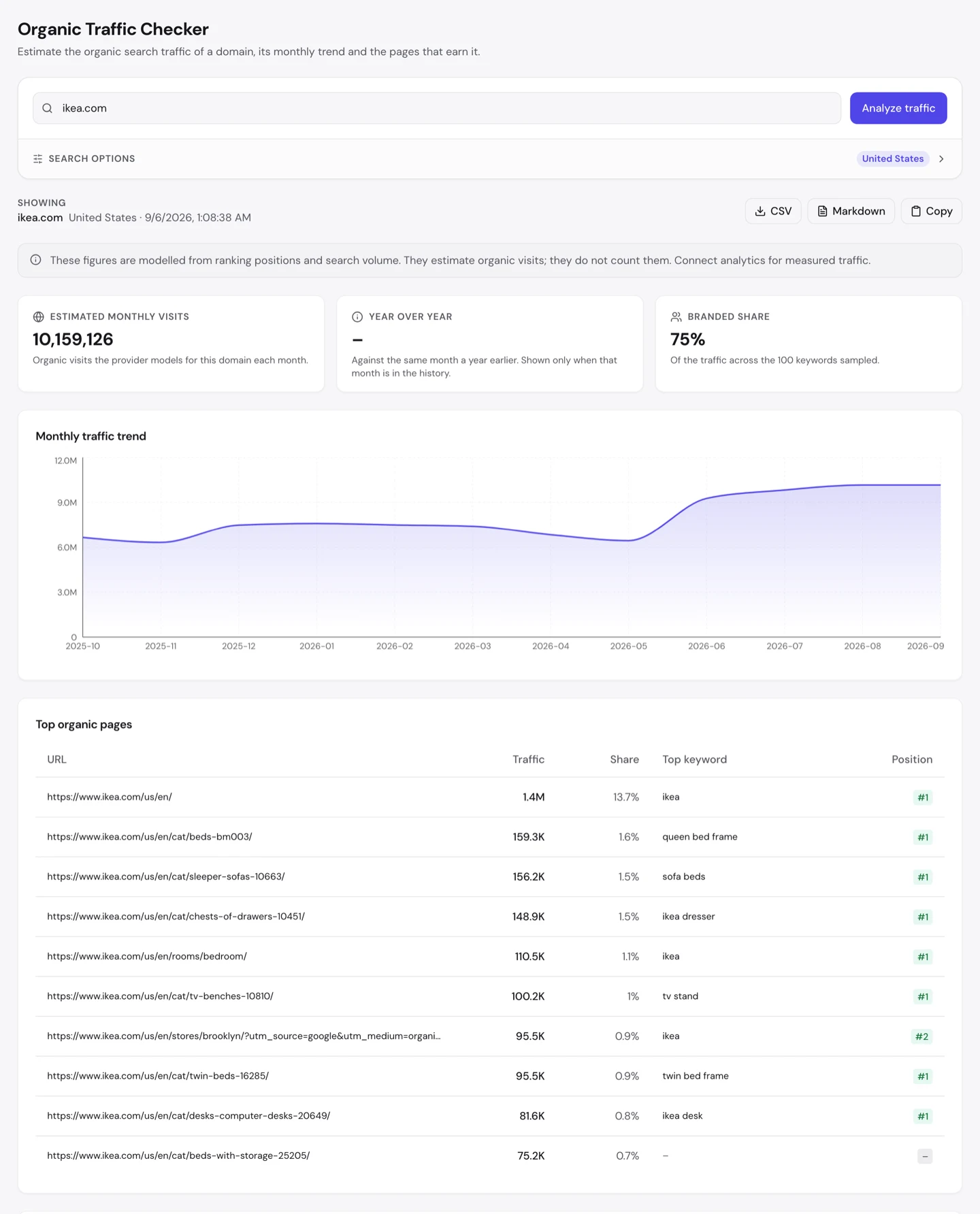
The Organic Traffic Checker puts ikea.com at about 10M estimated monthly US visits, with the homepage taking an eighth. Behind it, the top pages are all category listings ranking 1st for terms with no brand in them.
Beds, 1st for "queen bed frame". Sleeper sofas, 1st for "sofa beds". TV benches, 1st for "tv stand". Twin beds, 1st for "twin bed frame".
Branded share is 75%, so most of this traffic is people typing "ikea". But the unbranded quarter is won by plain category pages on generic product nouns, not by articles about interior design.
If you sell things, the page that should rank for "tv stand" is your tv stand listing — not a blog post about choosing one.
Check whether yours does, with Keyword Research and the SERP Analyzer, before you commission the article. You may find your own category page is already close, and needs 200 words rather than 2,000.
A perfect score is the absence of faults
The Website Audit scores ikea.com 100/100, with nothing flagged anywhere.
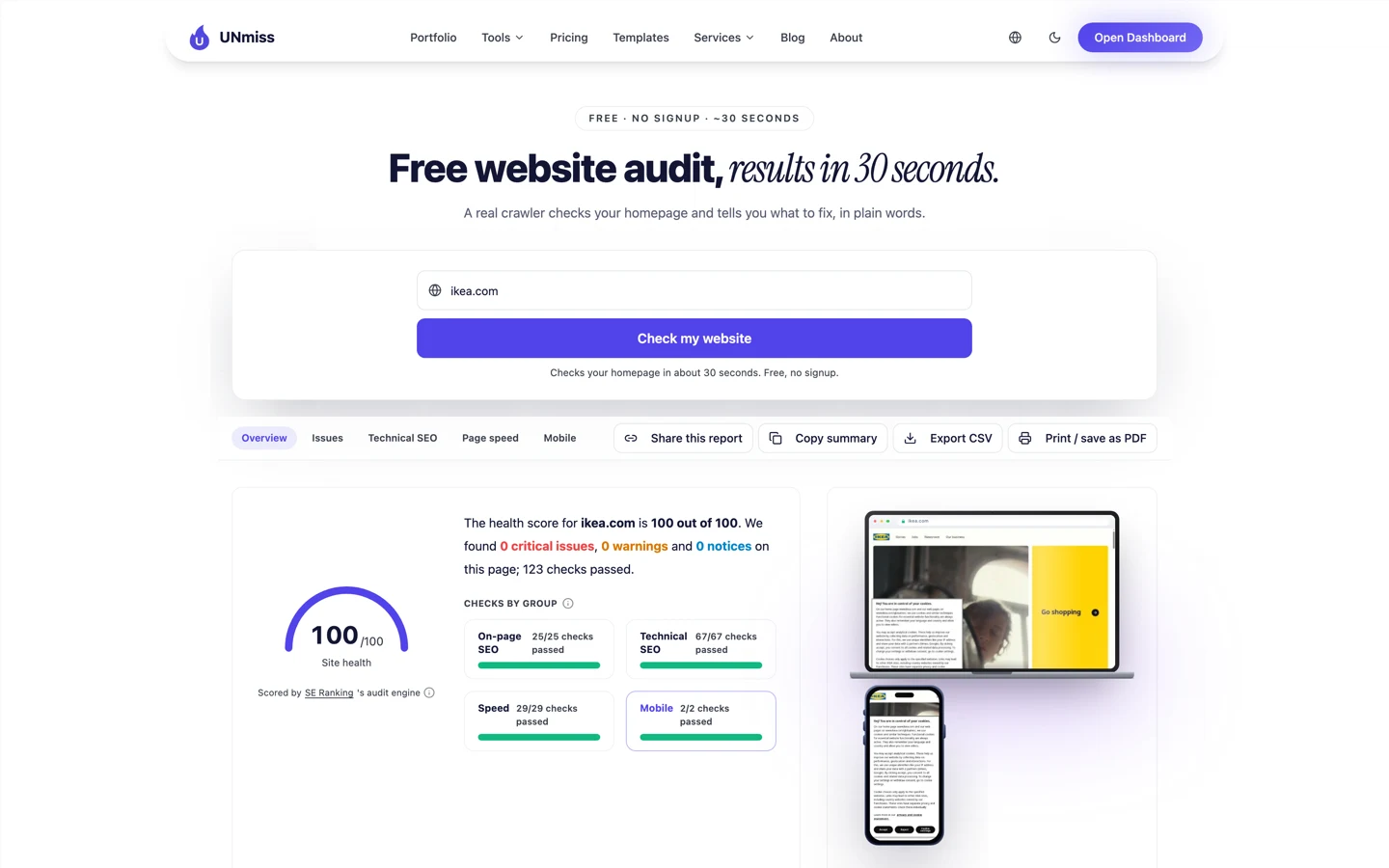
It is the 4th perfect score measured here. And it sits on a domain with the weakest average ranking position in the entire series.
Those two facts belong together. A perfect technical score is the absence of faults, not the presence of rankings, and IKEA is the clearest case of that gap anywhere in this work.
So if your audit is green and your rankings are deep, stop treating the score as progress. You have proved nothing is broken, which is worth knowing once and worth nothing monthly.
One of IKEA's product sitemaps is 47.6 MB with fewer than 5,000 products in it, because the hreflang is 99% of the payload. Most teams have never opened theirs.
- Walks a sitemap index and counts what a crawler receives
- Shows where a feed hits the 50K-URL or 50 MB ceiling
- Free, no signup, no card
What you cannot copy
And here is what I could not measure, or had to qualify. A couple of the tools I name below are partners of ours — if you buy through those links we earn a commission, and you do not pay a cent more.
You cannot copy 116 markets. Every locale in that sitemap exists because IKEA has stores, stock and a price list behind it. The delivery mechanism transfers to any site; the 116 versions do not.
Our traffic figures are United States only and modelled from ranking positions rather than counted. IKEA is global, so its worldwide traffic is far larger — and a US-only sample is a strange lens on a company whose whole point here is international.
The hreflang counts, the sampled country versions, the sitemap children and the Estonian file were measured on 22 August 2026. The tool figures — traffic, keywords, audit and backlinks — are from 6 September 2026.
One of our own numbers on this page is wrong, and it is worth showing you. The Backlink Analyzer's result header reads 15M backlinks, and its dofollow and nofollow figures sum to exactly that. The BACKLINKS tile immediately below reads 13K.
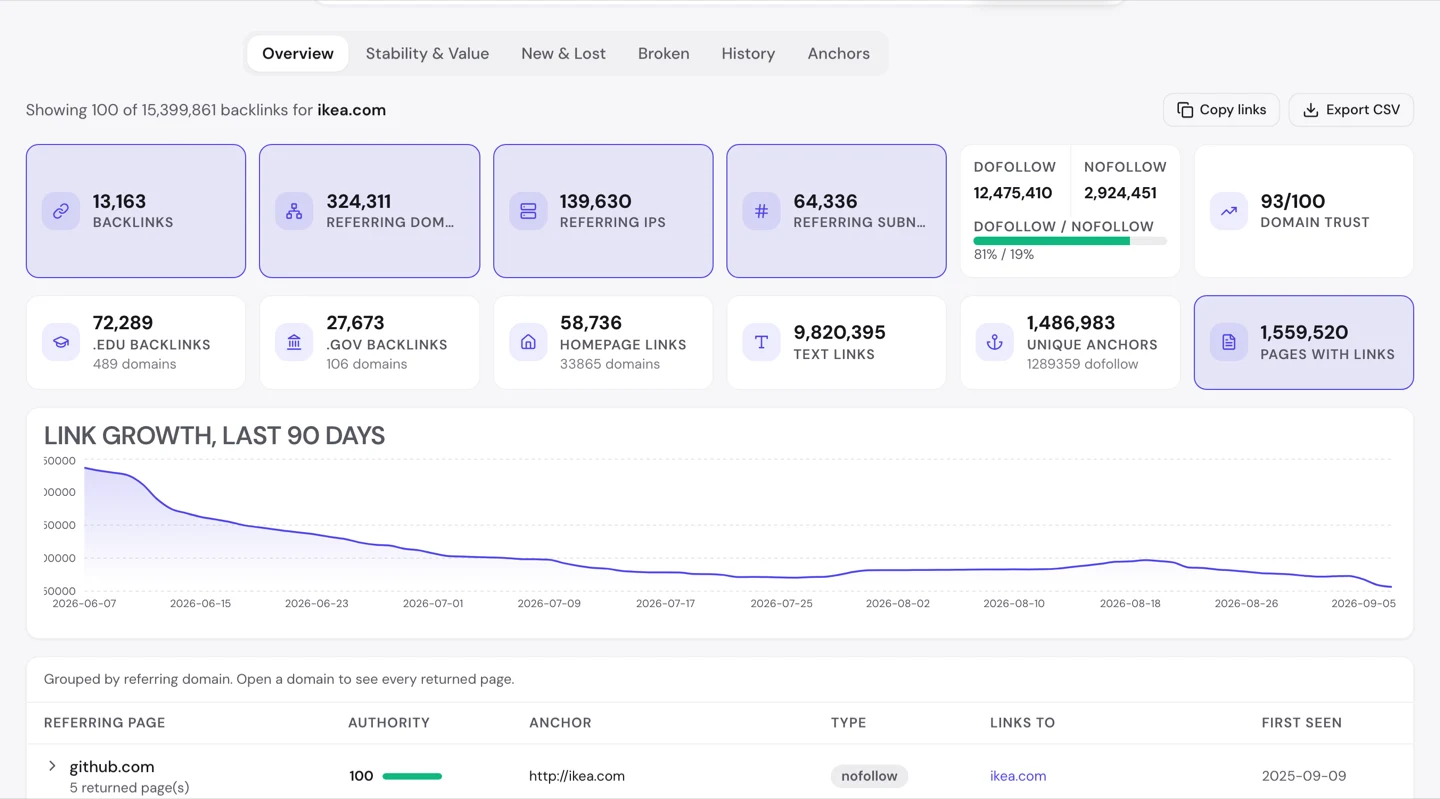
The header is right and the tile is a defect in our app, the second time this series has caught it. So the figures worth quoting are 320K referring domains at Domain Trust 93 — not the tile.
Apply the same suspicion to any tool you use, ours included. When two numbers on one screen disagree, the one that reconciles with something else is the one to trust.
We did not verify how many of the 116 locale versions are genuinely distinct rather than near-duplicates, and we did not run Keyword Research, which has an open defect returning implausible volumes.
Frequently asked questions
How many country versions does IKEA have?
116 hreflang alternates plus an x-default on the global homepage, across 91 distinct locales in its sitemaps. 47 of the 116 are English variants — English for Canada, Qatar, Ireland, Singapore and so on — because hreflang is a market signal rather than a translation signal.
Where does IKEA put its hreflang tags?
In the XML sitemaps, not the page. We sampled 12 country versions: none carried an hreflang tag in the HTML and none returned a Link: rel="alternate" header. The spec allows head tags, HTTP headers or the sitemap, and IKEA uses the third consistently.
How many sitemaps does IKEA have?
2,200 children under one index across 91 locales, partitioned by locale × page type — 481 product files plus roughly 91 each of category, series, store-events, planner and second-hand files.
Why does IKEA need so many sitemap files?
The hreflang forces the split, not the product count. Its Estonian product sitemap holds 4,500 URLs and 320K hreflang entries at 47.6 MB — 95% of the protocol's 50 MB limit, with fewer than 5,000 products in it.
Should I put hreflang in the sitemap or the page?
Both are valid. Roughly 70 alternates in a page head is about 7 KB of markup every visitor downloads; in the sitemap only the crawler pays. The weight does not disappear, it relocates — and in IKEA's case it relocates into 2,200 files that nearly hit the size limit.
How much traffic does IKEA get from search?
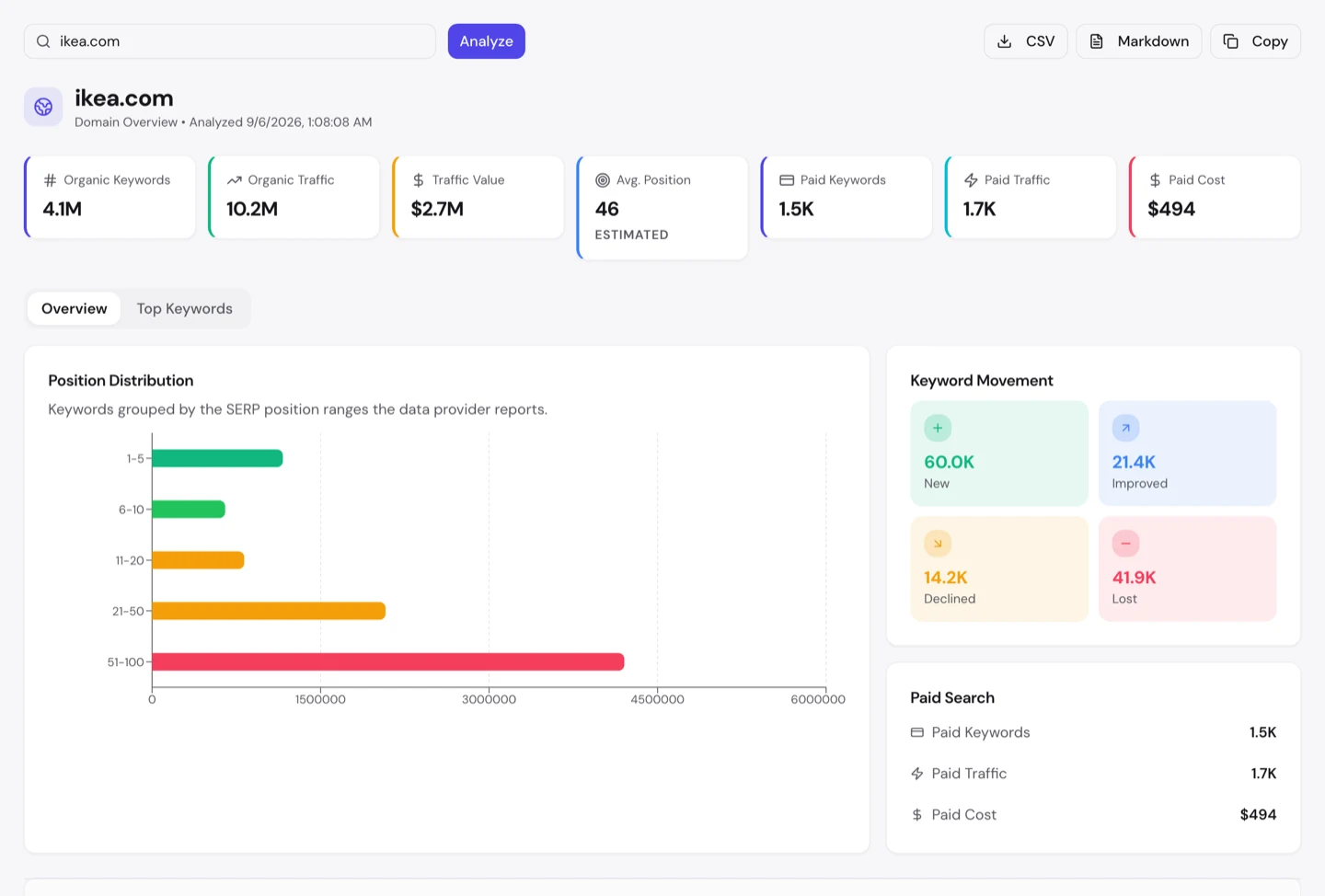
Roughly 10M estimated US organic visits a month, worth $2.7M, against 4.1M ranking keywords at an average position of 46, measured 6 September 2026. Branded share is 75%. That is US-only and modelled, so worldwide traffic is much larger.
What ranks best on ikea.com?
Category pages on generic product nouns. Beds ranks 1st for "queen bed frame" at 160K visits, sleeper sofas 1st for "sofa beds" at 160K, TV benches 1st for "tv stand" at 100K, twin beds 1st at 96K. The homepage is 14% of traffic; no blog post appears at all.
What is IKEA's website audit score?
100 out of 100, with 0 critical issues, 0 warnings, 0 notices and 123 checks passed — the 4th perfect score in this series after Dribbble, ClinicalTrials.gov and Booking.com. Its average ranking position is 46, the weakest measured.
The one number to take away
47.6 MB.
That is one Estonian product sitemap holding fewer than 5,000 products, sitting at 95% of the protocol's hard limit because 320K hreflang entries are stacked inside it.
Everyone repeats the advice — put hreflang in the sitemap, keep it out of the page head — and it is good advice. Nobody mentions that at 116 markets it produces files that nearly break the format, and 2,200 of them to stay under the ceiling.
There is no free placement. In the head, every visitor downloads it. In the sitemap, your crawl budget and your file count absorb it. IKEA chose the second and then had to build an entire sharding scheme to survive the choice.
Count your markets before you pick. Under about 10, the page head is simpler and nothing bad happens. Past 50, you are in IKEA's problem, and you should design the sitemap partition first rather than discovering the 50 MB limit in production.
Domain Overview, Organic Traffic Checker, Website Audit and Backlink Analyzer figures were measured on 6 September 2026, United States scope, and are modelled rather than counted where the tool says so. The hreflang counts, the 12 sampled country versions, the 2,200 sitemap children and the 47.6 MB file were measured on 22 August 2026. The tools used are all free, so you can check every figure here yourself. No revenue figure for IKEA was available to us.