Zillow publishes 5,000 sitemap files for homes that are off the market and 34 for homes you can actually buy.
That is a ratio of 147 to 1, in favour of the houses nobody can purchase.
Zillow is the largest programmatic catalogue in this series by a wide margin, and the only subject we have never been able to look at — every direct request returns a 403.
Everything below comes from files it publishes for crawlers, plus our own tools. Here are the 6 lessons, and the first is the one you can act on tomorrow.
Keep the page after the sale ends
Zillow's robots.txt declares 15 sitemap indexes. Nine are home-detail feeds split by listing status, and that split is the whole story:
| Listing status | Sitemap files |
|---|---|
| Off-market | 5,000 |
| Recently sold | 256 |
| For sale, by agent | 34 |
| For rent | 21 |
| New construction | 5 |
| Pending | 2 |
| Auction | 2 |
| For sale, by owner | 2 |
Read that column again. The inventory Zillow makes money on is 34 files. The inventory it does not is 5,000.
This is the single most transferable idea in the series, and almost nobody does it: the page is not there to sell the thing. The page is there to exist when somebody searches the address.
A house sold in 2019 is still a query. The neighbours look it up, the next buyer looks it up, the owner checks what it is worth now.
So go and list what you delete or unpublish the moment a transaction ends. Closed roles. Discontinued products. Past events. Sold listings. Former staff.
Most of those are still searched by name for years, and you are taking the page down on the day it stops being commercially interesting to you — which is not the day it stops being interesting to a searcher.
Count the URLs, not the files
File counts are not URLs, so we counted the URLs — and this is where the trap is if you ever size up a competitor this way.
We sampled 5 leaves across the full off-market range. They hold 23K to 24K URLs each, a spread of about 1%.
Multiply that across the 5,000 files and you get roughly 118 million pages.
The for-sale leaves are different. They are packed to the protocol's 50K ceiling, so a single sample from the wrong shard would have doubled your estimate.
Add the recently-sold layer and the arithmetic is stark: 98% of Zillow's home pages cannot be bought.
So sample across the range and publish every count, rather than taking one file and multiplying. If your samples cluster at exactly 50K, you have measured the ceiling and your number is a floor.
There is a permanent layer underneath as well — buildings, home values by region, schools, school districts, points of interest, lender profiles. None of it is for sale either, and all of it is searched.
The XML Sitemap Generator walks an index the same way we did, so you can put a competitor's catalogue through it this afternoon and see what they have decided to keep.
Where a site blocks us, Semrush and SE Ranking are the next place to look — both hold third-party estimates for domains that will not answer a live crawl, which is how you get any read at all on a site like this.
Do not expect links to a catalogue
Now the number that reframes the whole thing.
Our Backlink Analyzer reports 300K referring domains at Domain Trust 94.
34 million backlinks sounds enormous. Set it against the page count and it is not: about 1 referring domain for every 426 pages. Booking.com and Canva both have more, on far smaller catalogues.
So if you are being told your catalogue will earn links as it grows, this is the site that disproves it at the largest scale anyone has tried.
Nobody links to a house. That is the constraint, and it is why 118M pages work on address queries and nothing else.
Expect the same if you are building a catalogue. Your item pages will not earn links, however many you publish, because nobody has a reason to cite one — so plan your link strategy around the brand and the few pages worth referencing, and stop waiting for the catalogue to do it.
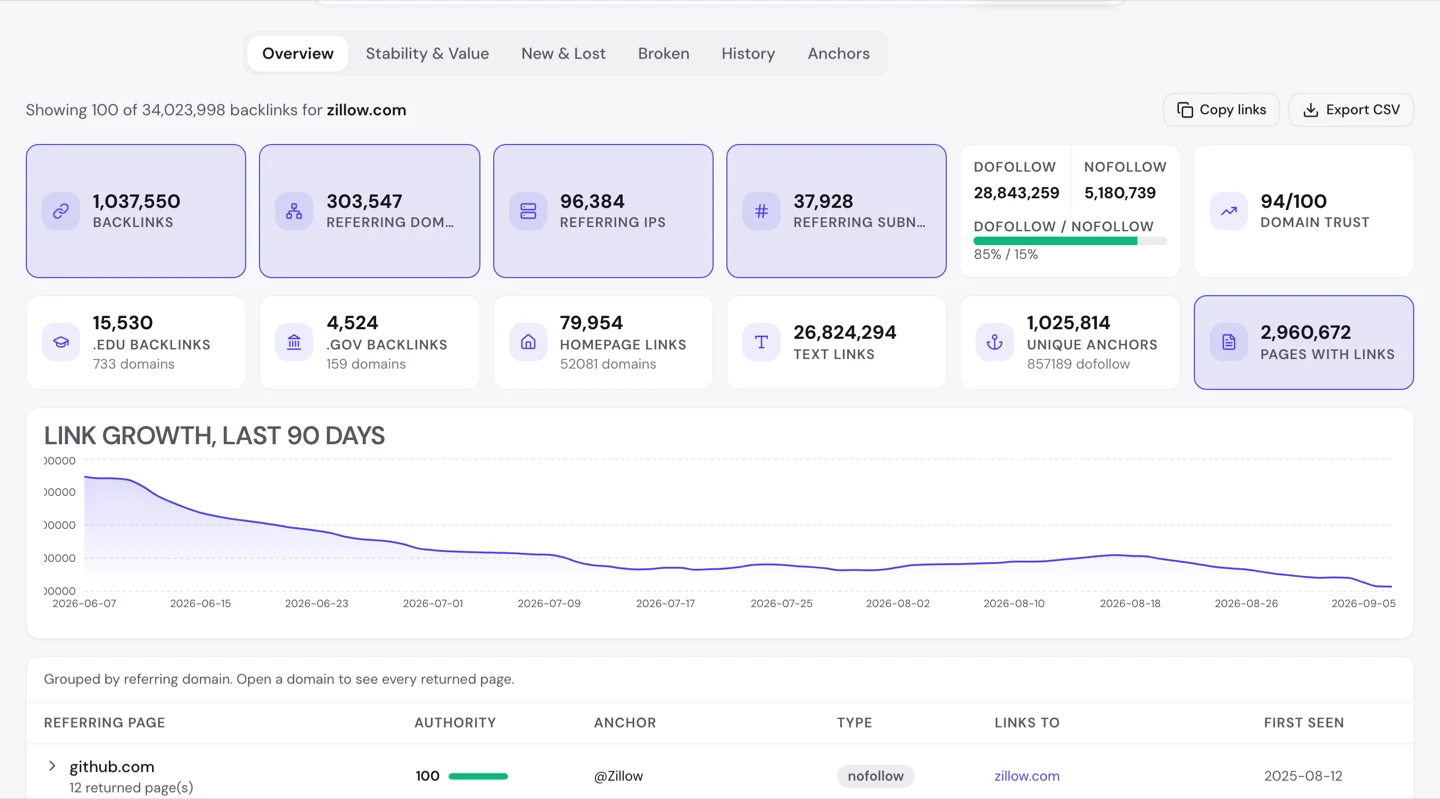
One figure to treat carefully: 16 days earlier we measured 340K referring domains, so this is down about 12%. We cannot tell from outside whether that is a real loss or the provider recounting, so both dates are reported rather than the drop — and you should apply the same caution to your own link graph.
Zillow keeps a page long after the sale ends, because the search demand outlives the listing. Most large catalogues get this backwards and delete their best assets. We plan the whole lifecycle before you build.
- We design the URL and retirement plan first
- Catalogue sites built to stay crawlable
- SEO and GEO across the whole estate
- Free consultation to review your setup
Always start at robots.txt
A small thing worth copying, and a trap if you are auditing a competitor.
zillow.com/sitemap.xml returns a 404. So does sitemap_index.xml. Check the conventional path and stop, and you will conclude Zillow has no sitemap at all — the opposite of true.
Everything is declared in robots.txt instead, across 15 indexes named for what they hold. Each feed regenerates on its own cadence, and a crawler learns the taxonomy before it fetches anything.
So always start at robots.txt, both when you audit a competitor and when you review your own site. It is the only place a site is obliged to declare its sitemaps.
And name your own indexes after their contents while you are there. It costs you a naming convention and it tells every crawler what your site is before it downloads a byte.
Check the 40 links on your front door
Our Website Audit scores zillow.com 80/100, with nothing critical but 5 warnings.
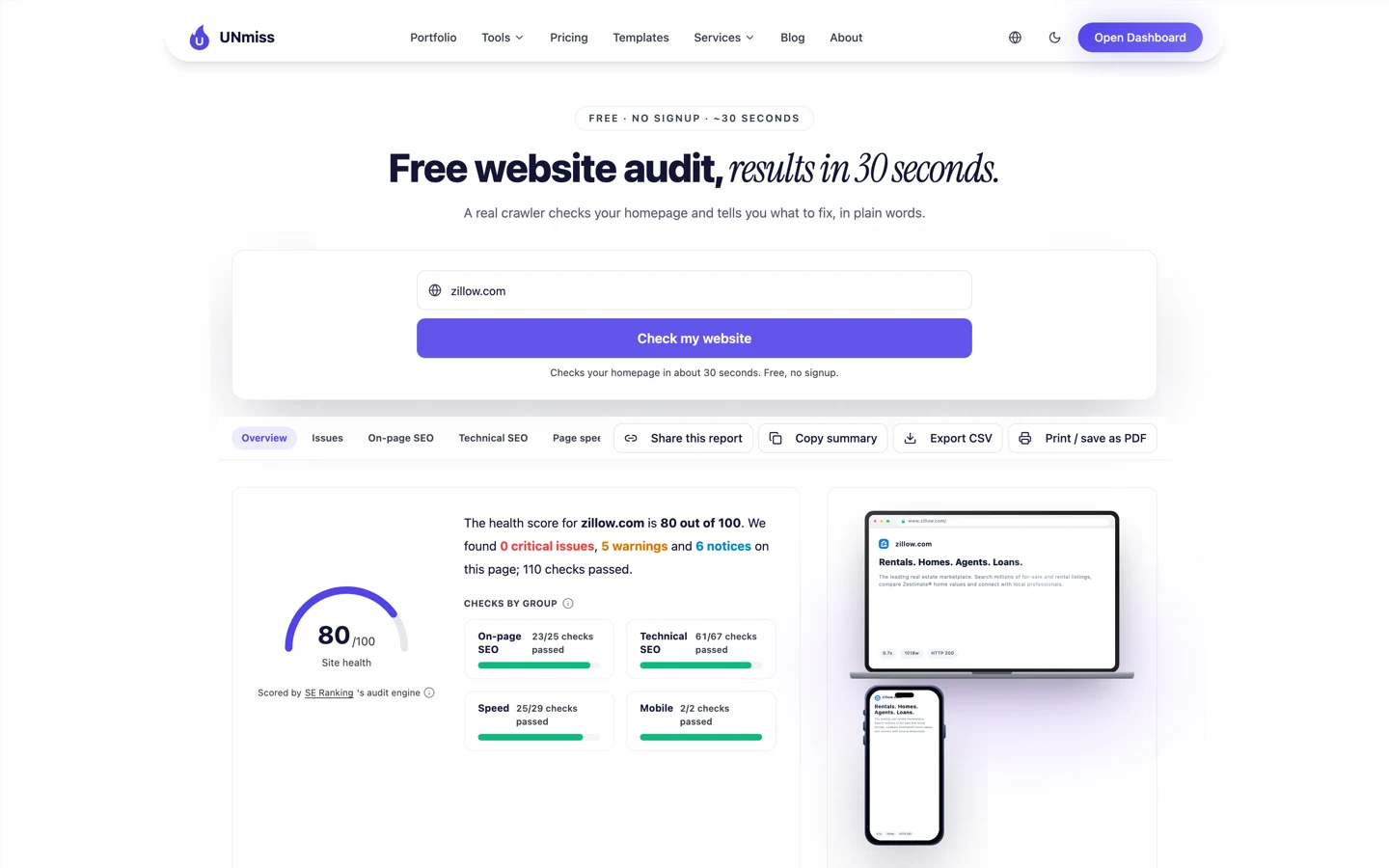
Sixteen days earlier the same check returned 88 with 3 warnings. You can lose 8 points in a fortnight without shipping anything you thought was risky.
The warning worth quoting is the other one: "Outbound links point to dead pages."
On a site whose entire strategy is never deleting a page, the homepage links to pages that are gone.
Which is your reminder to check the 40 links on your own front door. Whatever discipline you have built for the pages you generate does not extend to the ones you hand-wrote, and nobody has looked at your footer since it was made.
We have never seen a Zillow page
And here is the limit that shapes this entire article.
Every direct request to a Zillow page returns 403 Access to this page has been denied — from a plain fetcher and from real headless Chromium alike. We have not loaded a single home-detail page, and we cannot tell you what is on one.
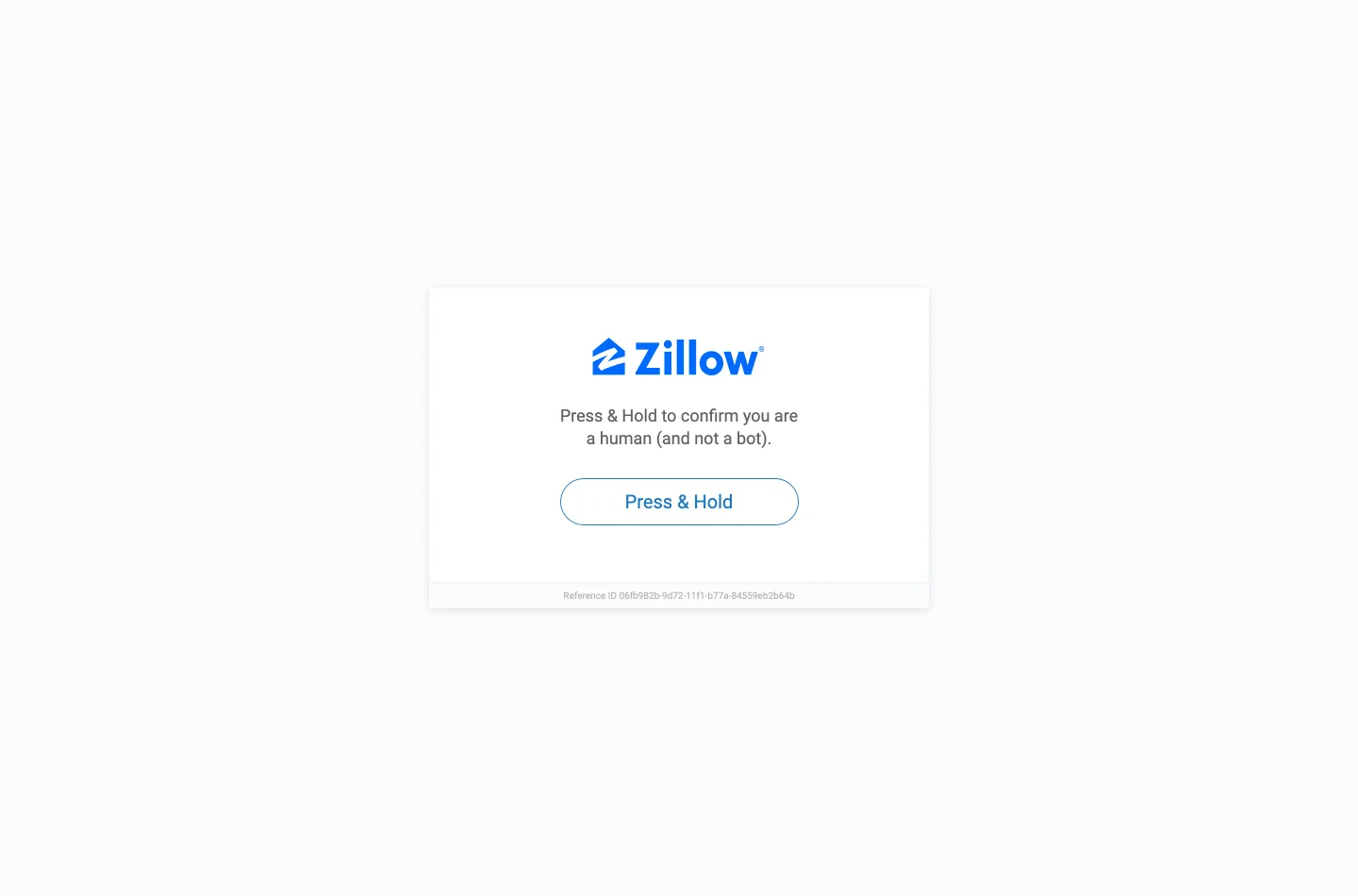
Our Website Audit works only because SE Ranking's crawler reaches Zillow from infrastructure Zillow accepts. Everything else here is a file Zillow publishes deliberately for machines.
So this is a study of what a company declares, not of what it renders. That turns out to be enough, because the taxonomy is the strategy and the taxonomy is public.
Which is the useful thing for you: you can do this to any competitor, however hard they block you. Their robots.txt and their sitemaps are published for machines, and they describe the strategy more honestly than any page you could read.
Zillow has no sitemap.xml, 15 indexes in robots.txt, and a 147:1 split that tells you its whole strategy before you read a single page. Most catalogues give themselves away the same way.
- Walks a sitemap index and counts what a crawler receives
- Pairs with the audit's noindex-in-sitemap check
- Free, no signup, no card
What we could not measure
And here is what this study does not show. A couple of the tools named on this site are partners of ours — if you buy through those links we earn a commission, and you do not pay a cent more.
There is no traffic figure in this article, and that is a failure of our own tooling. Our Domain Overview and Organic Traffic Checker have now been pointed at zillow.com five times across three weeks. They return HTTP 200 and render nothing — no error, no empty state, no message. Every other subject in this series opens on a traffic number; this one cannot, because we do not have one and will not borrow somebody else's. It is on our list to fix.
Declared is not indexed. A sitemap URL is a request, not a result. We make no claim about how many of these 118M pages Google keeps, how many it crawls, or how many earn a visit. Page counts here are page counts, nothing more.
The 118M is an estimate: 5 leaves sampled out of 5,000, multiplied out. We publish every sampled count — 23K to 24K, a 1% spread — so you can check the arithmetic. The recently-sold and for-sale-by-agent figures come from 5 and 3 sampled leaves respectively, and those shards sit at the 50K ceiling, so treat them as floors rather than means.
One of our own numbers on this page is wrong. The Backlink Analyzer's result header reads 34M backlinks and its dofollow and nofollow figures sum to exactly that. The BACKLINKS tile directly beneath reads 1M. The header is right and the tile is a defect in our app — the third time this series has caught it. Quote the header and the split; never the tile.
We did not run Keyword Research: it has an open defect returning implausible volumes. An earlier run of it for this article measured "recently sold homes" at 595 searches a month, which was too thin to build a section on, so it was dropped rather than dressed up.
Frequently asked questions
How many pages does Zillow have?
Its off-market home layer alone is about 118M URLs — 5,000 sitemap files averaging 24K each, with for-sale-by-agent leaves packed to 50K and recently-sold at about 44K — 5,000 sitemap files averaging 24K each, measured 6 September 2026. Add roughly 11M recently-sold, 9.7M building pages and 1.7M for-sale listings. These are declared URLs, not indexed pages.
Why does Zillow keep pages for homes that are not for sale?
Because the address is still a query. A house sold years ago is looked up by neighbours, by the next buyer and by the owner checking its value. Zillow publishes 5,000 sitemap files of off-market homes against 34 of homes for sale — 147 to 1 in favour of the ones nobody can buy.
What share of Zillow's home pages are for sale?
About 2%. Roughly 129M pages cover homes that are off-market or already sold, against about 2M that are actually purchasable.
How many backlinks does Zillow have?
34M from 300K referring domains at Domain Trust 94, 85% dofollow, measured 6 September 2026. That is roughly 1 referring domain per 426 pages — fewer referring domains than Booking.com's 1.4M or Canva's 620K, on a far larger catalogue.
Does zillow.com have a sitemap.xml?
No — both /sitemap.xml and /sitemap_index.xml return 404. All 15 sitemap indexes are declared in robots.txt instead, named by what they hold. Checking the conventional path and stopping would tell you Zillow has no sitemap, which is the opposite of true.
What is Zillow's website audit score?
80 out of 100, with 0 critical issues, 5 warnings, 6 notices and 110 checks passed — 23/25 on-page, 61/67 technical, 25/29 speed, 2/2 mobile, measured 6 September 2026 — down from 88 on 21 August, with two new speed warnings. One standing warning is "outbound links point to dead pages", on a site built never to delete one.
How much search traffic does Zillow get?
We do not have a figure. Our Domain Overview and Organic Traffic Checker have returned no data for zillow.com across five attempts in three weeks — HTTP 200 and an empty render. Rather than quote a third party's estimate, this article carries no traffic number and says so.
Can you crawl Zillow?
We could not. Every direct page request returns 403 from a plain fetcher and from real headless Chromium. Everything in this article comes from files Zillow publishes for crawlers, plus tools whose own crawlers Zillow accepts.
The one number to take away
147 to 1.
That is Zillow's sitemap ratio: 5,000 files of homes nobody can buy against 34 of homes for sale.
Every other catalogue in this series is built around the thing being sold. PyPI publishes a page per package. Goodreads publishes a page per book. Zillow publishes a page per address, and whether that address is currently a product is almost irrelevant to it.
That is the move worth stealing. Look at the records you delete or never publish because they are inactive — closed jobs, discontinued products, past events, former staff, sold listings. Most of them are still searched by name, and most companies take the page down the day the transaction ends.
Zillow does the opposite at a scale nobody has matched, and it does it on fewer referring domains than a design tool. The catalogue is not winning on authority. It is winning by being the only page that exists when somebody types an address.
Measured 6 September 2026. The sitemap census is public and re-runnable — the method is scripts/survey-zillow-sitemaps.mjs in our repo and the raw output is in evidence/surveys/, with every sampled leaf count recorded. Backlink and Website Audit figures are free runs of our own tools; the 21 August comparisons are our own earlier runs. No traffic or revenue figure for Zillow was available to us, and none is claimed.