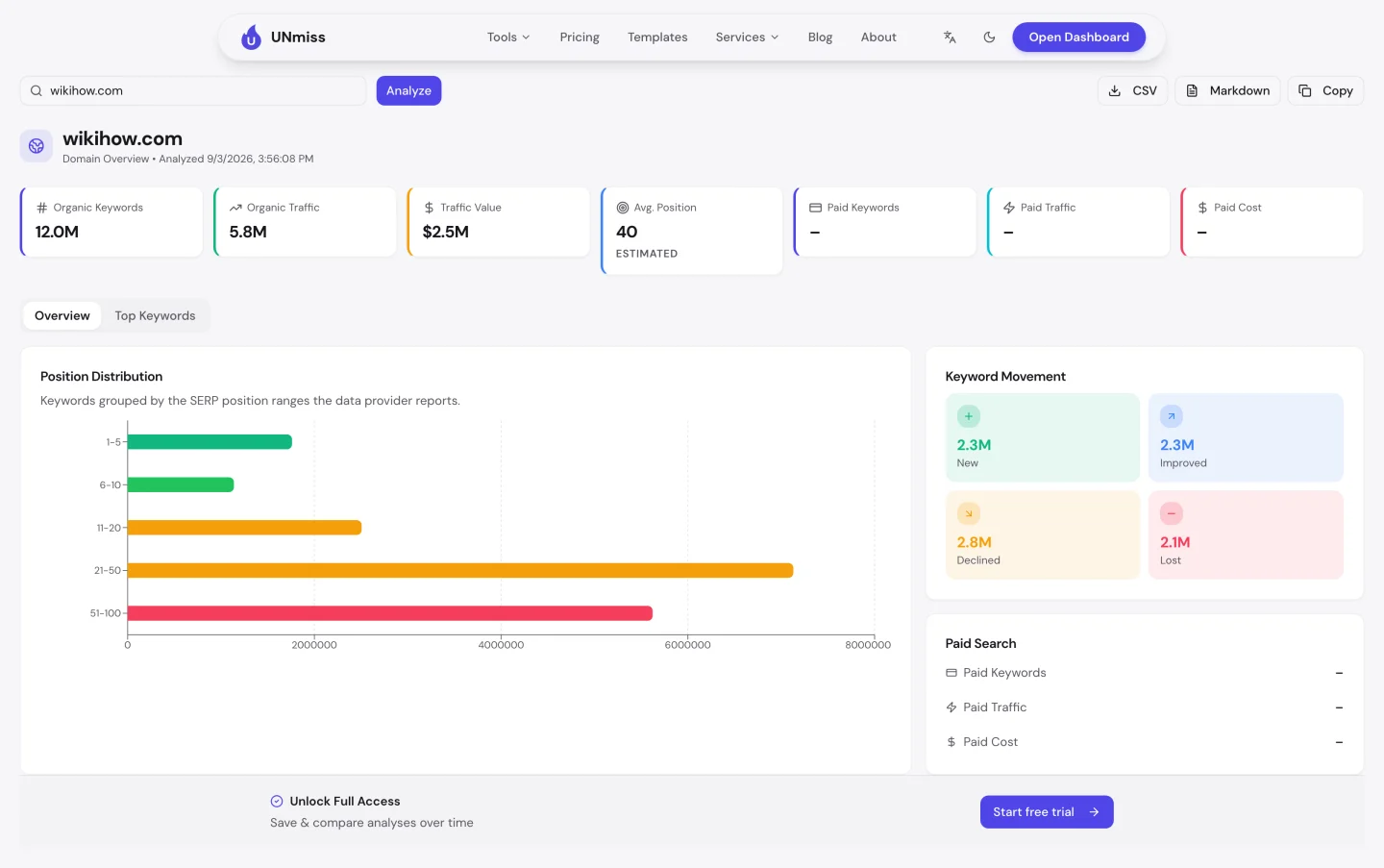
wikiHow's free traffic is worth $2.5M a month, and it spends nothing at all on ads.
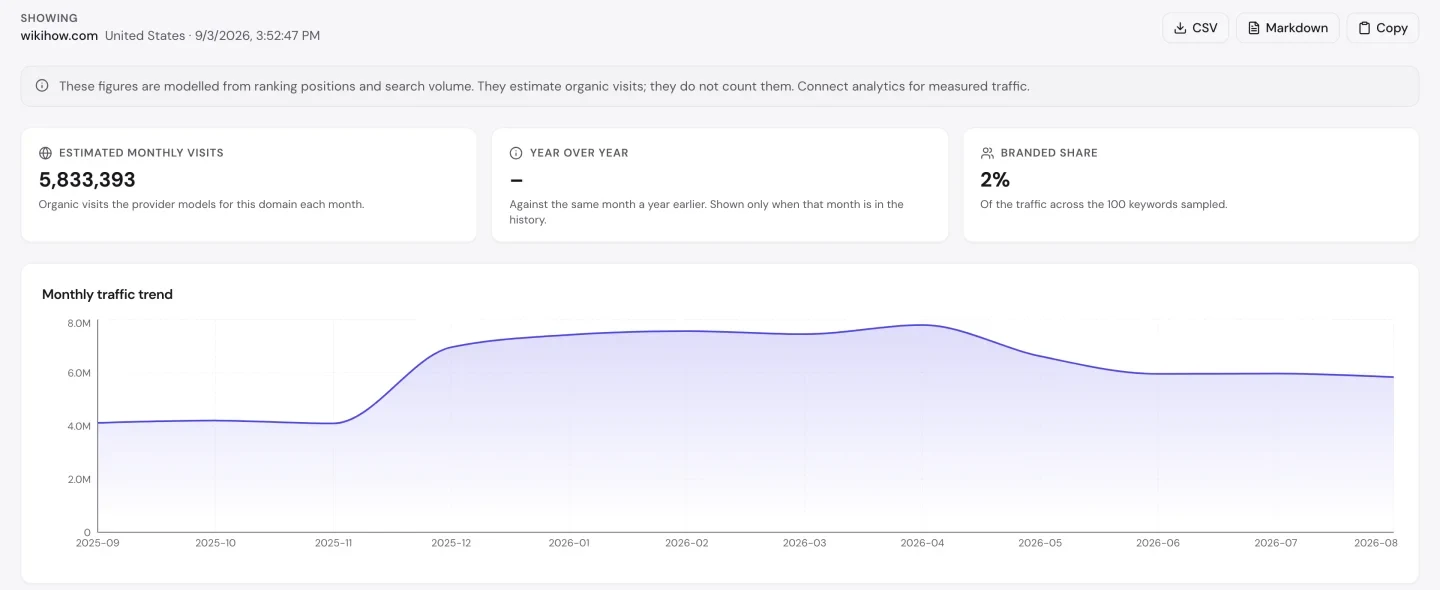
That is 5.8M organic visits a month in the US, spread across more than 62K pages.
Our Domain Overview prices that traffic at $2.5M if you had to buy it, and puts wikiHow's paid spend at zero.
That is free. For a library this size you want the full export rather than the top pages, and Semrush and SE Ranking both hand you every keyword you rank for, which is where the 4-cent problem becomes visible.
I ran wikiHow through five of our tools to find out how a 20-year-old how-to site still earns that in the year chatbots answer how-to questions for free. Here are the 10 things the data shows, including the 2 going wrong — and at each one I will show you the check to run on your own site.
| Metric | wikihow.com | Source |
|---|---|---|
| Traffic value | $2.5M / month | UNmiss Domain Overview |
| Organic traffic (US) | 5.8M / month | UNmiss Domain Overview |
| Organic keywords | 12M | UNmiss Domain Overview |
| Average position | 40 | UNmiss Domain Overview |
| Paid spend | none | UNmiss Domain Overview |
| Branded share | 2% | UNmiss Organic Traffic Checker |
| Referring domains | 460K | UNmiss Backlink Analyzer |
| Domain Rank | 96 / 100 | UNmiss Backlink Analyzer |
| Pages | 63K | wikiHow's sitemap, counted in full |
Check how much of your traffic is your name
Grammarly gets 39% of its organic traffic from people typing its own name. wikiHow gets 2%.
Almost nobody wakes up wanting wikiHow. They want to know how to tie a tie, and wikiHow happens to be the page that answers it. That is a brutal way to run a business — there is no loyal audience to fall back on — but it is also the purest possible test of whether your pages actually deserve to rank.
What to do: check your own branded share in the organic traffic checker. A high number feels good but tells you your SEO is coasting on brand marketing. The non-branded half is the part search actually earned.
Spread your traffic across many pages
Grammarly sends 30% of its traffic to one URL, its homepage. wikiHow's biggest page takes 0.6%. The second takes 0.6%. The fifth takes 0.5%.
There is no head. 63K pages each contribute a rounding error, and the site is the sum of them. That is what a long tail actually looks like when it works, and it is why no single Google update has ever killed wikiHow — there is nothing concentrated enough to lose.
What to do: pull your top pages and add up what your best 5 contribute. If it is more than half, you do not have a content strategy, you have five lucky pages.
Look at what your readers actually want
Here is what I did not expect. wikiHow's highest-traffic pages are not the crafts and the life advice it is famous for. They are:
How to Track a USPS Package. The meaning of "awww". How to Draw. How to Play Quordle. What Does Snapchat Plus Do.
Definitions and trending queries — the same pattern Ahrefs found at HubSpot, where the biggest traffic came from "shrug emoji" and "famous quotes". A site with 20 years of evergreen how-to content earns its biggest single pages from a Wordle clone and an interjection.
Note the USPS page: it ranks #29 and still takes 36K visits a month, because the query is enormous. Position 29 is usually a rounding error. On a big enough term it is a business.
What to do: stop assuming your best pages are the ones you are proudest of. Check which URLs actually earn, then go and find more queries shaped like those.
Publish what a model cannot generate
Ask a chatbot how to tie a tie and it produces seven correct steps in about a second. The words on a how-to page are now the cheapest thing on it.
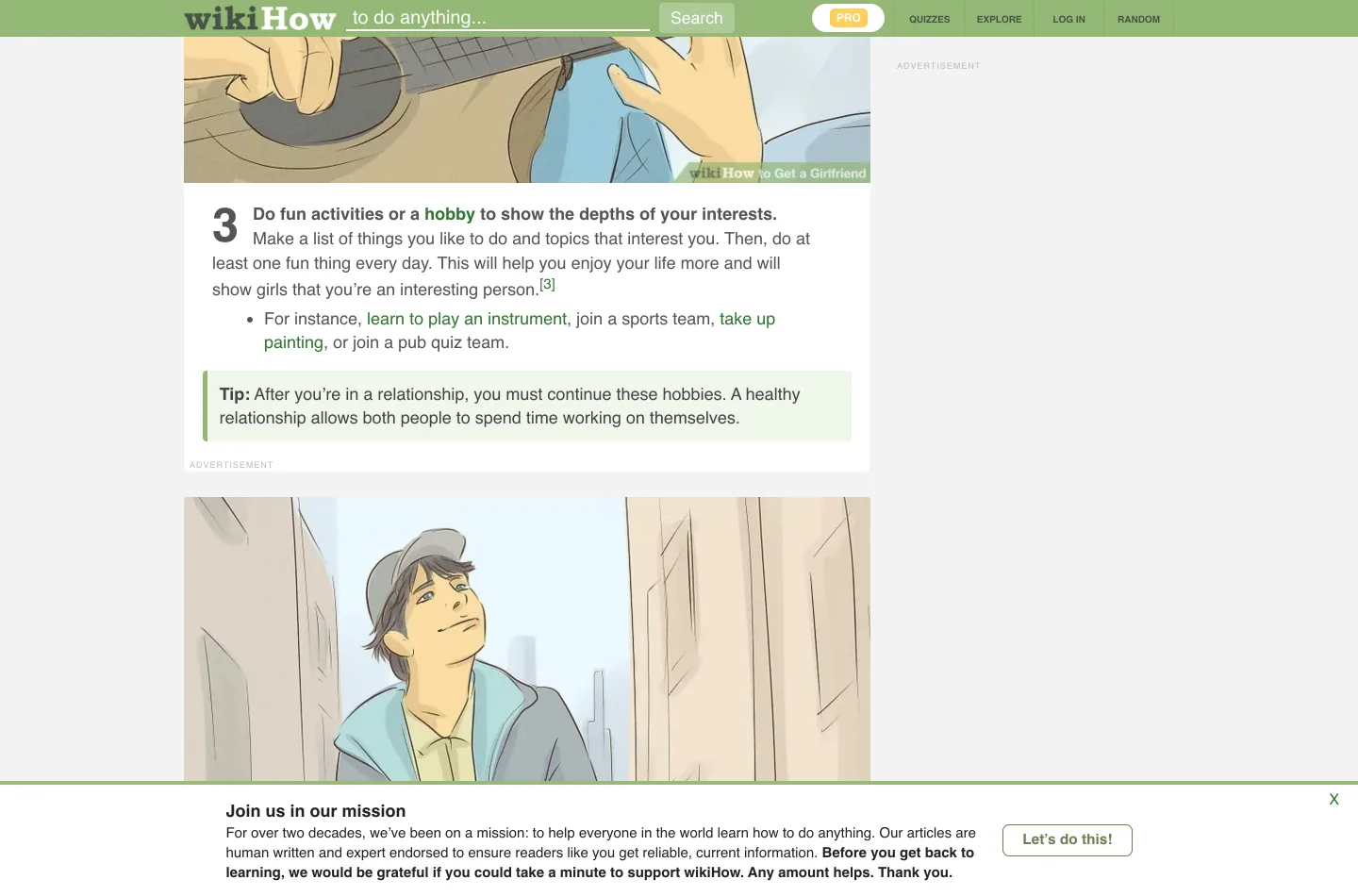
wikiHow's pages survive because the words are not the product. Every step carries a custom picture made for that step — roughly 14 per article, somewhere near 880K in total, commissioned over two decades. Photographed when the task is physical, drawn when it is not, because you cannot photograph "show her you are interesting".
What to do: take your best page and ask what a model could reproduce in one prompt. Whatever is left is your moat. If nothing is left, that page is already commoditised and rewriting it will not help.
Build your own version this week
You are not commissioning 880K illustrations. You do not have to. What you can copy is the discipline: decide what on your page a model could not have produced, then make that the part you actually invest in.
Here is the sequence I would run if this were your site.
1. Find the page worth defending. Take your highest-traffic informational page and paste the topic into an AI visibility check. If the models answer it completely and never name you, that page is already being consumed without the visit. That is the page to rebuild first, not the one you like most.
2. Brief it before you write it. Run the target term through our content brief generator so you know the questions the page has to answer, then draft against that outline rather than against a word count.
3. Add the expensive ingredient. One original photo, one diagram you drew, one screenshot of your own product doing the thing, one number you measured yourself. wikiHow chose a picture per step. You only need something that cannot be typed.
4. Check it does not read as machine-written. Paste the draft into our AI content detector. A page that scores as generated is a page whose text a model can already reproduce — which is the whole problem this article is about. If it flags, our AI humanizer will rewrite the flat passages, but treat the score as a signal to add something real rather than to launder the same words.
5. Score it against what already ranks. Put the finished draft through the content editor and fix what it flags before you publish, not three months later.
That is one page, in an afternoon. Do it to your ten most important pages and you have the habit wikiHow spent twenty years building.
wikiHow earns millions a month from pages that answer a question simply and completely. You do not need its size. You need the same discipline applied to your 50 best topics, and that is a job we do end to end.
- We pick the 50 topics worth owning
- Written, built and published for you
- SEO and GEO so AI answers name you too
- Free consultation before any commitment
Price your keywords before you chase them
$2.5M of traffic value sounds enormous until you divide it by 5.8M visits. That is about 43 cents a visit — and the individual terms are worse.
I ran the "how to tie a tie" family through Keyword Research. Every keyword in it, all 25, prices between $0.00 and $0.12 a click.
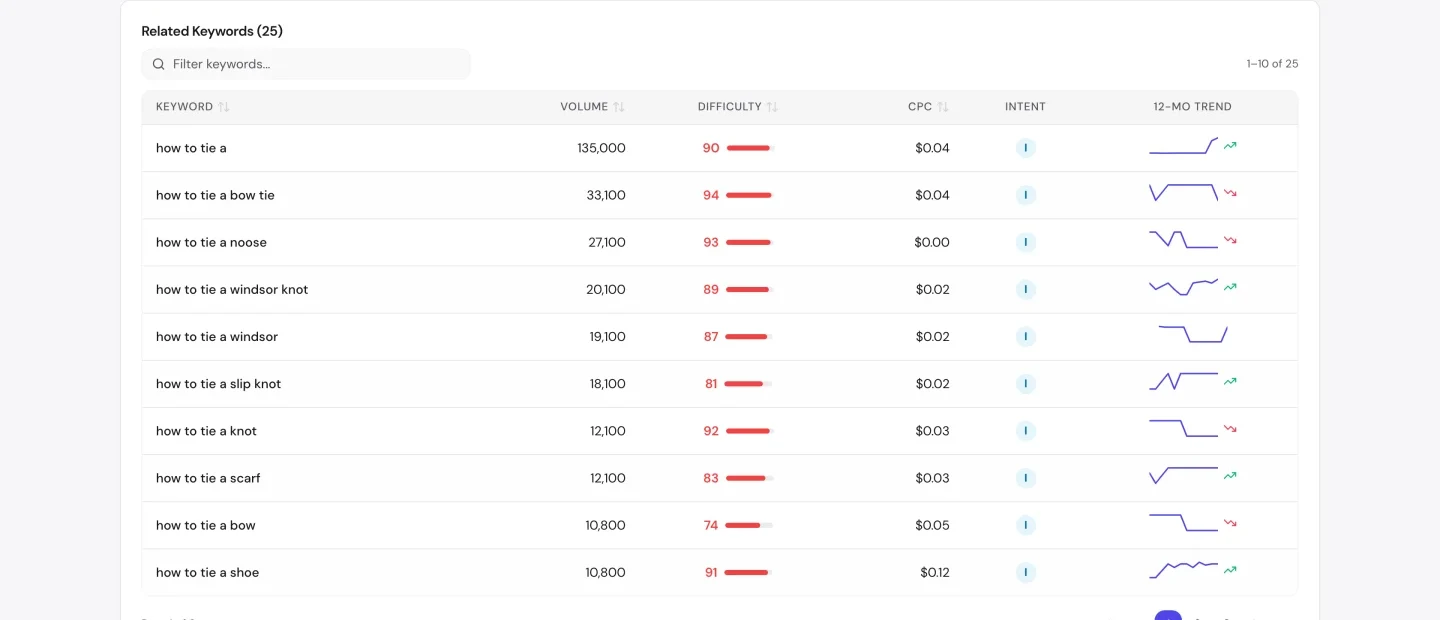
That is the economics of informational content in one screenshot. Nobody bids on "how to tie a noose" — its CPC is literally $0.00. wikiHow's business only works because it collects millions of these, not because any one is valuable.
What to do: before committing to an informational hub, check the CPC on the terms you are chasing. If it is pennies, you need volume at wikiHow's scale for the maths to work, and you should know that before you commission anything.
Expect most of your keywords to rank deep
The Position Distribution chart in the screenshot above is the shape of this whole business. Most of wikiHow's 12M keywords are nowhere near the top 10.
They are stacked deep, between positions 21 and 100, which is why the average sits at 40.
A number that bad would be a crisis on a normal site. Here it is the model working as designed: rank shallowly for a colossal number of things rather than deeply for a few. The traffic comes from the sheer count of positions held, not the quality of any one.
What to do: if your average position is poor but your traffic is fine, do not "fix" it by pruning. Check whether you have accidentally built the same machine.
Read the lost column, not the total
Now the part that is going wrong, and it is visible in the same report.
It gains 2.3M new keywords against 2.1M lost. Of the ones it keeps, 2.3M improved and 2.8M declined.
Add those up and 4.6M keywords are moving up while 4.9M move down. wikiHow is running to stand still, and losing slightly.
The traffic trend agrees. Our own chart peaks around April 2026 and has been sliding since. The moat is holding a position; it is not winning ground.
What to do: track the movement columns, not just the totals. A flat traffic number can hide a site that is replacing its losses rather than growing.
Weigh your images against your speed
880K illustrations arrive with a bill, and our audit shows where it lands: Google PageSpeed of 68 on mobile against 95 on desktop.
Most of wikiHow's audience is on a phone. The one format that makes the site defensible against AI is also the thing making it slowest on the device most people read it on.
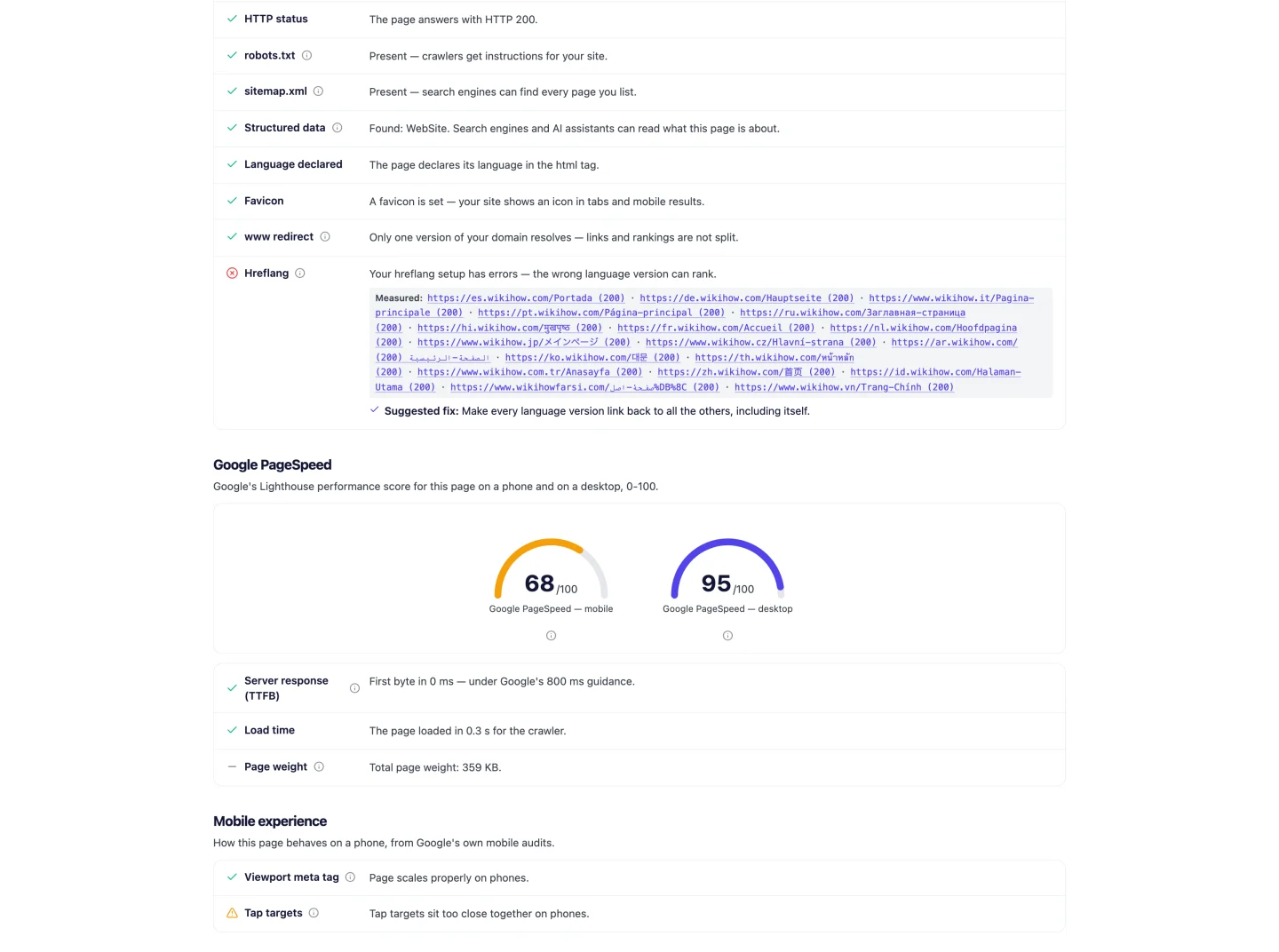
The same report finds a second problem worth more than it looks: wikiHow's hreflang setup has errors, across the 16 language versions it declares. When those tags are wrong the wrong language version can outrank the right one, which quietly costs traffic in every market at once.
What to do: run your own site through the technical audit and look at the mobile score separately from desktop. An average hides the device your readers actually use.
Track links per page, not links
460K referring domains is a big number. It is not the useful one.
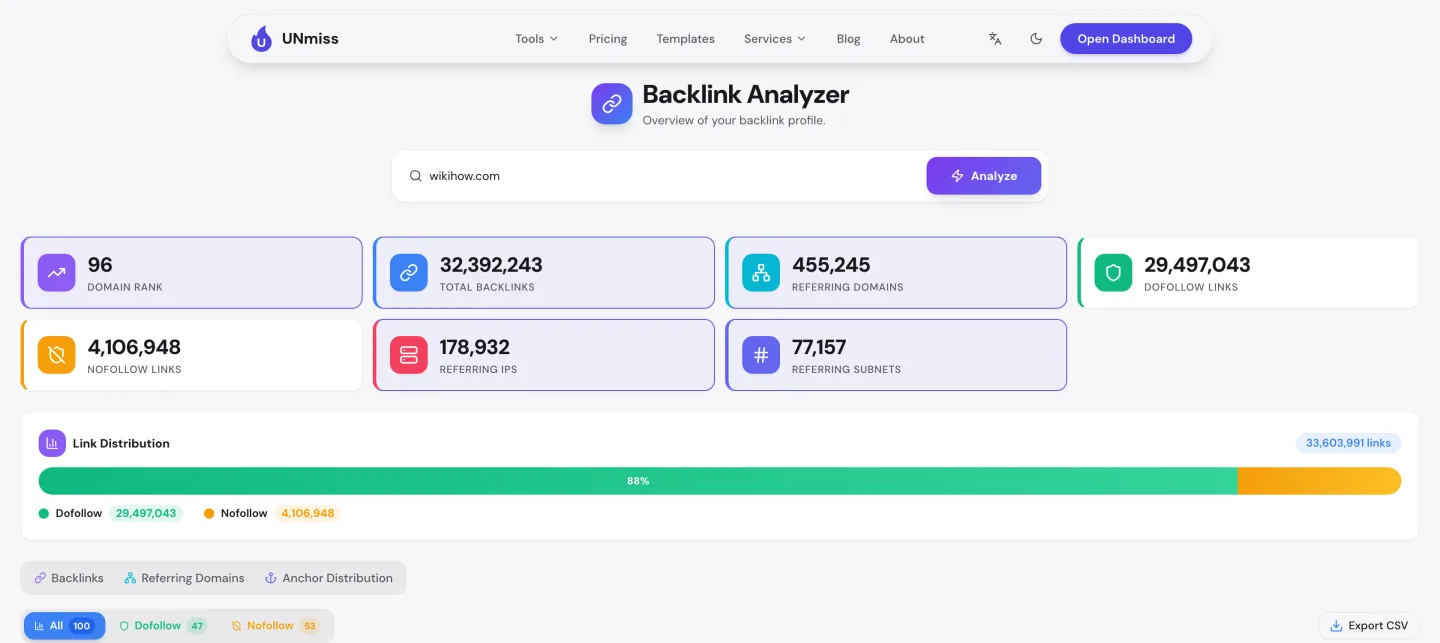
Divide it. wikiHow earns about 7 referring domains per page. Zillow, measured with the same tool, returned Domain Rank 94 from an archive of roughly 118 million pages — a ratio close to zero.
People link to a picture. A forum answer, a teacher's handout, a Reddit reply: when someone needs to show a step rather than describe it, they link to the page that already drew it. Nobody has ever linked to a database row.
What to do: run your domain through the backlink report, divide referring domains by the page count in your sitemap, and watch that number as you publish. If it falls, you are manufacturing pages rather than authority.
What you cannot copy
Twenty years of accumulation. wikiHow started this in the mid-2000s, when pictures were merely expensive rather than strategically brilliant. The library compounded quietly for two decades.
The volunteer engine. A great deal of wikiHow was written and edited by people who were not paid to do it. That is very hard to manufacture deliberately.
And here is what I could not measure, or had to qualify. A couple of the tools I name below are partners of ours — if you buy through those links we earn a commission, and you do not pay a cent more.
Everything from our Domain Overview and Organic Traffic Checker is modelled, not counted. The tool says so on its own face: these figures are estimated from ranking positions and search volume, and the keyword and backlink data underneath them comes from SE Ranking. The $2.5M traffic value is a model on top of a model — it is what the traffic would cost at the CPCs those keywords carry, not money wikiHow received.
Our figures are United States only. Semrush reads wikiHow's global organic traffic at about 23M a month, roughly 4 times our US number. That is what you would expect for a site taking under half its visits from the US, so do not compare the two directly.
The picture count is a floor. I matched images by filename, so an article whose pictures are named differently from its title gets undercounted — the page on boiling an egg serves images named for a different phrasing entirely. The real number is above 880K.
AI referrals are barely visible. That same third-party dataset attributes roughly 27K visits over six months to Gemini, Copilot and Perplexity combined. Against 23M organic visits a month, that is about 0.02%. The moat is defending Google traffic. It has not yet earned anything from the models.
The number that made this article was $2.5M against $0 of ad spend. Domain Overview returns the same three figures for any domain: organic keywords, organic traffic, and what that traffic would cost to buy. It takes about thirty seconds.
- The same report that priced wikiHow's traffic at $2.5M a month
- Organic keywords, position distribution and keyword movement
- 3 checks a day, no signup, no card
Frequently asked questions
How much is wikiHow's traffic worth?
Our Domain Overview prices it at $2.5M a month, against 5.8M US organic visits from 12M ranking keywords, measured 3 September 2026. That is a modelled figure: it estimates what the same traffic would cost to buy through ads at the CPCs those keywords carry. It is not wikiHow's revenue, and no revenue figure for wikiHow was available to us.
How many articles does wikiHow have?
63K as of 22 August 2026. Its sitemap index points at exactly two files: one holding 50K pages, which is the maximum a single sitemap file may contain, and one holding 13K. Because both were counted in full, this is an exact figure rather than an estimate.
Why is its average position 40?
Because it holds shallow rankings across an enormous number of terms rather than deep rankings across a few. Our position distribution shows the mass of its 12M keywords sitting in the 21–50 and 51–100 bands, with comparatively few in 1–5. On a normal site that average would signal a problem; here it is the design.
Is wikiHow's traffic falling?
Mildly, and the composition is worse than the total. Our 12-month trend peaks around April 2026 and declines afterwards. The keyword movement columns show 2.3M new and 2.3M improved against 2.8M declined and 2.1M lost — more going down than up. The third-party estimate reads July 2026 at 43M total visits, up 10% month on month, so the short-term direction depends on which tool and which window you take.
How much traffic does AI send it?
Almost none. The third-party traffic dataset attributes about 27K visits over six months to Gemini, Copilot and Perplexity together — roughly 4,500 a month against 23M monthly organic visits, or about 0.02%. Third-party estimate, not re-verified by us.
What is wikiHow's backlink profile?
On 22 August 2026 our Backlink Analyzer returned Domain Rank 96 out of 100, 460K referring domains, 29M dofollow and 4.1M nofollow links, 180K referring IPs and 77K referring subnets. A third-party index independently reads 460K referring domains for July 2026, within 1% of our count.
How did you count the pictures?
I opened eight articles taken at fixed intervals through the sitemap, so the sample was not cherry-picked, and counted the distinct step images whose filenames belong to that article. The counts were 9, 13, 13, 21, 12, 17, 16 and 10, giving a mean of about 14. Multiplied across 63K articles that is roughly 880K, and it is a floor rather than a ceiling.
What is wrong with its hreflang?
Our Website Audit flags an error across the 16 language versions wikiHow declares, with the consequence that the wrong language version can rank. The fix is the standard one: every language version must link back to all the others, including itself. We have not audited each of the 16 individually.
The one number to take away
$2.5M of traffic, and nothing spent to get it.
Not because wikiHow found cheap keywords — its keywords cost 4 cents because nobody else wants them. Because it put something on 63K pages that a language model cannot produce, and then waited twenty years.
You cannot copy the twenty years. You can copy the decision, and you can copy it this week: find the one part of your page that could not be typed, and make it the part you spend money on.
So go and price your own traffic. If your number is large and your ad spend is zero, you have a moat worth defending. If it is large and you are buying most of it, you have a bill — and now you know which of your pages to rebuild first.
— RH Fardin. Something here you would measure differently? I would genuinely like to know — the tools used are all free, so you can check every figure yourself.
Measured 3 September 2026 unless stated. Domain Overview, Organic Traffic Checker, Keyword Research, Website Audit and Backlink Analyzer figures are free runs of our own tools, all United States scope, and all modelled rather than counted where the tool says so. The article count comes from wikiHow's own sitemap, counted in full on 22 August 2026.
Third-party traffic figures are Semrush and Similarweb estimates for July 2026 and were not re-verified by us. No revenue data for wikiHow was available and none is claimed here.