Nobody decides to spend $5,952 a year on SEO software. It happens one reasonable purchase at a time.
You buy Semrush because you need a site crawl. Six months later a client asks about their link profile and Ahrefs goes on the card. Then someone wants Domain Authority specifically, because that is the number their prospect's PR agency uses, so Moz gets added. Majestic comes in for Trust Flow. SE Ranking arrives because rank tracking on the other plans is capped and the overage pricing is worse than a second subscription.
Five invoices. Nobody ever sat down and approved $5,952.
So we sat down and approved it retroactively — on paper. We priced every subscription a working SEO team is expected to carry, read every number off the vendor's own pricing page on 7 August 2026, and then asked the uncomfortable question: how many of those four jobs can one $99 plan actually do, and which ones does it genuinely fail at?
This is the receipt, the proof for each job, and the part most vendor case studies leave out — the list of things you lose.
A working five-vendor stack lists at $495.99/month, or $5,951.88/year. seotools.pro Business is $99/month, $1,188/year — a difference of $4,763.88 per seat per year. Three of the four jobs moved across cleanly, and we show the output for each. The fourth — index freshness and toxicity scoring — did not, and we say exactly where it breaks.
The receipt, line by line
Every figure below is the monthly list price for the cheapest tier that actually does the job. That qualifier matters. Ahrefs sells a $29 Starter plan, but it caps you at a handful of credits and no site audit, so it is not the plan you would run an agency on — Lite at $129 is. Semrush's cheapest real plan is Pro at $139. Comparing monthly list to monthly list keeps the arithmetic fair on both sides: several of these vendors discount for annual billing, and so do we.
One seat. A five-person content team running the same stack is at $29,759.40 a year before anyone has written a word or built a link.
Four questions, five invoices
Here is the part that makes the number feel less like a coincidence. Strip the branding away and an SEO stack answers four questions. Five subscriptions were covering them, with overlap in the middle and a gap at the edges.
A table like that is easy to draw and easy to fake. So here is the output for each row, from real runs, with the failures left in.
Proof 1: three client sites, built on this stack
The technical health question is the one people are least willing to give up, and fairly so — it is the job with the most moving parts. A demo domain proves nothing about it. What proves something is delivery work at a scale where a broken crawl would be immediately, publicly obvious.
These are three sites our team built and still runs. Each one is published in full, with the numbers and the live URL, so you can go and check the claims against the actual website rather than take a screenshot's word for it.
BeCoin.net — 10,681 URLs, 44 languages, zero index errors
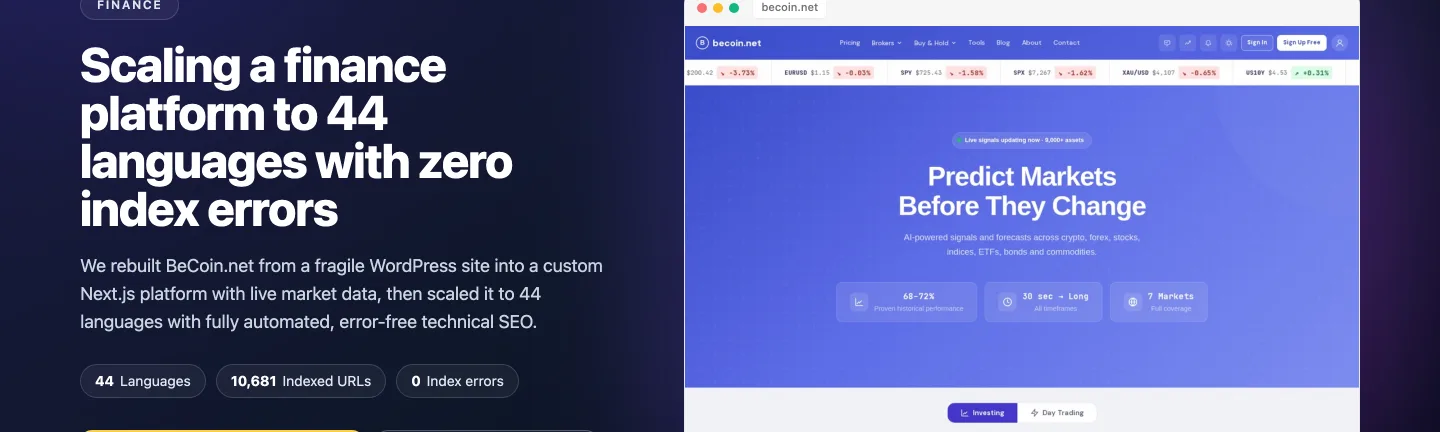
This is the hardest version of the crawl job. 10,681 validated URLs across 44 languages, with 57,070 hreflang alternates and 0 index errors. Hreflang at that volume is where sites quietly break: one missing return tag in one locale and Google starts serving the wrong language, silently, for months.
Catching that is exactly what a $139 site-audit subscription is bought for. It was caught here by making validation part of every build — template-driven canonicals, sitemap indexes and hreflang checks that fail the deploy rather than appear in a dashboard a week later. That is the same job, moved earlier.
DanEri Yachts — 271,947 words and 165 schema pages, after a broken migration
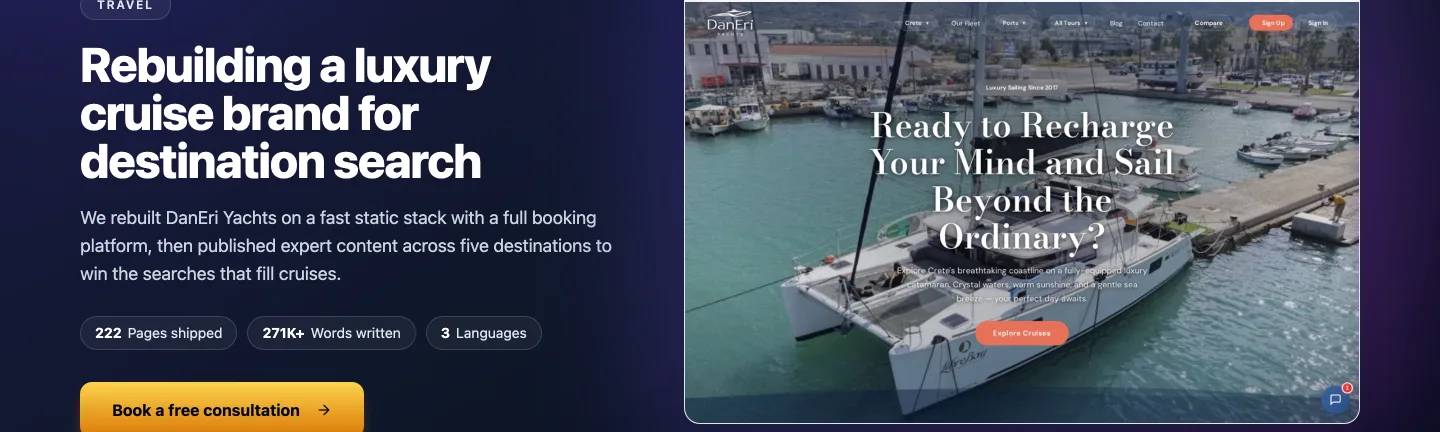
DanEri arrived with the classic post-migration wreckage: redirects pointing nowhere, canonical conflicts, money pages orphaned out of the sitemap. That diagnosis is a crawl, a redirect trace and a sitemap audit — the three things people keep the Semrush seat for.
Then 170 pages, 271,947 words, 71 expert articles and 165 pages carrying schema, planned across 5 destination clusters. The keyword and clustering work behind that is the SE Ranking line item, and it is the job our Keyword Research and Rank Tracker now do on one plan.
sem.chat — 893 indexed pages in 26 languages
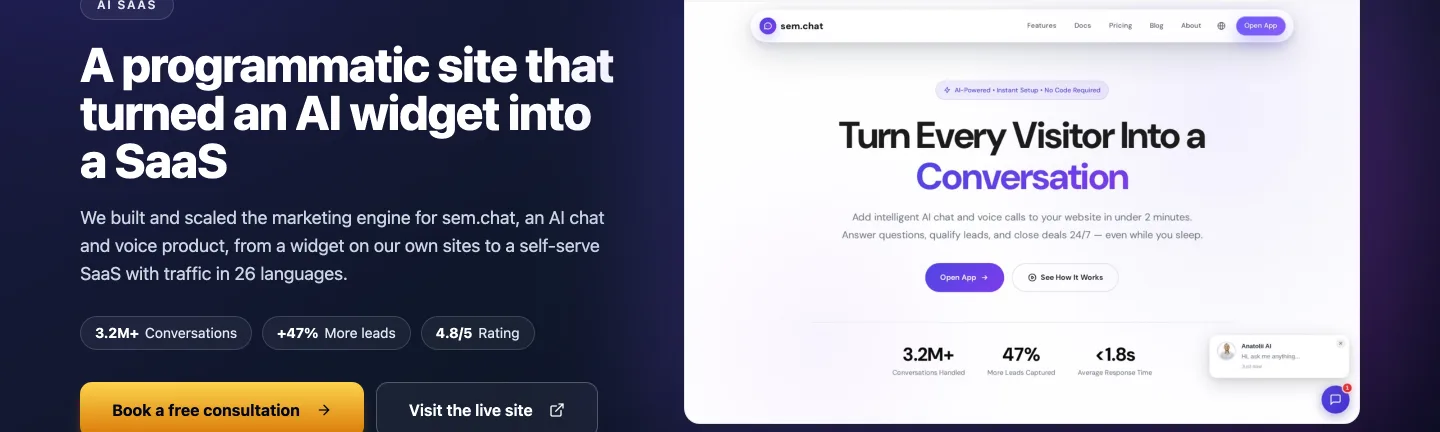
sem.chat is the programmatic case: 893 pages indexed across 26 languages, including 16 competitor-comparison pages and 12 industry landing pages. Publishing at that rate is where duplicate titles, cannibalised clusters and thin templates normally appear, and finding them is squarely a site-audit and keyword-clustering job.
Three sites, four questions, one toolchain. None of that needed a per-seat subscription to five vendors.
One piece of friction worth naming, because we would flag it if a competitor buried it: our Website Audit asks for a name and work email before it runs. There is no account to create and no card, but it is not zero-click, and any comparison that calls it "instant" is overselling. Semrush wants a full signup and a paid plan for the same crawl depth, so the trade still favours us — but the honest description is one form, not none.
Proof 2: the link profile that cost $178.99 a month
Two of the five subscriptions — Ahrefs Lite at $129 and Majestic Lite at $49.99 — existed to answer one question: who links to this domain, and are those links worth anything? $178.99 a month for one question.
We pointed our Backlink Analyzer at moz.com, on the free tier, logged out. Using a competitor's own domain as the test subject removes any suspicion that we picked a site where the data happened to look good.
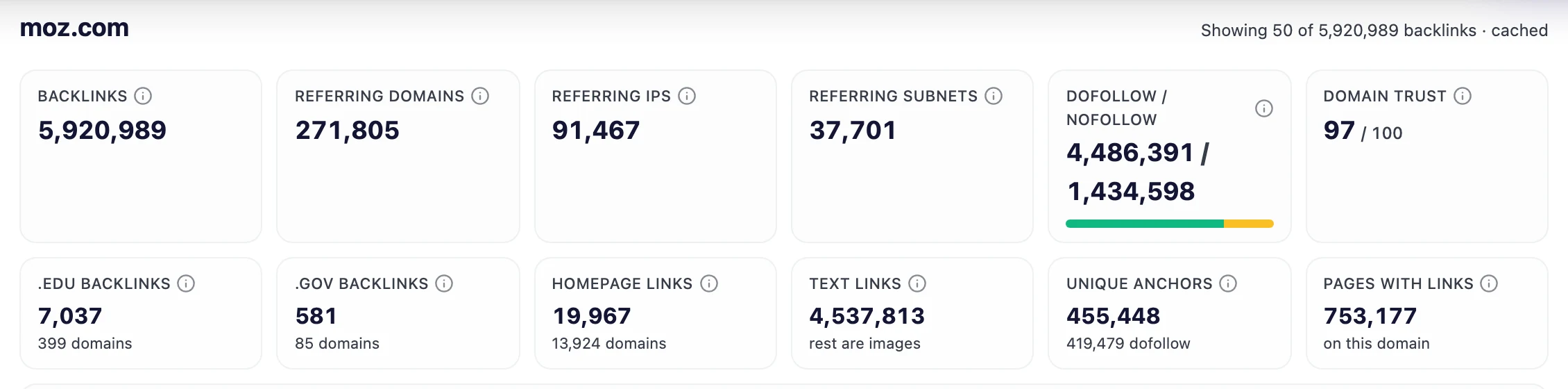
Twelve metrics, free, no signup: total backlinks, referring domains, referring IPs, subnets, the dofollow/nofollow split, .edu and .gov counts, homepage links, text links, unique anchors and linked pages, plus a 0–100 Domain Trust score. That last one is the Moz line item — a single number that answers is this domain worth a link from. It is a different scale to Domain Authority and we do not pretend otherwise, but it drives the same decision.
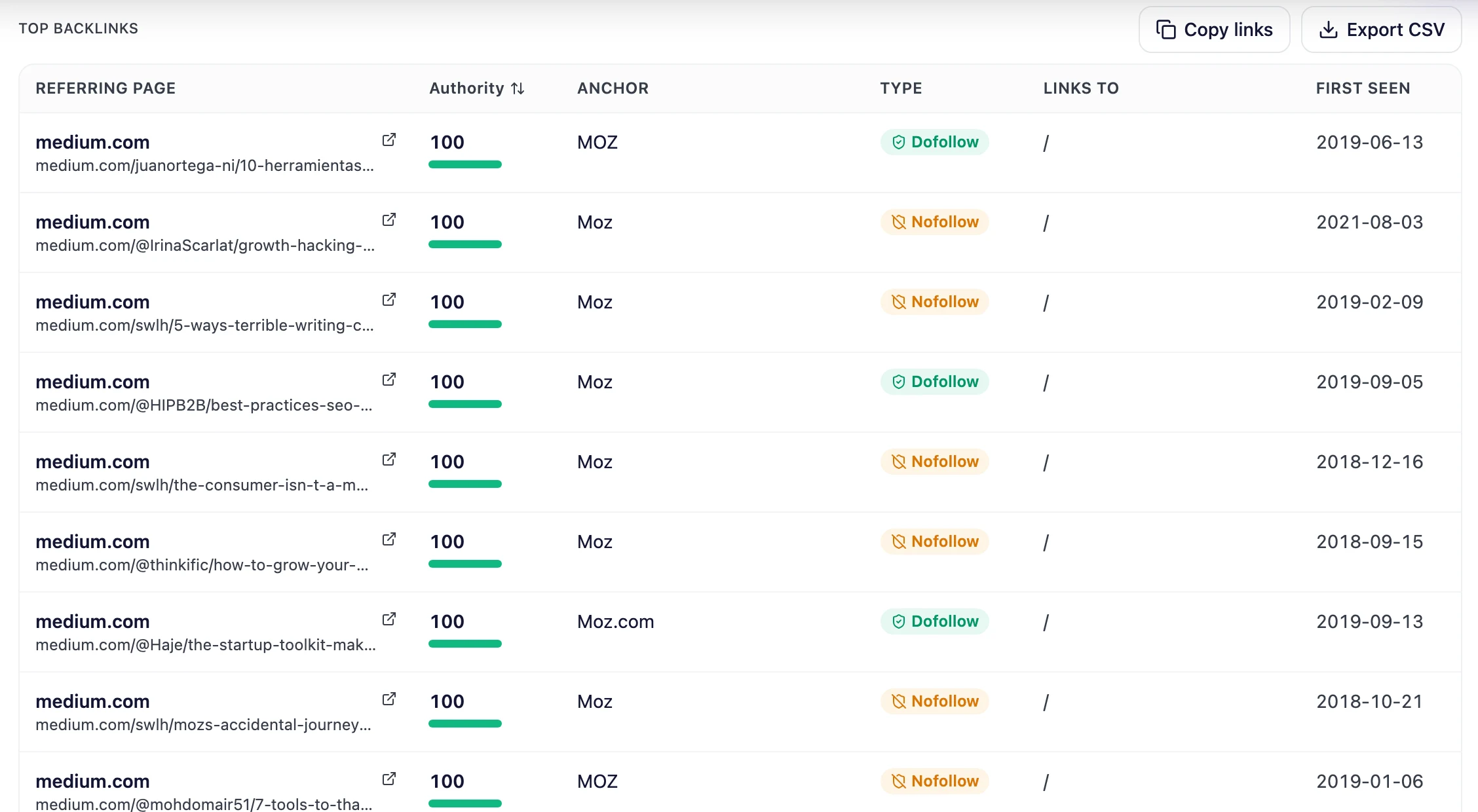
The sample-size line matters more than the metrics do. "Showing 50 of 5,920,989 backlinks" is a tool telling you what it is not showing you. Most free backlink checkers give you a headline count and let you assume the table beneath it is representative. Fifty rows out of 5.9 million is not representative and we print the ratio rather than hiding it.
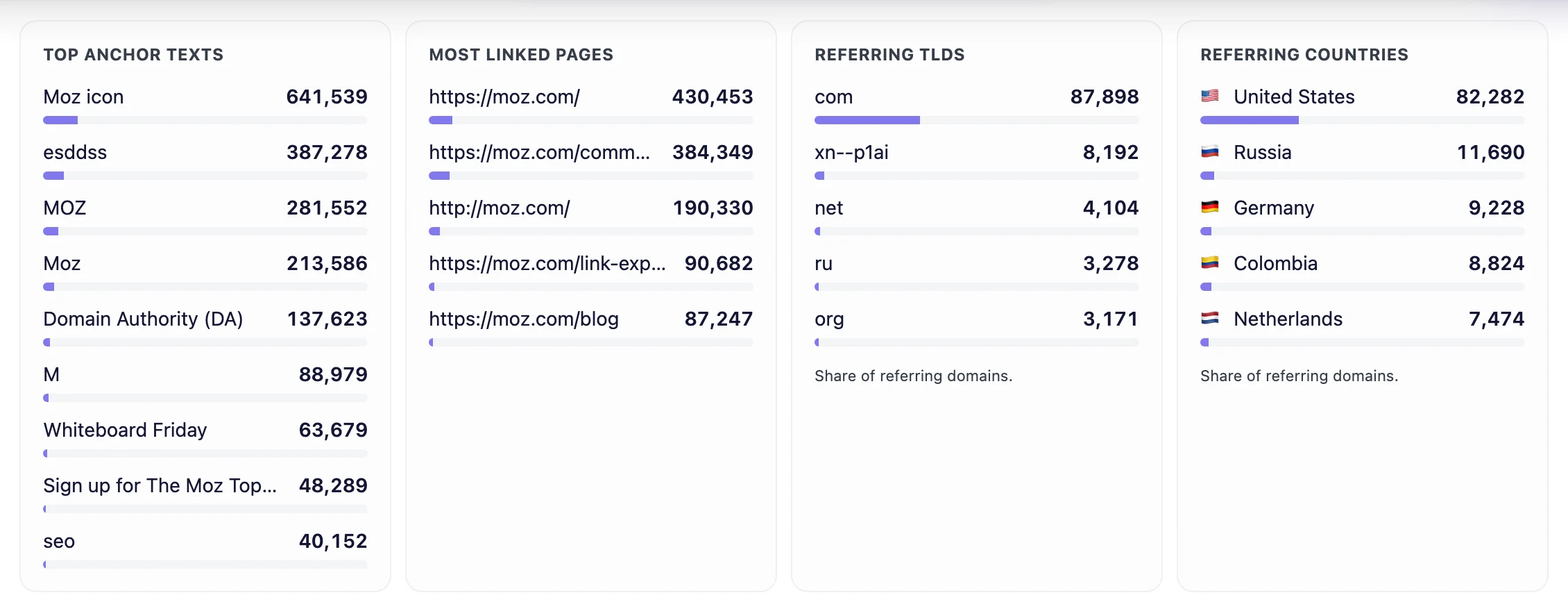
This is the row we are most confident about. Not because our index beats Ahrefs — it does not, and we said so in our own backlink checker comparison — but because for the actual decisions a team makes weekly (is this prospect worth pitching, what anchors are we accumulating, did we lose the link we cared about), $178.99 a month buys precision that the decision does not need.
Proof 3: the indexing pings, with the failures left in
The last row is the one where SEO tooling has the worst reputation, and it deserves it. Free "backlink maker" tools have historically been the purest form of decorative software: submit a URL, watch a progress bar, get told 60 out of 60 succeeded, and receive nothing.
We shipped a fix for exactly that in our own tool this week, because our version was doing the same thing. It counted every attempt as a success. Here is a run from 7 August 2026, pointed at our own blog:
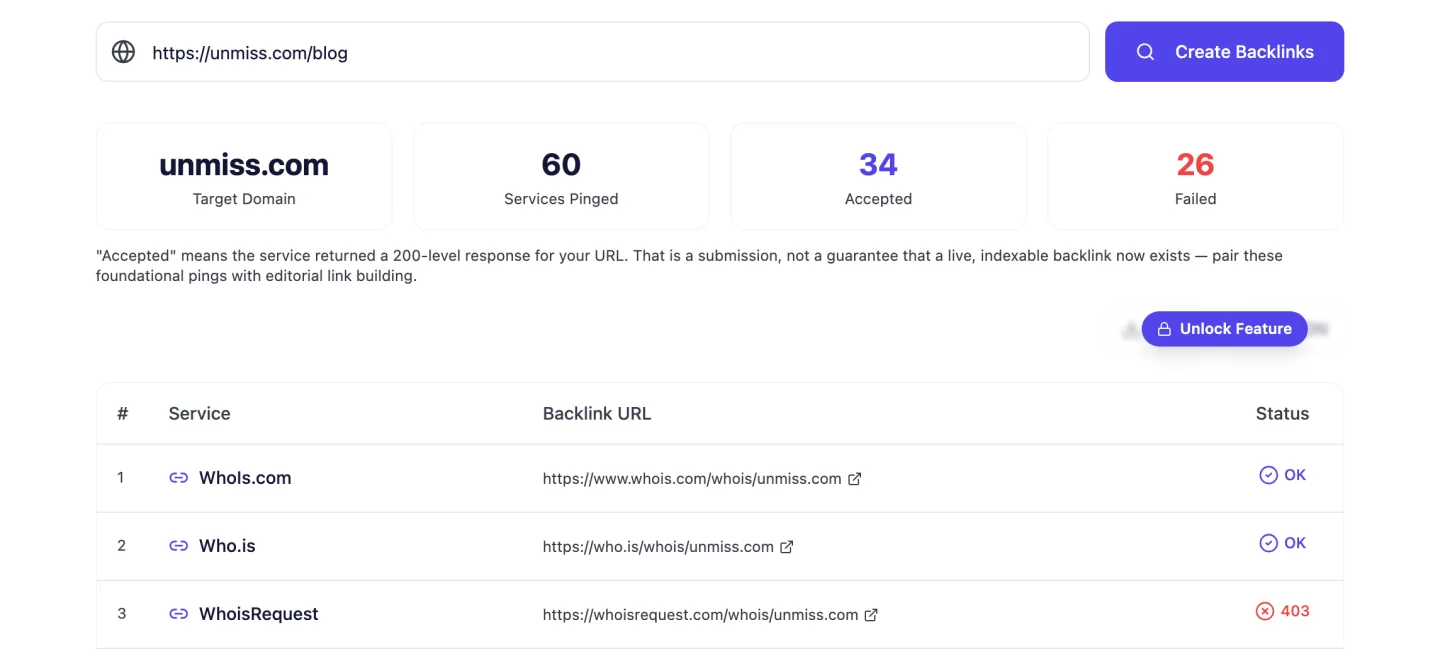
60 services pinged. 34 accepted. 26 failed. Broken down: 9 returned 403, 8 returned 404, 6 failed at the network layer and 3 timed out. The whole run took 37 seconds.
And the line underneath the counters is the one we care about most:
"Accepted" means the service returned a 200-level response for your URL. That is a submission, not a guarantee that a live, indexable backlink now exists.
— the disclaimer printed above every Backlink Maker resultThat sentence costs us conversions. It stays because a tool that reports 60/60 on a run where 26 endpoints returned errors is not a cheaper tool — it is a broken one, and the $5,952 stack at least reports honestly. Matching the price is the easy half. Matching the reporting standard is the half that counts.
The gap, compounded
A monthly difference of $396.99 is easy to wave away as a rounding error on a marketing budget. It stops looking like one somewhere around month four.
By month three the difference is $1,190.97. By month six it is $2,381.94. At twelve months the team that never made the fifth reasonable purchase has $4,763.88 it did not spend, per seat.
The useful way to read that is not "money saved". It is money relocated. $4,764 is a freelance technical SEO for a month, or two good link placements, or the entire content budget for a small site's first year. The stack was consuming budget that the actual work needed.
Where the expensive tools still win
This is the section that should make you trust the rest of the article, or stop reading it. Three of the four rows moved. Here is precisely what did not.
Five capabilities do not survive the move. Each one is a real reason to keep paying, and the price next to it is what that capability actually costs.
| Capability | Who wins | Keep paying if… |
|---|---|---|
| Index freshness | Ahrefs $129/mo |
You need a new link spotted within hours — competitive link monitoring, or reactive digital PR. Ahrefs crawls more, faster, and $129 is a fair price for it. |
| Toxicity scoring and disavow files | Semrush $139/mo |
You are cleaning up after a penalty or inheriting a domain with an unknown link history. There is no equivalent here. Buy the month of Semrush — we would. |
| Multi-year historical depth | Ahrefs, Semrush | You report on five-year link or ranking trend lines. That history is expensive to store and we do not carry as much of it. |
| Domain Authority, the metric itself | Moz $49/mo |
Your client, PR agency or media kit is denominated in Moz DA. No substitute score ends that argument — it is a market convention, not a data problem. |
| Zero-click crawling | Nobody, cleanly | You want a crawl with no form at all. Ours asks for a name and email; Semrush wants a full signup and a paid plan. Small difference, but real. |
Read that as a decision rule rather than a scoreboard. If your work lives in that table — penalty recovery, link monitoring at hourly resolution, DA-denominated reporting — the $5,952 stack is doing something for you, and this article is not an argument to cancel it.
What did move across is narrower and duller, which is why we would rather list it than hint at it: the recurring site crawl with Core Web Vitals and a prioritised fix list; the link profile check with 12 metrics, 50 live rows and 4 distributions with the sample size stated; a domain-strength score in that same report; keyword research and rank tracking, local included, on one plan; and failure reporting that prints 26 failures instead of inventing 60 successes.
That is four jobs out of four covered, with five specific capabilities lost. Most teams' work sits entirely in the covered half — which is the only reason the arithmetic at the top means anything.
What we actually run, and what we still pay for
The honest ending to a cost study is not "we spend nothing now". We moved the cost; we did not delete it.
Underneath our tools sits paid third-party data. Backlink and SERP data is licensed at the API layer. Performance and Core Web Vitals data comes from Google's PageSpeed Insights. The AI features run on a paid model API. Those bills are real and they arrive every month.
What changed is the shape of the bill. Five vendors charging per seat became one data cost amortised across every user of the platform. That is the entire mechanism, and it is not magic — it is the difference between retail and wholesale. A ten-person agency buying five subscriptions each is paying the retail markup fifty times.
Which means the fair claim is narrow, and we will make only that one: for the four jobs above, at team scale, buying access once beats buying five seat licences. Not "our data is better than Ahrefs'". It is not.
How to price your own stack in an afternoon
Do not take our arithmetic. Do yours — it takes about two hours and the number is usually worse than people expect.
- List every SEO subscription on the card, including the ones one person uses. Annualise each. Multiply by seats.
- Write the question each one answers in a single sentence. Not the feature list — the question. Most stacks collapse to four or five questions.
- Circle the duplicates. If two tools answer the same question, one of them is a preference, not a requirement. That is fine, but price the preference.
- Run the free tier of the alternative on your own domain — not a demo. Website Audit for the crawl, Backlink Analyzer for the link profile. Compare the outputs side by side, on the same domain, on the same day.
- Write down what breaks. If nothing breaks, you found the duplicate. If something breaks, you just learned exactly what you are paying for — which is worth knowing even if you keep paying it.
Step five is the one people skip, and it is the only step that makes the exercise honest. A tool audit that concludes "cancel everything" was not an audit.
- Site crawl with Core Web Vitals and prioritised fixes
- 12 link-profile metrics and 50 live backlink rows, with the sample size stated
- A 0–100 domain strength score for prospecting decisions
- CSV export on the free tier
Frequently asked questions
How much does a full SEO tool stack cost per year?
Priced on 7 August 2026 at each vendor's own monthly list price for the cheapest genuinely usable tier: Semrush Pro $139, SE Ranking Core $129, Ahrefs Lite $129, Majestic Lite $49.99 and Moz Pro Standard $49 — $495.99 a month, or $5,951.88 a year, per seat. Annual billing lowers several of those. Cheaper tiers exist on most of these platforms but cap credits or drop the site audit entirely, which is why they are not in the total.
Can one tool really replace Semrush, Ahrefs, Moz and Majestic?
For three of the four jobs those subscriptions cover, yes, and this article shows the output for each. For the fourth — index freshness at hourly resolution and toxic-link cleanup with a disavow file — no. If that is your work, keep the subscription. We would rather lose the sale than have you find out after switching.
Is Domain Trust the same as Moz Domain Authority?
No. Both are 0–100 estimates of how strong a domain's link profile is, and both are third-party approximations rather than anything Google publishes, but they are computed differently and the numbers are not interchangeable. They support the same decision — is this domain worth a link from — but if your reporting is contractually denominated in Moz DA, you still need Moz.
Why does the Backlink Maker report failures instead of hiding them?
Because the alternative is a lie. In the run shown above, 26 of 60 endpoints returned errors — 9 returned 403, 8 returned 404, 6 failed at the network layer and 3 timed out. A tool that displayed 60/60 for that run would be reporting fiction. The counters also carry a disclaimer that "accepted" means a 200-level HTTP response, not a guaranteed live indexable link, because those are genuinely different things.
What is the cheapest way to audit a website for free?
Run the free Website Audit on your homepage — it crawls the page, pulls Core Web Vitals from Google's data, and returns a prioritised fix list rather than an undifferentiated warning dump. It asks for a name and work email before it runs; there is no account and no card. For the link side, the Backlink Analyzer needs neither.
Does seotools.pro still pay for third-party SEO data?
Yes. Backlink and SERP data is licensed at the API layer, performance data comes from Google PageSpeed Insights, and the AI features run on a paid model API. Nothing here is free to produce. The saving is structural: one wholesale data cost amortised across the platform instead of five retail seat licences per person. That is the whole mechanism, and it is worth being clear that it is a pricing-model difference, not a claim that our index beats Ahrefs'.
Is this comparison fair, given you make one of these tools?
We make one of them, so weigh it accordingly. What we can offer instead of neutrality is checkability: every price came from the vendor's public pricing page on 7 August 2026 and can be re-read in a browser, every screenshot is a real run with the failures left in, and the limits section names four specific capabilities where paying more is the right call. Our own backlink checker comparison ranks Ahrefs above us on index freshness. Check the numbers rather than trusting the conclusion.
The verdict
The $5,952 was never a decision. It was five reasonable purchases that nobody added up, answering four questions with a lot of overlap in the middle.
Adding them up is the whole exercise. Once the stack is one number on one line, the question stops being "which tool is best" — an unanswerable question — and becomes "what is each of these five bills actually buying me, and would I approve it today". For most teams, three of those bills survive the question in a different form and one or two do not survive at all.
Start with your own crawl and your own link profile, on your own domain, this afternoon: Website Audit and Backlink Analyzer are both free and both print what they do not know. Then go and read your own invoices.