Every backlink checker will happily tell you a number. The hard part is knowing whether that number means anything — and whether the tool that produced it is the right one for the job you are actually doing.
Backlinks still separate page one from page two. In Backlinko's study of 11.8 million Google results, the #1 result had 3.8× more backlinks than positions 2–10. And links do not stay put: Ahrefs sampled 2,062,173 websites and found that 66.5% of the links pointing to them since 2013 have rotted away. A backlink checker is how you find out what you have, what you lost, and what your competitors have that you do not.
I tested the 8 best backlink checker tools for 2026 — free and paid — on the things that decide a real decision: how big and how fresh the index is, which authority metric it speaks, whether it tracks new and lost links, whether it flags toxic ones, and exactly how much you get before the paywall. Every price below was read from the vendor's own pricing page in August 2026, and where I could not verify something first-hand, I say so instead of guessing.
For a fast, honest look at any domain's link profile, start with the seotools.pro Backlink Analyzer — 12 profile metrics, 4 distribution breakdowns and 50 live backlink rows, free, with no signup. For the freshest index and the deepest prospecting filters, Ahrefs leads. For toxicity cleanup and a disavow file, Semrush and SE Ranking are the strongest. For pure link forensics at the lowest serious price, Majestic. If your market speaks Domain Authority, you still need Moz.
Those four numbers frame the whole category. Links correlate with rankings, so you need to measure them. Links rot, so a one-off snapshot ages badly. Link authority now correlates with being cited in AI answers too (Pearson 0.65 across 1,000 domains), so the stakes went up in 2026. And Ahrefs' own disavow experiment cost one page about 18% of its search traffic in the first month — which is the best argument going for not trusting any single toxicity score blindly.
Google defines link spam as creating links “primarily for the purpose of manipulating search rankings.”
— Google Search Central, Spam policies for Google web searchHow we tested and chose these tools
There are dozens of backlink checkers. Every tool below was judged on the same seven things:
- Index size and freshness. How many links the vendor claims to know about — and, more importantly, how often that index is refreshed.
- Authority metric and scale. Which score it reports, on what scale, and whether that score is the one your market speaks.
- New and lost link tracking. Can it tell you what changed, or only what exists today?
- Toxicity and disavow. Does it flag risky links, and can it build a disavow file?
- Competitor analysis. Link gap, link intersect, or nothing at all.
- The free tier ceiling. How many rows you actually see before the paywall — and whether you need an account to see any.
- Honest price. The real entry price today, monthly and annual, not the number a two-year-old listicle remembers.
Every vendor counts differently. Semrush and Ahrefs report total backlinks; Majestic splits its data into a rolling Fresh index and a Historic archive going back to 2006, so its two numbers answer two different questions. Vendors also disagree on what counts as a "backlink" and how long a dead link stays in the index. Treat the figures below as a rough sense of scale, never as a league table.
The 8 best backlink checker tools at a glance
Most comparison articles publish a table of prices. The two columns that actually decide your choice — which authority metric the tool speaks and what the free tier really gives you — are the two nobody prints. So they lead here.
| Tool | Best for | Authority metric & scale | Free tier ceiling | Cheapest paid |
|---|---|---|---|---|
| seotools.pro Backlink Analyzer | A fast, free profile read with no account | InLink Rank 0–100 | 50 rows, 3 checks/day, no signup | Free |
| Ahrefs | The freshest index and the best prospecting filters | Domain Rating / URL Rating 0–100 | Free checker (no login) + Webmaster Tools on verified sites | $29/mo |
| Semrush | Toxicity cleanup and competitor link gaps | Authority Score 0–100 | Free no-login checker; 10 reports/day on a free account | $139/mo |
| SE Ranking | Big fresh index plus monitoring and disavow in one plan | Domain Trust / Page Trust 1–100 | Headline metrics only — 0 rows without signup | $129/mo |
| Majestic | Link-only forensics at the lowest serious price | Trust Flow / Citation Flow 0–100 | Demo profile, 5 bulk rows, Majestic Million — no login | $49.99/mo |
| Moz Link Explorer | Speaking Domain Authority to clients and outreach | Domain Authority / Page Authority / Spam Score 0–100 | 10 queries/month, account required | $49/mo |
| Mangools LinkMiner | Fast, readable link prospecting on a budget | Link Strength (scale unpublished) + CF/TF 0–100 | Permanent free plan, account required | $30.50/mo ($18.85 annual) |
| Ubersuggest | Directional data at the lowest cost, or a lifetime licence | Domain Authority / Page Authority / Spam Score | Permanent free account, few searches/day | $12/mo (promotional) |
And the capability matrix — the yes/no questions that eliminate a tool before price ever enters the conversation:
| Tool | New & lost links | Toxicity score | Link gap / intersect | Disavow export | URL-level analysis | No-login free surface |
|---|---|---|---|---|---|---|
| seotools.pro Backlink Analyzer | No | No | No | No | No | Yes |
| Ahrefs | Yes | No | Yes | Yes | Yes | Yes |
| Semrush | Yes | Yes | Yes | Yes | Yes | Yes |
| SE Ranking | Yes | Yes | Partial | Yes | Yes | Metrics only |
| Majestic | Yes | No | Yes | No | Yes | Yes (limited) |
| Moz Link Explorer | Yes | Yes | Yes | Yes | Yes | No |
| Mangools LinkMiner | Yes | No | No | No | Yes | No |
| Ubersuggest | Yes (30 days) | Yes | Yes | No | Yes | No |
Entry prices are in USD and were read from each vendor's own pricing page in August 2026. Three things changed that most articles still miss: Mangools removed its cheap "Entry" plan (many listicles still quote $19.90), SE Ranking's pricing moved to /pricing.html — the old /prices.html URL now 404s — and Ubersuggest's headline prices are currently promotional, with the vendor's own comparison strip citing a $29–$99 range. Always confirm on the tool's own site before you buy.
The 8 best backlink checker tools, ranked
1. seotools.pro Backlink Analyzer: Best Free Profile Check With No Signup (Our Pick)
Most free backlink checkers show you three numbers and a "sign up to see the rest" wall. seotools.pro shows you the profile.
Type a domain and you get 12 profile metrics in one screen: total backlinks, referring domains, referring IPs, referring subnets, the dofollow/nofollow split, Domain Trust, plus .edu and .gov link counts, homepage links, text-vs-image links, unique anchors and how many of your own pages carry links. No account, no email, no card. The data is live from SE Ranking's commercial link index — the same paid dataset behind the rest of the platform.
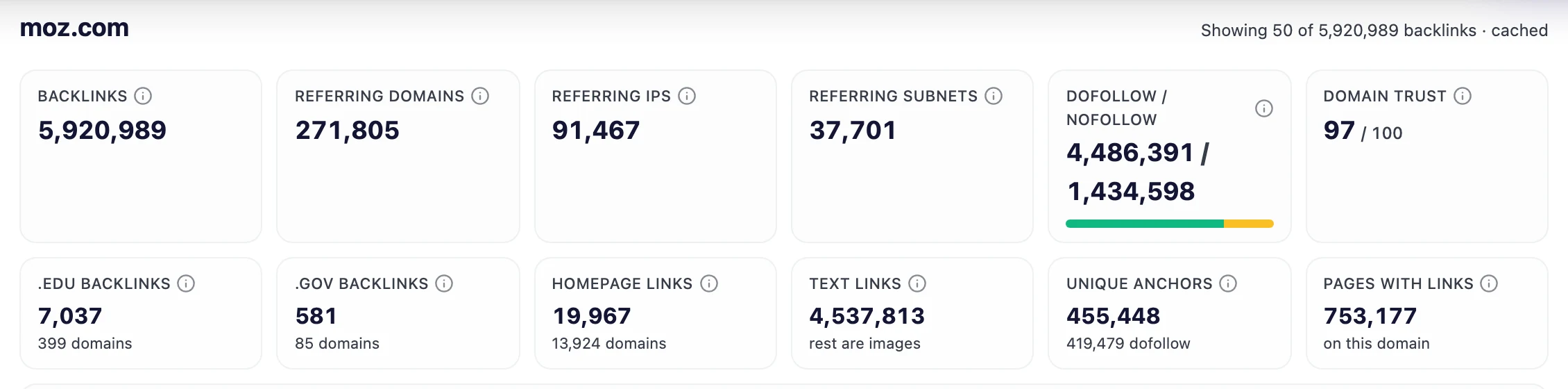
That sample-size line is the detail I would point to first. Every free backlink checker limits how many rows it returns; almost none of them tell you. seotools.pro puts "Showing 50 of 5,920,989" directly above the table, so you always know the difference between the profile and your slice of it.
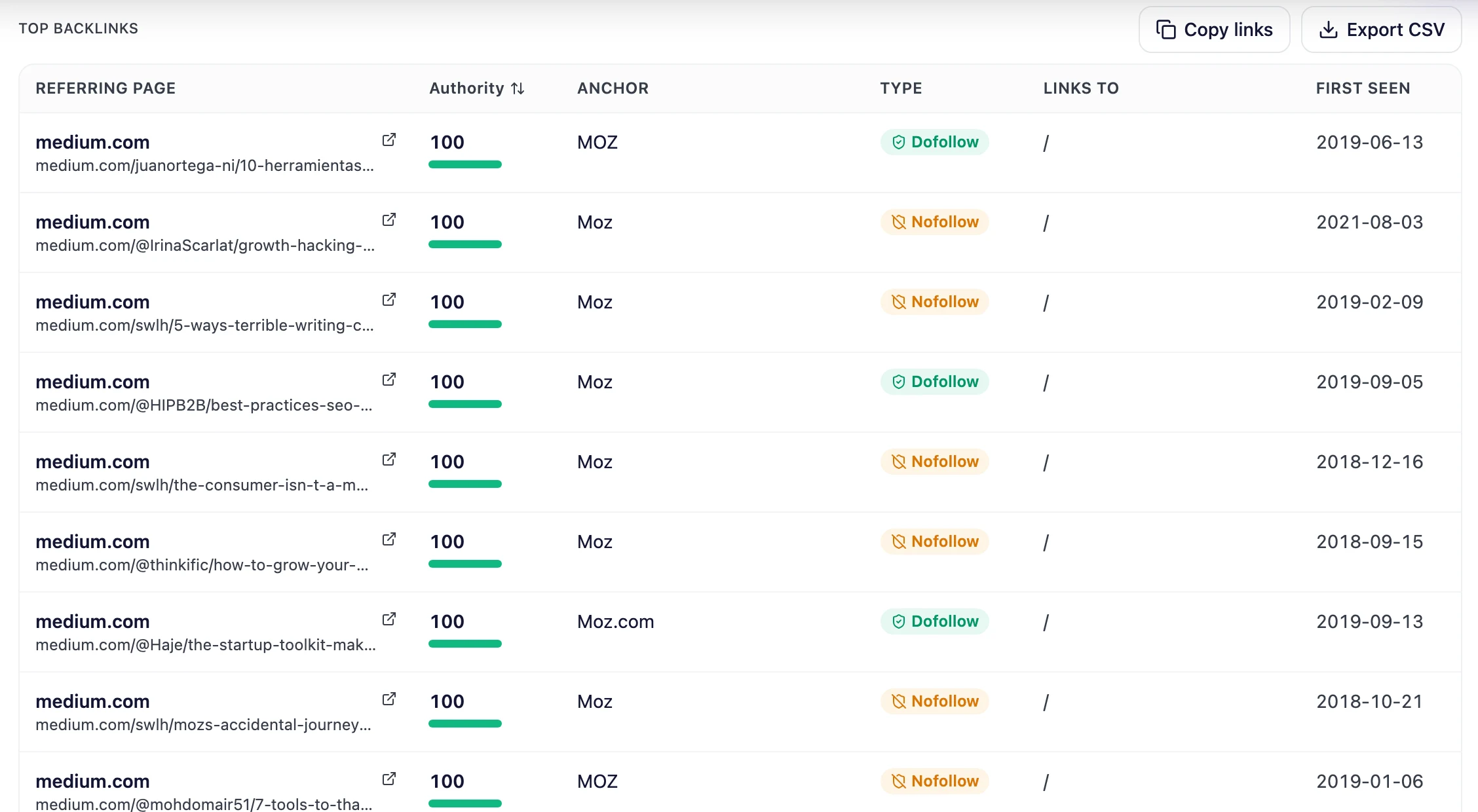
The table itself gives you the referring page and its parent domain, an authority score with a visual bar, the anchor text, whether the link is dofollow or nofollow, which of your URLs it points at, and the date the link was first seen. You can sort by authority, copy every URL to the clipboard, or export to CSV — all free.
Below the table sit four distribution panels that turn a list into a diagnosis: top anchor texts, most-linked pages, referring TLDs and referring countries. This is where you spot an over-optimised anchor profile, a single page hoarding all the equity, or a link profile that is 90% one country.
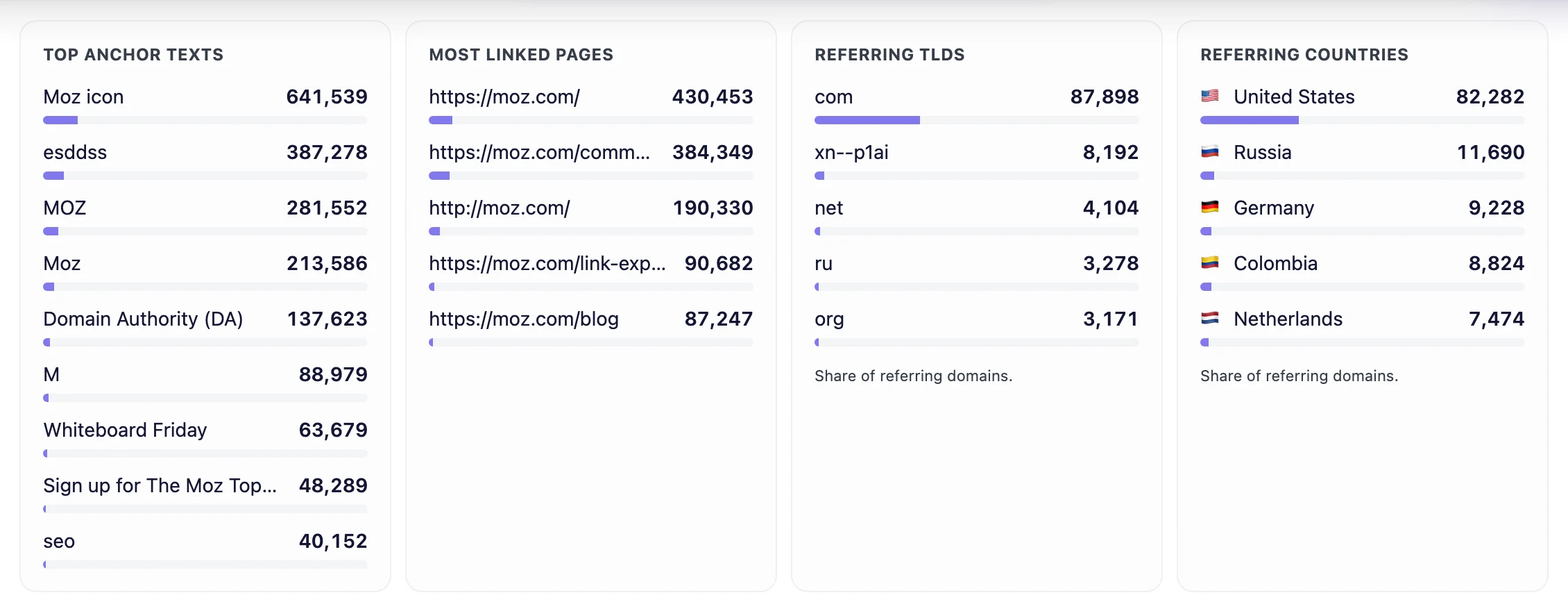
Two honesty details worth naming, because they are the reason to trust the rest. The Domain Trust score is labelled as SE Ranking's InLink Rank on a 0–100 scale, with an explicit warning that it is not Moz DA or Ahrefs DR and should not be compared across tools. And when the index has nothing for a field, the tool prints "no data" rather than a zero that looks like a measurement.
- 12 profile metrics, 4 distribution breakdowns and 50 live backlink rows — all free
- No signup, no email wall, no credit card
- States the sample size beside the total, so you always know what you are looking at
- Labels its 0–100 scale and warns it is not comparable to DA or DR
- Free CSV export and one-click copy of every URL
- 50 rows per check on free (100 on a plan) — a slice, not the profile
- Domain-level only; there is no URL-level analysis and no link intersect
- No new/lost link tracking, no toxicity score, no disavow file
- Results are cached for up to 7 days, so a brand-new link may not appear yet
- No saved history, monitoring, alerts or API
| Useful feature | Why it matters |
|---|---|
| 12 metrics on the free tier | You get IPs, subnets, .edu/.gov and anchor counts without a subscription — the signals that reveal a manufactured profile. |
| Stated sample size | "Showing 50 of 5,920,989" stops you mistaking a slice for the whole profile. |
| Referring IPs and subnets | Far fewer IPs than domains is the fastest tell that a "diverse" profile is one network. |
| Anchor and country distributions | Over-optimised anchors and a single-country profile both show up in seconds. |
| Free CSV export | Take the rows into a spreadsheet without retyping or paying. |
Best for: anyone who wants a fast, honest read on any domain's link profile without creating an account.
Not best for: ongoing link monitoring. If you need to know which links you gained or lost this week, or you need a disavow file, this is not the tool — buy one of the paid suites below.
Pricing: free, with 3 checks a day and 50 links per check. A seotools.pro plan raises that to 10 checks a day and 100 links per check. The wider platform (audits, AI fixes, AI-search visibility) starts at $24/month.
12 profile metrics, 4 distribution breakdowns and 50 live backlink rows from a commercial link index — no signup, no email wall, no card.
- Works on any domain, including competitors
- Anchor, TLD and country breakdowns
- Free CSV export
- Sample size stated, never implied
2. Ahrefs: Best for Freshness and Prospecting Filters
Ahrefs is the tool most link builders reach for, and the reason is speed of data. You enter a domain, URL, subfolder or subdomain into Site Explorer and land on an overview carrying Domain Rating, Ahrefs Rank, referring domains and backlink counts. The Backlinks report then lists every linking page with its anchor, target URL, DR, UR and — unusually — an estimate of the organic traffic reaching the linking page itself. That single column changes how you prioritise outreach: a DR 80 link on a page nobody visits is worth less than a DR 50 link on a page with real readers.
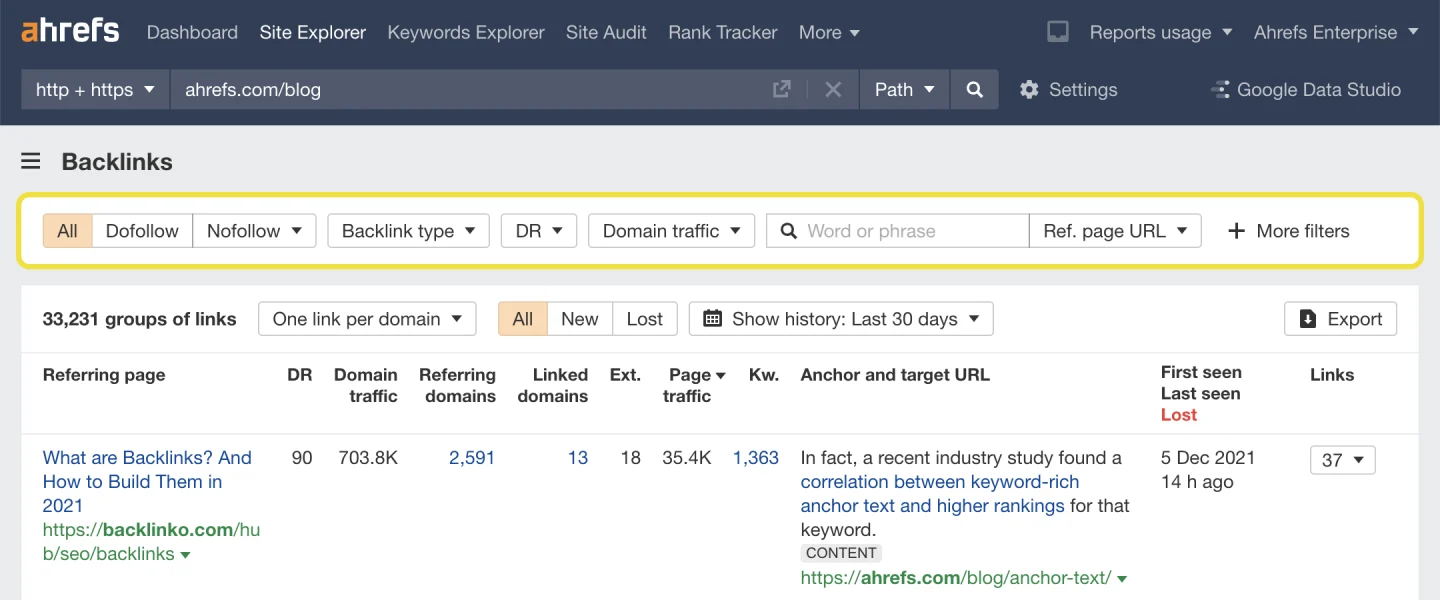
The standout mechanic is Link Intersect, which turns a set of competitors into a ranked list of domains linking to them but not to you. Filters cover dofollow, nofollow, UGC and sponsored, DR bands, platform and link status, and each row has a "Show history" dropdown that replays when the link first appeared, changed or broke. Ahrefs states its backlink index is updated with fresh data every 15 minutes across 35 trillion external backlinks, 493 billion pages and 500 million domains.
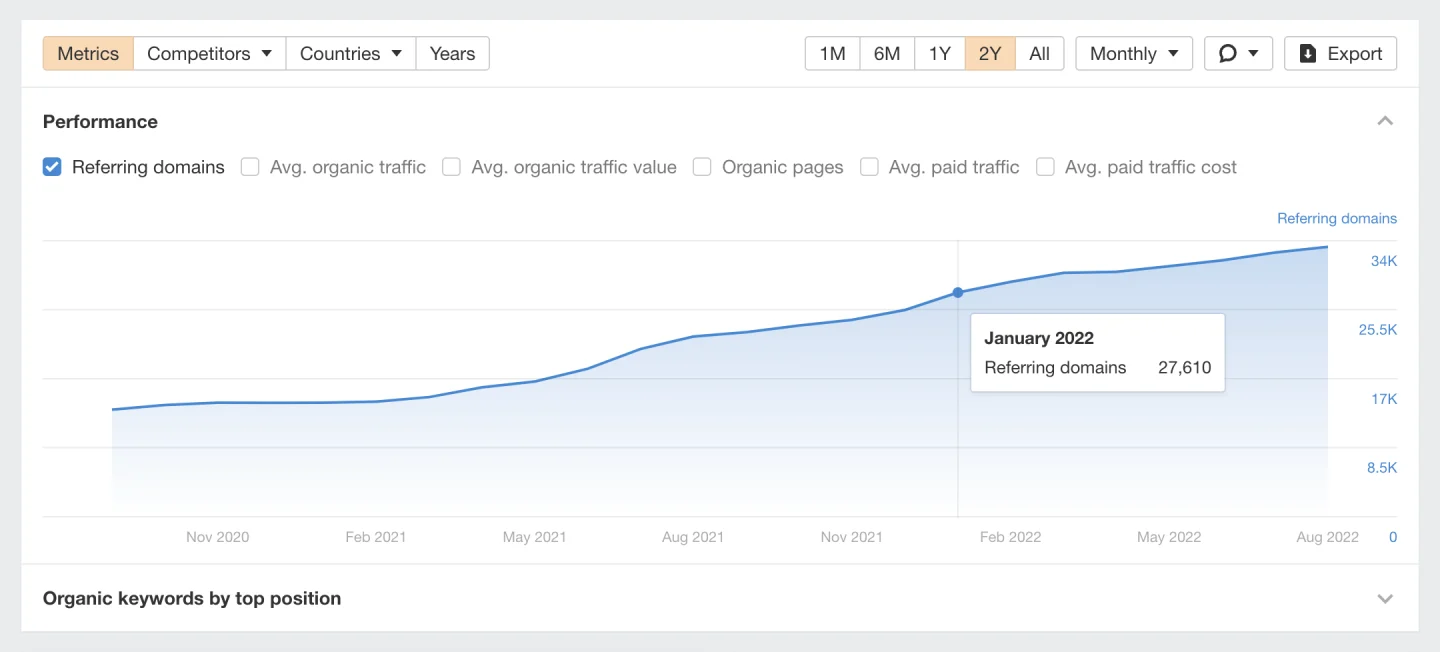
- 35T external backlinks across 493B pages, refreshed every 15 minutes by the vendor's own claim
- The only tool here showing estimated organic traffic for each linking page and referring domain
- Link Intersect converts a competitor set into a prospect list with no spreadsheet work
- The free Backlink Checker works with no login, so you can spot-check any domain in seconds
- Ahrefs Webmaster Tools is free on sites you verify — unlimited sites, 1,000 backlinks visible at once
- The credit system on Starter (200/month) and Lite (1,000/month) burns fast during real link research
- No permanent free competitor analysis — Webmaster Tools only covers sites whose ownership you verify
- No native toxicity or spam score; you judge link quality yourself from DR and traffic
| Useful feature | Why it matters |
|---|---|
| Link Intersect | Turns your competitor set into a ranked list of the domains you are missing. |
| Referring page traffic | Tells you whether a link sits on a page real people actually visit. |
| Backlinks report filters | Cuts a six-figure link list down to the handful worth outreach time. |
| Per-row "Show history" | Makes link decay auditable rather than guessed at. |
| Ahrefs Webmaster Tools | Free backlink data for sites you own, with no subscription. |
Best for: serious link builders and agencies who need the freshest index and the deepest prospecting filters.
Not best for: anyone doing competitor backlink analysis on a small budget — real research starts at the $129/month Lite plan, and Starter's 200 monthly credits will not carry you.
Pricing: Starter $29/mo, Lite $129/mo, Standard $249/mo, Advanced $449/mo, Enterprise $1,499/mo. Ahrefs advertises up to 17% off on annual billing but does not print per-plan annual prices — check at checkout.
Try Ahrefs' free backlink checker →
3. Semrush: Best for Toxicity Cleanup and Link Gaps
Semrush publishes the largest index of the majors — more than 43 trillion backlinks and 390 million referring domains, refreshed at least hourly. Enter a domain in Backlink Analytics and you get an overview with Authority Score, total backlinks, referring domains and a dofollow split, then tabs for Backlinks, Referring Domains, Anchors, Referring IPs, Indexed Pages, Outbound Domains and Competitors.
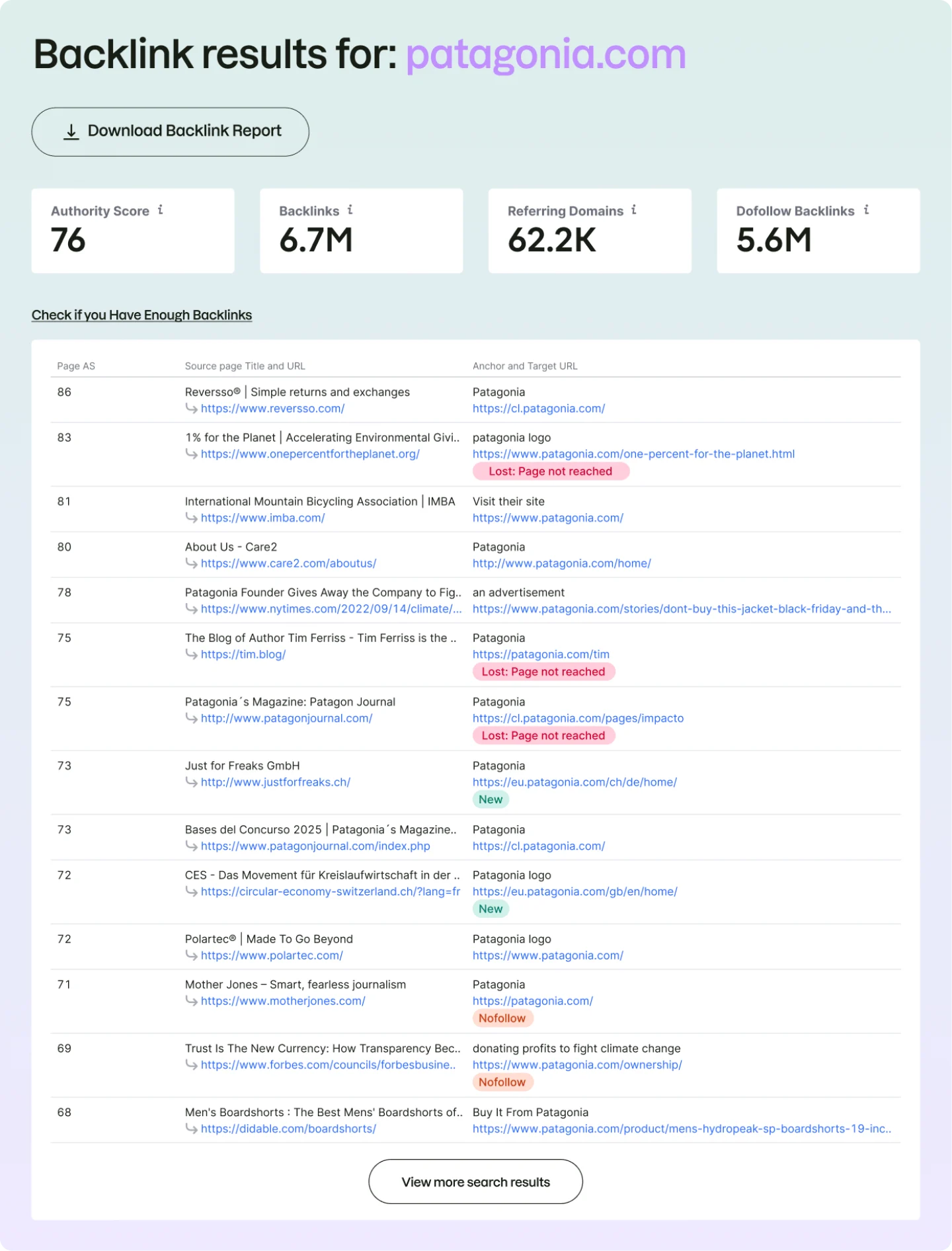
The differentiator is Backlink Audit. It scores every link 0–100 for toxicity against 45+ documented toxic markers and builds a Google-ready disavow file at URL or domain level. Backlink Gap is the other one: it compares you against up to five competitors at once and sorts the result by authority and relevance. Authority Score itself blends link power, organic traffic and spam factors across eight weighted signals, which makes it a broader read than a pure link metric — for better and worse.
- Largest published index of the majors: 43T+ backlinks, 390M referring domains, refreshed at least hourly
- Toxicity Score built on 45+ documented markers, with one-click disavow export
- Backlink Gap handles 5 competitors at once, sorted by authority and relevance
- A genuinely useful free no-login checker that shows real rows with new/lost tags
- Broadest export set here — Excel, CSV, PDF, plus PNG for the Network Graph
- The cheapest real plan is $139/month — the highest entry price in this comparison
- A free account is capped at 10 reports per day across all tools combined
- Authority Score is domain-level only; there is no separate page-level authority metric
| Useful feature | Why it matters |
|---|---|
| Backlink Audit toxicity scores | Flags the risky links and builds the disavow file in one pass. |
| Backlink Gap | Compares 5 competitors simultaneously to surface domains linking to them, not you. |
| Authority Score | One 0–100 read that folds in traffic and spam signals, not just links. |
| Referring Domains report | Tracks profile growth by unique site rather than inflated raw link counts. |
| Free no-login checker | Sanity-check any domain, including new/lost tags, before committing to a plan. |
Best for: marketing teams who want backlink analysis, toxicity cleanup and a full SEO suite on a single bill.
Not best for: teams that only want backlink data — you are paying for a fifty-tool marketing suite whether or not you open the rest of it.
Pricing: SEO $139/mo ($117.33/mo annual), Starter $199/mo, Pro+ $299/mo, Advanced $549/mo. Free account: 1 project, 10 reports/day, no card.
Try Semrush's free backlink checker →
4. SE Ranking: Best Big Index With Monitoring Included
SE Ranking is the tool most often left out of these lists and most often deserving of a slot. You drop in a domain or URL, choose whether to include subdomains, and get an overview with Domain Trust, Page Trust, total backlinks, referring domains and the dofollow/nofollow split. The Backlink Checker grades each link against 15+ parameters — target URL, anchor, link type (text or image), HTTP status, domain and page trust — across Domains, Anchors, Pages, IPs/Subnets and Disavow tabs.
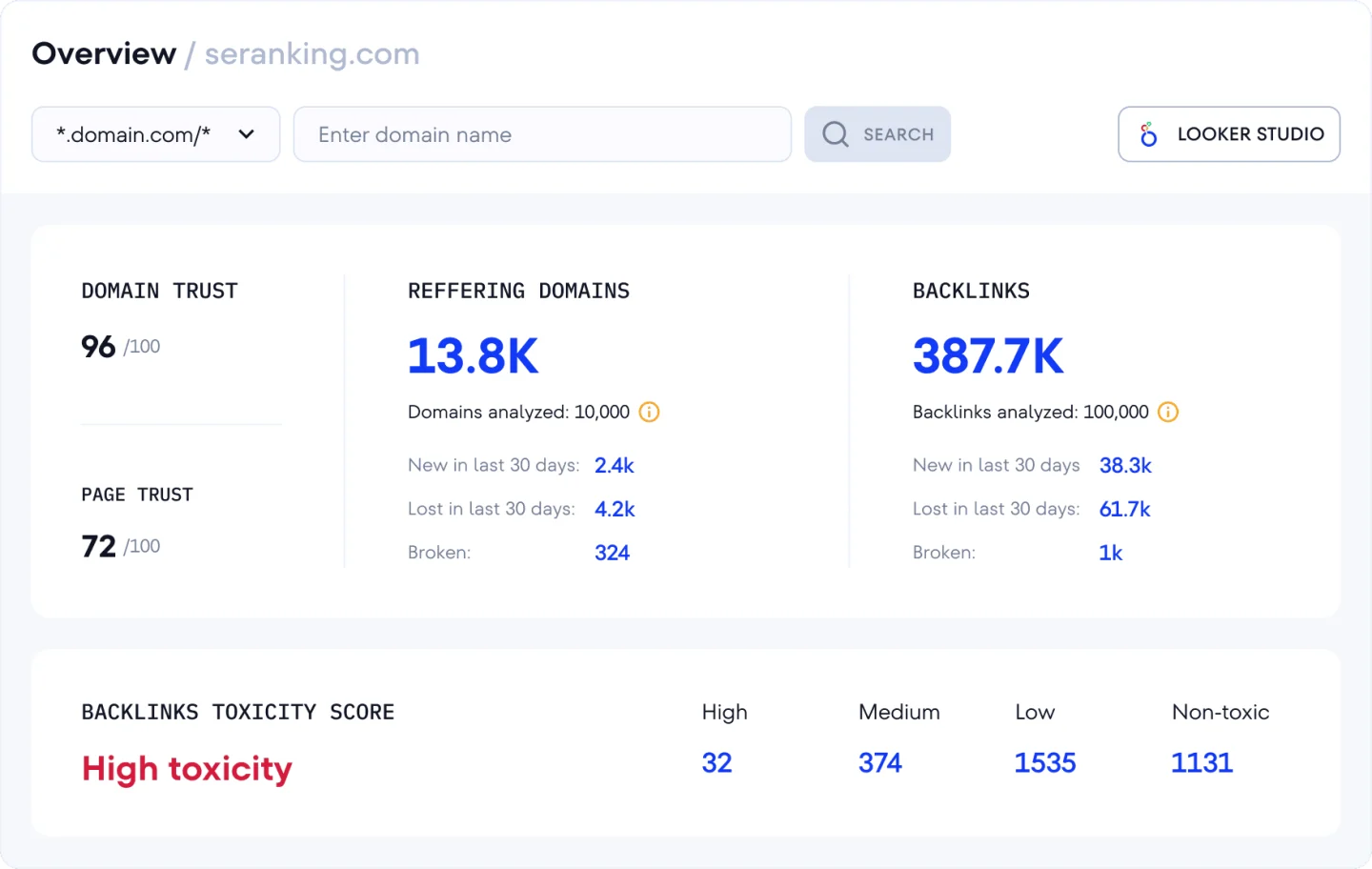
Two things set it apart. First, SE Ranking publishes a data-freshness figure almost nobody else does: 58% of backlinks updated every 90 days, against an index it describes as 2.9 trillion backlinks and 411 million referring domains. Second, Backlink Monitor is included rather than sold separately — you add the links you built by hand, by CSV, or by importing from Google Search Console, and it rechecks them weekly and emails you when one breaks. For an in-house team that builds links and needs to know when they die, that is the whole job in one plan.
Verified live on 6 August 2026: the single page seranking.com/backlink-checker.html carries a stat band reading "2.7T backlinks indexed · 420M domains indexed" and body copy on the same page reading "2.9 trillion backlinks and 411 million referring domains indexed." The 2.9T/411M pair is the one repeated across their other pages, so that is what this article uses — but a data vendor disagreeing with itself on one page is worth knowing before you quote the number to a client.
- 2.9T backlinks and 411M referring domains, with a published freshness figure (58% updated every 90 days)
- Toxicity scoring and disavow-file generation included, not sold as an add-on
- Backlink Monitor rechecks the links you built weekly and emails you when one dies
- 15+ analysis parameters per link, including HTTP status and image-vs-text link type
- An IPs/Subnets tab that exposes link networks hiding behind many domains
- The 14-day trial is fully functional and needs no credit card
- The vendor's own backlink-checker page states two different index sizes (see above)
- No permanent free tier — unregistered visitors get headline metrics and zero backlink rows
- At $129/month the entry price is well above the budget positioning it still gets credited with
| Useful feature | Why it matters |
|---|---|
| Backlink Monitor | Weekly automatic rechecks that email you the moment a link you built disappears. |
| Toxicity score + disavow | Flags risky links and exports a Google-ready disavow file in one click. |
| Domain Trust and Page Trust | Separate site and page scores, so you judge the page, not just the domain. |
| IPs / Subnets tab | Exposes link networks hiding behind many domains on shared infrastructure. |
| 14-day full trial | Complete backlink data on real domains, with no credit card. |
Best for: agencies and in-house teams who want a big, fresh index plus link monitoring and disavow without paying Ahrefs or Semrush rates.
Not best for: solo bloggers and side projects — once the trial ends, $129/month is agency pricing.
Pricing: Core $129/mo ($103.20/mo annual), Growth $279/mo ($223.20/mo annual), Enterprise custom. 14-day trial, no card.
5. Majestic: Best Link-Only Specialist
Majestic does links and nothing else, and it has done so since 2006. You enter a domain, URL or even a search phrase, and — uniquely — you pick Fresh Index or Historic Index before anything loads. Fresh is a rolling window of roughly four months; Historic reaches back nearly two decades. As of 6 August 2026 the live counters on Majestic's own page read 193.2 billion URLs crawled in the Fresh index and 4.5 trillion in Historic, with 614 billion and 21.7 trillion unique URLs found respectively.
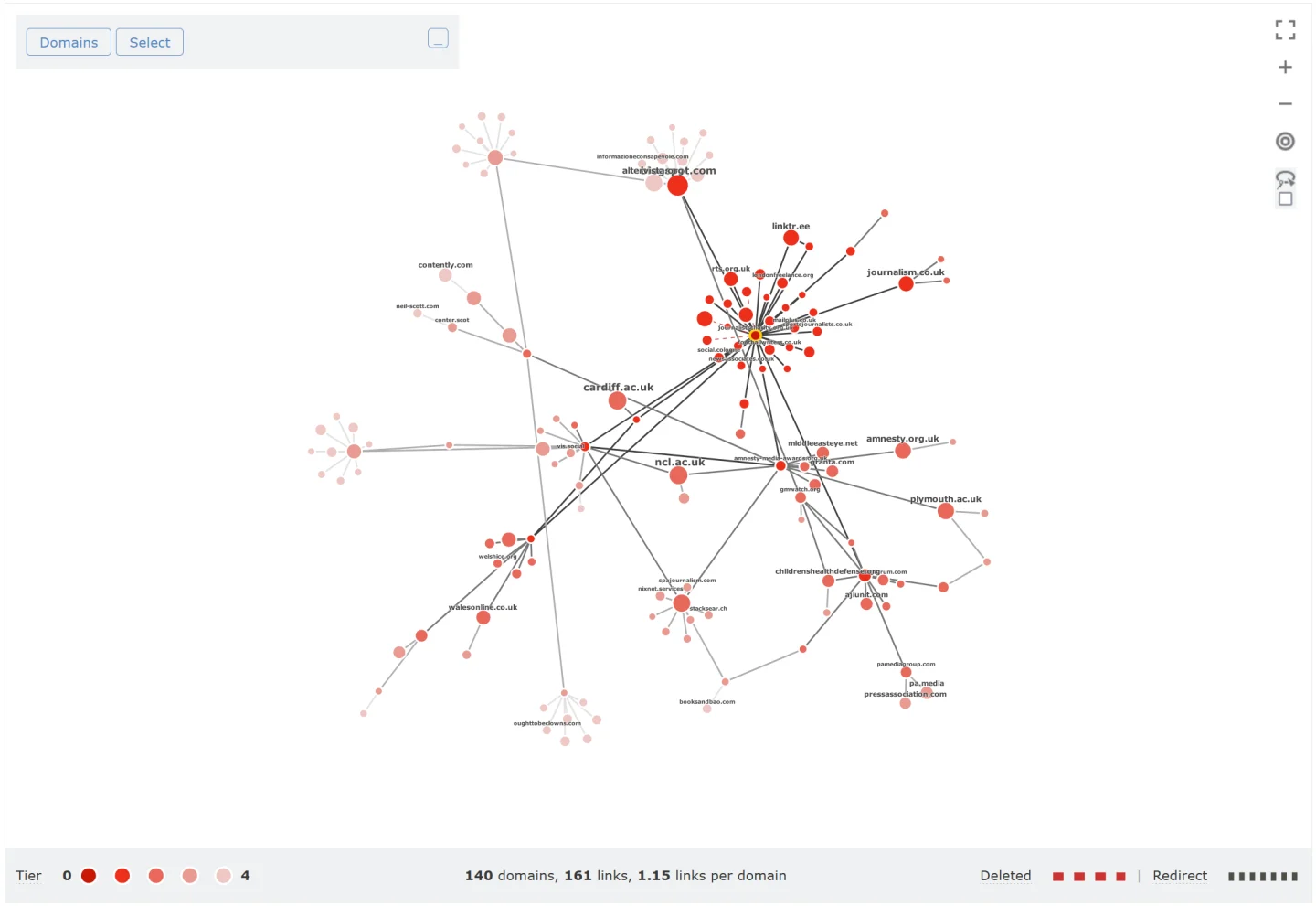
Every row carries Trust Flow and Citation Flow, the oldest and most-cited two-axis authority model in the category. Citation Flow measures how much link equity points at a page; Trust Flow measures quality, derived from a human-curated seed set. The gap between them is the technique worth learning: a site with Citation Flow 60 and Trust Flow 8 has bought or spammed its way to volume. Majestic has no toxicity score, and it does not need one — that gap is the toxicity read. Topical Trust Flow then places each link in one of 800+ topic pools, so you can tell a relevant link from a merely powerful one.
- Cheapest serious backlink tool among the majors at $49.99/mo, or $41.67/mo effective on annual
- The Trust Flow / Citation Flow split is more diagnostic than any single blended score
- Topical Trust Flow across 800+ topic pools is unmatched for judging relevance
- Two genuinely distinct indexes — Fresh (rolling ~4 months) and Historic (back to 2006)
- Publishes live, verifiable crawl counters instead of a rounded marketing number
- Clique Hunter and Site Comparator handle competitor link overlap for up to 10 sites
- No keyword research, rank tracking or site audit whatsoever — links only
- No traffic estimates for linking pages, so you cannot tell whether a link is ever seen
- The interface and terminology feel dated next to Semrush or SE Ranking
| Useful feature | Why it matters |
|---|---|
| Trust Flow / Citation Flow | Splits link quality from link quantity, exposing volume-padded profiles instantly. |
| Topical Trust Flow | Shows whether a link is topically relevant, not merely powerful. |
| Fresh vs Historic Index | Choose recent crawl data or a multi-year archive for the same query. |
| Link Graph | Maps the network around a site to reveal clusters and hub domains. |
| Bulk Backlink Checker | Scores an entire prospect list at once instead of one domain at a time. |
Best for: link builders and forensic SEOs who want the deepest, longest-running link-only dataset at the lowest serious price.
Not best for: anyone wanting one platform for everything — you will still buy keyword research, rank tracking and site audit elsewhere.
Pricing: Lite $49.99/mo ($41.67 annual, 5,000 Site Explorer rows), Pro $99.99/mo ($83.33 annual, 30,000 rows), API $399.99/mo. No permanent free plan, but the demo profile, the first 5 rows of the Bulk Backlink Checker and the Majestic Million CSV all work with no login.
6. Moz Link Explorer: Best for Speaking Domain Authority
Moz earns its slot on a social fact rather than a technical one. Domain Authority is the metric outreach targets quote, guest-post sellers price by, and clients ask about — so even if you run your day-to-day analysis elsewhere, you will eventually need a DA number that came from Moz itself.
Link Explorer takes a domain, subdomain or exact page and returns Domain Authority, Page Authority and Spam Score alongside linking domains, inbound links, anchor text and top pages. Reports split into Discovered and Lost linking domains, so recent wins and silent losses sit side by side, and Link Intersect finds sites linking to several competitors but not to you. Spam Score is the genuinely differentiated piece: it reports the percentage of sites with similar features that were penalised, which is a native risk read that neither Ahrefs nor Majestic offers.
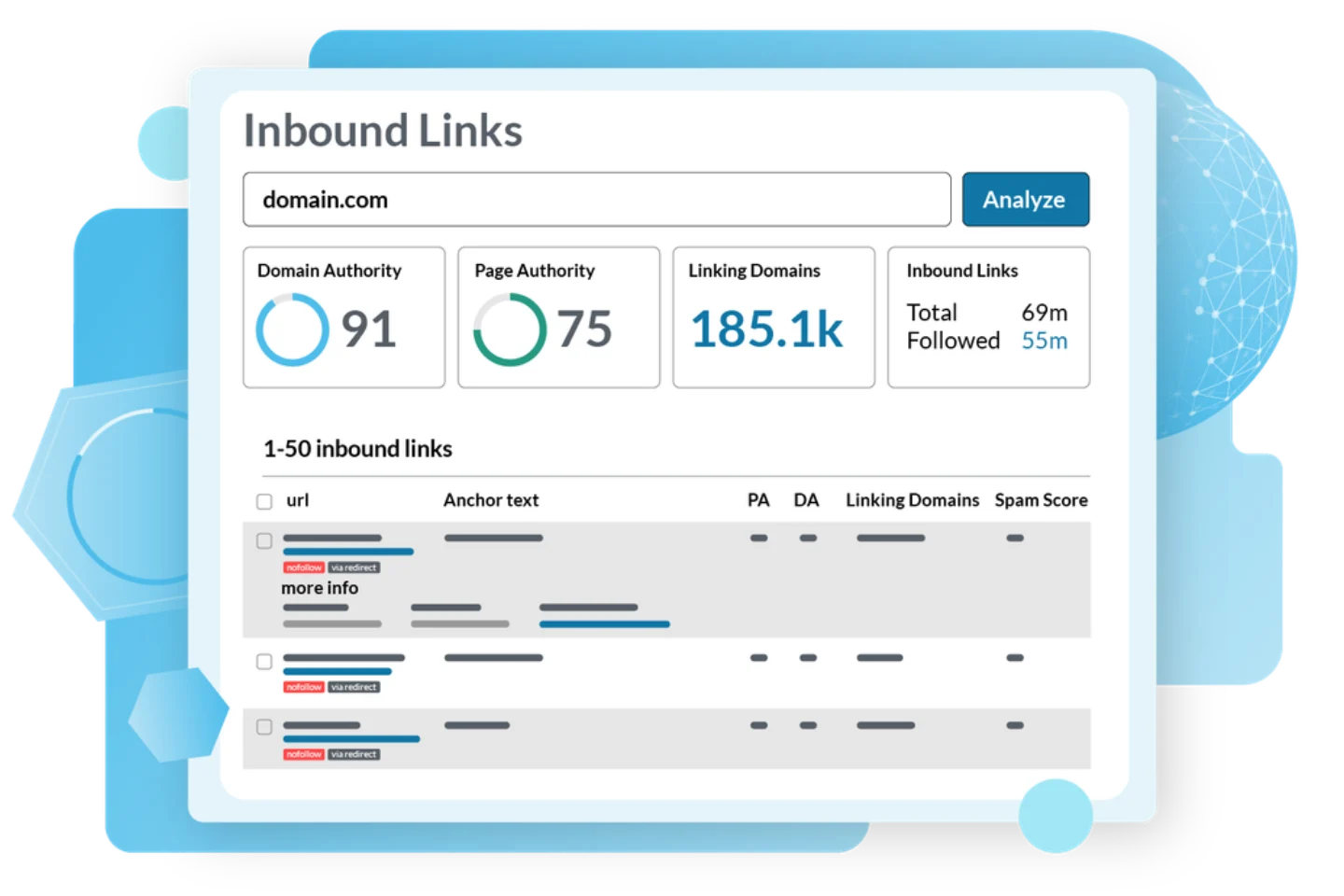
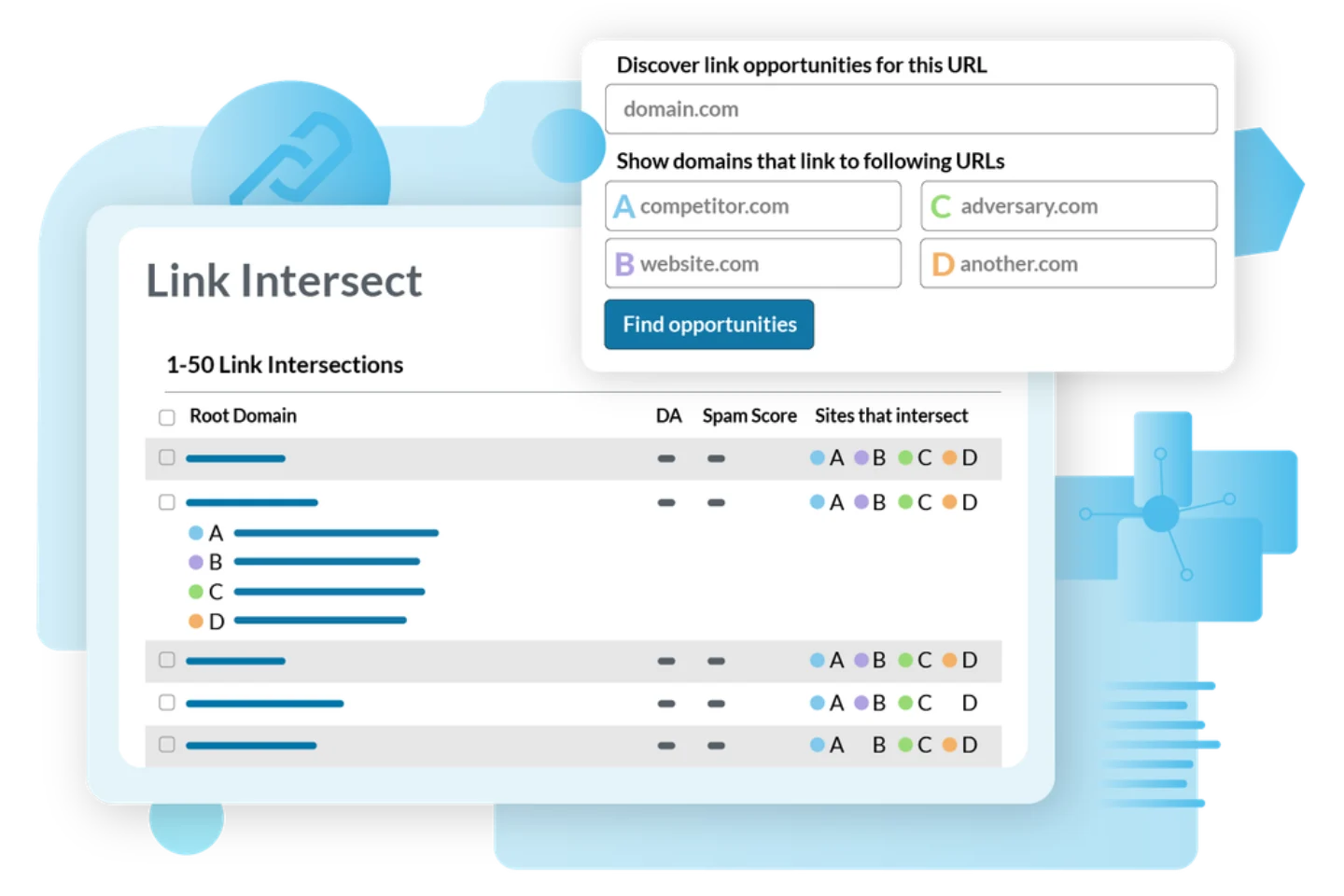
Moz blocks automated tools aggressively. Its product imagery and metric definitions above were read directly from moz.com/link-explorer, but the pricing and query limits below could not be confirmed on a Moz-hosted page and come from third-party trackers that agree with each other. Treat them as indicative and confirm on Moz's own pricing page before you buy — this is the one section of this article I could not verify first-hand end to end.
- Domain Authority is the most widely recognised third-party authority metric in outreach and link marketplaces
- Spam Score gives a native risk read that Ahrefs and Majestic do not offer
- Discovered and Lost linking-domain reports separate new wins from silent losses
- Link Intersect is included on paid plans rather than sold separately
- A permanent free tier exists — 10 queries a month on a registered account
- The Starter plan's 75 Link Explorer queries a month is the tightest limit of any paid plan here
- Refresh cadence lags Ahrefs' 15-minute claim, so newly earned links surface later
- Moz blocks automated access, which makes its own limits unusually hard to verify independently
| Useful feature | Why it matters |
|---|---|
| Domain Authority (DA) | The 0–100 score most outreach targets and link sellers still quote by name. |
| Spam Score | Flags link sources sharing traits with penalised sites before you pursue them. |
| Link Intersect | Finds domains linking to several of your competitors but not to you. |
| Discovered & Lost links | Separates new wins from silent losses in your link profile. |
| Free monthly queries | Ten checks a month with no subscription, for occasional DA spot-checks. |
Best for: teams whose clients and outreach partners speak in Domain Authority and who want Spam Score risk checks.
Not best for: link prospecting at volume — the Starter plan's 75 queries a month runs out in a single afternoon of real research.
Pricing (third-party sourced): Starter $49/mo ($39 annual, 75 queries), Standard $99/mo ($79 annual, 5,000), Medium $179/mo ($143 annual, 20,000), Large $299/mo ($239 annual, 70,000). Free tier: 10 queries/month with an account.
7. Mangools LinkMiner: Best Budget Prospecting Interface
LinkMiner is the cheapest full backlink tool here and, for prospecting specifically, the fastest to read. Type a domain — or a URL pattern like example.com/blog/*, which no other tool on this list accepts — and you get a table with Link Strength, Citation Flow, Trust Flow, external link count, referring IPs and anchor text, tagged dofollow, nofollow or deleted. All / New / Lost tabs sit across the top, and a "one link per referring domain" toggle collapses site-wide noise into genuine opportunities.
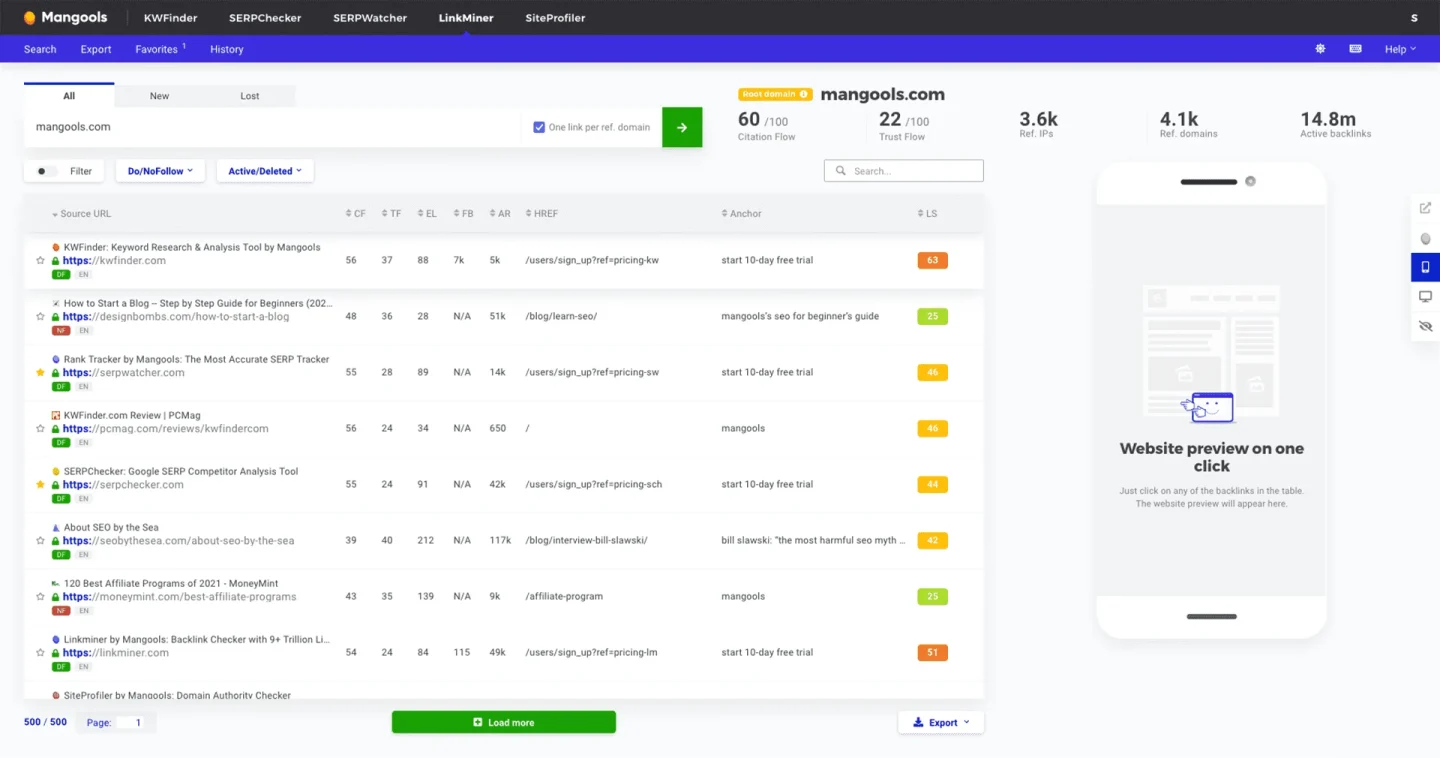
The mechanic that earns it a slot is that preview pane. Click any row and the referring page renders on the right, auto-scrolled to the link with the anchor text ringed in orange. Judging a link in its actual page context, without opening a tab, is meaningfully faster than everything else here. You star prospects into a Favorites list as you scan, then export just the shortlist. The honest caveat: LinkMiner licenses Majestic's index rather than running its own crawler, so it is not an independent second opinion on a link profile — it is a better interface onto data you can also get from Majestic.
- Cheapest full backlink tool in this comparison at $18.85/mo on annual billing
- The live preview pane with highlighted anchor text is genuinely faster than opening tabs
- Bundled with four other tools (KWFinder, SERPChecker, SERPWatcher, SiteProfiler) at one price
- Generous row allowances — 100,000 backlink rows a month even on the cheapest paid plan
- URL wildcard patterns let you analyse just a blog or subfolder
- The free plan is permanent and needs no credit card
- Runs on Majestic's index, so it is not an independent check on a link profile
- No toxicity scoring and no disavow-file generation at all
- No link intersect or backlink gap feature
- Link Strength is proprietary and Mangools does not publish its scale
| Useful feature | Why it matters |
|---|---|
| Live backlink preview | See the actual link in its page context before judging or pitching it. |
| URL wildcard patterns | Analyse one subfolder instead of a whole domain. |
| New / Lost tabs | Spot competitor link wins and your own losses without building a report. |
| Favorites list | Star prospects while scanning, then export only the shortlist. |
| One link per domain | Collapses site-wide links so the list reflects real opportunities. |
Best for: freelancers and small teams who want fast, readable link prospecting on the lowest possible budget.
Not best for: enterprise link forensics, or anyone who needs a second opinion independent of Majestic's crawler.
Pricing: Basic $30.50/mo ($18.85 annual, 100k rows), Premium $40.50/mo ($26.35 annual, 500k rows), Agency $70.50/mo ($48.85 annual, 1.2M rows). Annual billing is 35% off. The old $19.90 Entry plan no longer appears on the pricing page.
8. Ubersuggest: Best Low-Cost Directional Check
Ubersuggest is the cheapest paid entry point here and the only tool on this list with a lifetime licence option. In the Link Building section you open Backlink Overview, enter a domain or URL, and toggle between Domain and URL mode. You get Domain Authority, total backlinks, referring domains and a trend graph you can hover for daily gains and losses. The Backlink List breaks each link into Domain Authority, Page Authority, Spam Score, link type, anchor text, source page title and First Seen / Last Seen dates.
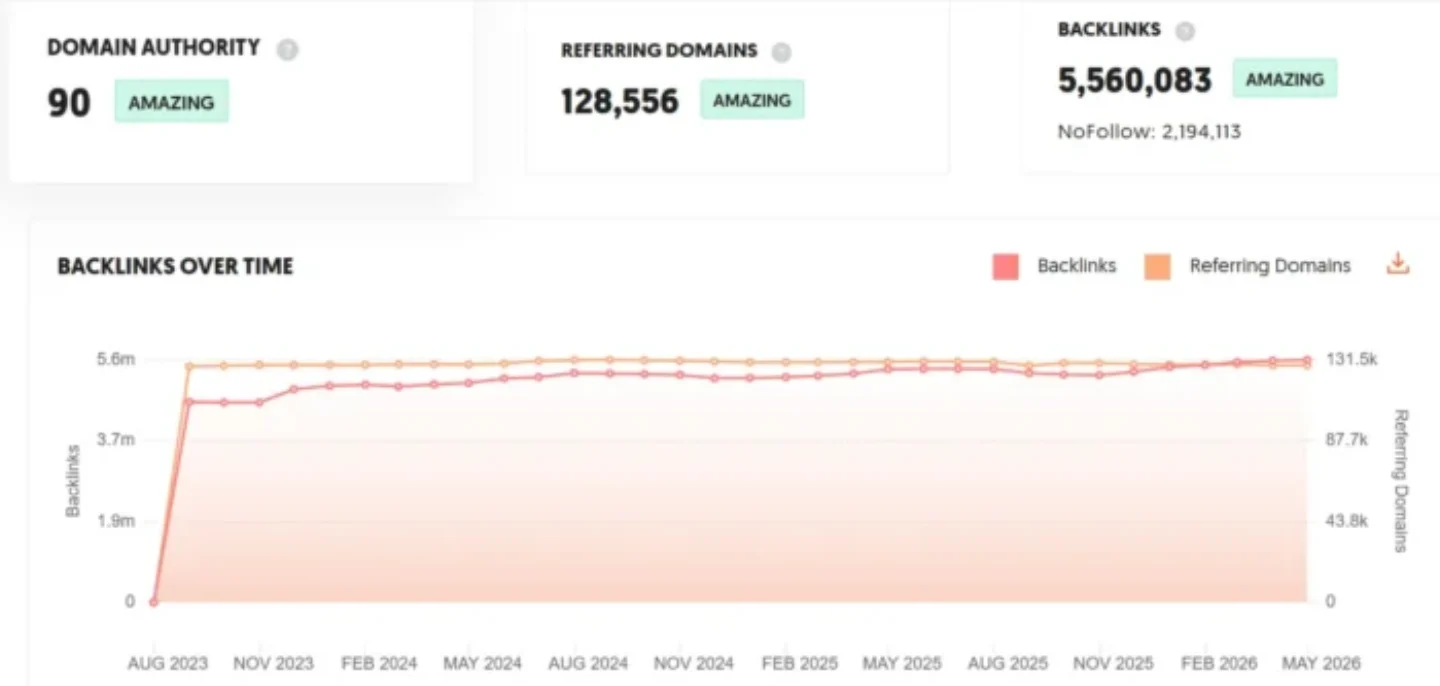
Two real limits shape what this is good for. Backlink rows cap at 2,000 on the entry plan, 5,000 on Business and 10,000 on Enterprise — an order of magnitude below every rival here. And the new/lost window is only 30 days on every plan, Enterprise included. Ubersuggest also publishes no index size at all; its own FAQ says it uses "multiple data providers" for estimations. That is more honest than inventing a figure, but it means you cannot compare its coverage to anyone else's.
- By far the cheapest paid entry point of the eight
- Lifetime plans remove subscription cost entirely — no other tool here offers that
- Reports Domain Authority, Page Authority and Spam Score without a Moz subscription
- Backlink Opportunity compares 5 competitors even on the entry plan
- Retains 3 years of link history on every tier, including the cheapest
- The free account is permanent rather than a countdown trial
- Backlink row caps (2,000 / 5,000 / 10,000) are an order of magnitude below every rival
- The new/lost link window is only 30 days on all plans, Enterprise included
- Data is licensed from unnamed providers and no index size is published
- Headline prices are promotional; the vendor's own comparison strip cites a $29–$99 range
| Useful feature | Why it matters |
|---|---|
| Backlink Opportunity | Compares you against up to 5 competitors to surface the links you are missing. |
| First Seen / Last Seen | Dates every link so you can pinpoint when a profile shifted. |
| Three years of history | Long-run trend on the cheapest tier, which rivals reserve for higher plans. |
| One link per domain | Strips site-wide links so the list shows unique opportunities. |
| Lifetime plan option | One payment instead of a subscription for long-horizon solo users. |
Best for: solo site owners and beginners who want directional backlink data at the lowest possible cost.
Not best for: serious link research — 2,000 rows and a 30-day change window will not support an audit.
Pricing: Individual $12/mo, Business $20/mo, Enterprise $40/mo as displayed, currently carrying a "Save 70%" promotional badge. A lifetime option exists but did not render prices when tested. Free account is permanent, with a handful of searches a day.
Where the paid tools genuinely beat us
Our tool is first on this list because it does one job — a fast, free, honest profile read — better than anything else that costs nothing. It is not first because it is the most capable tool here. It plainly is not, and pretending otherwise would waste your time.
Four things the paid suites do that the seotools.pro Backlink Analyzer does not do at all:
- New and lost link tracking. Ahrefs, Semrush, SE Ranking, Moz, Mangools and Ubersuggest all tell you what changed. We show you a snapshot. If your job is knowing which links died this week, you need one of them.
- Toxicity scoring and disavow files. Semrush's 45-marker Toxicity Score, SE Ranking's toxicity panel and Moz's Spam Score have no equivalent here. We would rather ship nothing than ship a risk score we cannot stand behind.
- URL-level analysis and link intersect. We are domain-level only. Comparing three competitors to find the domains linking to all of them is a paid-tool job.
- Monitoring, alerts, saved history and an API. There is no dashboard, no email when a link breaks, no stored past check. Every run starts fresh.
There is also a scale reality. Ahrefs at 35 trillion backlinks, Semrush at 43 trillion and Majestic's 21.7-trillion historic archive are doing something a free tool does not attempt. And Ahrefs' 15-minute refresh cadence is a genuine engineering advantage over anything cached.
The honest recommendation: use the free check to answer "what does this profile look like right now?" — for your site, a prospect, a client pitch, an acquisition target. When the question becomes "what changed, and what should I disavow?", buy the paid tool that matches your budget.
Why two backlink checkers disagree about the same site
Run one domain through three tools and you will get three different backlink counts, sometimes off by an order of magnitude. This is the single most common reason people distrust the whole category, and it is worth understanding, because none of the tools is lying.
They crawl different webs. Every vendor runs its own crawler on its own budget and priorities. Ahrefs, Semrush, Majestic and SE Ranking each maintain independent indexes. Mangools LinkMiner licenses Majestic's, so LinkMiner and Majestic will broadly agree with each other and disagree with the rest — which makes them a poor pair to "cross-check" with. Ubersuggest licenses from unnamed providers and publishes no index size at all.
They define "a backlink" differently. Does a site-wide footer link on a 50,000-page site count as 50,000 backlinks or as one? Does an image link count? A redirected link? A link inside a canonicalised duplicate? Each vendor answers differently, and those answers alone can produce a tenfold gap on the same domain.
They forget at different speeds. When a link disappears, how long does it stay in the index? Majestic makes this explicit by splitting Fresh from Historic. Everyone else bakes a retention policy into one number, so a tool with a long memory reports a bigger profile than a tool with a short one — for the same site, on the same day.
They refresh at different cadences. Ahrefs claims fresh data every 15 minutes. Semrush says at least hourly. SE Ranking publishes 58% of backlinks updated every 90 days. A link earned yesterday may exist in one index and not another for weeks.
What to do about it: pick one tool as your system of record and track the trend inside it. A backlink count is only meaningful compared to the same tool's number last month, or to a competitor measured by the same tool on the same day. Comparing an Ahrefs DR to a Moz DA, or a Semrush total to a Majestic Fresh total, is comparing two different questions.
Run any domain — yours or a competitor's — through a commercial link index and get 12 profile metrics plus 50 live backlink rows. No account required.
- Sample size stated beside the total
- Anchor, TLD and country breakdowns
- Dofollow / nofollow split
- Free CSV export
What a backlink checker actually does
A backlink checker queries a link index — a database built by a crawler that walks the web recording which pages link to which — and reports what it knows about the links pointing at a domain or URL you name.
That is worth stating plainly, because it explains both the power and the limits. The power: you can inspect any site's link profile, including competitors, without access to their analytics. The limit: you only ever see what that particular crawler found, on its particular schedule, under its particular definition of a link.
A good checker answers five questions:
- How many links, and from how many sites? Referring domains matters more than raw backlinks — 500 links from 5 sites is a much weaker profile than 500 links from 400 sites.
- How strong are the linking sites? This is what DR, DA, Authority Score, Trust Flow and Domain Trust each try to express, on scales that are not interchangeable.
- What do the links say? Anchor text distribution reveals both what you rank for and whether the profile looks manufactured.
- What changed? New and lost links over time — the question a snapshot cannot answer.
- What looks risky? Spam or toxicity signals, and whether anything needs disavowing.
Free vs paid backlink checkers
Free backlink checkers are genuinely useful, and they are genuinely limited, and it is worth being precise about which is which.
What free tools do well: profile-level metrics (totals, referring domains, follow split, authority score) are usually accurate, because they come from the same index the paid product uses. A free tool's summary numbers are typically the real numbers.
Where free tools stop: row counts. Almost every free checker returns a top slice — 50 rows here, 100 there, sometimes an unpublished cap. If a free tool shows you 50 links out of 5.9 million and does not say so, you can badly misread a profile. That is why a stated sample size matters more than a bigger cap.
A note on Google Search Console. GSC is free, uses Google's own data, and is the most authoritative source for links pointing at your site — but it cannot check anybody else's. Since competitor analysis is the core job of this category, GSC is a complement to a backlink checker, not one of them. Use it to validate what your paid tool tells you about your own profile, then use the paid tool for everything you do not own.
How to use a backlink checker: a 5-step workflow
- Audit your own profile first. Run your domain and read the distributions before the list. Anchor text that is 60% exact-match, or a profile where referring IPs are a fraction of referring domains, tells you more than the headline count.
- Find the competitor gap. Run your three closest competitors and look for domains linking to two or more of them and none to you. In Ahrefs this is Link Intersect, in Semrush it is Backlink Gap, in Moz it is Link Intersect. Those domains already link to sites like yours — they are the warmest prospects you will find.
- Qualify before you pitch. Do not chase a link because the domain score is high. Check whether the linking page gets traffic (Ahrefs shows this directly), whether the topic is relevant (Majestic's Topical Trust Flow), and whether the site's Citation Flow wildly exceeds its Trust Flow.
- Monitor new and lost. Given that two-thirds of links rot, the links you already earned are worth defending. A weekly lost-link alert often recovers more equity than a month of outreach.
- Disavow last, and carefully. Ahrefs' own experiment cost a page 18% of its traffic in month one, and it recovered to 99% only after the disavow was lifted. Google handles most spam links on its own. Reserve disavow for links you know are the result of a negative-SEO attack or your own past paid-link buying.
What is a backlink checker and how does it work?
A backlink checker queries a link index — a database built by a web crawler that records which pages link to which — and reports the links pointing at any domain or URL you enter. Because the data comes from the tool's own crawler rather than from your analytics, you can check competitors as easily as your own site. The trade-off is that you only ever see what that particular crawler found, on its own refresh schedule.
Which backlink checker has the largest database?
By published figures, Semrush claims the largest at more than 43 trillion backlinks and 390 million referring domains, with Ahrefs close behind at 35 trillion backlinks across 493 billion pages. Majestic's Historic index has found 21.7 trillion unique URLs going back to 2006. But these numbers are not directly comparable — vendors define "backlink" differently and retain dead links for different lengths of time, so size alone should not decide your choice.
Are free backlink checkers accurate?
Their summary metrics usually are, because free tiers typically read the same commercial index as the paid product. What free tools limit is the number of individual link rows you see — often a top slice of 50 or 100 out of millions. The accuracy problem is not wrong numbers; it is mistaking a slice for the whole profile. Prefer a tool that states its sample size, like the seotools.pro Backlink Analyzer's "Showing 50 of 5,920,989" line.
Why do different backlink checkers show different numbers for the same site?
Four reasons: they run independent crawlers that found different parts of the web; they define a backlink differently (a site-wide footer link may count once or fifty thousand times); they retain dead links for different periods; and they refresh at different cadences, from Ahrefs' claimed 15 minutes to SE Ranking's 58% of links updated every 90 days. Pick one tool as your system of record and track the trend within it, rather than comparing absolute numbers across tools.
Can I check a competitor's backlinks for free?
Yes. The seotools.pro Backlink Analyzer, Ahrefs' free Backlink Checker and Semrush's free Backlink Checker all run on any domain with no login. Majestic offers a demo profile plus the first 5 rows of its Bulk Backlink Checker without signup. Moz, Mangools and Ubersuggest all require an account first, and SE Ranking shows headline metrics but no link rows to unregistered visitors.
Is Google Search Console a backlink checker?
Only for your own site. GSC's Links report is free, comes from Google's own crawl, and is the most authoritative source for links pointing at properties you have verified — but it cannot analyse a competitor. Since competitive link research is the main reason to use this category of tool, treat GSC as a companion for validating your own profile rather than a replacement for a backlink checker.
How often should I check my backlink profile?
Monthly is enough for a full audit of anchor distribution, referring domains and country spread. Lost-link monitoring should be more frequent — weekly, ideally automated — because links disappear silently and a broken link you notice within days is far easier to reclaim than one you find a year later. Ahrefs found that 66.5% of links to its sample of 2 million sites had rotted since 2013.
Do nofollow backlinks still help SEO?
Google treats rel="nofollow", ugc and sponsored as hints rather than directives, so they may be considered for ranking. More practically, nofollow links still send referral traffic, build brand visibility and often precede editorial follow links. What matters is the ratio: a profile that is overwhelmingly nofollow passes far less authority than the raw total suggests, which is why every tool on this list reports the split separately.
What counts as a good Domain Rating or Domain Authority score?
There is no universal threshold, and the scales are not interchangeable — Ahrefs DR, Moz DA, Semrush Authority Score, SE Ranking Domain Trust and Majestic Trust Flow are five different formulas on similar-looking 0–100 scales. All of them are logarithmic in practice, so moving from 20 to 30 is far easier than 70 to 80. The useful benchmark is not an absolute number but the range of the sites currently ranking for your target keywords, measured with the same tool.
Can a backlink checker find toxic links, and should I disavow them?
Semrush, SE Ranking, Moz and Ubersuggest all report a spam or toxicity score; Ahrefs, Majestic, Mangools and the seotools.pro Backlink Analyzer do not. Finding them is the easy part — deciding is the hard part. Google says it ignores most spam links automatically, and Ahrefs' own experiment showed a page losing about 18% of its search traffic in the first month after a disavow, recovering only once the file was removed. Reserve disavow for links from a negative-SEO attack or your own past paid-link buying, and leave the rest alone.
The verdict: which backlink checker should you pick?
Pick the tool that matches the question you are actually asking.
If the question is "what does this profile look like right now?", start free with the seotools.pro Backlink Analyzer — 12 metrics, 4 distributions and 50 live rows, no account. If it is "which links can I win from my competitors?", choose Ahrefs for the freshest index and the best filters. If it is "what should I clean up?", choose Semrush or SE Ranking for toxicity scoring and a disavow file — and SE Ranking if you also want link monitoring included. If it is "is this link genuinely trustworthy?", choose Majestic and read Trust Flow against Citation Flow. If it is "what DA will my outreach partner quote?", you need Moz. If it is "how do I prospect quickly on a small budget?", choose Mangools LinkMiner. And if the budget is the binding constraint, Ubersuggest gives you directional data for the price of a coffee.
The smart first move costs nothing: run your own domain, look at the anchor and country distributions rather than the headline count, and see whether your link profile actually looks like the profile of a site that deserves to rank.
12 profile metrics, 4 distribution breakdowns and 50 live backlink rows from a commercial link index — on any domain, including your competitors'.
- No account and no email wall
- Dofollow / nofollow split and Domain Trust
- Anchor, page, TLD and country breakdowns
- Free CSV export and one-click copy
This guide was written and tested by RH Fardin. Tool prices and free-tier limits were verified in August 2026 on each vendor's own pricing page — always confirm the current details on the tool's own site before you buy. Last updated August 2026.