Every article rewriter promises the same thing: paste your text, get a new version, keep the meaning. The promise is easy to make because almost nobody checks the second half of it.
So I checked. One 103-word excerpt — a passage about espresso with nine specific, checkable facts buried in it — pasted into every article rewriter I could reach without a credit card. Same text, same day. Then I read every output word by word and asked one question: are the facts still true?
Nine tools. Five produced a rewrite for free. Four would not run at all without an account or a CAPTCHA I was not willing to solve. And among the five that did run, one changed the subject of the passage from a shot of espresso to an image, and another reversed the relationship between what goes into a coffee basket and what comes out of it.
One disclosure before anything else, because this article ranks our own tool first: UNmiss makes one of the tools below. Discount our opinion accordingly. That is why the section on our tool leads with its hardest limit, why there is a section on what the paid tools do better than us, and why I published the exact number for how much of the original our own rewriter leaves untouched — 32.6% — rather than rounding it into a marketing claim.
The best article rewriter tool for most people is the UNmiss Article Rewriter: it takes 10,000 characters at once, kept 10 out of 10 checkable facts intact in testing, returns up to 3 alternative drafts in a single run, and needs no account. For the cleanest competitor rewrite, QuillBot — it kept every fact, though it caps each run at 125 words free. Avoid pure spinners like Spinbot for anything factual. Wordtune, Rytr, Paraphraser.io and SmallSEOTools could not be run free at all on the day of testing.
That middle number is the one worth sitting with. Rewriting is not a style exercise. If a tool alters wording and meaning, you have not saved yourself an edit — you have bought yourself a fact-check you did not know you needed.
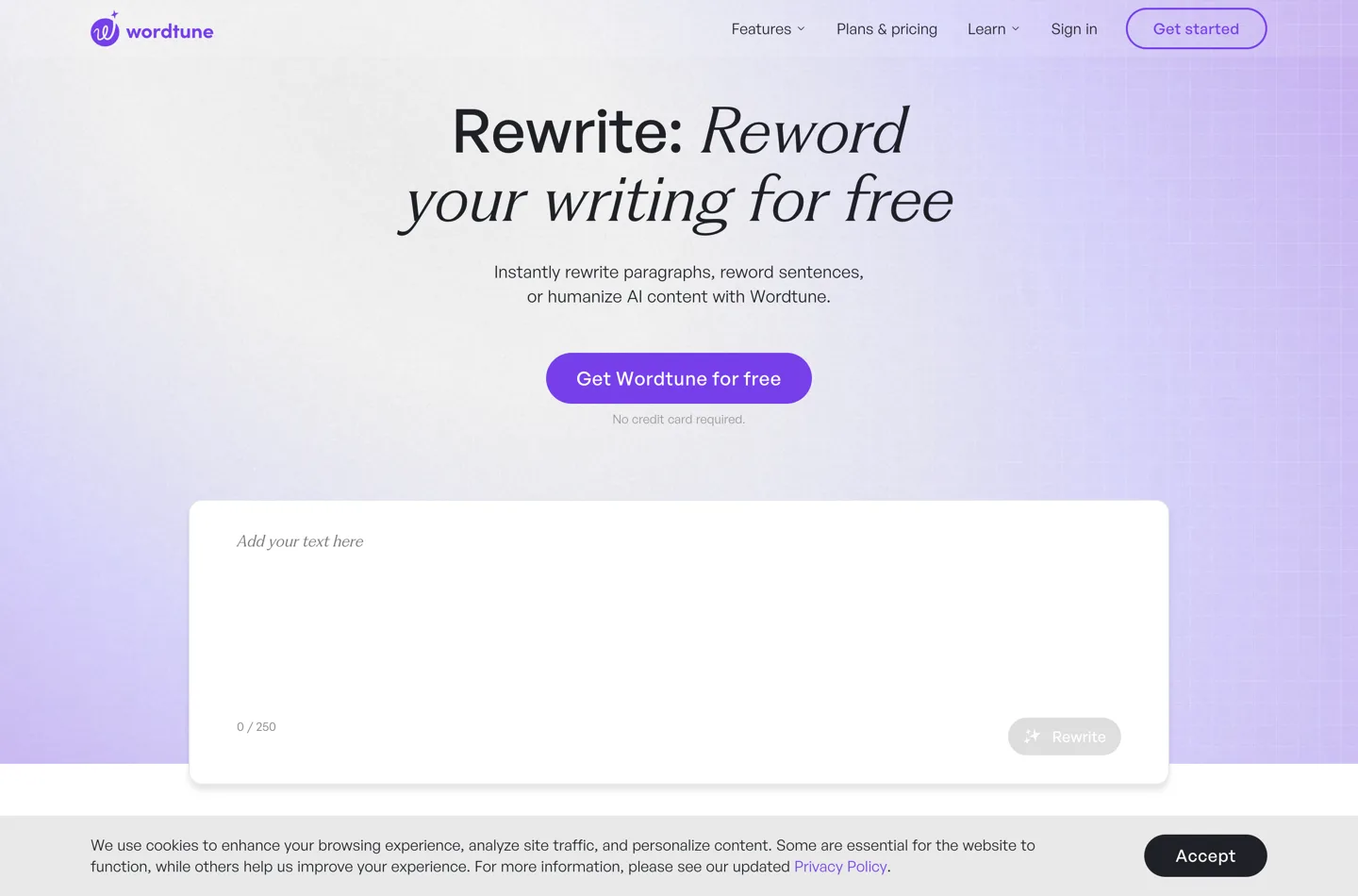
Instantly rewrite paragraphs, reword sentences, or humanize AI content.
— Wordtune, on its own free rewriting pageThree verbs, three different jobs, one page. That conflation is the reason this category is so hard to shop in, so it is worth separating them before comparing anything.
Rewriting, humanising and spinning are three different jobs
Rewriting changes how something is worded while keeping what it says. You do it because a draft is clumsy, too long, in the wrong register, or written for a different audience than the one you now have. Success is measured by whether a reader who knows the subject would agree the new version says the same thing.
Humanising changes the statistical fingerprint of text so that AI-detection software scores it as human-written. That is a different target, and it is the one our AI humanizer comparison covers. A humaniser is judged by a detector score. A rewriter is judged by a human reader. A tool can be excellent at one and useless at the other.
Spinning is the oldest of the three and the one that gave the category its bad name. A spinner swaps words for synonyms from a thesaurus, with no model of what the sentence means. It was built to mass-produce "unique" pages for search engines in an era when that worked. It does not work now, and — as this test shows in a way I did not expect to be so tidy — it actively destroys meaning.
The reason this matters for your shortlist: several tools in this roundup sell all three from the same box, and the free tier you land on may not be the job you came to do. A tool whose free mode is a spinner will happily hand you back nonsense that looks rewritten.
How I tested: one passage, nine tools, nine checkable facts
Feature tables are easy to write and impossible to verify. So the test here is deliberately small and completely reproducible: a single passage, short enough to clear the tightest free word cap in the category, dense enough that any loss of meaning shows up immediately.
Here is the exact text that went into all nine tools:
Start with the shot itself. A conventional espresso uses 18 grams of ground coffee in the basket and produces about 36 grams of liquid in the cup. That two-to-one ratio is the reference point almost every cafe works from, and it should take somewhere between 25 and 30 seconds to pour. Those three numbers are the whole diagnostic kit. Sourness is the most common complaint, and it nearly always means the shot is under-extracted. The usual cause is that the grind is too coarse, so water races through the bed in fifteen seconds and leaves most of the flavour behind in the basket.
That passage was chosen for one reason: it contains nine facts a knowledgeable reader can check without leaving the page. 18 grams in. 36 grams out. A two-to-one ratio. 25 to 30 seconds. Fifteen seconds when it runs fast. Sourness means under-extraction. The cause is a coarse grind. Water goes through a bed. The flavour stays in the basket.
Break any one of those and the rewrite has failed, no matter how fluent it reads. That is the whole test.
Three rules I held to, because they change what the results mean:
- No accounts. I never registered, never gave an email, never entered a card. A tool that demands a signup before it will show you anything is reported as such — that is the finding, not a gap in the test.
- No CAPTCHAs solved. Two tools put a human-verification wall between me and a free rewrite. I recorded that and moved on.
- Consent banners rejected, never accepted. Where a cookie bar appeared, I declined non-essential tracking, as any privacy-conscious reader would.
One methodological note that is unusual for this kind of roundup: this article quotes the actual output text from every tool rather than showing screenshots of it. That is deliberate. A screenshot proves a tool rendered something; quoted text lets you paste the same passage in yourself and compare word for word. Every quoted rewrite below was read out of the live page on 12 August 2026.
Alongside the shared passage I ran a longer test on our own tool — the full 684-word article the excerpt was taken from — to measure things a 103-word sample cannot show: speed at real length, how much of the original survives verbatim, and whether the extra features actually work.
The nine tools at a glance
| Tool | Free rewrite? | Free cap shown in the tool | Facts kept | What stopped it |
|---|---|---|---|---|
| UNmiss | Yes, no account | 10,000 characters | All | — |
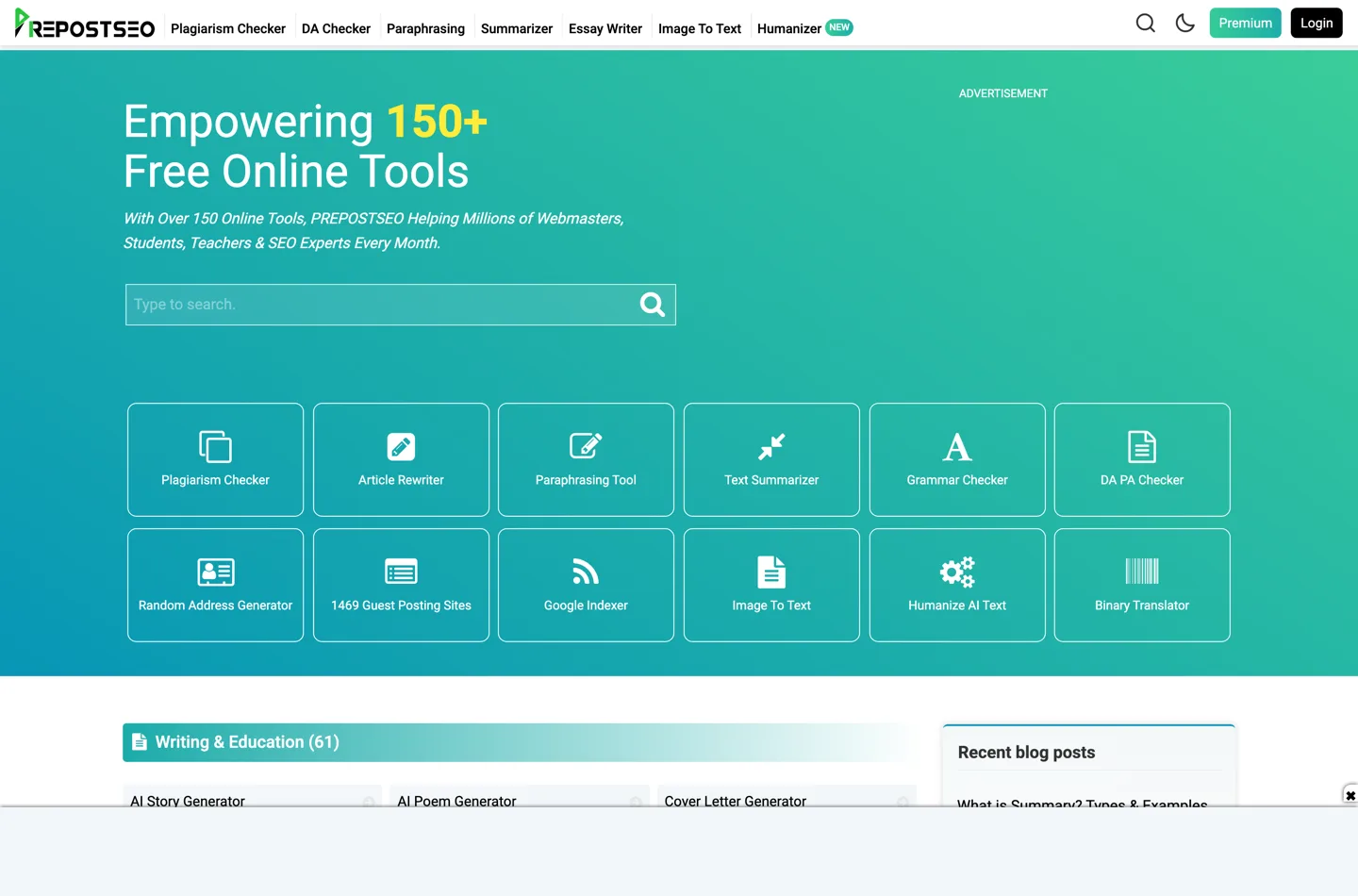
| Prepostseo | No | 1,500 words advertised | Not tested | Returned the input unchanged; human check after run |
| QuillBot | Yes | 125 words | All | — |
| Editpad | Yes | None shown at 103 words | Damaged | — |
| Spinbot | Yes | 10,000 characters | Damaged | — |
| Wordtune | No | — | Not tested | Signup required |
| Paraphraser.io | No | — | Not tested | CAPTCHA required |
| SmallSEOTools | No | — | Not tested | Run button never armed |
| Rytr | No | — | Not tested | No editor without an account |
A word on what is missing from that table: prices. Every tool here sells a paid tier, and every one of those prices moves. Rather than publish figures that will be wrong within a quarter, this article compares the thing I could measure directly and that vendors cannot quietly change between your reading this and your trying it — what the free tier actually does to your text. Check current pricing on the vendor's own page before you buy anything.
The tools, ranked
1. UNmiss Article Rewriter — the most capable free tier
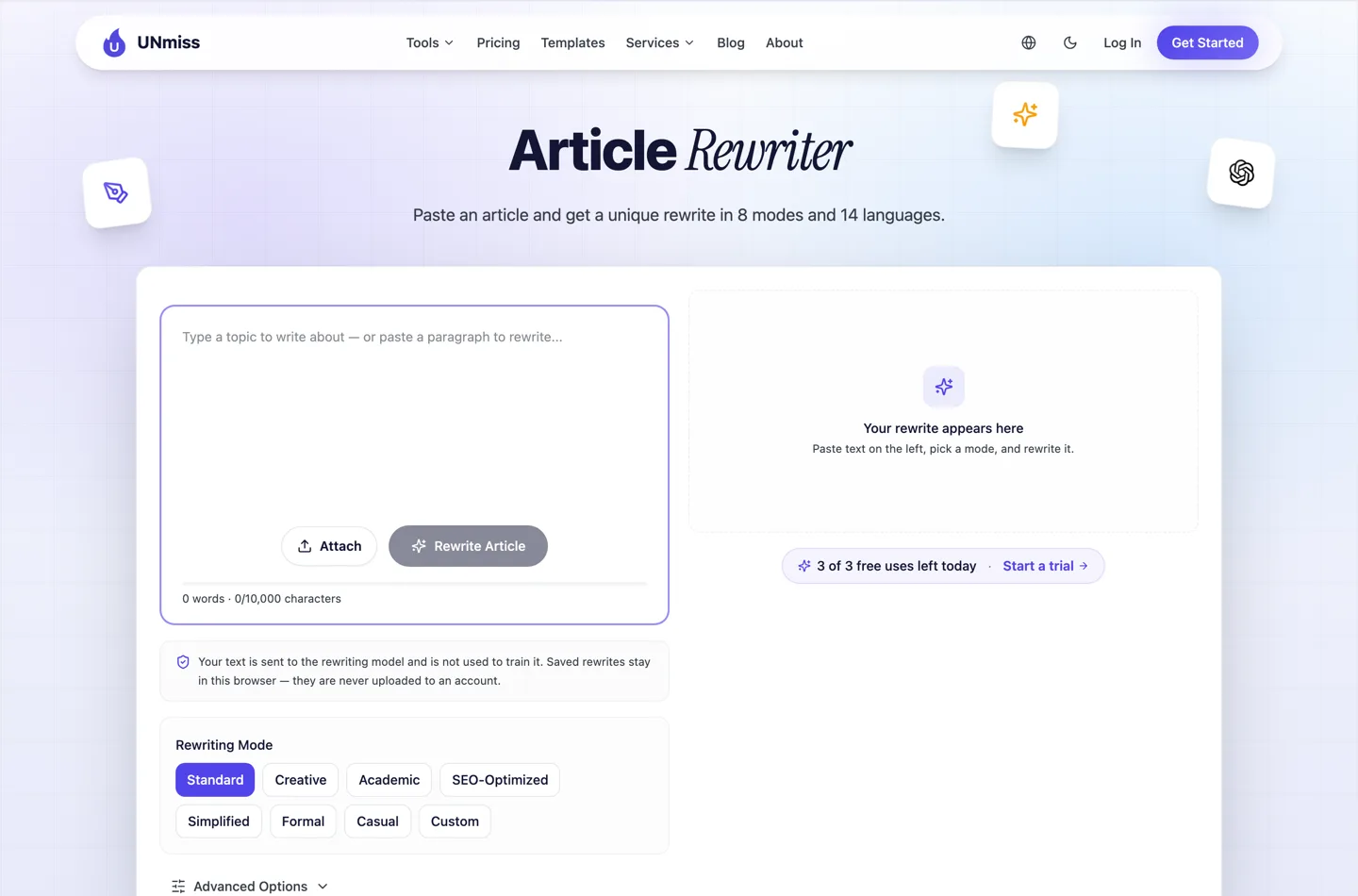
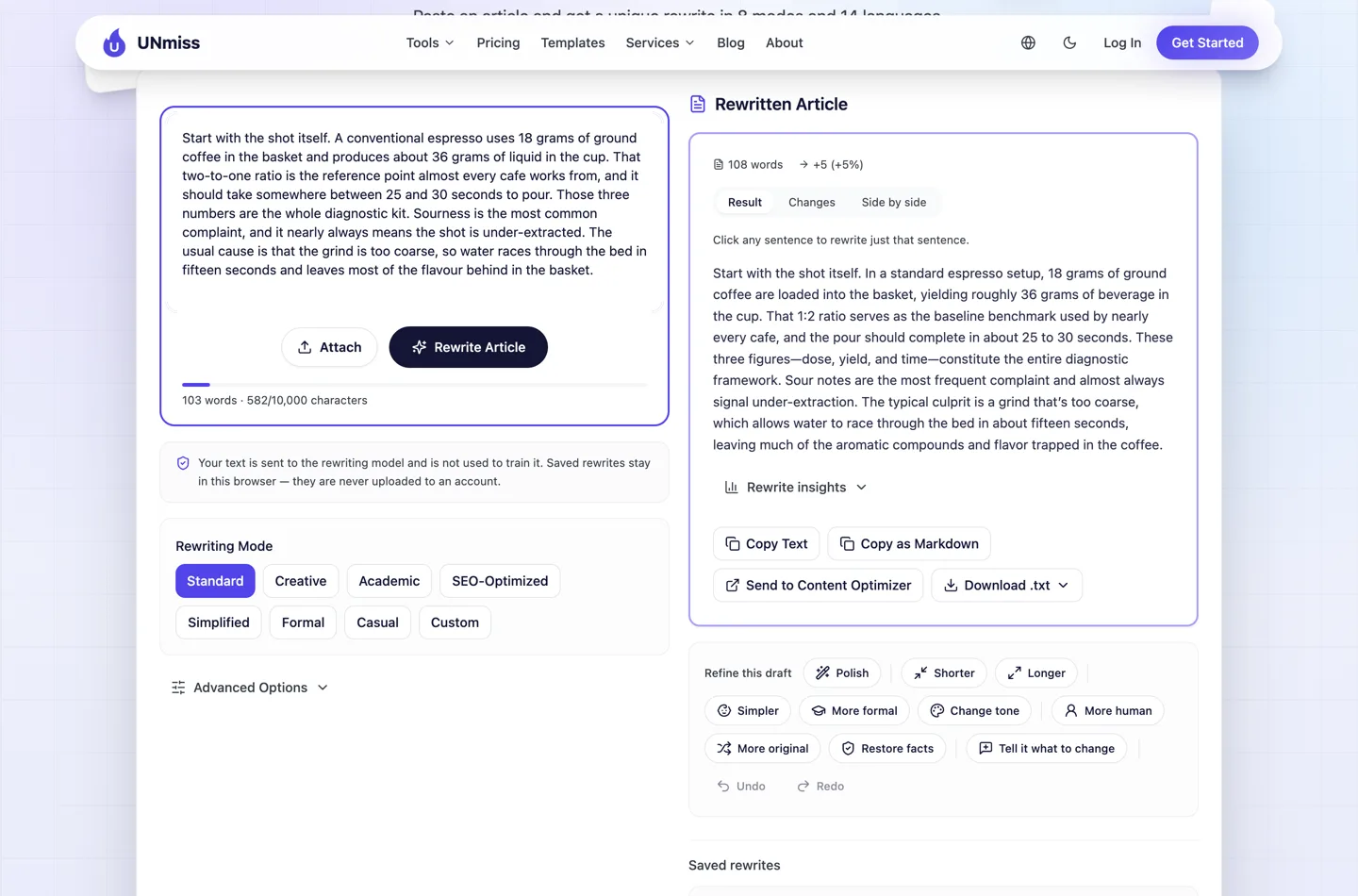
The UNmiss Article Rewriter is a free, no-account tool that rewrites up to 10,000 characters at a time and can return several alternative drafts from a single run.
On the shared 103-word passage it kept every fact. More useful is what happened on the full 684-word article, which is closer to what anyone actually rewrites:
- 673 words back from 684 in, in 12.0 seconds. No truncation, no dropped paragraph.
- 10 out of 10 checkable facts preserved — including the two easiest to mangle, that sourness means under-extraction and bitterness means over-extraction, which are opposites a synonym swapper cannot tell apart.
- 32.6% of the source survived verbatim, measured as the share of eight-word sequences from the original that reappear unchanged. I will come back to that number, because it is the least flattering thing in this article and it is ours.
- Three alternative drafts in a single run, 9.5 seconds for all three, at 656, 665 and 587 words. Most tools here give you one draft and a re-roll button.
- Spanish output worked from the same English input, one of 16 output languages.
What distinguishes it from the rest of this list is not the rewrite itself — QuillBot's was comparably clean, inside its much smaller window — it is what you can do afterwards without starting over. Four separate operations run on a draft you already have: a full rewrite, a tone change, a free-text instruction ("make the third paragraph less hedged"), and a sentence-level rewrite that replaces one sentence inside its surrounding paragraph rather than regenerating the whole block. That last one is the genuine differentiator. Every other tool tested is all-or-nothing: you get a new version of everything, and if one sentence was already right, bad luck.
It also imports six file formats directly — .txt, .md, .docx, .rtf, .odt and .pdf — which matters more than it sounds when your draft is a Word file and the alternative is copy-pasting out of it and losing your structure.
The quality check deserves a specific mention because it was broken until this test. Running it on the full 684-word article failed twice with a server error before I found the cause: it was set to a reasoning budget that could not finish inside its own timeout at real article length, so the feature only worked on short passages. That is fixed — the same article now scores in 12 to 18 seconds, returning an overall 88 with seven specific issues flagged. I am mentioning a bug I found in our own tool because the alternative is telling you a feature works when, a week ago, it did not.
- 10,000 characters per run — the joint-largest free capacity tested
- Kept every checkable fact in both the short and long tests
- Up to 3 alternative drafts from one run, not one draft and a re-roll
- Sentence-level rewriting — fix one line without regenerating the article
- Refine with a free-text instruction instead of starting over
- 16 output languages; 6 import formats including PDF and .docx
- No account, no email, no card
- 3 rewrites per day on the free tier — the real limit, and the one to weigh
- Leaves about a third of the source wording untouched by default
- No browser extension or Word add-in
- Refines and quality checks have their own separate daily caps
The honest summary: the daily cap is three full rewrites, not three hundred. If you are rewriting a batch of thirty product descriptions this afternoon, the free tier will stop you a tenth of the way in. It is built for someone with one article to fix properly, not a content mill.
2. QuillBot — the best editor, the smallest window
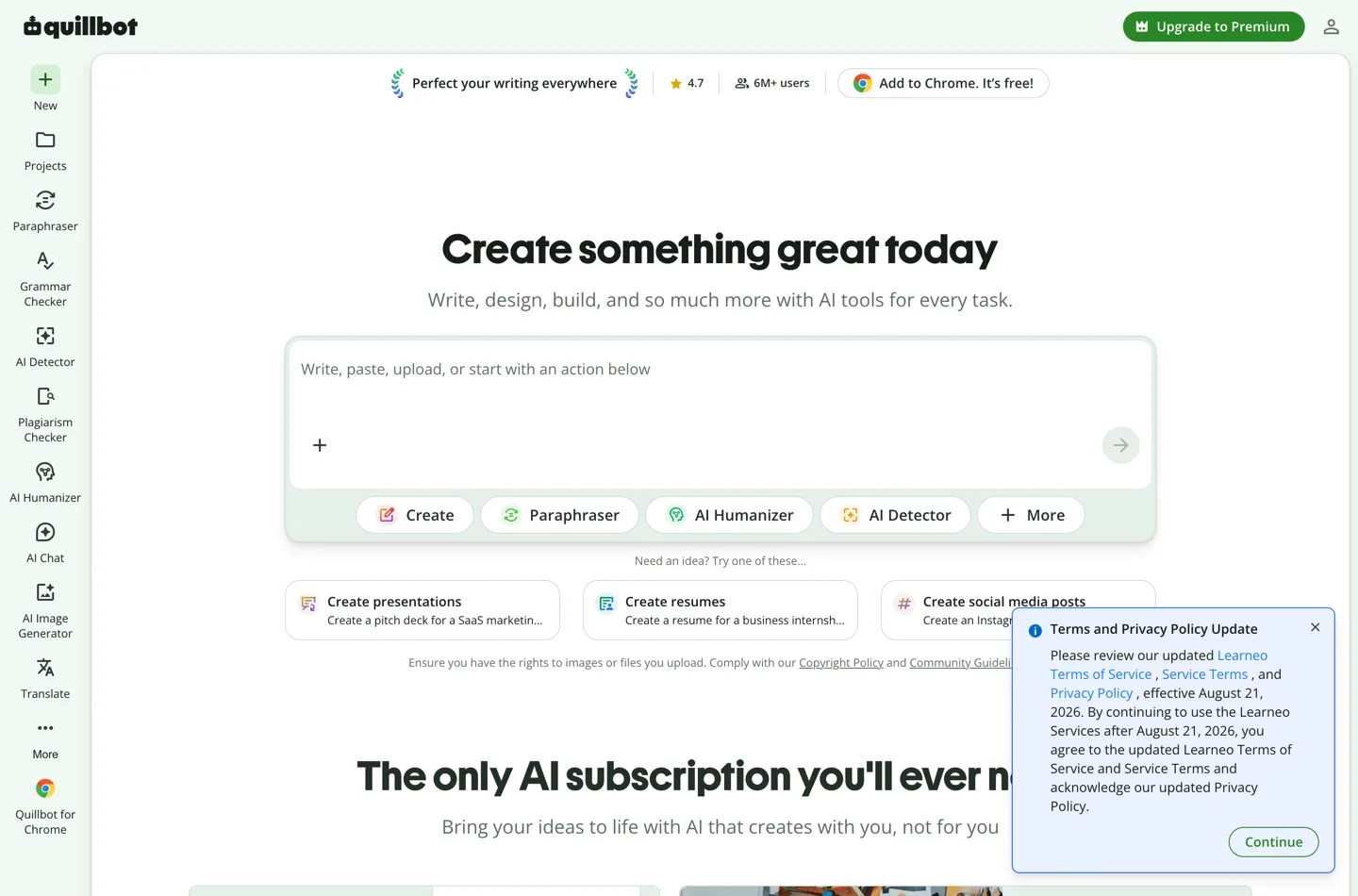
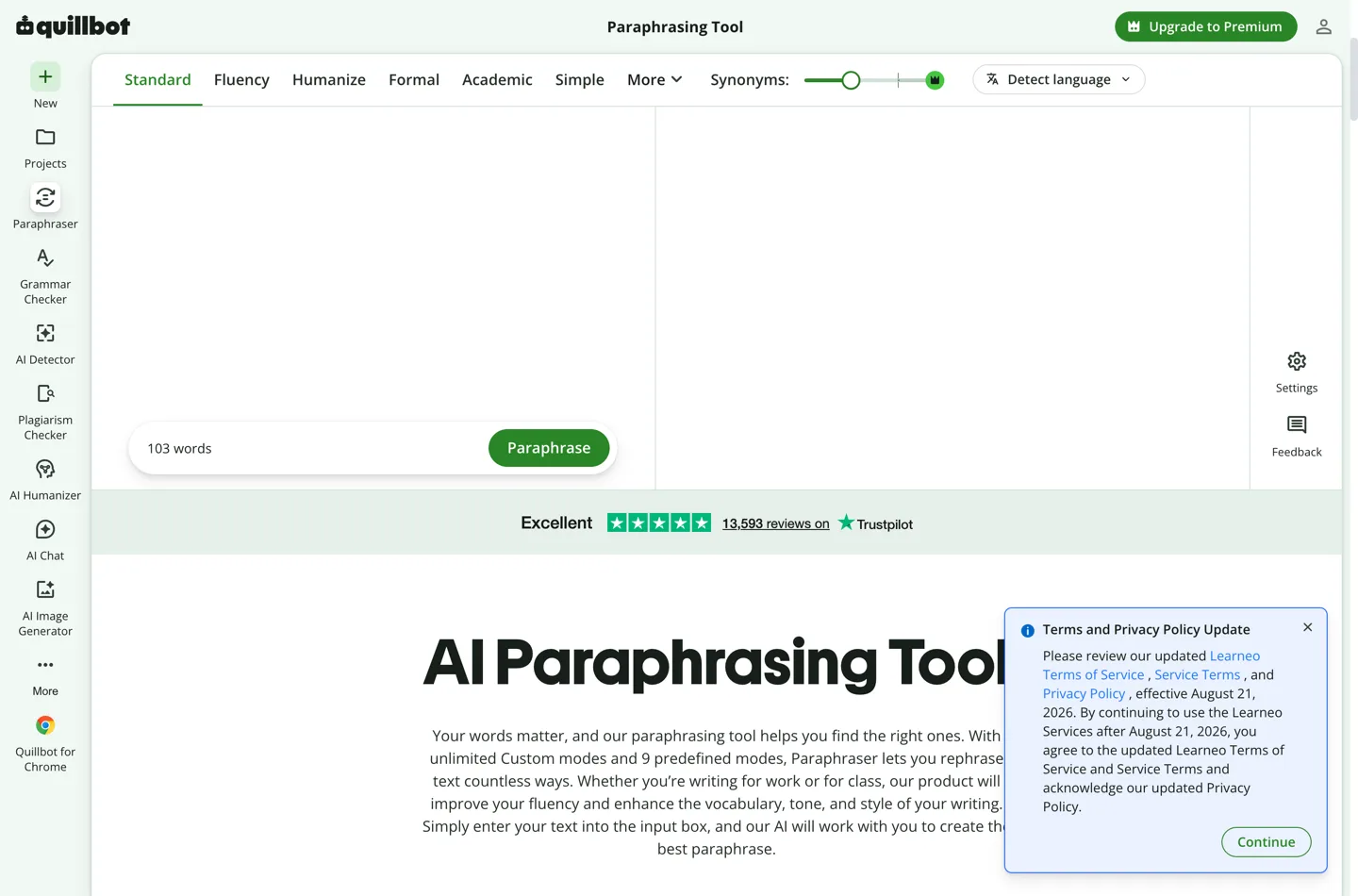
QuillBot is the most polished product in this roundup and the most restrictive free tier. The word counter tells you the whole story: it reads "103 / 125 words". Paste a normal article and it simply will not process it.
Inside that 125-word window the output was accurate. Every fact survived, including the numbers and the sourness-to-under-extraction link:
Let's start with the actual shot. About 36 grams of liquid are produced in the cup of a traditional espresso, which employs 18 grams of ground coffee in the basket. It should take between 25 and 30 seconds to pour, and practically all cafes operate from that two-to-one ratio.
Note that it inverted the sentence — leading with the output rather than the input — without breaking the relationship between them. That is a real rewrite, not a word swap, and it is the difference between a language model and a thesaurus.
One blemish worth flagging because it is the kind of thing that survives into published copy: it wrote "water rushes thru the bed". "Thru" is not a rewrite of "through"; it is a spelling most style guides reject outright, and it appeared unprompted in the Standard mode.
QuillBot also does the most to make the free tier feel like a trial rather than a tool, with a persistent premium banner and a locked set of modes.
- Genuinely good rewriting inside its limit — restructures rather than swaps
- Best editing interface of any tool tested
- Word-level synonym control and a sentence navigator
- Browser and Word integrations on paid tiers
- 125 words free — roughly two paragraphs, unusable for a whole article
- Produced "thru" for "through" unprompted
- Most modes locked behind the paid tier
- Constant upgrade prompting around the editor
3. Editpad — ran freely, damaged the meaning
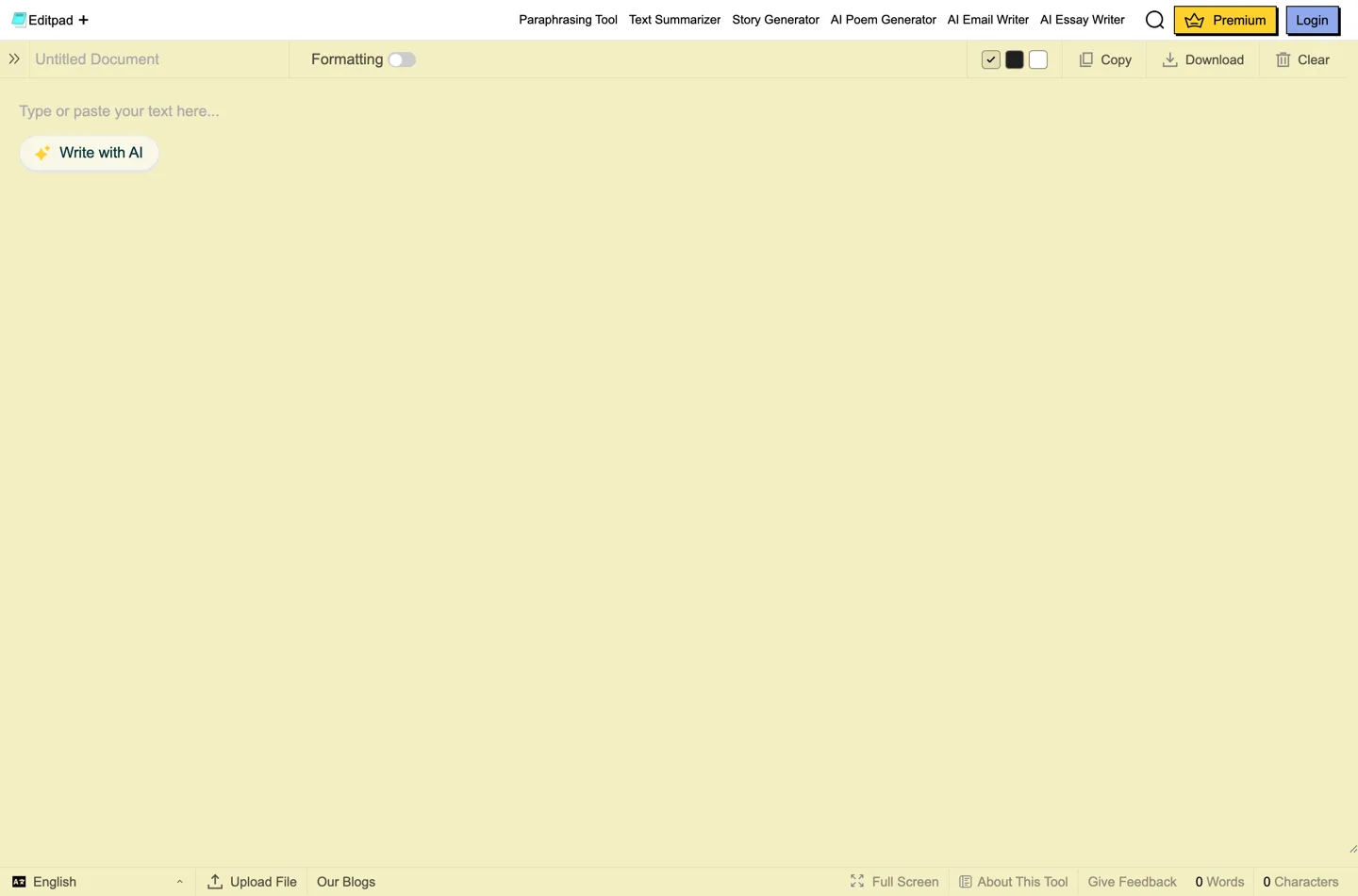
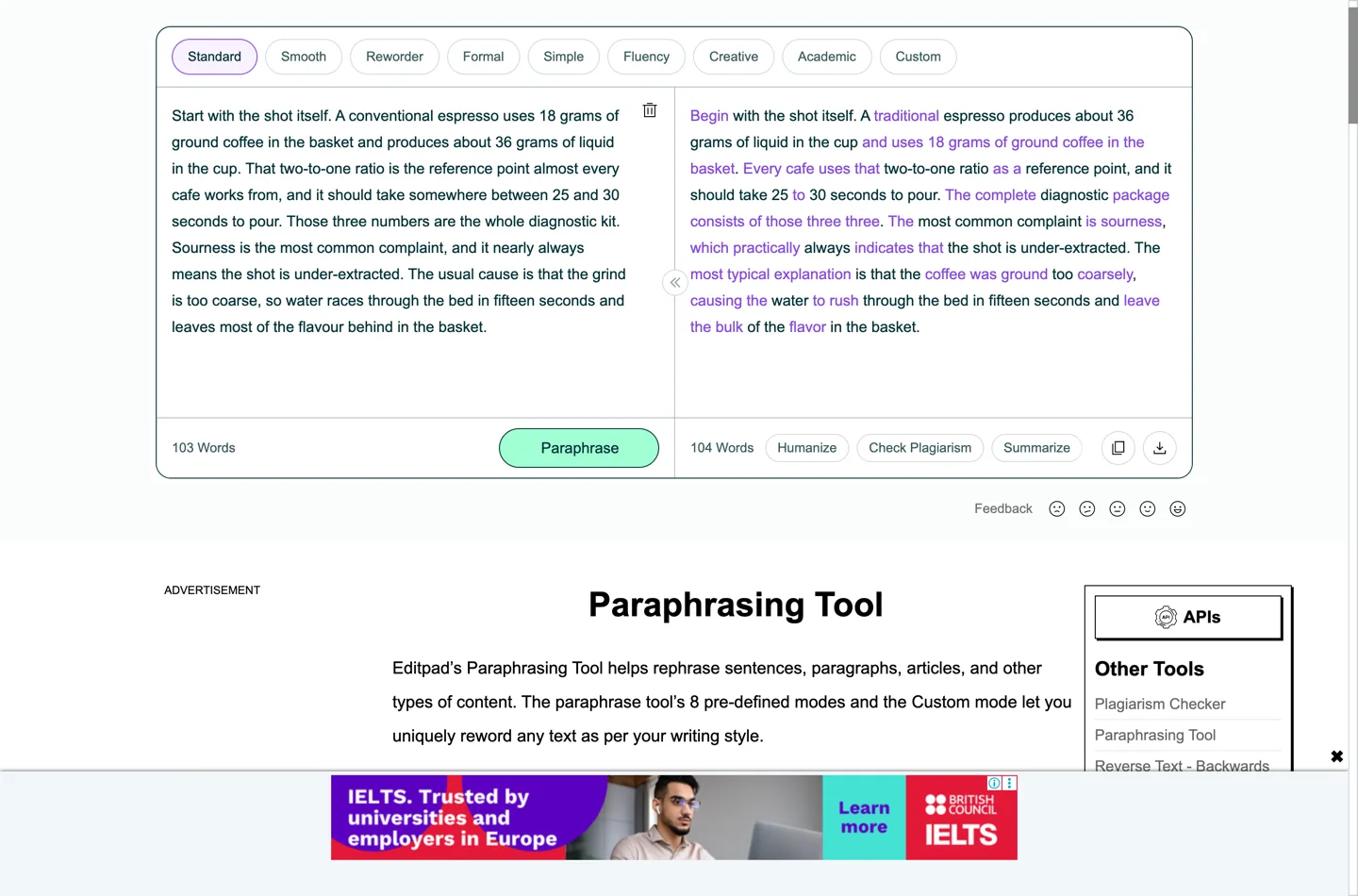
Editpad's paraphrasing tool ran on the full 103 words without an account and without a visible cap, which puts it ahead of four tools on this list on access alone. Then it produced this:
Begin with the shot itself. A regular espresso is made by putting around 36 grams of liquid in the cup and 18 grams of ground coffee in the basket. This two-to-one ratio serves as the standard for practically every café, and pouring should take 25 to 30 seconds. The whole diagnostic kit consists of those three three numbers.
Two failures in three sentences.
The first is factual and serious. The original says espresso produces about 36 grams of liquid — that is the output, the thing that comes out of the machine. Editpad rewrote it as something you put in: "made by putting around 36 grams of liquid in the cup and 18 grams of ground coffee in the basket." As written, you make espresso by pouring liquid into a cup. The numbers are all still there, which is exactly what makes this dangerous — a spot check on the figures passes while the sentence has been turned inside out.
The second is simpler: "those three three numbers." A duplicated word, shipped straight into the output.
Neither would survive a careful read. Both would survive a skim, which is how rewritten copy usually gets published.
- Ran the full passage free with no account and no cap shown
- Nine rewrite modes offered on the free tier
- Clean, fast, uncluttered interface
- Chains into its own summarizer and plagiarism checker
- Inverted a cause-and-effect relationship while keeping the numbers intact
- Emitted a duplicated word ("three three")
- No alternative drafts
- Requires a full read-through to trust the result
4. Spinbot — the clearest demonstration of why spinning fails
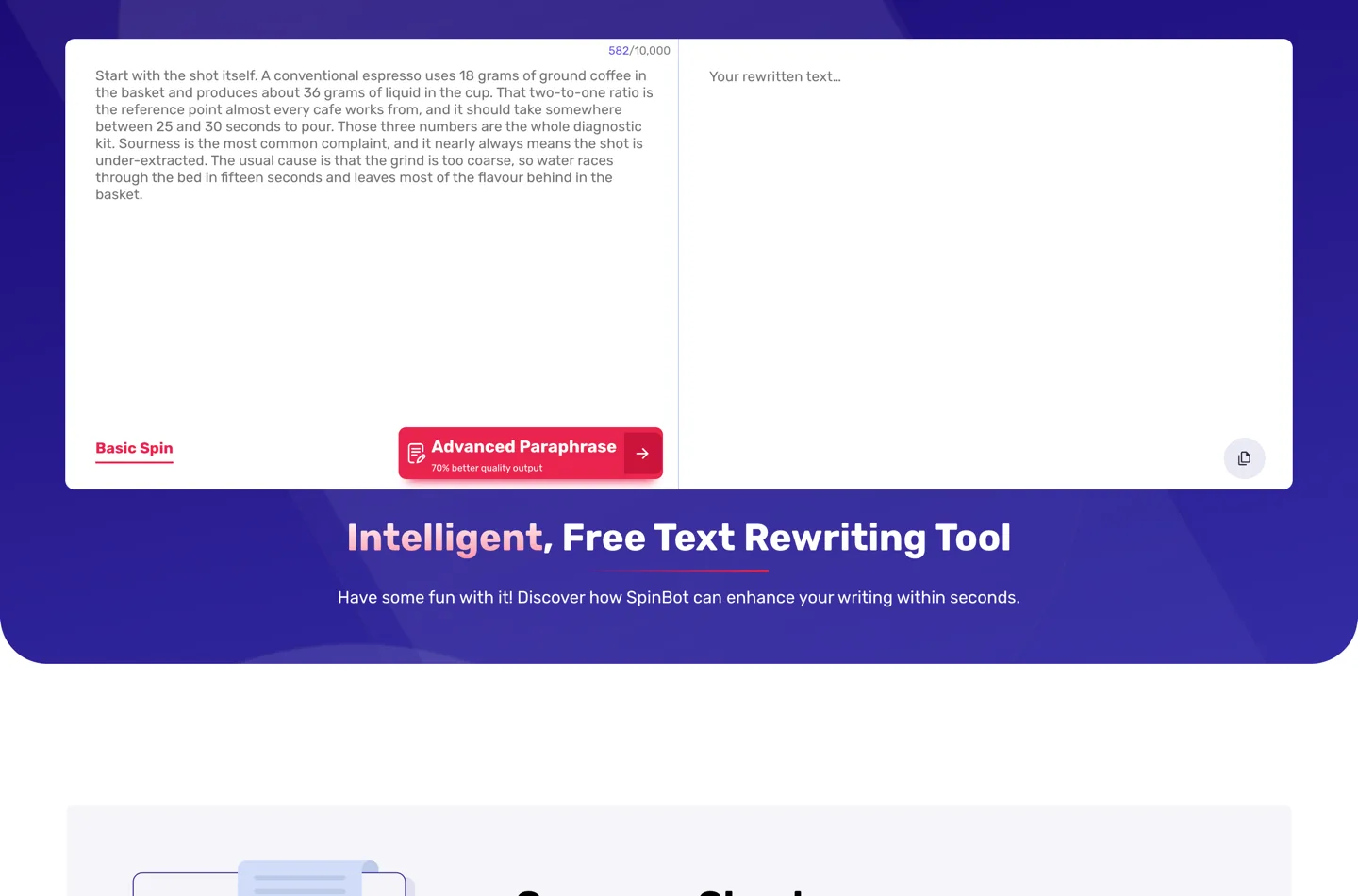
Spinbot accepts 10,000 characters free — the counter showed "582 / 10,000" — which is the joint-largest free capacity here. Its free mode is labelled Basic Spin; a red "Advanced Paraphrase, 70% better quality output" button sits next to it as the upsell.
Basic Spin returned this opening line:
Begin with the image itself. A conventional espresso uses 18 grams of ground coffee in the basket and produces about 36 grams of liquid in the cup.
The passage is about a shot of espresso. Spinbot replaced "shot" with "image" — a valid synonym for one meaning of the word and completely wrong for this one. In a single substitution it changed the subject of the article from coffee to photography, in the very first sentence, and left every subsequent number perfectly intact so that nothing looks obviously broken.
This is the failure mode that defines the whole spinning category. There is no model of meaning behind the swap — only a lookup table in which "shot" and "image" are neighbours. The rest of the output is largely untouched, which tells you the tool is doing shallow substitution rather than rewriting.
To Spinbot's credit, it ran instantly, free, without an account, and its own naming is honest: it calls the free mode a spin, and it sells the paraphraser separately.
- 10,000 characters free, no account, no cap on runs encountered
- Instant results
- Honest naming — the free mode is called a spin, not a rewrite
- Changed the subject of the passage in the first sentence
- Synonym substitution with no model of meaning
- Leaves most sentences structurally identical to the source
- The mode you probably want is the paid one
5. Prepostseo — accepted the text, returned it unchanged
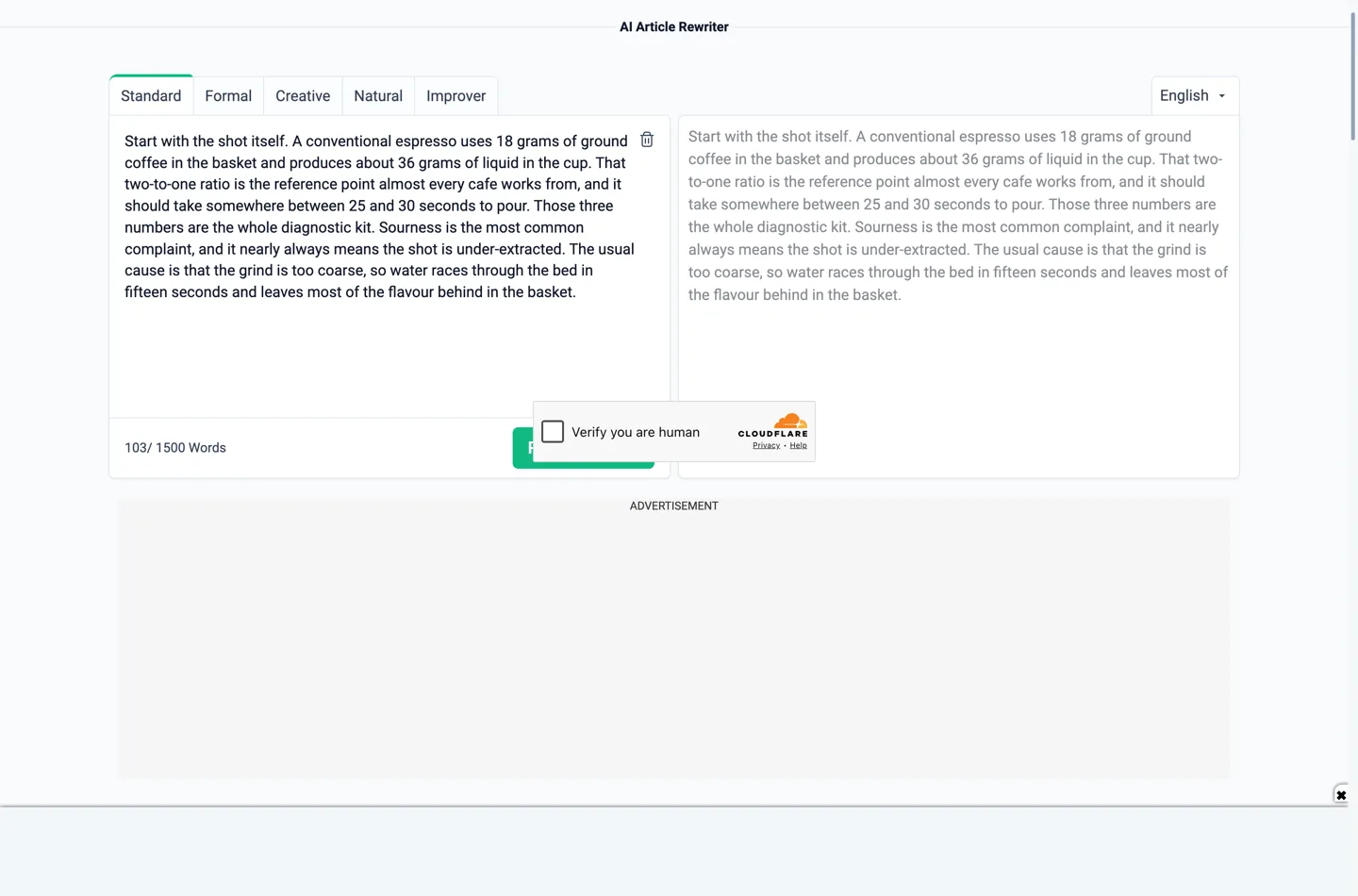
Prepostseo's AI Article Rewriter advertises 1,500 free words — the counter really does read "103 / 1500 Words" as you paste — and offers five modes: Standard, Formal, Creative, Natural and Improver. Everything up to the run works exactly as described.
The run is where it stopped. Pressing Rewrite Article filled the output pane with the submitted text, word for word: 103 words in, the same 103 words out, not a single substitution anywhere in the passage. A Cloudflare "Verify you are human" widget then appeared over the run button.
We tested this twice, a month apart — once through an automated session, and once by hand in an ordinary browser window that had loaded the page with no challenge at all. Both ended the same way. We do not solve CAPTCHAs to test a tool, so whatever Prepostseo does after that verification step is untested here, and is counted neither for nor against it.
The advertised cap is the largest free allowance in this comparison. If that human check is a one-time step for a normal visitor, this may work perfectly well for you — but a rewrite we never received is not a rewrite we can judge.
- 1,500-word free cap advertised — the largest here
- Five rewrite modes offered on the free tier
- No account needed to reach the tool
- Live word counter against the cap
- Returned the input unchanged in both of our runs
- Human-verification widget appears after pressing run
- Ad-heavy page that pushes the tool below the fold
- No rewrite obtained, so output quality is untested
6. Wordtune — free page, paid product
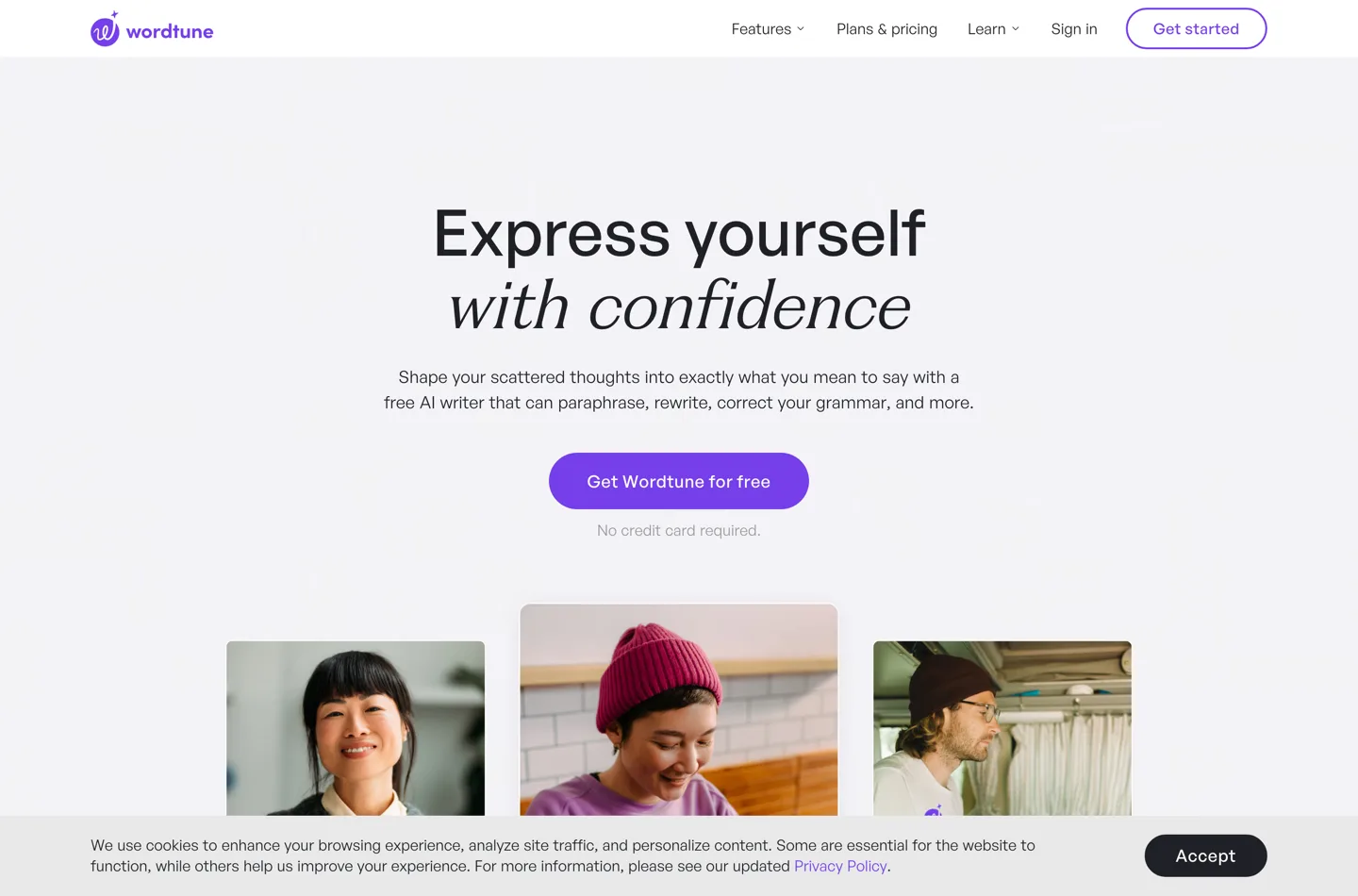
Wordtune's rewriting page invites you to "Instantly rewrite paragraphs, reword sentences, or humanize AI content" and offers a "Get Wordtune for free" button with "No credit card required" beneath it. What it does not offer is a rewrite. The page is a signup landing page: the path from pasting text to seeing output runs through account creation.
That is a legitimate business model and Wordtune has a strong reputation among people who pay for it. But it means Wordtune cannot be compared on output here, and it means the word "free" on that page describes an account, not a tool you can try.
7. Paraphraser.io — blocked by a CAPTCHA
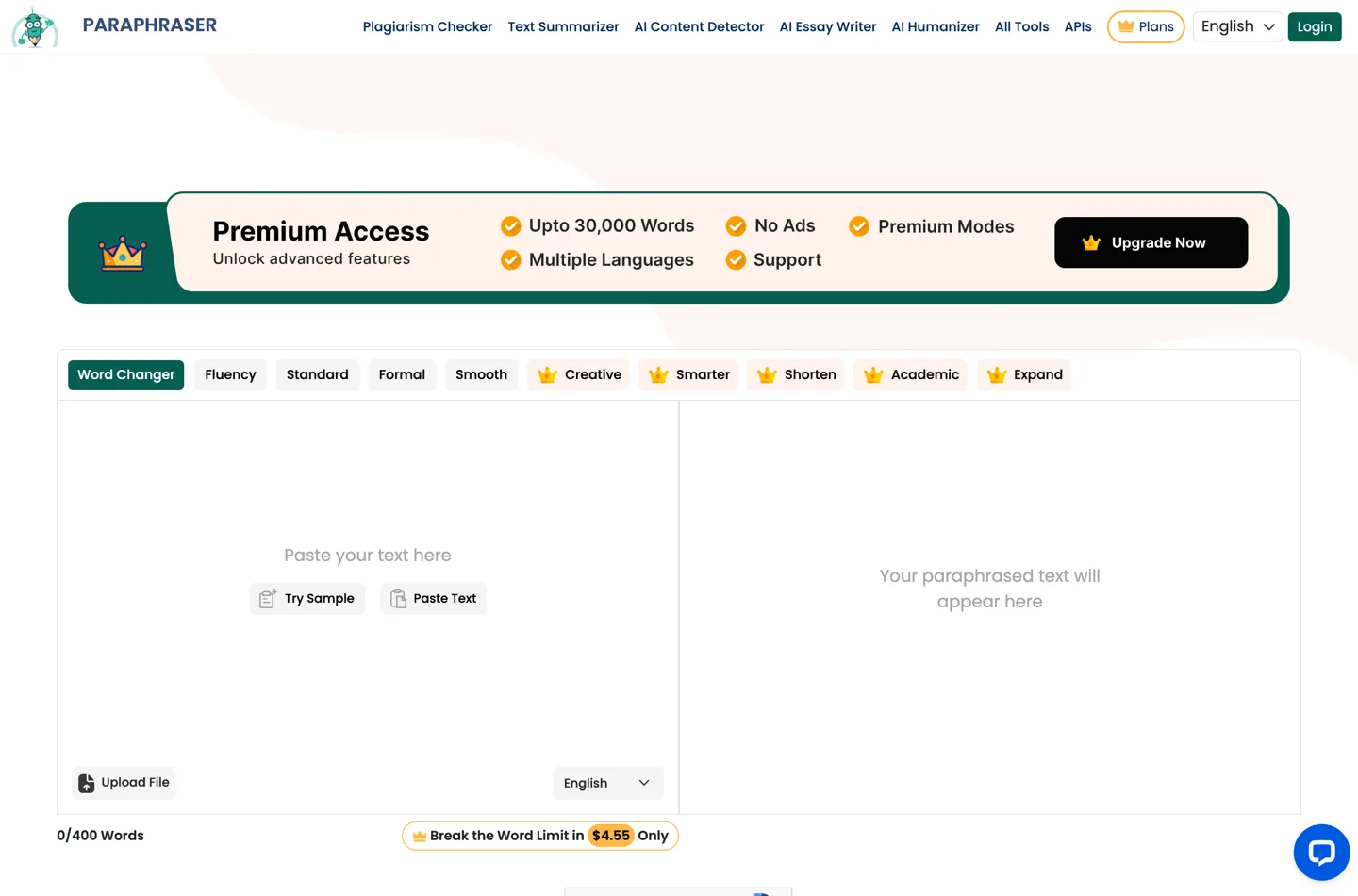
Paraphraser.io has the most feature-rich free interface in the roundup on paper: multiple paraphrasing styles, speech-to-text, screenshot input, a synonym picker. The text pasted in fine and the "Paraphrase Now" button armed.
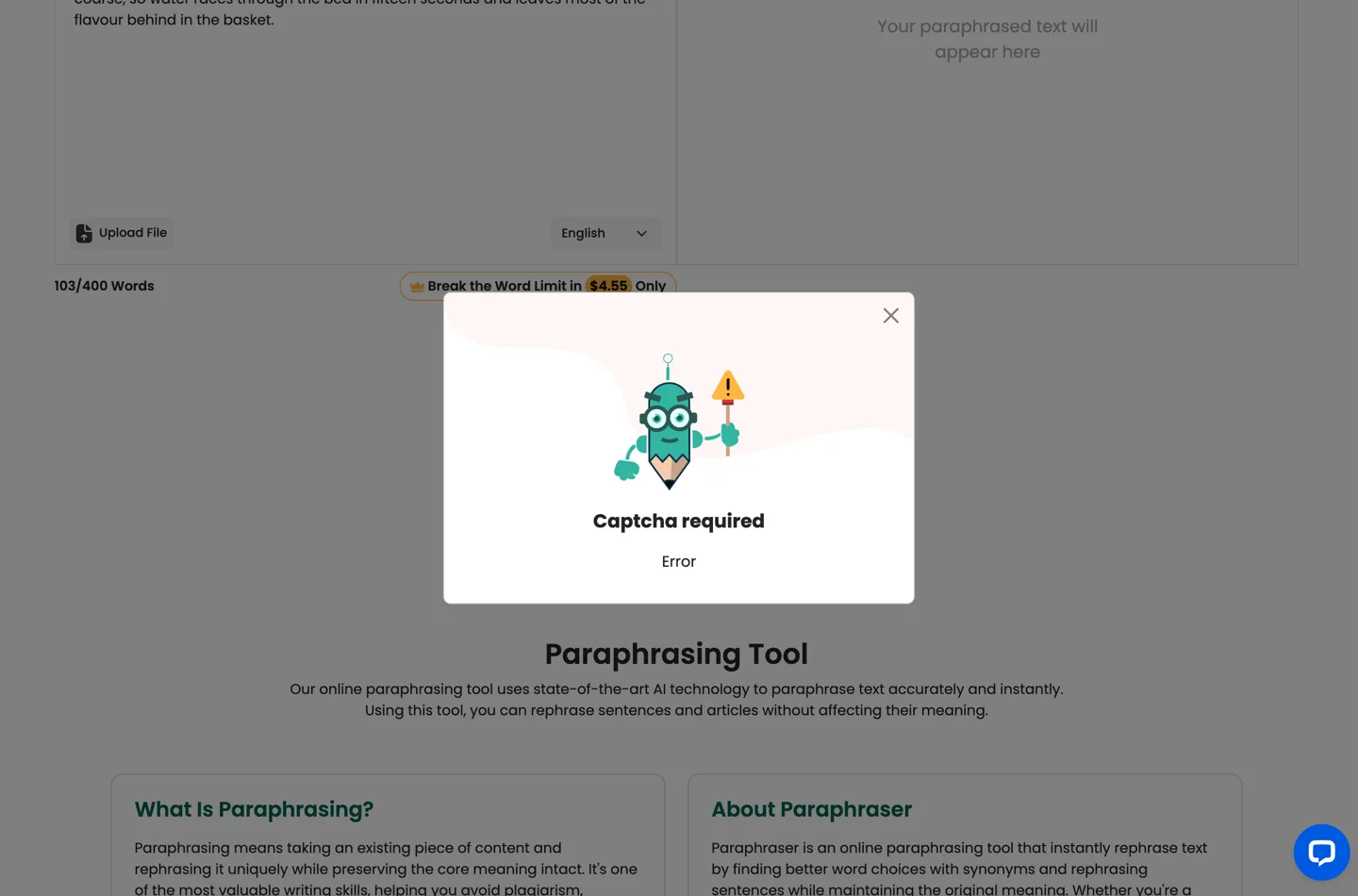
Clicking it produced a modal reading "Captcha required" and, below it, "Error". I do not solve CAPTCHAs to test software, so the run ends there. Worth noting for shoppers: the wall appears after you have pasted your text and clicked, not before, so you discover it having already done the work.
8. SmallSEOTools — a run button that never arms
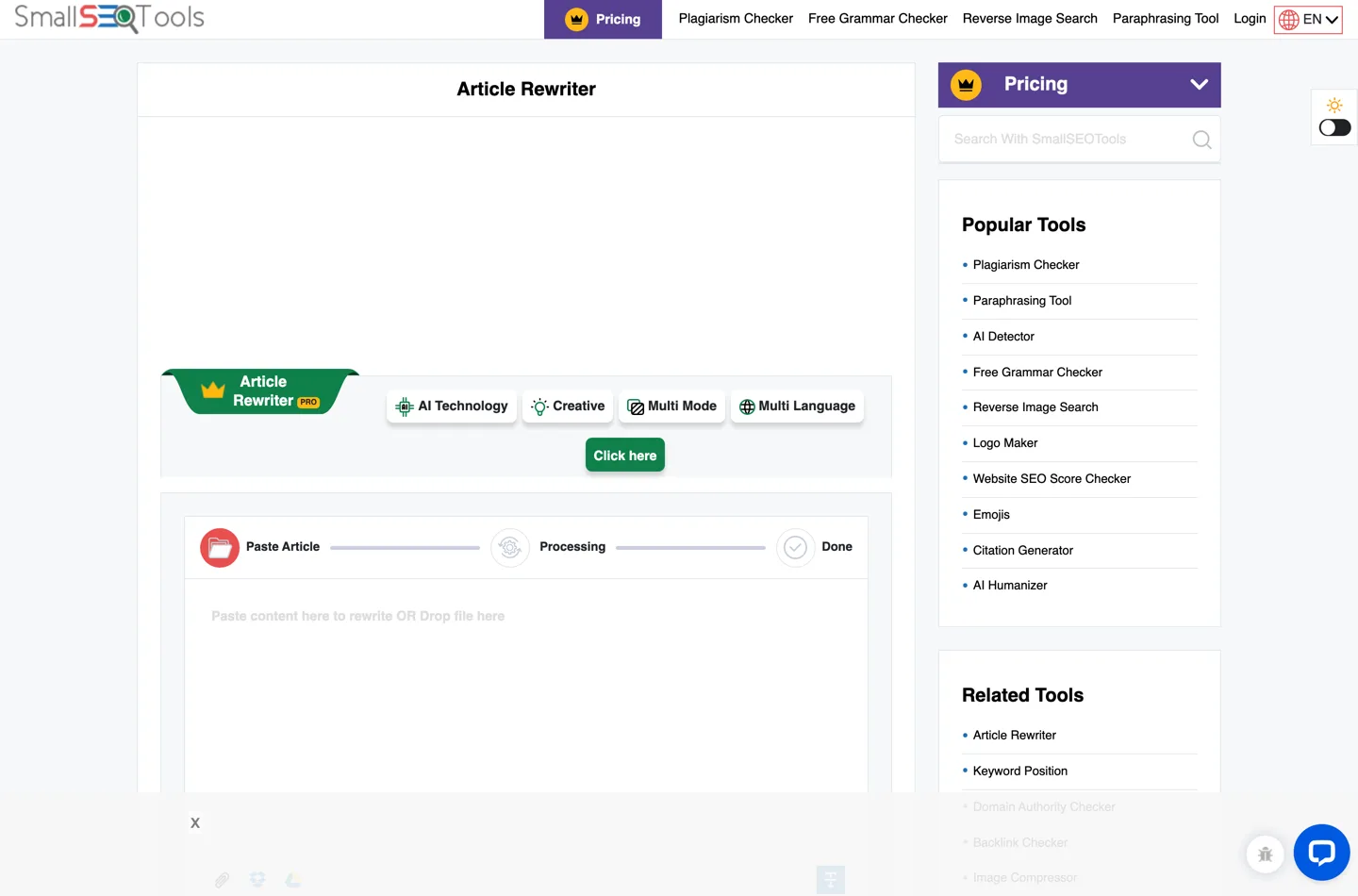
SmallSEOTools' Article Rewriter accepted the passage into its editor without complaint. Its main action button, however, sat reading "Loading" and never changed, with a reCAPTCHA present on the page. Waiting did not resolve it.
Whether that is bot protection doing its job or simply a broken free tier, the outcome for a reader is the same: text goes in, nothing comes out, and there is no message explaining why.
9. Rytr — no tool without an account
Rytr is a general AI writing assistant with rewriting among its use cases rather than a dedicated rewriter. On its public site there is no editor to type into at all without registering — not a limited one, not a demo. It ranks last here strictly on free-tier accessibility, which is what this test measures; it is not a judgement on the paid product.


What the free tiers actually cost you
Put the five working tools side by side and a pattern appears that no pricing page states: free tiers are limited along different axes, and the axis matters more than the number.
QuillBot limits you by passage length — 125 words, but as often as you like. That is fine for polishing an abstract and useless for an article. UNmiss limits you by runs per day — 3, but each one takes 10,000 characters. That is fine for one article done properly and useless for bulk. Spinbot barely limits you at all, because the thing it is giving away is not worth metering.
So the honest question is not "which free tier is most generous" but "which limit do I hit first, given what I actually do?" If you rewrite one long piece a week, a daily run cap is invisible and a word cap is fatal. If you touch up dozens of short snippets, the reverse.
Four of the nine tools here reveal their real gate only after you have pasted your text: a signup wall, a CAPTCHA, or a button that never arms. Budget for the possibility that the tool you picked from a listicle will not run at all, and test it with a throwaway paragraph before you commit a real draft to it.
How much of the original should a rewrite actually change?
Here is the number I promised to come back to. Running the full 684-word article through our own tool, 32.6% of the source survived verbatim — measured by taking every eight-word sequence in the original and counting how many reappear unchanged in the rewrite. Roughly a third of the phrasing came through untouched.
The instinct is to read that as a failure. It is not obvious that it is, and the reason is worth understanding before you judge any tool in this category by how different the output looks.
There is a straightforward trade-off between how much text changes and how much meaning survives. Push a rewriter to alter everything and you force it to find new ways to say things that were already precisely said — which is exactly the pressure that produces "shot" becoming "image". Sentences carrying numbers, units, technical terms and fixed relationships have fewer valid rewordings than sentences carrying opinion. A tool that rewrites those aggressively is not being thorough; it is inventing.
Look at where the overlap actually sits in our output. The untouched runs are clauses like "18 grams of ground coffee in the basket" and "between 25 and 30 seconds" — the parts that should be untouched, because there is no better way to say them and every alternative is worse. The sentences around them were restructured.
Compare that with Spinbot, which left most of its sentences structurally identical to the source — the opposite pattern. Its overlap is high because it barely rewrote anything, and the one thing it did change was the one thing it should not have. Low verbatim overlap and high fidelity is the ideal; high overlap with a broken subject is the worst of both.
Verbatim overlap is only meaningful next to fact retention. A tool with 30% overlap and every fact intact has rewritten the prose and left the substance alone, which is the job. A tool with 30% overlap and a broken relationship has simply changed more things, some of them wrong. Never judge a rewriter by how different the output looks.
The practical consequence for you: if you need text that shares no phrasing with the original — because you are working around a strict internal similarity threshold, say — no tool here reliably delivers that and keeps your facts. That is a job for rewriting it yourself, from the ideas rather than from the sentences.
Which one should you actually pick?
Four situations, four different answers.
You have one article to fix properly. UNmiss. The whole piece goes in at once, you get three drafts to choose from, and you can fix individual sentences afterwards without regenerating anything. Three runs a day is plenty when you need one.
You rewrite short passages constantly. QuillBot, and probably its paid tier. The 125-word window is a poor fit for articles and a fine fit for abstracts, product blurbs and email paragraphs, and the editing interface is the best here by some margin.
You want the most free words with no account. UNmiss, at 10,000 characters per run, capped at 3 runs a day. Prepostseo advertises a larger 1,500-word allowance, but it never returned a rewrite for us — see below.
You are rewriting at volume for work. Pay for something. Every free tier on this list caps you somewhere, and the time you spend working around free limits costs more than a subscription within a week.
Where the paid tools genuinely beat us
Three things the paid competitors do that our free tier does not, stated plainly because a comparison that finds no fault with its author's product is not a comparison.
Volume. Three rewrites a day is the binding constraint on the UNmiss free tier, and it is a real one. Every paid tool here removes that ceiling. If your job involves rewriting at scale — an agency reworking a client's back catalogue, an e-commerce team on product copy — you will hit our cap on day one, and paying someone is the correct answer.
Living where you write. QuillBot's browser extension and Word add-in mean the rewriter is present in the document you are already in. We have no extension. Copy-paste is a small friction, but it is a friction you pay every single time, and over a working week it adds up to more than the feature list suggests.
Word-level control. QuillBot's synonym slider and click-a-word-to-change-it interaction give you fine-grained control over an individual phrase that our sentence-level rewrite does not match. We operate at the sentence; they operate at the word.
What none of them do better, on this evidence, is keep your facts straight — and that is the thing worth optimising for first, because a fluent rewrite with a broken fact is worse than no rewrite at all.
What a rewriter can and cannot fix for SEO
A great deal of nonsense is written about rewriting and rankings, so here is the useful version.
What rewriting can genuinely help with. Rewriting is a reasonable tool for a page whose content is fundamentally sound but whose expression is not: a draft written for the wrong audience, an old post whose tone no longer matches your site, a translation that reads stiffly, an AI first draft that needs a human register. In each case the value in the page already exists and the rewrite makes it readable.
What rewriting cannot fix: duplicate content. The old model — take a competitor's page, spin it, publish it as yours — does not work and has not for years. Search engines are not comparing strings; a rewritten copy of someone else's article is still a copy of their article in every way that matters, and it will not outrank the original by virtue of different wording. Worse, spinning is exactly the process most likely to introduce the factual errors documented above.
What rewriting cannot fix: thin content. If a page ranks poorly because it does not answer the question, rewriting it produces a differently-worded page that still does not answer the question. Length is not the issue and neither is phrasing — the missing thing is information. That is a research problem, and a rewriter is the wrong tool. Our content optimizer is aimed at that gap, and an article writer at the blank-page version of it.
The one SEO risk to watch. If you rewrite a page that currently ranks, you can lose the phrasing that earned the ranking. Keep the exact terms your audience searches for intact — a rewriter that "improves" your primary keyword into a synonym has cost you the page. This is precisely why the sentence-level approach matters: change the paragraph that reads badly, leave the heading that ranks alone.
How to rewrite an article without breaking it
A five-step routine that survives contact with real work.
1. Decide what you are actually fixing. Register, length, clarity, or repetition — pick one. "Make it better" produces a differently-mediocre draft, because the tool has no way to know what you disliked.
2. Rewrite in sections, not all at once. Feed one section, read it, accept or reject, then move on. Whole-article rewrites are hard to review honestly, because by paragraph nine you are skimming, and paragraph nine is where the error is.
3. Protect your terms before you start. List the words that must not change — product names, the primary keyword, technical terms with precise meanings, numbers with units. Then check them explicitly afterwards. This is the step that catches "shot" becoming "image".
4. Read for facts, not for fluency. Fluency is what these tools are best at and it is what makes errors invisible. Read the rewrite next to the original with one question in mind: does each sentence still assert the same thing? Every failure in this test — the inverted dose, the changed subject, the duplicated word — is caught by that pass and by nothing else.
5. Edit the output yourself. No tool here produced text I would publish untouched, ours included. Treat the rewrite as a strong draft that saved you thirty minutes, not as finished copy.
Mistakes that ruin a rewrite
Rewriting to escape a plagiarism checker. If the underlying text is someone else's, changed wording does not make it yours. This is a licensing and ethics problem, not a tooling one.
Rewriting repeatedly. Running output back through a rewriter compounds drift. Each pass moves a little further from the original meaning, and after three passes you have a fluent article that quietly disagrees with the one you started with.
Trusting a spinner because the numbers survived. The Editpad result is the case study: every figure intact, the relationship between them reversed. Numbers surviving is not evidence that meaning survived.
Rewriting a page that already ranks, without a record. Keep the original. If traffic drops, you need to be able to put it back.
Assuming the free tier is the product. Several tools here reserve their good mode for paying users — Spinbot's is explicit about it. Judging a paid tool by its free spin mode is unfair to the tool and misleading to you.
Rewriting in languages other than English
Most rewriters are built and tuned in English, and quality falls off outside it in ways the interface never signals — the same button, the same speed, quietly worse output.
Of the tools here, UNmiss offers 16 output languages and can take English in and return another language out, which is a translation-plus-rewrite in one step; the Spanish run in this test worked cleanly. Prepostseo and Editpad expose language selectors. QuillBot supports multiple languages on paid tiers.
The advice for any non-English rewrite is the same and it is stricter than for English: have a fluent speaker read it. The failure modes documented above — a subject swapped for a false synonym, a relationship inverted — are harder to spot in a language you read but do not write, and no tool will flag them for you.
Frequently asked questions
What is the best article rewriter tool?
For most people, the UNmiss Article Rewriter: it accepts 10,000 characters with no account, preserved all 10 checkable facts in testing, returns up to 3 alternative drafts per run, and can rewrite a single sentence in place. Its real limit is 3 rewrites per day. QuillBot was the best competitor: every fact intact, though capped at 125 words per run. We make one of these tools, so weigh the ranking accordingly.
Is there a genuinely free article rewriter with no signup?
Yes — four of the nine tested produced a rewrite with no account and no card: UNmiss, QuillBot, Editpad and Spinbot. Five did not: Prepostseo returned our text unchanged and then raised a human-verification check, Wordtune requires registration, Rytr shows no editor at all to signed-out visitors, Paraphraser.io returned a "Captcha required" error, and SmallSEOTools' run button never left its "Loading" state.
Do article rewriters hurt your SEO?
Rewriting itself is neutral; what you do with it is not. Rewriting your own draft to read better is fine. Rewriting a competitor's page and publishing it is duplicate content regardless of how different the words are, and it will not outrank the original. The specific risk to watch is rewriting a page that already ranks and losing the exact phrasing that earned it — protect your primary keyword and headings before you run anything.
Can Google detect rewritten content?
The question is usually the wrong one. Search engines are not running a "was this rewritten" test; they are assessing whether a page is useful and original in substance. A rewritten page that adds nothing new competes badly not because it was detected but because it is a worse version of something that already exists. Conversely, a rewrite of your own work that makes it clearer is simply a better page.
What is the difference between an article rewriter and an AI humanizer?
A rewriter changes wording while preserving meaning, and is judged by whether a knowledgeable reader agrees it still says the same thing. A humanizer changes the statistical fingerprint of text so AI detectors score it as human-written, and is judged by a detector score. They optimise for different targets and a tool can be good at one and poor at the other. Our AI humanizer comparison covers the second category.
What is article spinning, and is it the same as rewriting?
No. Spinning substitutes words for thesaurus synonyms with no model of what the sentence means. This test produced a textbook example: Spinbot rewrote "Start with the shot itself" as "Begin with the image itself", changing the subject of a passage about espresso to photography, because "shot" and "image" are synonyms in a different sense of the word. Rewriting, done by a language model that tracks meaning, restructures sentences while keeping what they assert.
How many words can you rewrite for free?
It varies enormously and along different axes. QuillBot caps each paraphrase at 125 words but does not limit how often you run it. Prepostseo advertises 1,500 words per run, though it produced no rewrite in our tests. UNmiss and Spinbot both accept 10,000 characters, but UNmiss limits you to 3 rewrites per day. Decide which limit you would hit first given your actual workload — for one long article a day cap is invisible; for many short snippets a word cap is.
Do article rewriters change facts and numbers?
Two of the five tools that ran did. Editpad kept every figure but inverted the relationship between them, rewriting "espresso produces about 36 grams of liquid" into "espresso is made by putting around 36 grams of liquid in the cup" — making an output into an input. Spinbot changed the subject of the passage entirely. The lesson is that intact numbers are not evidence of intact meaning; you have to read the sentences.
Can I rewrite a PDF or Word document directly?
With some tools. UNmiss imports six formats — .txt, .md, .docx, .rtf, .odt and .pdf — so a Word draft or a PDF goes in without copy-pasting. Several competitors offer document upload as a paid feature. Check before you rely on it, because pasting out of a formatted document usually costs you the structure.
Is it better to rewrite a whole article or one section at a time?
Section at a time, for a reason that has nothing to do with the tools: whole-article rewrites are hard to review honestly. By the ninth paragraph you are skimming, and errors do not distribute themselves conveniently into the first two. Rewriting in sections also lets you keep the parts that were already working — which matters if the page ranks.
Can article rewriters work in languages other than English?
Yes, but quality usually drops outside English without the interface signalling it. UNmiss offers 16 output languages and can take English in and return another language out. Prepostseo and Editpad have language selectors; QuillBot supports more languages on paid tiers. For any non-English rewrite, have a fluent speaker check it — a swapped false synonym is much harder to spot in a language you read but do not write.
How were these tools tested?
One 103-word passage about espresso, containing nine facts a reader can check, was pasted into all nine tools on 12 August 2026. No accounts were created, no CAPTCHAs solved, and cookie banners were declined rather than accepted. Each output was read word by word against the original to see whether the facts survived. Our own tool was additionally run on the full 684-word source article to measure speed, fact retention and how much of the original survived verbatim.
Should I pay for an article rewriter?
Pay if volume is your constraint — every free tier here caps you somewhere, and if you rewrite for a living you will hit that cap immediately. Pay if you want the rewriter inside the document you are already writing in, which currently means QuillBot's browser and Word integrations. Do not pay expecting better fact preservation: the free tools that handled this test cleanly handled it as cleanly as anything, and the failures were failures of method, not of budget.
The verdict
Nine tools, one passage, nine facts. Five tools produced a rewrite for free and four would not run at all without an account or a CAPTCHA — which is itself the most useful finding for anyone shopping from a listicle.
Among the five that ran, the split was not between good and bad interfaces or generous and stingy limits. It was between tools that understand what a sentence says and tools that only know which words look alike. UNmiss and QuillBot kept the facts. Editpad and Spinbot did not, in ways that a quick skim of the output would not catch.
Our tool ranks first on capability: 10,000 characters against QuillBot's 125 words, three alternative drafts where others give one, sentence-level rewriting that no competitor here offers, six import formats and 16 languages. It ranks first with an asterisk, and the asterisk is three rewrites a day. If that is enough for what you do, nothing else on this list gives you more. If it is not, no free tier here is a clean answer — QuillBot is the most trustworthy but stops at 125 words a run — and paying for something is a reasonable answer to a volume problem.
Whichever you choose, do the read-for-facts pass. This test found a tool that turned a shot of espresso into an image and another that made a drink out of pouring liquid into a cup, and both of those outputs read perfectly well.
All nine tools were run on the same 103-word passage on 12 August 2026, with no account created and no CAPTCHA solved. Quoted rewrites were read out of each tool's live output. Free-tier caps are the figures each tool displayed in its own interface on that date and change often — check the vendor's page before you buy.
- 10,000 characters per run, 3 free rewrites a day
- Up to 3 alternative drafts from one run
- Rewrite one sentence in place, or refine with your own instruction
- Import .docx, .pdf, .rtf, .odt, .md and .txt
- 16 output languages