Search "best AI humanizer tool" and you will meet a wall of confident percentages. One vendor reports a 96.8% bypass rate. Another says its output averages a 99.7% human score across 100,000 documents. A third simply promises it "beats every AI detector."
Here is the part nobody mentions: almost every one of those pages is published by a humanizer company, about itself. Phrasly's roundup ranks Phrasly first. Walter Writes' roundup ranks Walter Writes first. The same pattern repeats at gpthuman.ai, texthumanizer.com and undetectedgpt.ai. Not one of those numbers can be reproduced by the person reading them.
So I did the only thing that makes a comparison mean anything: I took one AI-written draft — textbook ChatGPT prose about remote onboarding — and fed the same text to every tool that would accept it without an account. Five did. Every price below was read from the vendor's own pricing page in August 2026, and every free-tier limit from the same place.
That constraint produced the first real finding. Four of the nine could not be tried at all without handing over an email or a card — including the two with the loudest marketing. And of the five that ran, two quietly damaged the text: one introduced spelling mistakes, the other changed what a sentence meant. You would not learn either fact from a pricing page.
And one disclosure up front, because this article ranks our own tool first: seotools.pro makes one of these 9 tools. You should discount our opinion accordingly, which is exactly why the section on our tool lists what it cannot do, and why there is a whole section below on where the paid tools genuinely beat us.
For a free rewrite you can actually inspect, use the seotools.pro AI Humanizer — 3 full runs a day with no account, a before/after score on one scale, and a sentence-level diff. For the largest free allowance and the cleanest output we measured, Grammarly rewrote 1,500 words with no account whatsoever — and it is also the one tool here that refuses to market detector evasion at all. QuillBot is the cheapest upgrade at $4.17/mo — but proofread it, because it put misspellings into our test text. For volume, Walter Writes is 30,000 words for $8/mo. And if a tool's own marketing is aimed at beating Turnitin, as StealthGPT's is, understand what you are buying.
Those four numbers frame the category. The advice is mostly written by the sellers. Most of the tools cannot be evaluated before you pay. Of the ones that can, nearly half degraded the writing they were asked to improve. And the central promise — that your text will pass — is one nobody is in a position to make, because the detectors change and none of these vendors control them.
This tool is not intended to bypass AI detectors.
— Grammarly, AI Humanizer product pageThat sentence is from the biggest writing brand in the world, on the product page for its own humanizer. It is worth holding in mind while you read the rest of this list, because several tools here promise the exact opposite.
How I tested: one draft, nine tools
The draft was written to be typical rather than tricky — the kind of thing a content team actually pastes in: heavy on "In today's rapidly evolving digital landscape", "It is important to note that", "Furthermore", and a closing paragraph beginning "In conclusion".
Our own tool got the full 408 words. Every competitor got the same 106-word opening excerpt, cut to that length so it cleared the tightest free cap in the group — QuillBot's 125 words — and so the tools that did run were compared on identical input rather than on whatever each would accept.
For each tool I recorded seven things:
- What it actually changes. A synonym swap is not a rewrite. I looked for whether sentence structure moved or only vocabulary.
- Whether the facts survived. Numbers, claims and specifics have a habit of quietly disappearing in a rewrite.
- What happens to length. Several humanizers pad; some cut hard.
- The real free tier. Not "free to try" — how many words, how many runs, and whether an account is required.
- Price, from the vendor's own page. Monthly and annual, since the headline figure is almost always the annual one.
- What it claims about detection, quoted exactly.
- Whether you can see the edit. Can you review what changed, or must you trust it?
I have not published a pass/fail grid against Originality.ai, GPTZero or Turnitin. We do not run those detectors, so any such table would be a guess dressed as a measurement — the precise thing this article exists to push back on. Where I quote a score, it comes from our own AI content detector and is labelled as ours. Vendor bypass rates appear only as the vendor's claim, attributed and linked.
What I could and could not run
One rule made the testing honest and also limited it: I did not create an account anywhere. No signups, no trial emails. That is how a first-time visitor meets these tools, and it turns out to be the sharpest dividing line in the category.
Four tools rewrote the excerpt with no account at all: seotools.pro, Grammarly, QuillBot and WriteHuman. HIX Bypass ran, but on its own pre-loaded sample rather than my text. Undetectable AI and Surfer showed no usable editor on the page without signing in, and StealthGPT and Walter Writes publish no free tier to test. Those are results too — a tool you cannot try is a tool you must buy on faith.
Everything below marked "tested" means I pasted the excerpt, pressed the button, and screenshotted whatever came back.
The 9 best AI humanizer tools at a glance
| Tool | Best for | Free tier (verified) | Paid from | Ran without an account? |
|---|---|---|---|---|
| seotools.pro AI Humanizer | A free rewrite you can inspect | 3 full runs/day, no account | Free | ✔ tested — diff + side-by-side |
| Grammarly | Client and academic work | 1,500 words, no account | Grammarly Pro | ✔ tested — cleanest output |
| QuillBot | Everyday short passages | 125 words, 6×/day | $4.17/mo annual | ✔ tested — added misspellings |
| Undetectable AI | Buyers who want a guarantee | 250 words, once | $5.00/mo annual | ✘ no editor without signin |
| Surfer AI Humanizer | Teams already using Surfer | 500 words, no login | Surfer plan | ✘ no editor found |
| WriteHuman | Trying before subscribing | 3 requests/month, 250 words | $12/mo annual | ✔ tested — "100% Human" |
| HIX Bypass | Unlimited volume, cheaply | Browser demo, no plan listed | $9.99/mo | ✔ ran, on its own sample |
| Walter Writes AI | Words per dollar | None on the pricing page | $8/mo annual | ✘ nothing to test |
| StealthGPT | Volume, billed by the day | None on the pricing page | $1.00/day | ✘ nothing to test |
Two things jump out of that table. First, only 5 of the 9 could be tried at all without handing over an email — and the two most aggressively marketed, StealthGPT and Walter Writes, publish no free tier whatsoever. Second, "free" means wildly different things: Grammarly gave 1,500 words to a total stranger, WriteHuman gives 3 requests a month.
The 9 best AI humanizer tools, ranked
1. seotools.pro AI Humanizer: Best Free Rewrite You Can Actually Inspect (Our Pick, Tested)
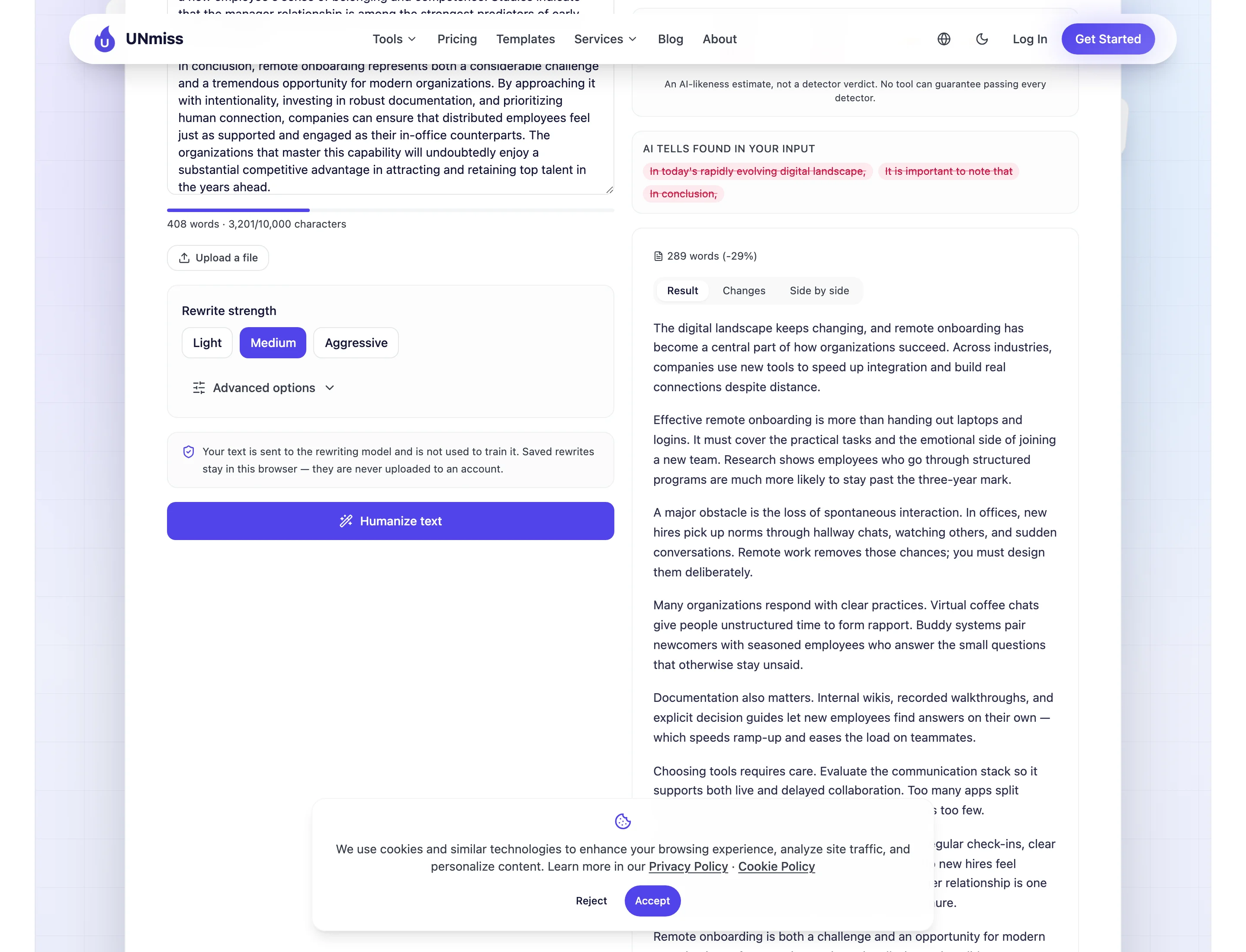
The seotools.pro AI Humanizer gives you 3 full runs a day with no account, no email and no card. That is the most generous no-signup allowance in this list by a distance — Undetectable AI gives you 250 words once, WriteHuman gives 3 requests a month.
But the allowance is not why it is first. It is first because it is one of only two tools here that shows you its own workings.

That panel is the single most useful thing any tool in this list produced. It did not just tell me the draft looked artificial — it pointed at "In today's rapidly evolving digital landscape,", "It is important to note that" and "It is worth noting that" and struck them out. That is a lesson you keep. Next time you write, you catch those yourself.
On scoring, the tool puts the input and the output on one shared 0–100 scale and shows the delta. Across six runs of the test draft, our own detector rated the input at 90–92 for AI-likeness every time and the rewrite between 50 and 75 — a gain of 15 to 42 points. The rewrite also tightened 408 words to 289, a 29% cut, without losing a point from the original.
That spread is worth naming rather than averaging away: the same input on the same setting can come back 20 points apart, because the rewrite is generative and so is the scoring. Run it twice on anything that matters. A tool that returns the identical confident number every time is not more accurate than that — it is just not showing you the variance.
What I want to be straight about: those absolute numbers are not flattering, and the tool does not hide them. It reports the rewrite as still reading fairly machine-typical, with an amber warning icon rather than a green tick, under a line that reads "An AI-likeness estimate, not a detector verdict. No tool can guarantee passing every detector." A tool that told you 99% would be easier to sell. It would also be the kind of number this article exists to distrust.
- 3 full runs a day, genuinely no account required
- Names the exact stock phrases it caught in your input
- Sentence-level diff and side-by-side review
- Before and after on one shared scale, so the delta is meaningful
- 18 strength × context combinations; 14 output languages
- Preserves facts with a survivor counter; can hold length within 10%
- Imports TXT, Markdown, DOCX, RTF, ODT and PDF
- 3 runs a day is tight for production volume
- Absolute scores are conservative — it will tell you the rewrite still reads AI-ish
- A run takes 20–35 seconds, slower than QuillBot's near-instant paraphrase
- 10,000-character ceiling per run
- No bulk processing and no public API
- Unlimited use requires an account on the app
Try it on your own draft: paste up to 10,000 characters into the free AI Humanizer and read the Changes tab before you copy anything. Pair it with the AI Content Detector for a second opinion on the input.
2. Grammarly: Best for Client and Academic Work (Tested)
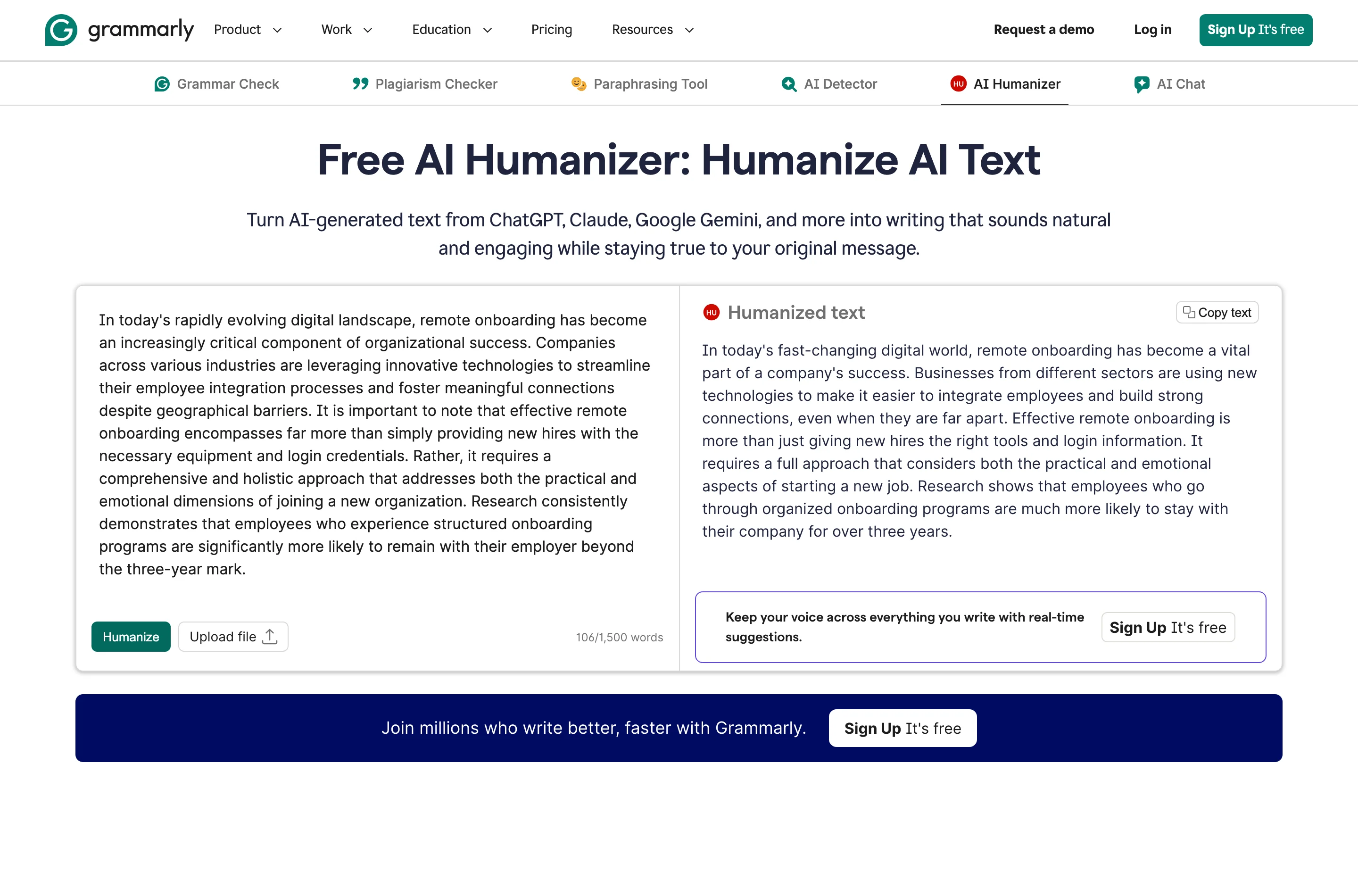
Grammarly's humanizer takes text from ChatGPT, Claude or Gemini and rewrites it to read naturally "while staying true to your original message".
It has the most generous free allowance in this entire comparison, and I had assumed otherwise until I tested it. The counter read 106/1,500 words — and it ran with no account, no email, nothing. That is 12× QuillBot's free limit and 6× WriteHuman's, from the one vendor that markets its humanizer least aggressively.
The output was also the cleanest of everything I ran. Our stodgy opening — "In today's rapidly evolving digital landscape, remote onboarding has become an increasingly critical component of organizational success" — came back as "In today's fast-changing digital world, remote onboarding has become a vital part of a company's success." Plain, correctly spelled, meaning intact. No injected typos, which is more than I can say for two of the tools below.
What sets it apart is not the rewrite. It is the position. Grammarly states plainly that the tool "is not intended to bypass AI detectors", and goes further — it says that using a humanizer to disguise AI use "may be considered unethical and could constitute cheating or plagiarism", and recommends acknowledging AI assistance in academic and professional work.
If you are a student, or you are writing for a client whose contract has an AI-disclosure clause, that framing matters more than any bypass percentage. Grammarly is the option you can point at without having to explain yourself.
- 1,500 free words per run, tested with no account at all
- Cleanest output of everything I ran — no injected errors
- The only tool here that explicitly refuses the detector-evasion framing
- Sits inside the editor you probably already use
- Backed by plagiarism checking, AI detection and citation tools
- Deliberately not optimised for beating detectors, if that is your goal
- No strength or context controls — one rewrite, take it or leave it
- No change review or diff
- Best features sit behind Grammarly Pro
- Upsells a signup under the result
3. QuillBot: Cheapest Paid Tier — but Check Its Spelling (Tested)
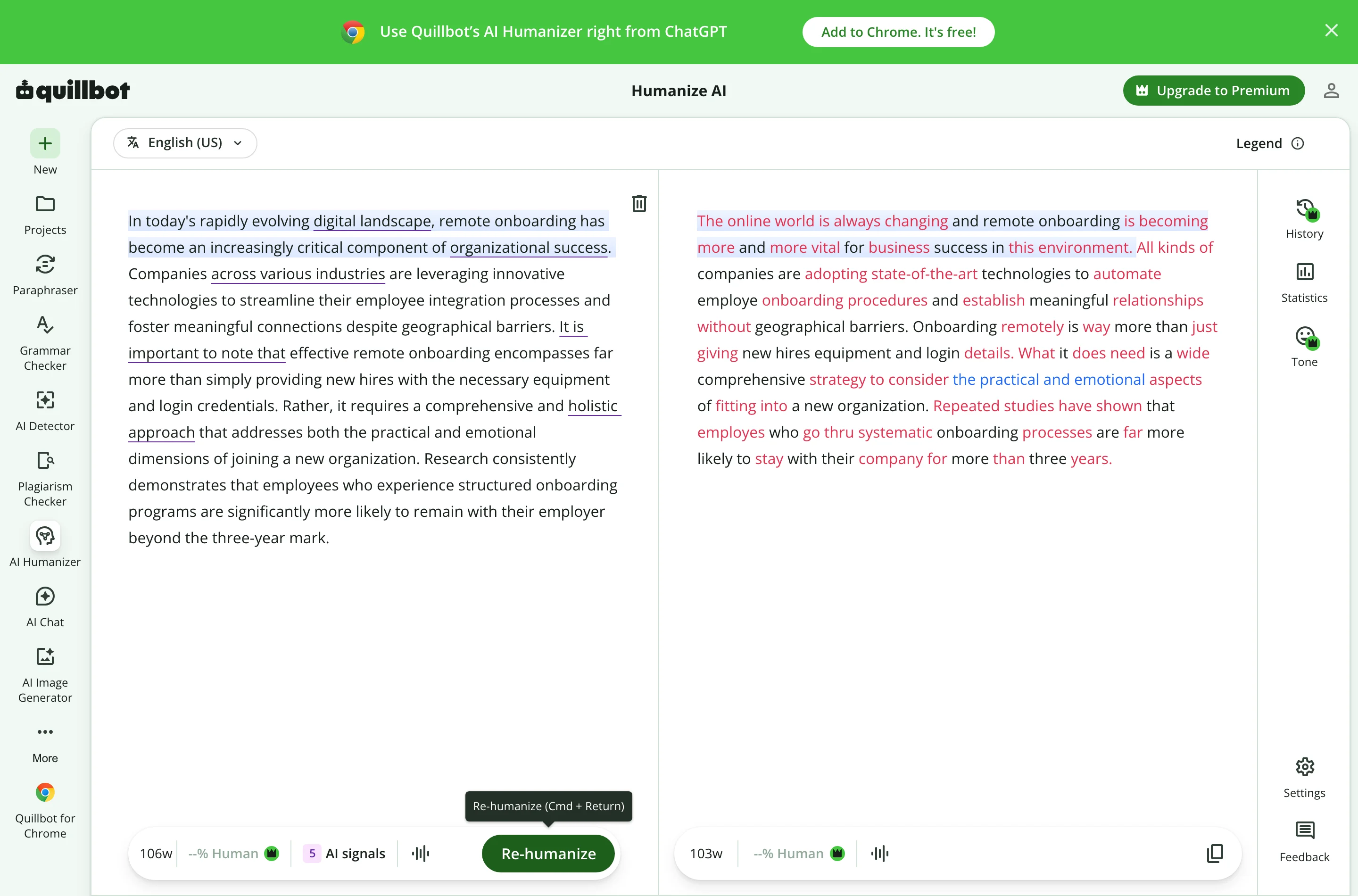
QuillBot is the mainstream option. Its free tier is 125 words, 6 uses a day, and Premium at $4.17/mo billed annually is the cheapest paid tier in this comparison, lifting humanizing to unlimited with a human score and tone insights.
It rewrote our 106 words down to 103 and flagged 5 AI signals in the input. Both the before and after human scores read --% — greyed out, Premium only. So on the free tier you get the rewrite but no way to tell whether it helped.
Read QuillBot's output closely and two words are simply wrong: "automate employe onboarding procedures", and "employes who go thru systematic onboarding processes". The input contained neither — the original said "employees" and had no "thru" anywhere.
This is error injection, the mechanism Walter Writes describes openly in its own FAQ, happening in a tool that does not mention it. Misspellings raise the statistical "humanness" of text because models rarely produce them. If you paste QuillBot's output into a published page without reading it, you are shipping typos.
125 words is a paragraph, not an article, but 6 times a day is a genuine working allowance for the job most people have: one stubborn paragraph. Just proofread what comes back.
- 6 free humanize uses a day, renewing, no account needed
- Cheapest paid tier here at $4.17/mo billed annually
- Marks its changes inline, so you can see what moved
- Counts the AI signals it found in your input
- Paraphraser, grammar checker, detector and summariser in one place
- Introduced two misspellings into our test text ("employe", "employes", "thru")
- Human score is greyed out on free — you get a rewrite you cannot evaluate
- 125 words per free use is a paragraph at a time
- Paraphrasing and humanizing blur together; it is not a specialist
4. Undetectable AI: Best for Buyers Who Want a Written Guarantee (Signup Required)
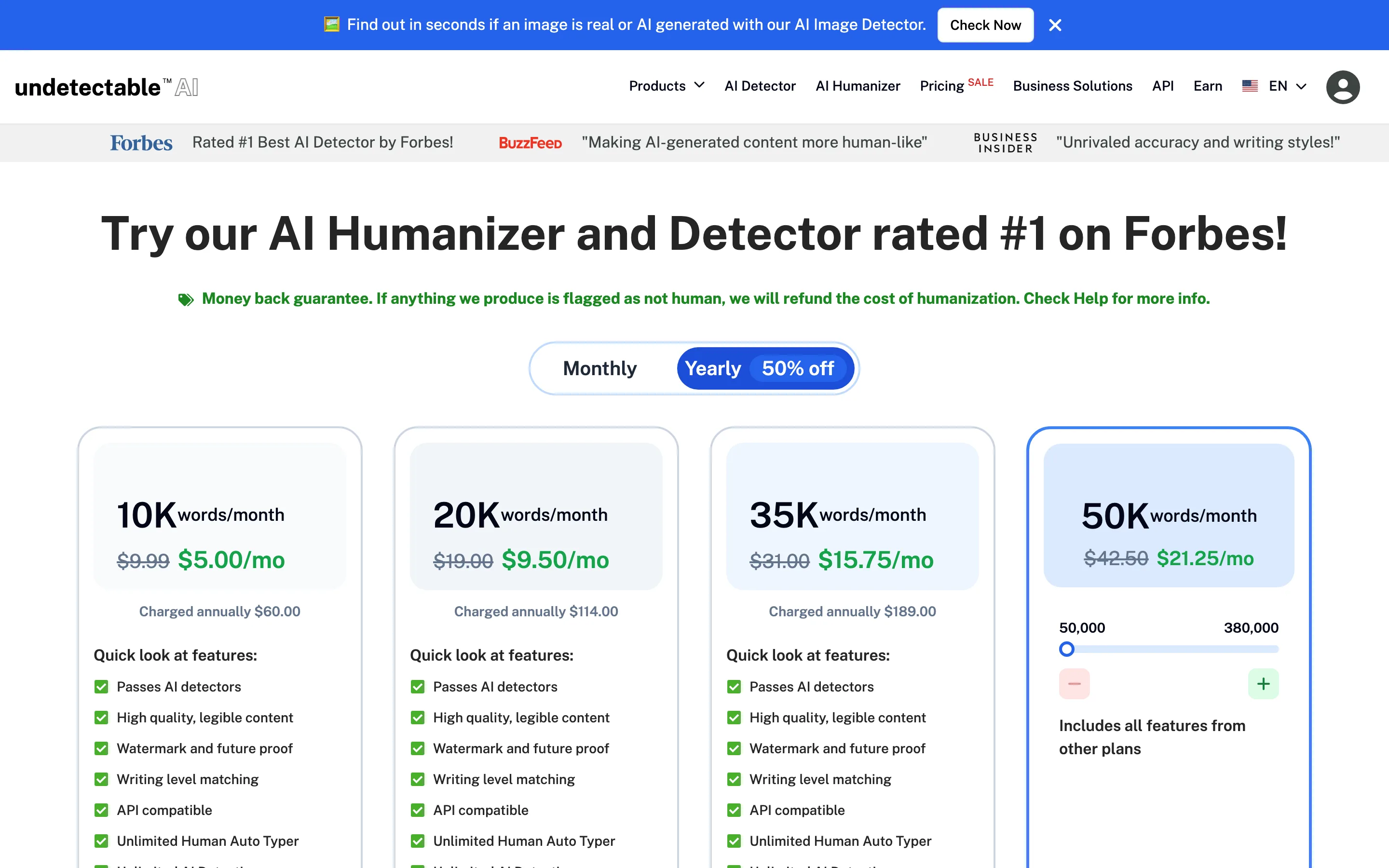
Undetectable AI is the biggest brand in the dedicated-humanizer category. Pricing runs from 10,000 words/mo at $9.99 monthly or $5.00/mo billed annually ($60/yr), through 20,000 words at $19.00/$9.50, to 35,000 at $31.00/$15.75. The free trial is 250 words.
Its distinguishing feature is a commercial one. The pricing page carries a money-back guarantee: "If anything we produce is flagged as not human, we will refund the cost of humanization." No other tool here puts money behind the claim.
Read that sentence carefully, though. It refunds the cost of the humanization — a few cents of your allowance. It does not undo a flagged submission, a rejected article or an academic integrity hearing. It is a quality guarantee on a service, not indemnity against consequences.
- A written money-back guarantee, unique in this list
- Annual billing halves the monthly cost
- Clear word-based tiers with no hidden request caps
- The most established brand in the category
- 250-word free trial, once — the thinnest here
- The guarantee refunds pennies, not consequences
- No change review, so you cannot see what it altered
- Monthly pricing is roughly double the annual rate
5. Surfer AI Humanizer: Best If Your Team Already Lives in Surfer (Signup Required)
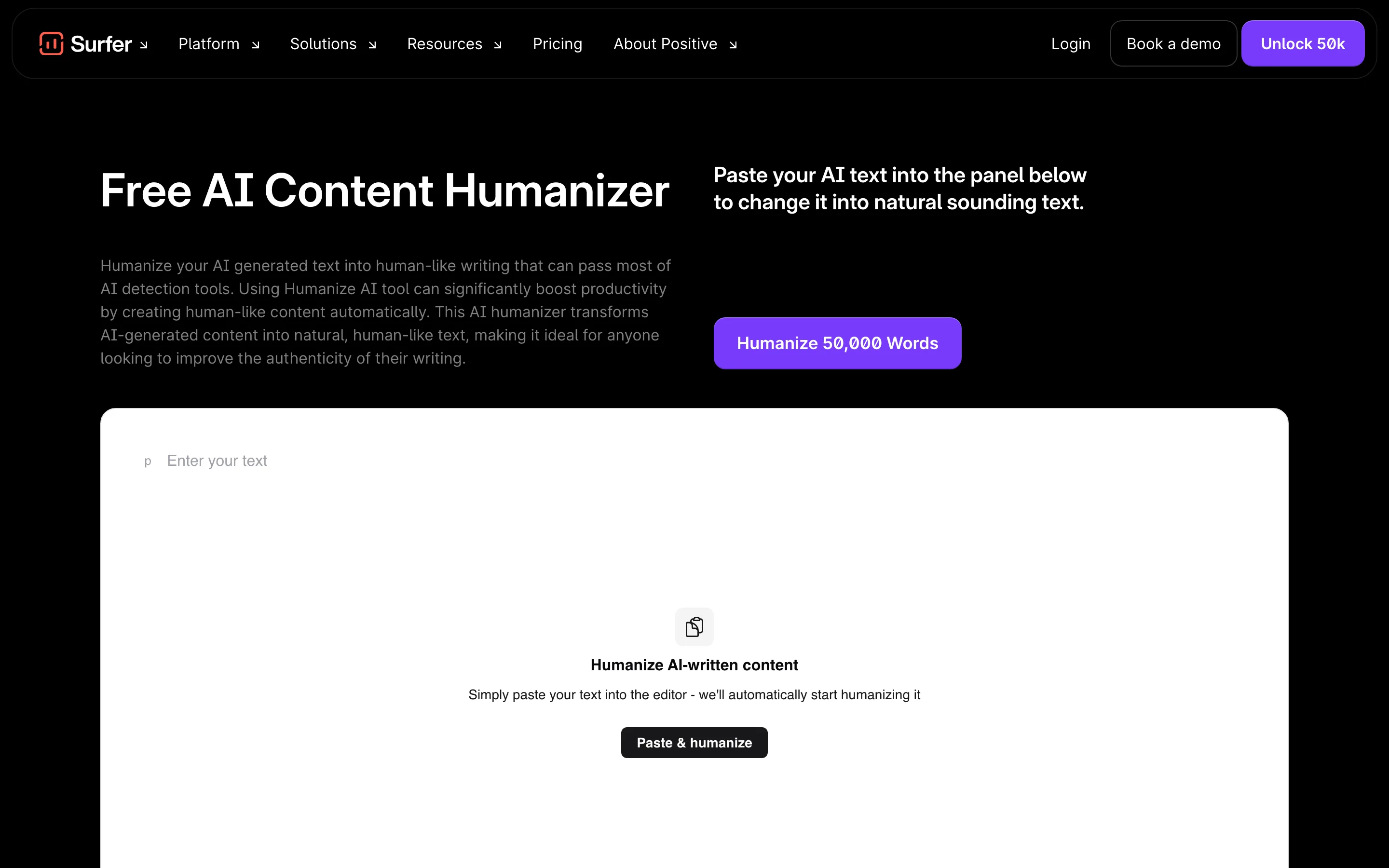
Surfer's humanizer gives 500 words to non-registered users and 1,000 words to registered users without a plan, rising to 50,000 words with unlimited AI detection on a paid plan. For an SEO team already running content briefs through Surfer, it is one less tab.
Surfer is also notably more measured than its competitors about what it does. It claims it can help content "bypass AI detection tools like Turnitin, Copyleaks and GPTZero" — but immediately qualifies it: "Less advanced detectors might not pick up an article written using an AI humanizer, but more advanced ones might." That is a vendor telling you its own limits, which is worth something.
The catch is language. Surfer states the humanizer supports English only, which rules it out for any multilingual content operation.
- 500 words with no login and no email
- 1,000 words free once registered, still without a plan
- Honest public caveat about advanced detectors
- Native for teams already using Surfer for briefs
- English only
- The 50,000-word tier means paying for the wider Surfer platform
- No sentence-level change review
- Overkill if you do not already use Surfer
6. WriteHuman: The "100% Human" Badge, and What It Is Worth (Tested)
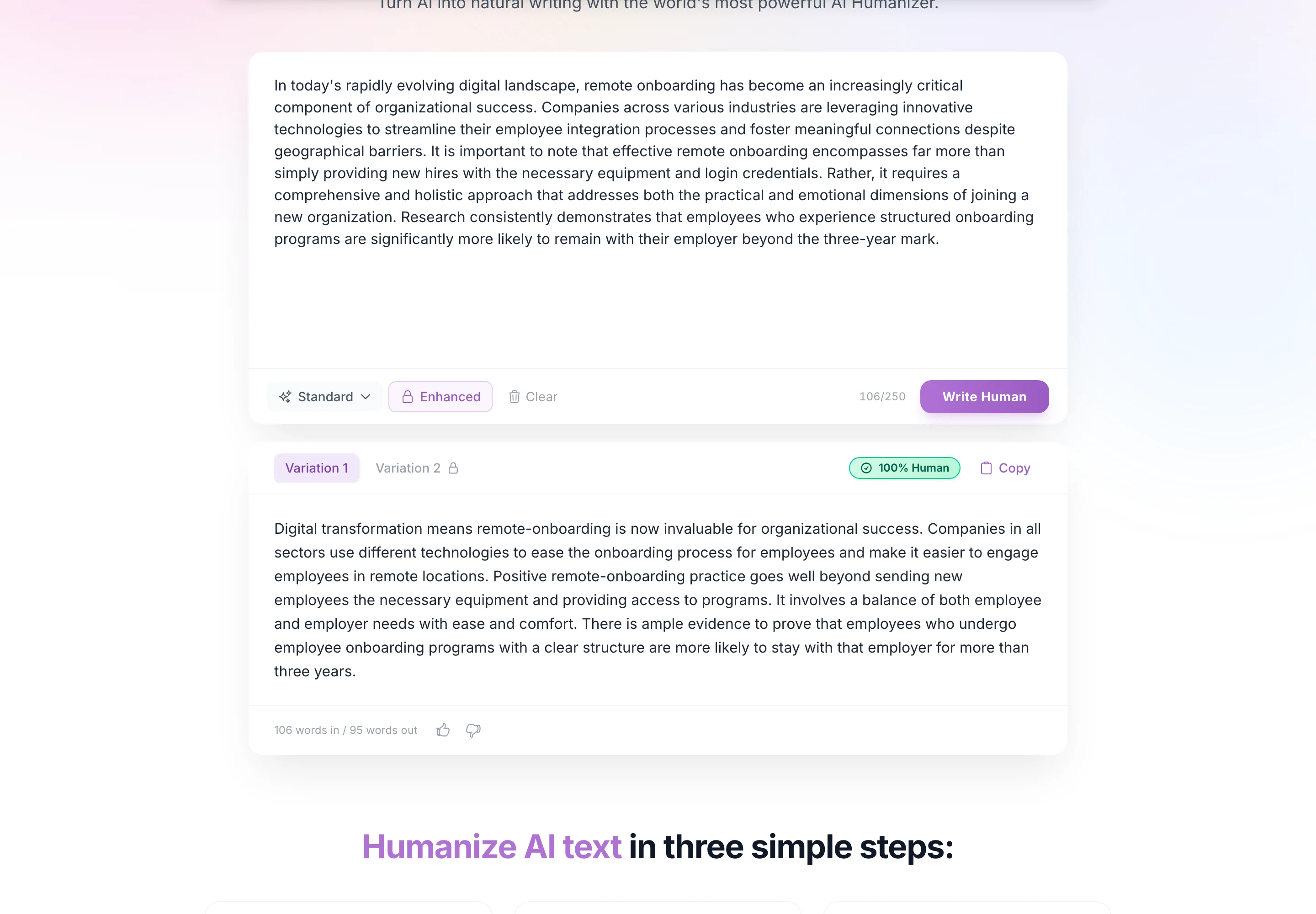
WriteHuman's free tier is 3 requests a month at 250 words each with 1 output variation. Paid runs Basic at $12/mo annually ($18 monthly), Pro at $18/$27, and Ultra at $36/$48 for unlimited requests at 3,000 words with 5 variations.
It ran without an account and rewrote our 106 words to 95, then stamped the result with a green "100% Human" badge.
That badge is worth pausing on, because it is the exact thing this article is about. It is an absolute, unqualified claim on a single output, with no before score to compare against and no statement of which detector produced it. Our own tool gave the same excerpt "+12% more human" beside an amber warning icon and the sentence "An AI-likeness estimate, not a detector verdict." One of those two numbers is more useful to a writer, and it is not the confident one.
The rewrite also drifted. Our input said effective onboarding "requires a comprehensive and holistic approach that addresses both the practical and emotional dimensions of joining a new organization." WriteHuman returned "It involves a balance of both employee and employer needs with ease and comfort" — a different claim about a different thing. That is the failure mode a diff would catch and a "100% Human" badge never will.
- Runs without an account, unlike most paid-only rivals
- Up to 5 output variations to choose between on Ultra
- Clear request and word caps at every tier
- Detection checks and image scans bundled in
- A bare "100% Human" badge with no before score and no named detector
- Changed the meaning of a sentence in our test excerpt
- 3 requests a month free is a demo, not a tier
- Second variation and Enhanced mode are padlocked on free
- Monthly billing is roughly 50% above annual
7. HIX Bypass: Best Unlimited Plan for the Money (Ran on Its Own Sample)
HIX Bypass prices at $9.99/mo for Standard (5,000 humanizer words and 5,000 detector words a month, 3,000 words per input), $14.99/mo for Premium (50,000 words), and $15.00/mo for Unlimited (unlimited words, unlimited input).
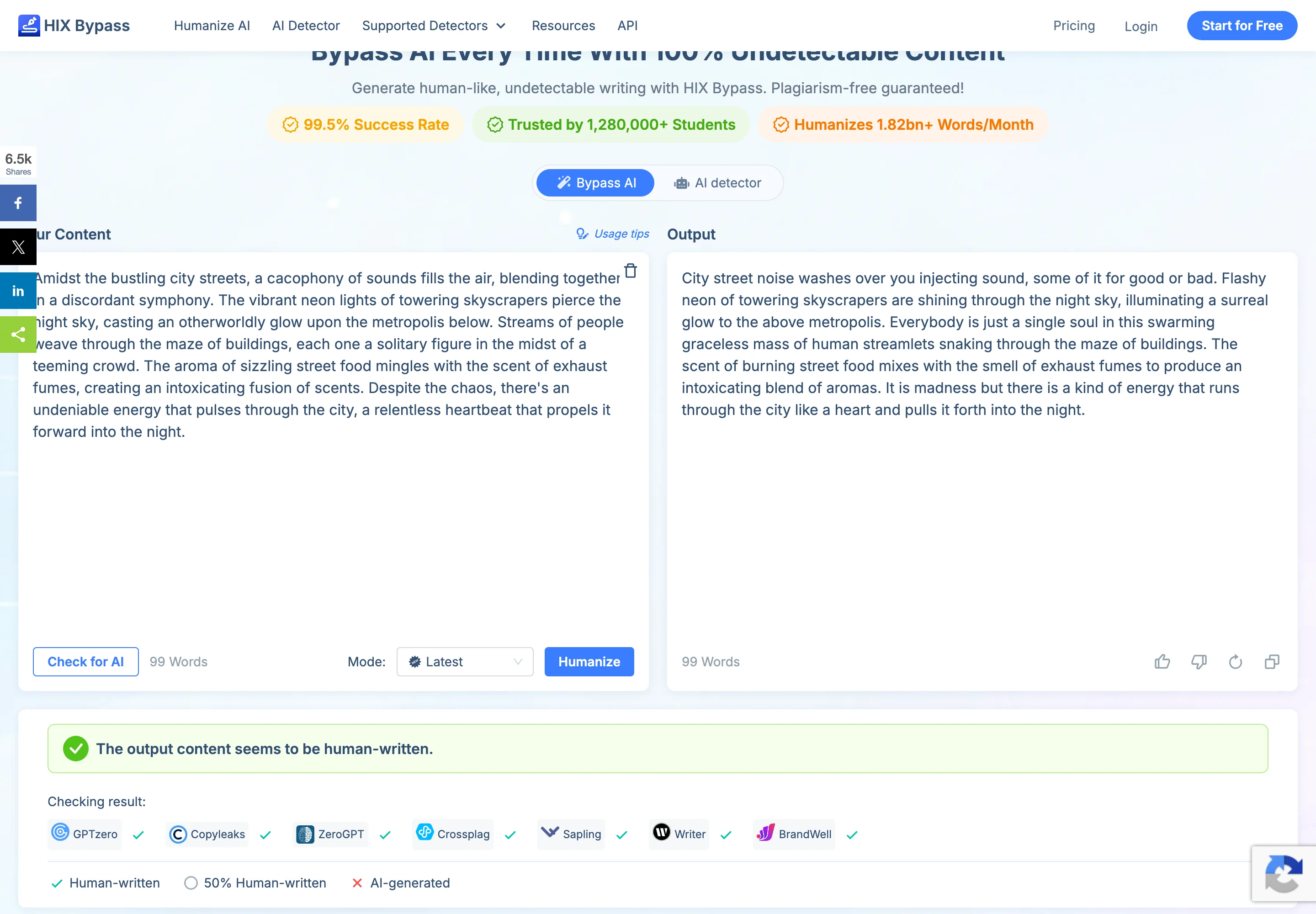
The tool runs in the browser without an account, though it kept reverting to its own demo passage rather than accepting our excerpt, so treat the screenshot as its sample rather than our test. What it does show is the most confident claim stack in this comparison, stacked three deep above the editor: "Bypass AI Every Time With 100% Undetectable Content", "99.5% Success Rate", "Trusted by 1,280,000+ Students" and "Humanizes 1.82bn+ Words/Month". Below the result sits a verdict — "The output content seems to be human-written" — with green ticks against GPTzero, Copyleaks, ZeroGPT, Crossplag, Sapling, Writer and BrandWell.
Two things about that panel. It is genuinely more useful than a single number, because it names the detectors. And "99.5% Success Rate" is still HIX measuring HIX, on text HIX chose, against detectors HIX selected — the pattern this article opened with. Note also the second student-targeted claim in this list, after StealthGPT.
Look at those three numbers again. Unlimited costs one cent more than Premium's 50,000 words, and $5.01 more than Standard's 5,000. If you are buying HIX at all, the pricing table is effectively telling you to buy Unlimited. It also offers Fast, Aggressive and Latest modes, 50+ languages, and an API — the only tool here besides Walter Writes with real integration options.
The pricing page shows no free tier.
- Unlimited words for $15.00/mo, the best volume value here
- Three rewrite modes rather than one setting
- 50+ languages
- API access for pipeline integration
- No free tier on the pricing page
- Tier pricing is confusing to the point of being self-defeating
- 3,000-word input cap on everything except Unlimited
- No change review
8. Walter Writes AI: Best Words Per Dollar (No Free Tier)
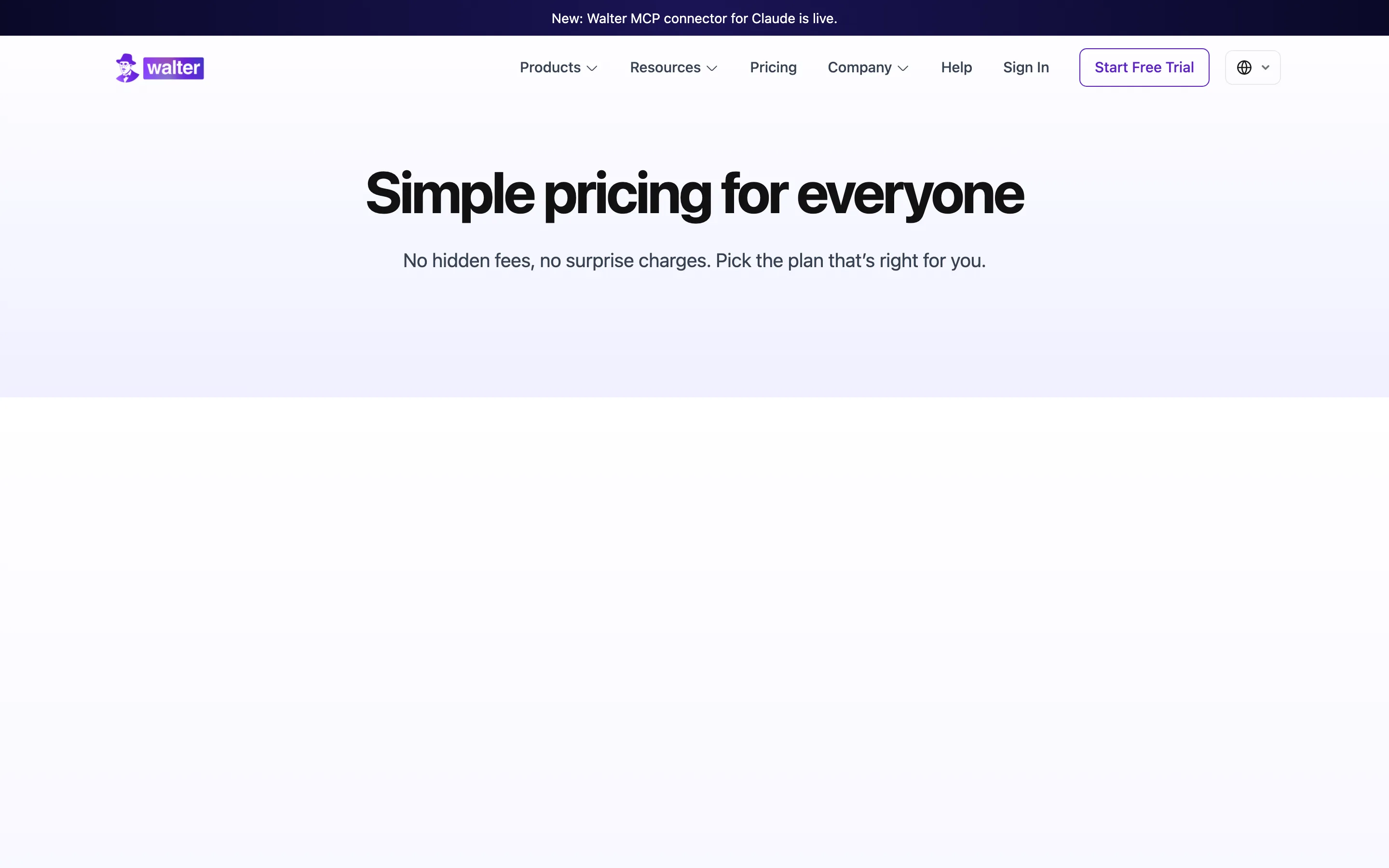
On pure volume Walter Writes wins: Starter at $8/mo ($96/yr) for 30,000 words at 750 words per request, Pro at $13/mo ($156/yr) for 70,000, Elite at $26/mo ($312/yr) for 200,000, and Teams at $99/mo ($1,188/yr) for 500,000 words across 10 seats. It supports 80+ languages, bundles a detector, and — unusually — ships an MCP connector, so it can plug directly into an AI assistant workflow.
One detail from its own FAQ is worth quoting, because it is the most candid description of how this whole category works that I found anywhere. Walter Writes says its humanizer "adjusts word choice, sentence structure, and length… reduces repetition, introduces varied formatting, and incorporates contextual nuances, minor errors, or informal language."
Minor errors. The tool deliberately introduces mistakes into your copy so it reads as human. For a student essay that may be a fair trade. For a brand's published content, you have just paid a subscription to add typos to your work. Whichever camp you are in, know that is the mechanism.
- 30,000 words for $8/mo — the best volume-per-dollar here
- 80+ languages
- MCP connector for assistant-based workflows
- Detector included at every tier
- Openly introduces "minor errors" into your text
- No free tier on the pricing page
- 750 words per request on Starter is restrictive
- Publishes a bypass rate that cannot be independently reproduced
9. StealthGPT: Highest Volume, and the Most Aggressive Marketing (No Free Tier)
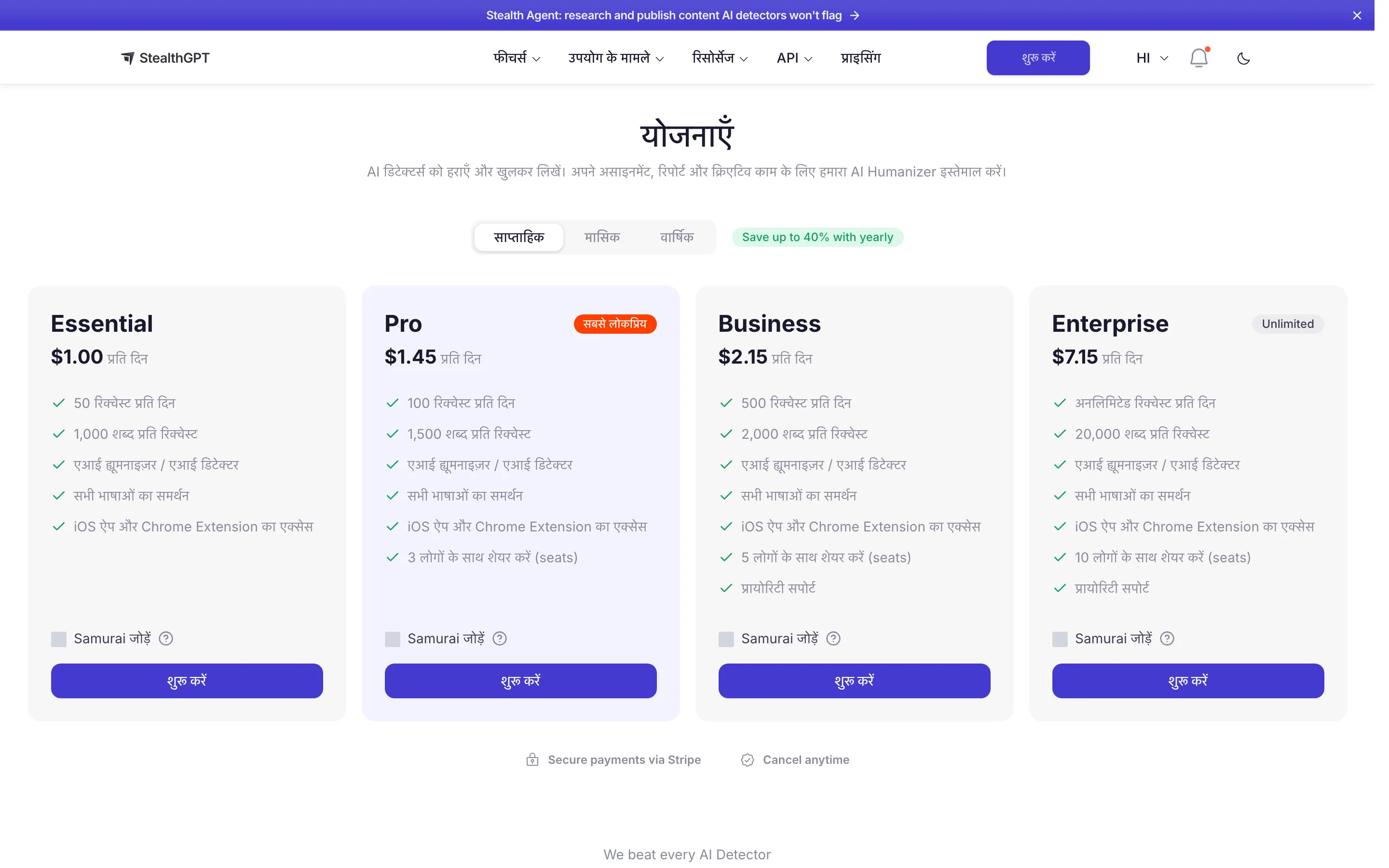
StealthGPT is the only tool here billed by the day: Essential at $1.00/day (50 requests/day, 1,000 words per request), Pro at $1.45/day (100 requests, 1,500 words), Business at $2.15/day (500 requests, 2,000 words) and Enterprise at $7.15/day (unlimited requests, 20,000 words per request). At roughly $30/mo equivalent for Essential, it is not cheap — but 20,000 words in a single request on Enterprise is the largest input ceiling in this comparison, and it claims 100+ languages.
Its marketing deserves a plain description. The pricing page carries the banner "We beat every AI Detector". Its FAQ answers the question "Does StealthGPT actually bypass Turnitin and GPTZero?" with "Yes. StealthGPT is engineered to humanize AI-generated text so it consistently scores as human on Turnitin, GPTZero, Originality.ai, and other major detectors." A featured testimonial states the product "100% bypasses Turnitin", and the page includes a section headed "Trusted by students from:".
That is a product openly sold to students for defeating academic integrity checks. Whether that is a feature or a red flag is your call — but it should be a conscious one, and it is the opposite end of the spectrum from Grammarly's stated position.
- 20,000-word input ceiling on Enterprise, the largest here
- Up to 500 requests a day on Business
- 100+ languages claimed
- iOS app and Chrome extension included at every tier
- Daily billing makes the true monthly cost easy to underestimate
- Detector-bypass claims are absolute and unverifiable
- Explicitly marketed to students for beating Turnitin
- No free tier; no change review
- Geo-localises the site with no obvious language override
Where the paid tools genuinely beat us
Our tool is first on this list and we built it, so here is the honest accounting of where it loses.
| What you need | Who does it better | Why |
|---|---|---|
| Production volume | Walter Writes, HIX Bypass | 30,000 words for $8/mo, or unlimited for $15/mo, against our 3 runs a day |
| Long documents | StealthGPT, HIX Bypass | 20,000 and 3,000-word inputs against our 10,000 characters |
| API and automation | HIX Bypass, Walter Writes | Both ship an API; Walter Writes also has an MCP connector. We have neither. |
| Choosing between rewrites | WriteHuman | Up to 5 output variations per request |
| A commercial guarantee | Undetectable AI | Refunds the humanization cost if the output is flagged |
| Working inside your editor | Grammarly, QuillBot | Mature extensions; ours is a web tool you paste into |
| Speed on a paragraph | QuillBot | Near-instant against our 20–35 seconds |
If you are rewriting 30,000 words a month, do not use our free tool three times a day. Buy Walter Writes or HIX Bypass. Our tool is built for the case where you want to understand a rewrite before you publish it, not for bulk throughput.
How AI detectors decide your text is machine-written
You cannot judge a humanizer without knowing what it is working against, and the mechanism is less mysterious than the marketing suggests. Detectors are not searching a database of AI outputs. They are measuring statistical properties of the writing itself, and two in particular.
Perplexity is how surprised a language model is by your next word. Given "the cat sat on the...", a model expects "mat" with high confidence. Human writing is full of choices a model would not have predicted — an odd adjective, a specific brand name, a sentence that turns where you did not expect. Language models, by design, pick the likely word. That makes their output low-perplexity, and low perplexity is the single strongest signal a detector has.
Burstiness is variation in sentence length and complexity. Human paragraphs lurch: a 34-word sentence, then a 6-word one. Then a fragment. Models produce sentences of strikingly uniform length and construction, paragraph after paragraph. Plot sentence lengths for AI text and the line is unusually flat.
Everything a humanizer does is aimed at those two numbers. Swapping in a less predictable synonym raises perplexity slightly. Splitting one long sentence into a long one and a short one raises burstiness. Deleting "In today's rapidly evolving landscape" removes a phrase that appears so often in model output it functions as a fingerprint. And injecting "minor errors", as Walter Writes says it does, raises both at once — which is exactly why some tools do it despite the cost to your prose.
Two consequences follow, and they explain most of this article.
First, no vendor can guarantee a pass, because the detectors are moving targets they do not control. A rewrite tuned against a detector's 2025 model may score differently after an update, and none of these companies get advance notice. This is the technical reason behind Surfer's public caveat and Grammarly's refusal to make the claim at all.
Second, the scores are estimates and should look like it. A detector reports a probability, not a verdict, and false positives are well documented — human writing that happens to be plain and evenly structured can score as machine-written. That is why our own tool showed the control paragraph in our testing as far from perfectly human, and why any single number in this category deserves the word "estimate" next to it.
What an AI humanizer actually changes
Strip away the marketing and every tool here does some combination of five things.
- Vocabulary substitution. "Utilise" becomes "use", "leverage" becomes "rely on". The cheapest and least effective change, because it leaves the underlying rhythm untouched.
- Sentence restructuring. Splitting a 40-word sentence in two, or merging three short ones. This is what actually moves the needle — AI prose has a distinctive evenness, and only structural change disturbs it.
- Stock-phrase removal. "In today's rapidly evolving landscape", "It is important to note that", "In conclusion". These are the fingerprints. Any decent tool strips them.
- Rhythm variation. Deliberately mixing sentence lengths, because humans do and language models tend not to.
- Error injection. Adding small mistakes and informalities, which Walter Writes describes openly in its own FAQ. Effective at looking human; expensive if you care about polish.
You can do all five yourself with a red pen. The tool's value is speed and a second pair of eyes — which is exactly why seeing the changes matters more than any score. If a tool restructures three sentences and swaps eleven words, you want to know that, because you are the one publishing it.
The same paragraph, before and after
Here is the opening of the test draft as ChatGPT wrote it, and as it came back. This is a real run, not an illustration:
| The AI draft (input) | After one Medium pass |
|---|---|
| "In today's rapidly evolving digital landscape, remote onboarding has become an increasingly critical component of organizational success. Companies across various industries are leveraging innovative technologies to streamline their employee integration processes and foster meaningful connections despite geographical barriers." | "Remote onboarding has become essential as the digital workplace changes quickly. Companies across industries now use new tools to speed up how they bring people on board and to help them connect despite distance." |
| "It is important to note that effective remote onboarding encompasses far more than simply providing new hires with the necessary equipment and login credentials." | "Effective remote onboarding is more than handing out hardware and access keys." |
Read what actually happened. "In today's rapidly evolving digital landscape" is gone. "It is important to note that" is gone. "Leveraging innovative technologies to streamline their employee integration processes" became "use new tools to speed up how they bring people on board" — 9 words for 10, but plain ones. The second row drops from 24 words to 12.
That is the honest shape of a good rewrite: shorter, plainer, and stripped of the phrases that mark the register. It is also, notably, not a transformation. The ideas, the order and the structure are identical. Anyone expecting a humanizer to turn a bland AI draft into distinctive writing is expecting the wrong thing — it removes the machine tells, and it leaves the blandness for you.
Free vs paid: what the money actually buys
The free tiers here differ by more than an order of magnitude, so "is there a free AI humanizer" has a genuinely different answer depending on your volume.
| If you rewrite… | Use | Cost |
|---|---|---|
| A paragraph, occasionally | QuillBot free, or Surfer's 500 no-login words | $0 |
| A few drafts a week | seotools.pro free — 3 full runs a day, no account | $0 |
| Client or academic work | Grammarly — 1,500 words, no account | $0 |
| Regular short-form, unlimited | QuillBot Premium | $4.17/mo annual |
| ~30,000 words a month | Walter Writes Starter | $8/mo annual |
| Unlimited words | HIX Bypass Unlimited | $15.00/mo |
| Volume plus a refund promise | Undetectable AI | $5.00/mo annual, 10k words |
| A team of 10 | Walter Writes Teams | $99/mo, 500k words |
Three things worth noticing. Paying more does not buy you a better rewrite — it buys throughput. Every tool here runs the same class of language model over your text; what a subscription changes is how many words you may push through it and how long an input may be.
Second, the annual/monthly gap is unusually wide in this category. Undetectable AI's monthly rate is roughly double its annual. WriteHuman's is about 50% higher. If you are testing a tool, you will pay the higher number, and the price on the landing page is almost always the lower one.
Third, several "unlimited" plans cost barely more than the tier below. HIX Bypass Unlimited is one cent above its 50,000-word Premium plan. If you have decided to buy, read the whole table before picking the middle option.
What no AI humanizer can promise
Three claims in this category do not survive contact with reality, and it is worth naming them.
"It will pass every detector." No vendor controls the detectors. Turnitin, GPTZero and Originality.ai update their models; a rewrite that passed in June can flag in September. Surfer says this out loud. Grammarly refuses the framing entirely. Where a tool states it absolutely, treat it as marketing rather than a specification.
"Our bypass rate is 96.8%." Any figure like this is measured by the vendor, on text the vendor chose, against detectors the vendor picked, at a moment the vendor decided. It is not reproducible, and none of the pages publishing these rates say how to reproduce them. That includes any number we might publish about ourselves — which is why the only score in this article is labelled as coming from our own detector, with its limits stated.
"It is undetectable, so it is safe to submit." This conflates a technical claim with an ethical one. If your university, publisher or client requires disclosure of AI assistance, a humanizer does not change that obligation — it just makes it harder to spot that you ignored it. Grammarly is direct about this: using a humanizer to disguise AI use "may be considered unethical and could constitute cheating or plagiarism". If you are a student, the tool that will not get you in front of a panel is the one you disclose.
The legitimate use of these tools is not concealment. It is editing: an AI draft is a fast first draft with a recognisable, flat register, and a humanizer is a way to break that register quickly before a human editor does a proper pass. That is a real job, and it is the one worth paying for.
Four mistakes that keep humanized text obvious
Running a draft through a tool and pasting the result is where most people stop, and it is why so much "humanized" content still reads like a machine wrote it. Four failures account for nearly all of it.
1. Humanizing the words but keeping the skeleton. The most common one. A tool swaps vocabulary while leaving five paragraphs of identical length, each opening with a topic sentence and closing with a summary. That structure is itself a tell, and no amount of word substitution touches it. If every paragraph in your piece is four sentences long, you have not fixed the problem — merge two, split another, delete one entirely.
2. Leaving the scaffolding in. Language models love signposts: "Firstly", "Moreover", "Furthermore", "In conclusion", "It is worth noting that". Good tools strip the famous ones — ours listed three from our test draft by name — but they rarely catch all of them, and they almost never catch the structural version, where every section begins by announcing what it is about to say. Read your draft and delete every sentence that only introduces the next sentence.
3. No specifics. This is the big one, and no tool can fix it. AI drafts are generic because the model has nothing particular to say — it has no client, no last Tuesday, no number it measured itself. "Research consistently demonstrates that structured onboarding improves retention" is the kind of sentence a model writes. "We lost two of four hires in 2025 before we wrote anything down" is the kind only you can. One concrete detail does more for a paragraph than any humanizer.
4. Trusting the score. A number moving from 90 to 70 tells you the register changed. It does not tell you the writing is good, that the facts survived, or that it says anything worth reading. Treat the score as a smoke alarm, not a certificate — it is useful for telling you something is wrong, useless for telling you something is right.
What about non-English content?
If you publish in more than one language, the field narrows fast. StealthGPT claims 100+ languages and Walter Writes 80+, with HIX Bypass at 50+. seotools.pro covers 14 output languages, including four English variants (US, UK, Australian, Canadian) which matters more than it sounds — a US-spelled draft handed to a UK client is its own kind of tell.
Surfer is English only, stated plainly on its own page, which removes it from consideration entirely for multilingual teams however good the rest of the product is.
One caution that applies across all of them: detector accuracy is substantially better studied in English than in other languages, and the humanizers are trained accordingly. A high "human" score on a Ukrainian or Turkish rewrite is a weaker signal than the same score in English, simply because there is less evidence behind the model producing it. Treat non-English scores with even more scepticism than English ones.
How to use an AI humanizer: a 5-step workflow
- Score the draft first. Run the original through a detector before you change anything, so you have a baseline. Without it, "more human" is a feeling, not a measurement.
- Rewrite a section, not the whole thing. Most tools degrade over long inputs, and shorter passes give you a rewrite you can actually read closely. Our test draft came back 29% shorter — you want to notice that.
- Read the diff before you copy. This is the step people skip and the one that catches dropped facts, mangled numbers and, in some tools, deliberately introduced errors.
- Re-score, and expect a real but partial gain. On our test draft the improvement was 15–42 points on a 100-point scale — a genuine move, and nowhere near "perfect". Any tool reporting 95%+ after one pass on generic input is flattering you.
- Edit it yourself. The humanizer breaks the machine rhythm; it does not add a point of view, a specific, or an opinion. Add one concrete example that only you could have written and the passage stops reading like anyone's AI.
- Before and after on one shared scale
- The exact stock phrases it caught, listed
- Sentence-level diff and side-by-side view
- TXT, Markdown, DOCX, RTF, ODT and PDF import
Frequently asked questions
What is the best AI humanizer tool?
For a free rewrite you can inspect before publishing, the seotools.pro AI Humanizer — 3 full runs a day with no account, a before/after score on one scale, and a sentence-level diff. For volume, Walter Writes at $8/mo for 30,000 words or HIX Bypass at $15/mo unlimited. For academic or client work where disclosure matters, Grammarly, which explicitly does not market detector evasion. We make one of these tools, so weigh our ranking accordingly.
Is there a genuinely free AI humanizer?
Several, with very different meanings of free. seotools.pro gives 3 full runs a day with no account at all. Surfer gives 500 words with no login. QuillBot gives 125 words 6 times a day. Grammarly gave 1,500 words with no account at all, the most generous free allowance I measured. At the other end, Undetectable AI gives 250 words once and WriteHuman gives 3 requests a month. HIX Bypass, Walter Writes and StealthGPT list no free tier on their pricing pages.
Can an AI humanizer beat Turnitin or GPTZero?
Nobody can promise that, and the tools that do are overreaching. Detector models change, and no humanizer vendor controls them. Surfer states the caveat publicly: less advanced detectors might miss humanized text, more advanced ones might not. Grammarly says its tool is not intended to bypass detectors at all. Treat absolute bypass claims as marketing.
Why do vendor bypass rates like 96.8% or 99.7% not mean much?
Because they are self-measured and unreproducible. The vendor picks the sample text, the detectors and the date, then publishes the result on its own site — usually in an article that also ranks the vendor's own tool first. There is nothing in those pages that lets you run the same test. That applies equally to any number we published about ourselves, which is why the only score in this article is labelled as coming from our own detector.
Do AI humanizers change the meaning of my text?
They can, which is why change review matters. Our test draft came back 29% shorter — that compression has to come from somewhere. Tools that preserve facts explicitly, and that show you a diff, let you catch a dropped statistic before you publish it. Tools that hand back a block of replacement text with no diff do not.
Is using an AI humanizer cheating?
It depends entirely on what you agreed to. If your university, publisher or client requires you to disclose AI assistance, using a humanizer to hide it does not remove that obligation. Grammarly puts it directly: doing so "may be considered unethical and could constitute cheating or plagiarism". Using one to tighten the flat register of an AI first draft, in work where AI assistance is permitted, is ordinary editing.
Which AI humanizer supports the most languages?
StealthGPT claims 100+ languages and Walter Writes claims 80+, with HIX Bypass at 50+. seotools.pro offers 14 output languages including 4 English variants. Surfer is English only, which rules it out for multilingual teams.
How much should an AI humanizer cost?
The spread here runs from free to $99/mo. QuillBot Premium is the cheapest paid option at $4.17/mo billed annually. Walter Writes Starter is $8/mo for 30,000 words. HIX Bypass Unlimited is $15/mo. Undetectable AI starts at $5.00/mo billed annually for 10,000 words. If you rewrite a few paragraphs a week, a free tier is genuinely enough; if you rewrite 30,000 words a month, $8 is the number to beat.
Do humanizers deliberately add mistakes to my writing?
Some do. Walter Writes describes it in its own FAQ — its humanizer "incorporates contextual nuances, minor errors, or informal language". Error injection is an effective way to look human and an expensive one if you care about polish. Read the output before you publish it, whichever tool you use.
Should I trust a tool's own AI score?
Only as guidance, and only if it shows you both halves. A single "98% human" figure on the output tells you nothing without the input score on the same scale — you cannot tell whether the tool improved anything or the text was already fine. Ask for the before, the after, and what specifically it caught.
Will an AI humanizer hurt my SEO?
Google's guidance is about quality and usefulness rather than how text was produced, so a rewrite is not itself a ranking problem. What can hurt you is the mechanism some tools use: Walter Writes states its humanizer introduces "minor errors" and informal language. Deliberately degrading grammar on a page you want to rank is a poor trade for a score. If you are optimising published content, work on substance — our content optimizer is aimed at that rather than at register.
Do these tools store the text I paste?
Policies vary and it is worth reading before pasting anything confidential. seotools.pro states the text goes to the rewriting model and is not used to train it, with saved rewrites kept in your browser rather than uploaded. Other vendors in this list publish their own privacy terms; if you are handling client material under NDA, check the specific tool rather than assuming, because none of them are identical.
How long should a passage be for the best result?
Shorter than you think. Most tools degrade over long inputs, and the request caps hint at it — 750 words on Walter Writes Starter, 1,000 on StealthGPT Essential, 250 on the free WriteHuman tier. A few hundred words at a time also gives you a rewrite short enough to actually read closely, which is the step that catches dropped facts.
What is the difference between a paraphraser and an AI humanizer?
A paraphraser restates a sentence in different words, usually one sentence at a time, and is aimed at avoiding repetition or plagiarism. A humanizer targets the statistical fingerprints of machine writing across a whole passage — sentence-length variation, predictable word choice, stock signposting. QuillBot sells both, which is why its humanize and paraphrase features can feel similar; the dedicated tools in this list only do the second job.
The verdict: which AI humanizer should you pick?
If you want a rewrite you can check before you publish it, start with the seotools.pro AI Humanizer. 3 full runs a day, no account, a before/after score on one shared scale, the exact stock phrases it caught, and a sentence-level diff. It will not tell you it made your text 99% human, because it did not — on our test draft it moved AI-likeness 15 to 42 points, and it shows you the run-to-run spread instead of hiding it.
If you are writing for a client or a university where disclosure matters, use Grammarly. It is the only tool here that tells you not to use it to beat a detector, and that position is worth more than a percentage.
If you rewrite a paragraph at a time, QuillBot gives you 6 free uses a day and the cheapest upgrade in the category at $4.17/mo.
If you need real volume, Walter Writes is 30,000 words for $8/mo and HIX Bypass is unlimited for $15/mo — both far past what our free tool is built for. If you want money behind the claim, Undetectable AI is the only one offering a refund.
And whichever you choose: read the diff, keep your facts, and add one sentence only you could have written. That last step is still the only reliable humanizer.
Prices and free-tier limits were read from each vendor's own pricing page in August 2026 and change often. Scores quoted are from seotools.pro's own scorer across six runs of a single 408-word test draft, and are an AI-likeness estimate rather than a detector verdict. For calibration: a hand-written paragraph scored 8 on that same scale, and raw ChatGPT output scored 90–92.