Every AI visibility checker sells the same promise: paste your brand, find out whether ChatGPT recommends you. The category barely existed eighteen months ago and now there are dozens of them, most built by SEO companies that already had a dashboard and needed a new metric to put in it.
One brand — Figma — through five free AI visibility checkers, on the same day, with no account created and no CAPTCHA solved. That last constraint turned out to matter more than anything else I planned to measure.
Two of the five never produced a report at all. The biggest names in SEO software are the two that stopped me: one put a Cloudflare human-verification challenge over its own run button, the other showed a signup wall. Of the three that did run, only one showed me the actual questions it asked and the actual text the AI wrote back.
One disclosure before anything else, because this article ranks our own tool first: seotools.pro makes one of the tools below. Discount our opinion accordingly. What I can offer instead of neutrality is evidence — every claim here is read off a screenshot you can open at full size, and where a tool refused to run, the refusal is the screenshot.
The best AI visibility checker for most people is the seotools.pro AI Visibility Checker: it ran free with no account, showed all 6 questions it asked, showed the full text of every AI answer behind its verdict, listed the exact pages the AI cited, and published no invented score. Scrunch AI is the strongest competitor that actually ran — real citation data, but it shows you icons rather than answers and routes you into a free trial. Knowatoa runs instantly but measures AI Overview traffic loss, which is a different question. Ahrefs and Semrush could not be run free on the day of testing.
That middle number is the one worth sitting with. Four of these tools will tell you a model mentioned your brand. Only one will show you the sentence it wrote, so you can decide for yourself whether "mentioned" meant recommended, listed fifth, or named as the cheap option people grow out of.
Mentions and citations are two different things, and most tools blur them
Before comparing anything, the vocabulary has to be straight, because the tools themselves use it loosely.
A mention is an AI answer naming your brand in its text. Someone asks "best prototyping tools for product teams" and the answer says Figma. Nobody clicked anything, no link was involved, but your name was in the recommendation.
A citation is an AI answer linking to your website as a source. That only happens when the model actually searched the web for that answer, because a model answering from memory has no URLs to give you. Citations are rarer, harder to earn, and the only one of the two that can send you a visitor.
Ahrefs states this distinction cleanly on its own FAQ — "A mention means the AI platform named your brand in its response. A citation means it linked to your website as a source" — and it is the single most useful sentence any of these vendors has written. The trouble starts when a tool reports one headline number and leaves you guessing which of the two it counted.
Two ways these tools get their data, and it changes what they can tell you
Underneath the similar-looking dashboards, the tools in this category split into two camps, and the split explains most of the disagreements you will see between them.
Index tools run enormous numbers of prompts on a schedule and store the answers. Ahrefs is the clearest example: it says its database covers 470M+ monthly prompts across AI Overviews, AI Mode, ChatGPT, Copilot, Gemini, Perplexity and Grok, and its free checker reads your brand out of that stored data. Scrunch's phrase "recent industry prompt results" describes the same shape. The advantage is scale — hundreds of prompts in your category, not six — and the ability to show trends over time. The cost is distance: you are reading a report about questions someone else chose, asked at a time you did not pick, and you generally cannot see the answer text.
Live-query tools ask the models your questions at the moment you press the button. That is what our checker does. The advantage is that everything is present and inspectable — the prompt, the answer, the citations, the timestamp — and the questions can be written from your actual website rather than assigned from a category taxonomy. The cost is breadth: six questions asked once each is a much smaller sample than an index, and it costs real money per run, which is why every live tool in this category has a daily cap.
Neither approach is cheating. They answer subtly different questions: an index tells you what AI has been saying across your category lately, a live query tells you what AI says right now, to this question, with the sources it used. If you only ever use one, know which one you have.
This also explains the Figma disagreement in this test. Scrunch's index put Figma third in its category at 4% of competitor citations; our live check had Figma named in 11 of 12 answers and leading the competitor count. Different prompts, different platforms, different moments — and no way to reconcile them without seeing both sets of answers, which only one of the two tools offers.
How I tested: one brand, five checkers, three rules
The subject is Figma, checked as the brand name and as figma.com depending on what each tool accepts. It is deliberately not our own brand and not a client's: a ranking that depends on a subject chosen to flatter the winner is not a ranking. Figma is also well enough known that every tool should have something to say about it, which makes an empty result meaningful rather than ambiguous.
These are the same rules used across our tool comparisons, and they decide how the bottom of this ranking is ordered.
- No accounts. Not a free trial, not a "free account for more data", not an email for the full report. If the tool needs a signup to show a result, that is the result.
- No CAPTCHAs solved. If a human-verification challenge stands between the run button and the report, testing stops there and the challenge gets screenshotted.
- Consent banners declined, never accepted. Every cookie dialog was rejected or closed, never accepted, on every tool including our own.
Everything below was captured on the same day, in the same browser, at the same window size. Where a tool blocked automated access I re-ran it by hand in an ordinary desktop Chrome profile with no automation history, to be sure I was not measuring my own tooling. In both cases the result was identical.
The five tools at a glance
| Tool | Ran free, no account? | Input | Shows the questions asked | Shows the full AI answer | What stopped it |
|---|---|---|---|---|---|
| seotools.pro | Yes | Brand + optional site | Yes, all 6 | Yes | — |
| Scrunch AI | Yes | Website URL | Yes, 4 of 5 shown | No | — |
| Knowatoa | Yes | Domain | No | No | — |
| Ahrefs | No | Brand name | Not tested | Not tested | Cloudflare human-verification challenge |
| Semrush | No | Domain | Not tested | Not tested | Daily limit, then a signup wall |
There are no prices in that table on purpose. This category reprices constantly, half the vendors quote "from" figures that depend on how many AI platforms you switch on, and a price I verify today is a liability in three months. Where a price is genuinely relevant to a tool's section I quote what its own pricing panel said on the day, and you should check it yourself before buying anything.
The tools, ranked
1. seotools.pro AI Visibility Checker — the only one that showed its work
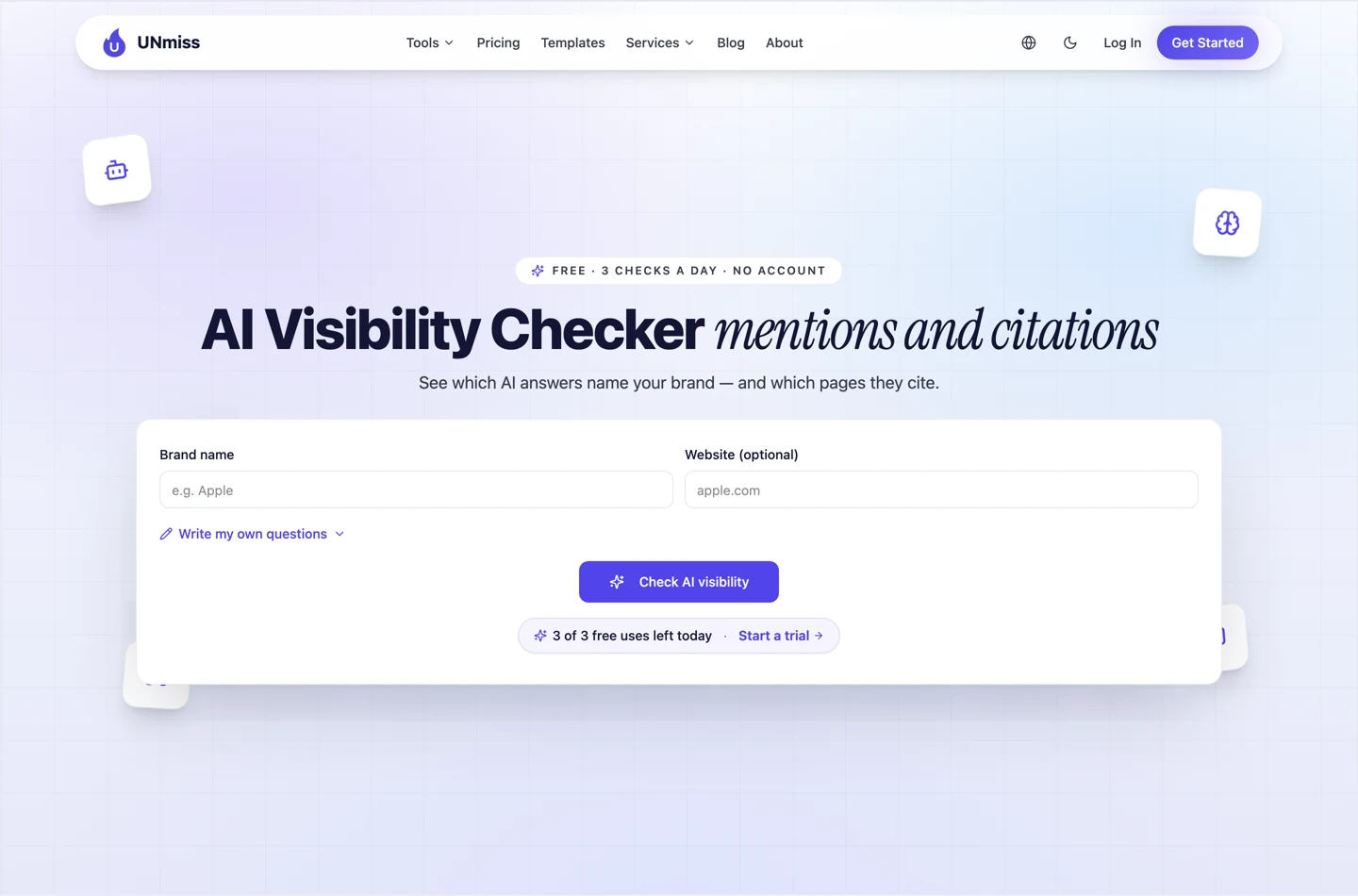
The seotools.pro AI Visibility Checker takes a brand name and, optionally, your website. It reads your home page first, writes six questions a buyer would ask before they know you exist, then puts those questions to the AI platforms and reports what came back.
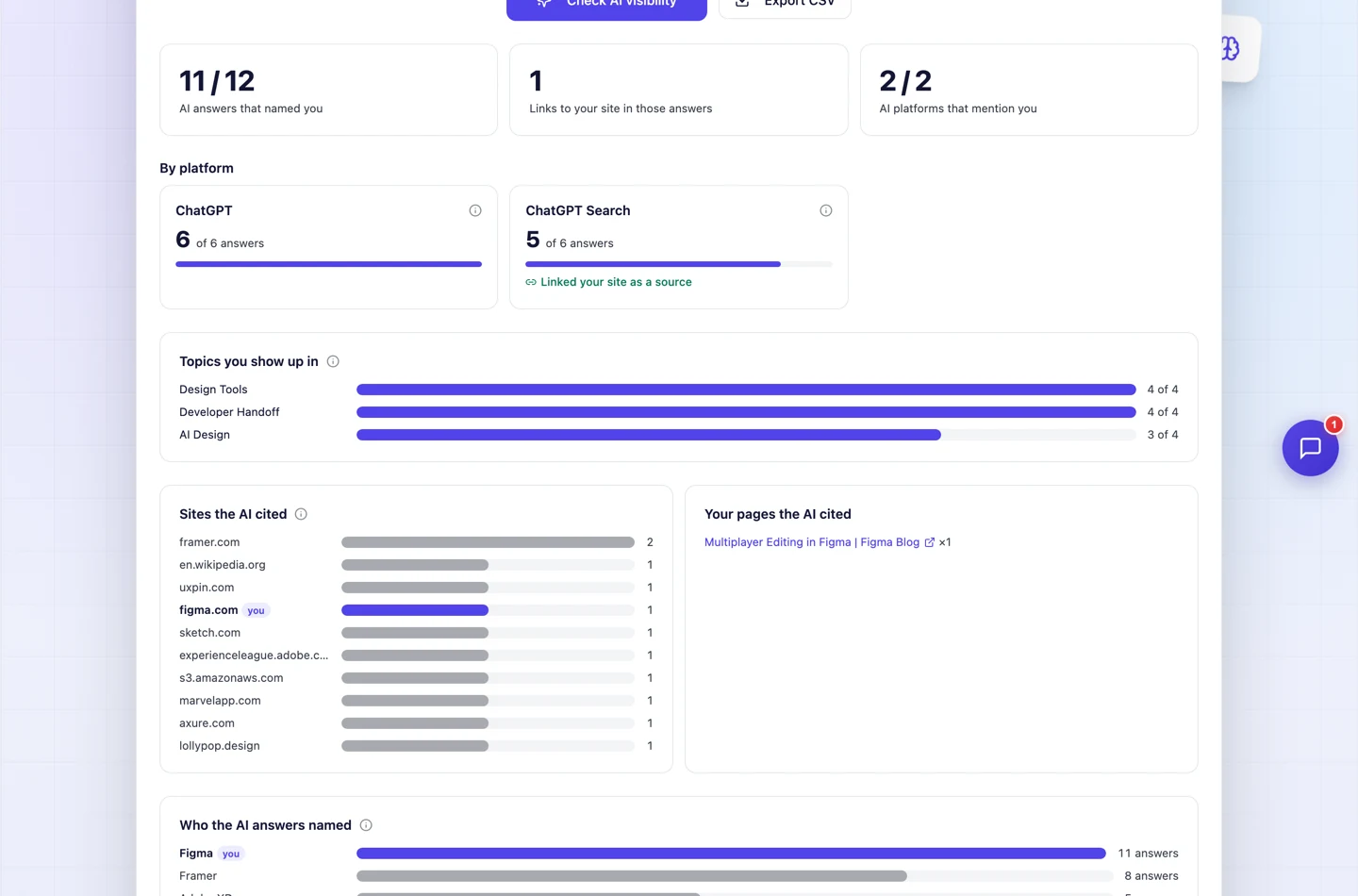
Read straight off that screenshot: 11 of 12 answers named Figma, 1 of those answers linked to figma.com, and 2 of 2 platforms mentioned it. ChatGPT answering from memory named Figma in 6 of 6 answers. ChatGPT with web search on named it in 5 of 6, and linked the site as a source in at least one of them.
The topic bars underneath are the part I find most actionable. Figma appears in 4 of 4 answers about Design Tools and 4 of 4 about Developer Handoff, but only 3 of 4 about AI Design — a visible soft spot in the newest part of its own category, on a tool that has shipped AI features.
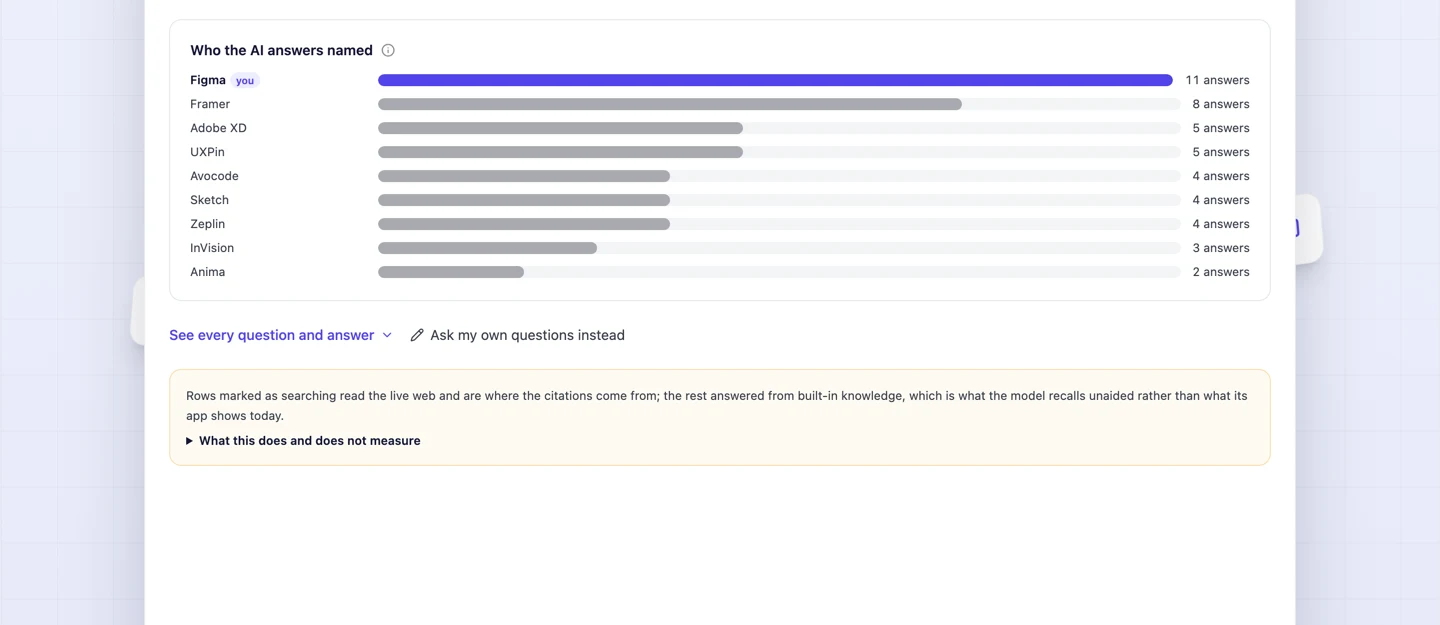
The competitor chart is a plain frequency count of the other brands those answers listed: Framer 8, Adobe XD 5, UXPin 5, Sketch 4, Zeplin 4, InVision 3. No weighting, no index, no opinion — just how many of the twelve answers named each company.
Four things this tool does that nothing else in the test did. It shows the six questions it asked, so you can judge whether they were fair. It lets you open the complete answer behind every single verdict, so a "mention" is checkable rather than asserted. It prints the exact instruction it sent to the models, so you can confirm the wording did not favour anyone. And it refuses to compress any of it into a score out of 100.
The honest limits: the free tier is 3 checks a day, the check queries fewer AI platforms than Ahrefs advertises, and the models are not deterministic — more on that below, with our own inconsistent numbers published.
- Ran free, no account, no card, no CAPTCHA
- Shows all 6 questions and the full text of every answer
- Separates mentions from citations, and lists the exact pages cited
- Writes the questions from your own website rather than guessing your category
- Publishes the exact instruction sent to the models
- No invented 0–100 score, and no estimated audience reach
- CSV export including every citation URL
- 3 checks a day on the free tier
- Queries fewer AI platforms than the paid tools advertise
- A single check is a snapshot, not a trend line
- Results move between runs, because the models do
Enter your brand and your website. You get the questions, the answers, the citations and the competitors — and you can read every word the models actually wrote. No email, no card.
- 6 buyer questions per check, written from your own site
- Mentions and citations counted separately
- The full text of every AI answer, one click away
- 3 free checks every day, no account
2. Scrunch AI — real citation data, delivered as a sales funnel
Scrunch takes a website URL from its home page and hands you a report immediately. It is the best competitor in this test and the only other tool that produced usable brand-mention data without an account.
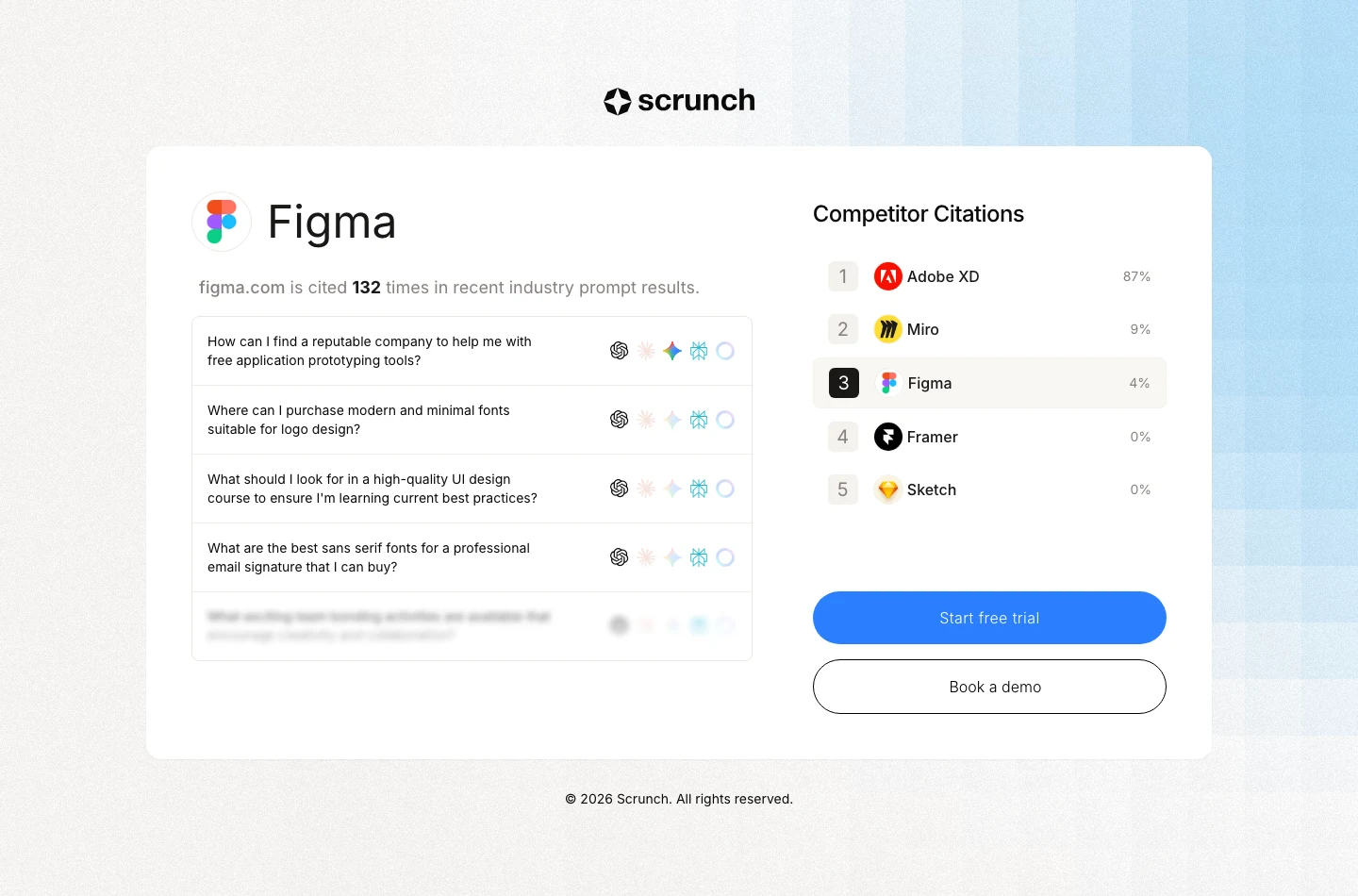
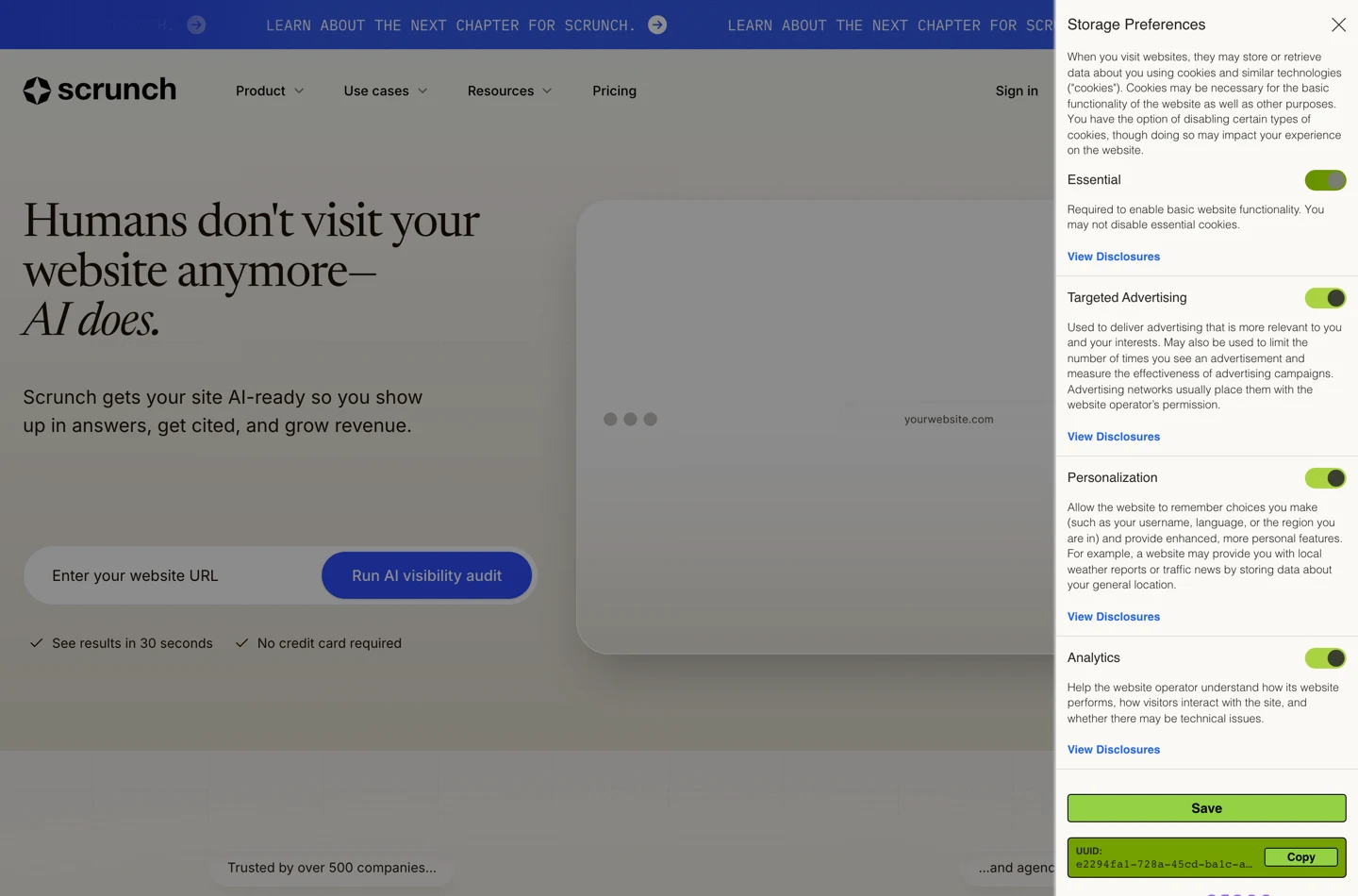
The headline is specific and checkable: "figma.com is cited 132 times in recent industry prompt results." Underneath, five real buyer questions, each with a row of platform icons showing which of ChatGPT, Claude, Google, Perplexity and Meta cited the site for that question. The prompts are genuinely the kind a customer would type — "What should I look for in a high-quality UI design course to ensure I'm learning current best practices?"
The right-hand panel is the sharpest thing any tool in this test produced, and it is not flattering to the subject: Competitor Citations — Adobe XD 87%, Miro 9%, Figma 4%, Framer 0%, Sketch 0%. Read alongside our own check, where Figma led every count, that is a striking disagreement between two tools looking at the same brand on the same day, and a good reminder that these numbers are estimates of different things measured different ways.
Two things hold it back. The fifth prompt row is deliberately blurred out, so the free report is a teaser with a visible locked edge. And you never see what any AI actually said — a coloured icon tells you "cited", and that is the entire evidence. When Scrunch and our tool disagree this sharply about Figma, being unable to read the underlying answers is exactly the moment you need them.
- Ran instantly, no account, no CAPTCHA
- Covers five AI platforms including Meta and Claude
- Shows the real buyer questions behind the result
- The competitor citation share is genuinely useful context
- You never see the AI's answer — only a cited / not cited icon
- The last prompt row is blurred out in the free report
- The result page is a trial signup flow, not a tool you return to
- No stated methodology for what "recent industry prompt results" covers
3. Knowatoa — fast, honest, and answering a different question
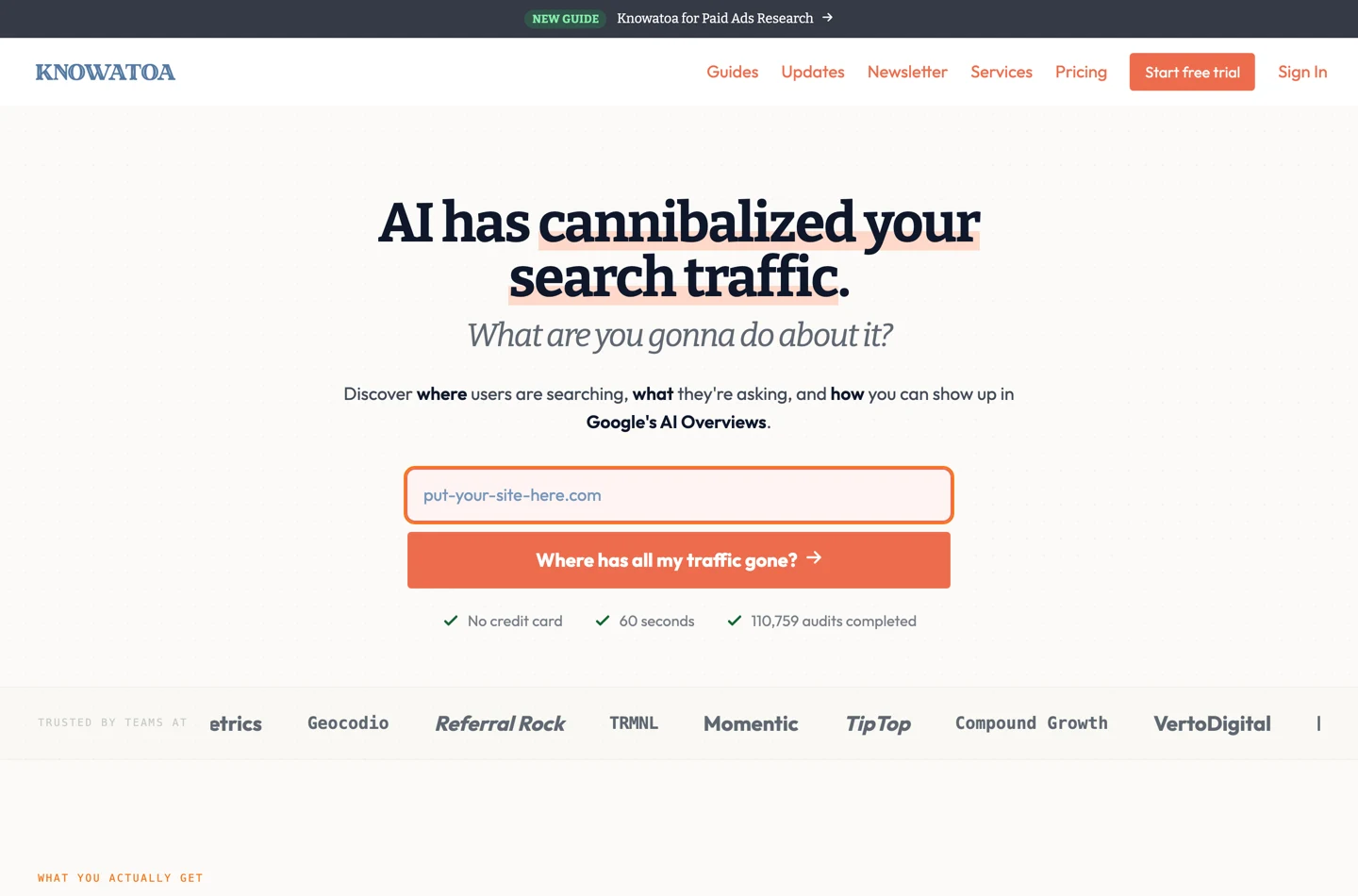
Knowatoa takes a domain and runs a scan that finished in about 35 seconds. What comes back is not a brand-mention report at all.
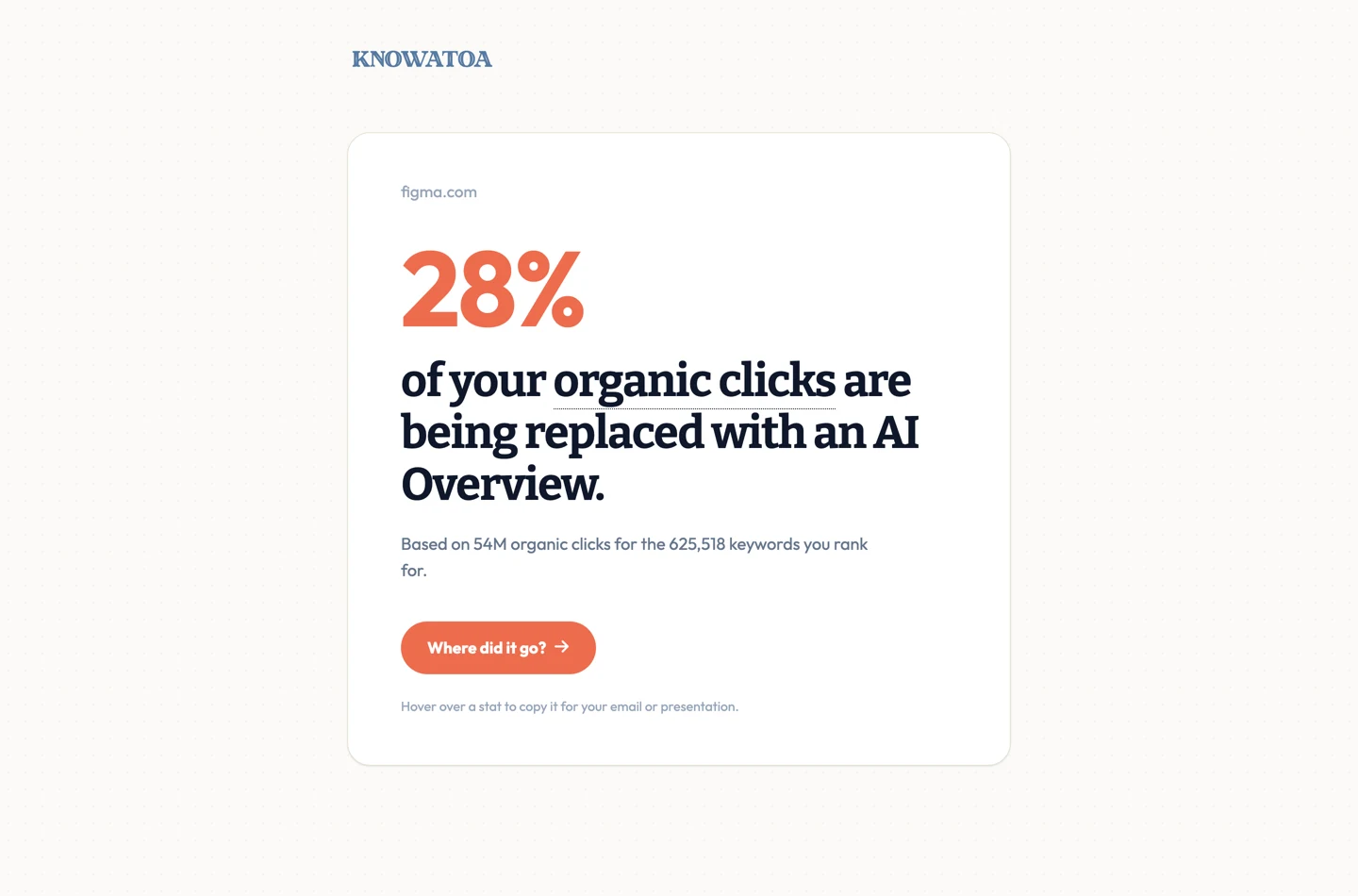
The result: "28% of your organic clicks are being replaced with an AI Overview", based on 54M organic clicks across the 625,518 keywords figma.com ranks for. That is a real, useful, well-presented number — and it is a measure of Google AI Overview displacement, not of whether ChatGPT recommends you.
It is ranked third here because it answers a different question, and that is a statement about fit, not quality. If your worry is "AI Overviews are eating my clicks", this is the fastest honest answer I found anywhere. If your worry is "does ChatGPT name us when someone asks for a recommendation", this tool does not address it: no prompts, no per-platform mention breakdown, no citations.
- Ran free with no account and no CAPTCHA
- Fast — about 35 seconds from domain to answer
- States its basis openly: click volume and keyword count are on screen
- Genuinely the clearest AI Overview displacement estimate in the test
- Does not measure brand mentions in AI answers at all
- No prompts, no platform breakdown, no citations
- The percentage is a modelled estimate with no shown workings
- Only useful for domains with enough ranking keywords to model
4. Ahrefs AI Visibility Checker — "No signup required", behind a human-verification challenge
Ahrefs' free checker has the best-designed promise in the category. Its own page says: "See how your brand shows up in AI search results from ChatGPT, Gemini, Perplexity, Copilot, and Google AI Overviews. No signup required. Results in seconds."
I could not get results in seconds, or at all.
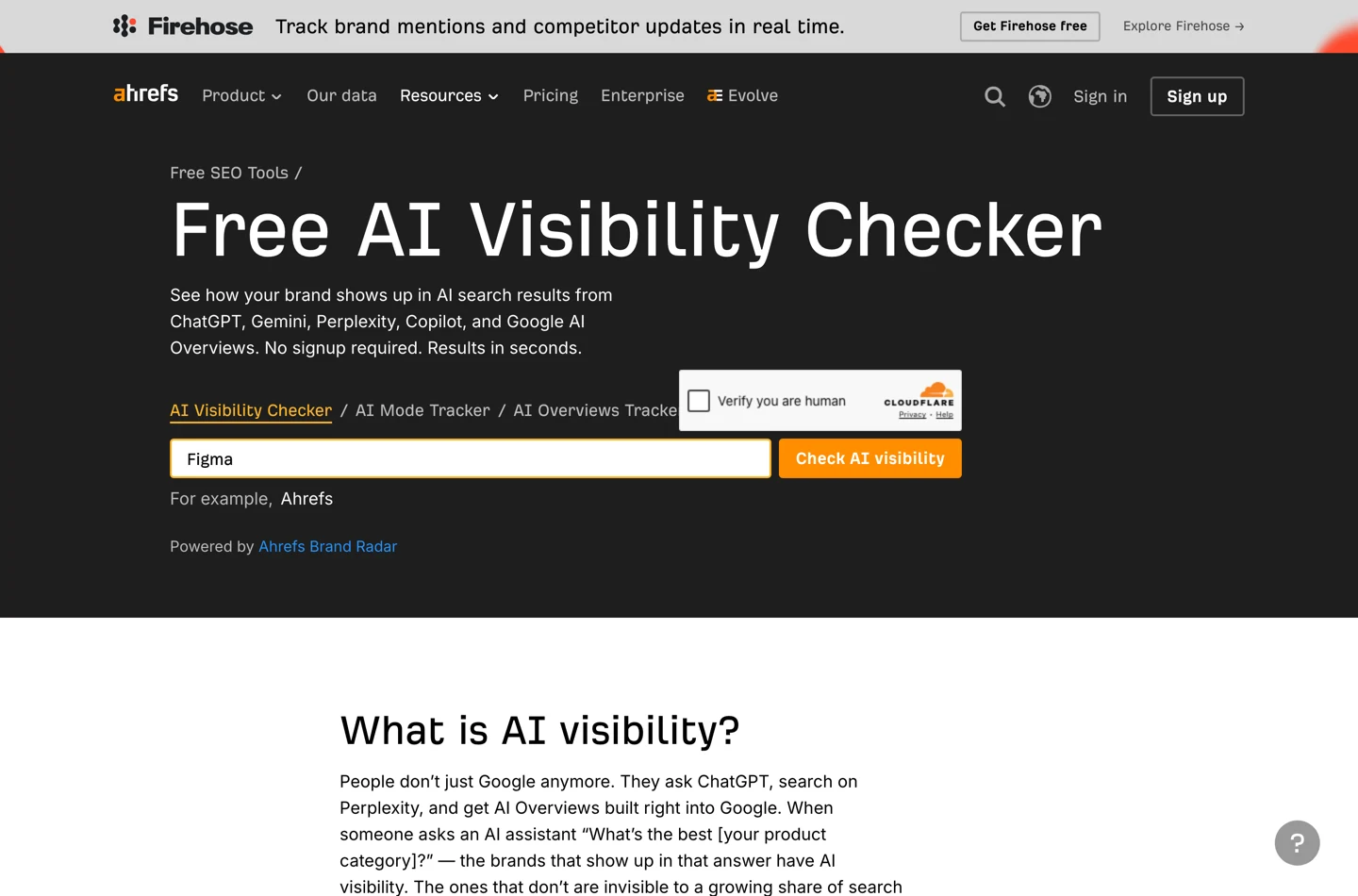
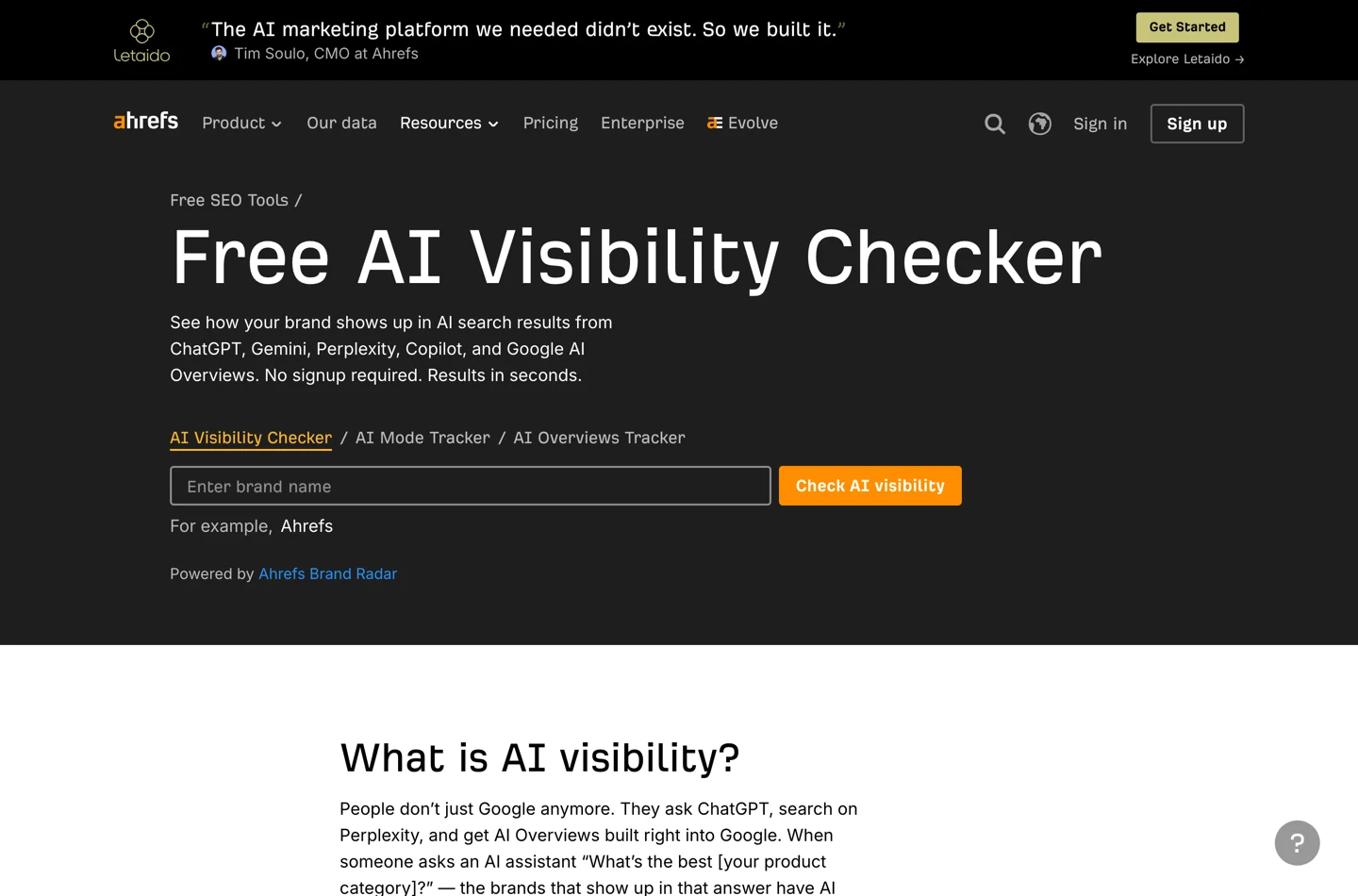
Submitting the brand raised a Cloudflare "Verify you are human" challenge over the form. I reproduced this in a second, completely ordinary desktop Chrome profile with no automation history and got the identical challenge, so this is not an artefact of how I was testing. We do not solve CAPTCHAs, so no Ahrefs report was obtained and nothing here is claimed about the quality of its output.
For completeness, here is what it advertises, as a claim rather than a result: total AI mentions, mentions by platform, top 5 topics, top 5 cited domains and top 5 cited pages, described on its own page as "a limited preview (top 5 results per section)". Its paid Brand Radar product was listed at $398/mo for selected platforms and $699/mo for all of them on the day of testing.
Ranked fourth on accessibility. If the challenge does not appear for you, you may well get the richest free report in this list — it is drawn from an index Ahrefs says covers 470M+ monthly prompts, which is a scale no live-query tool can match. I simply could not verify any of it.
Try the Ahrefs AI Visibility Checker →
5. Semrush AI Search Visibility Checker — three checks a day, and a wall
Semrush's free tool takes a domain and shows a counter on the page reading 0/3 — three checks a day. It promises an AI Visibility Score, total mentions, citations, platform coverage, top cited pages, best performing topics and an estimated audience reach.
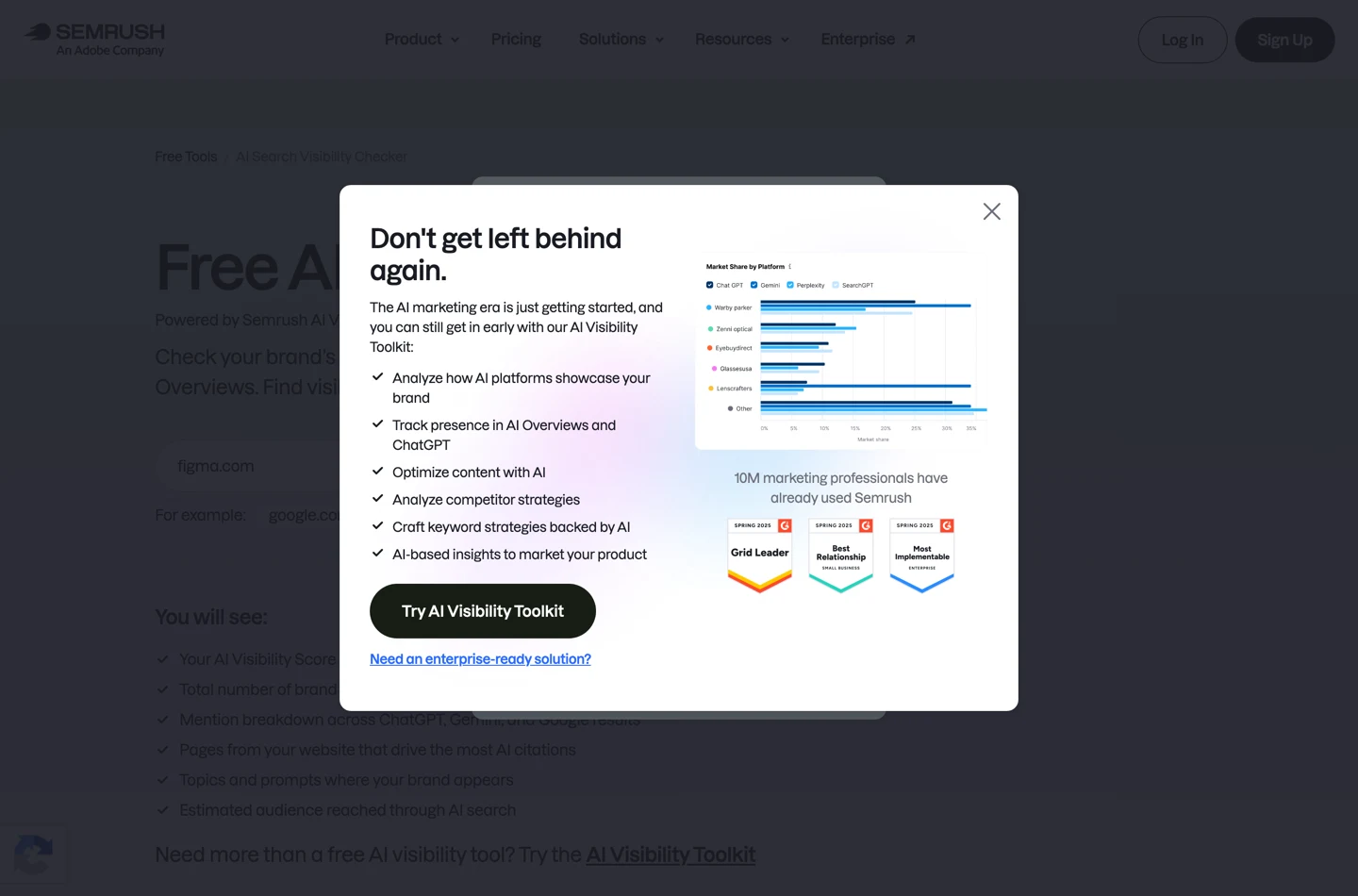
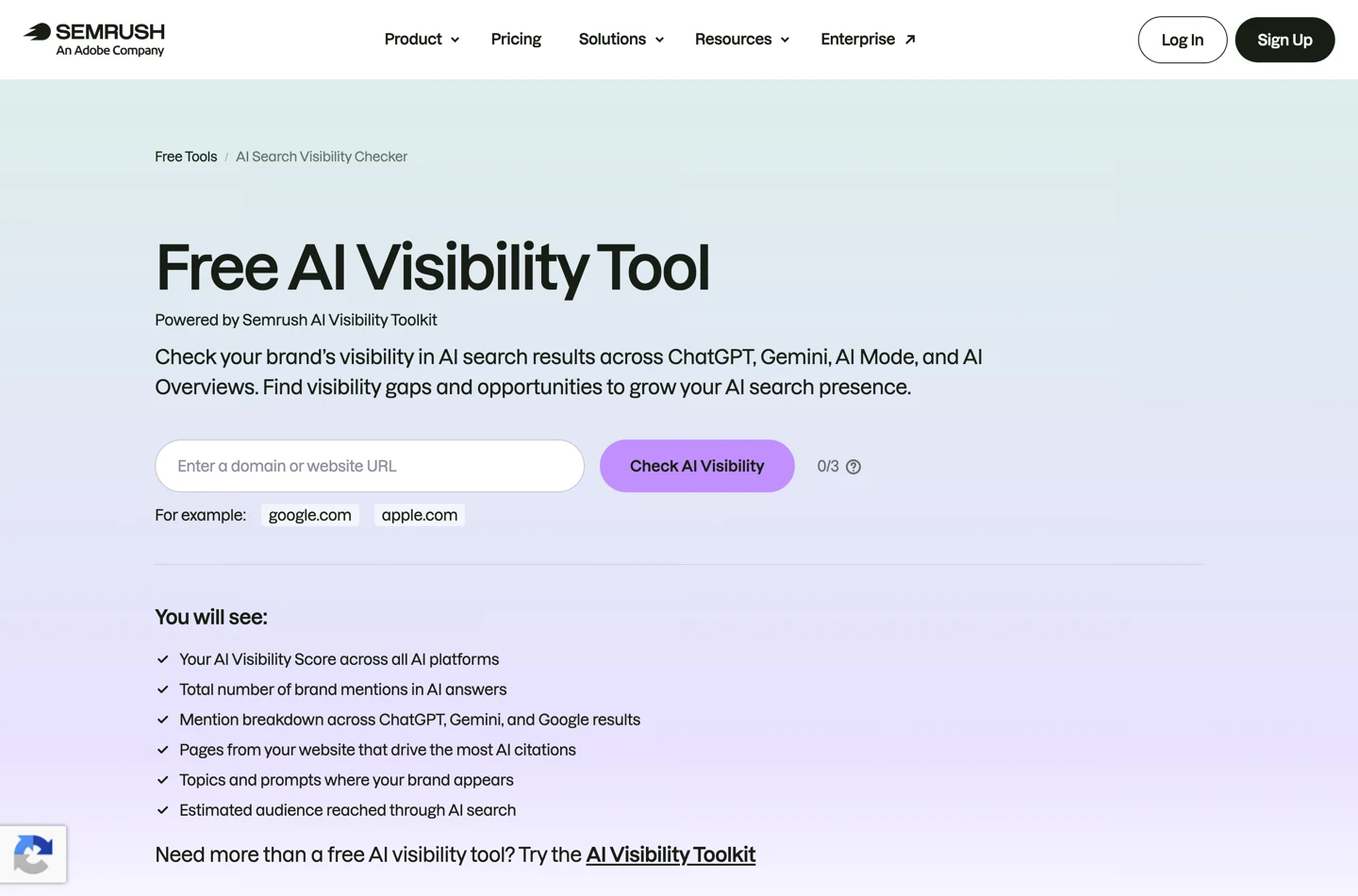
No report ever rendered. The three daily checks were consumed across our attempts without a single one returning a visible result, and what appeared instead was a modal reading "You've reached the daily limit for this free tool!" with "Register for a free account to get more access and more data" and a Get Your Free Account button. We did not register, so no Semrush report was obtained and nothing is claimed about its accuracy.
Ranked fifth on accessibility alone. Semrush is a serious product with a serious AI visibility toolkit behind it; this ranking reflects what a person with no account could get from the free checker on the day, which was nothing.
Try the Semrush AI Search Visibility Checker →
What the free tiers actually cost you
Every tool here is free in the sense that no card is required. They are limited along completely different axes, and the axis matters more than the number.
seotools.pro limits how often: three full checks a day, everything visible in each one. Semrush also limits how often — three a day — but in our test the wall arrived before the data did. Scrunch limits how much: the report renders in full except for the last row, which is blurred, and the page is built to move you into a trial. Knowatoa barely limits anything, because the thing it gives away is a single number. Ahrefs limits depth rather than frequency: unlimited brands, top 5 results per section.
Two of the five tools in this test were gated by something no pricing page mentions: a bot-detection challenge and a daily-limit modal. Neither is dishonest — both are ordinary defences against automated abuse — but if you are evaluating tools on a deadline, budget for the possibility that the two biggest names simply will not run for you today.
The number nobody in this category can actually measure
Semrush's free report promises an "estimated audience reach" — how many people supposedly saw your brand mentioned across AI platforms each month. Several paid tools in this space sell something similar.
There is no public data on how many humans read any particular AI answer. AI platforms do not publish per-answer impressions the way Search Console publishes per-query impressions. Any number of that shape is a model built on assumptions about platform traffic, prompt frequency and answer composition, none of which the vendor can observe for your brand specifically.
The same applies, more mildly, to a 0–100 AI Visibility Score. There is no defensible way to compress a set of yes/no answers into an index, and once it exists people track the index instead of the answers. Our tool refuses to publish one, and that refusal is the single clearest difference between it and the paid category.
Ask one question of every metric a visibility tool shows you: could I verify this myself if I had an afternoon? A count of answers that named you, yes — open the answers and count. A list of cited URLs, yes — click them. A 0–100 score or a monthly reach estimate, no. Weight them accordingly.
Our own inconvenient number: the same brand, twice, on the same day
Here is a result that does not flatter our tool, published because leaving it out would make everything above less trustworthy.
Figma was checked twice through seotools.pro on 13 August 2026, a few hours apart. The first run returned 12 of 12 answers naming the brand with 4 citations to figma.com. The run in the screenshot above returned 11 of 12 with 1 citation. Same brand, same tool, same day.
Language models are not deterministic, and a searching model gets whatever the live web hands it that minute. That is not a bug in any of these tools — it is the material they are all made of, and it applies equally to every competitor in this list. It has two practical consequences. A single check is a snapshot, not a measurement: treat one miss as weak evidence and absence from every answer as strong evidence. And any tool that reports a precise-looking score off a single run is presenting more certainty than the underlying data contains.
It is also why Scrunch putting Figma third at 4% while our check had it first is not necessarily either tool being wrong. They asked different questions, of different platforms, at different moments.
Which one should you actually pick?
You want to know whether AI recommends you, and you want to see the evidence. The seotools.pro AI Visibility Checker. It is the only tool in this test that will show you the questions, the answers and the cited URLs, which means it is the only one whose verdict you can audit.
You want the widest platform coverage in a free check. Scrunch AI, which covered ChatGPT, Claude, Google, Perplexity and Meta in one pass. Accept that you are reading icons rather than answers, and that the page wants you in a trial.
You are worried about AI Overviews eating your Google clicks. Knowatoa, in about 35 seconds. It is the wrong tool for brand mentions and the right one for that specific question.
You need month-over-month tracking of a fixed prompt set. None of the free tiers here, including ours. That is the genuine job of the paid products — Ahrefs Brand Radar, the Semrush AI Visibility Toolkit, Scrunch's paid tier — and a single free check is not a substitute for it.
What an AI visibility checker cannot tell you
It cannot tell you what your specific customer saw. Answers vary by phrasing, by account history, by country and by minute. A checker gives you a sample, not a transcript of your market.
It cannot tell you why you were left out. Absence from an answer has many causes — a training cut-off that predates your launch, a category the model reads differently to you, a competitor with far more third-party coverage. The tools report the outcome, never the reason.
It cannot tell you a miss is your fault. A brand that launched or rebranded recently cannot appear in a model's memory however visible it is today. Treat a zero from a young brand as "not yet measurable" rather than as a failure.
What to look for when you pick one of these tools
The category is young enough that feature lists are not comparable, so here is the checklist I would use on any AI visibility tool, in the order that matters.
Can you see the prompts? If a tool will not show you the questions it asked, its headline number is unfalsifiable. A brand can score badly because it is invisible, or because the tool asked about a category it does not sell in. Those are opposite problems with the same number, and only the prompt list separates them.
Can you see the answers? This is the one most tools fail. "Mentioned" covers being the top recommendation and being named as the thing people outgrow. Without the answer text you cannot tell which you got, and sentiment scores are a vendor's summary of a document they will not show you.
Does it separate mentions from citations? A tool that reports one blended "visibility" figure has decided for you that a passing name-check and a linked source are worth the same. They are not, and they need completely different work to earn.
Does it disclose whether the model searched? An answer written from a model's training memory and an answer written after a live web search are different measurements. A tool that mixes them without saying so will show you a citation count of zero and let you conclude something false about your site.
Does it name the model? "ChatGPT said" is marketing. A model identifier and a date is a fact you can reproduce. Model versions change what gets recommended, and a report from an unnamed model cannot be compared to last month's.
Can you get the data out? A CSV export with the prompts, verdicts and cited URLs turns a one-off check into something you can diff next month. A dashboard you cannot export is a dashboard you cannot audit.
What happens at the free limit? Worth knowing before you build a workflow on it: three of the five tools here cap you, and only one of the caps was visible on the page before I hit it.
How to actually improve what AI says about you
The cited-domains list is the most actionable output any of these tools produce, and it is worth acting on rather than admiring. In our Figma check the AI drew on framer.com, en.wikipedia.org, uxpin.com, sketch.com and adobe.com's help pages. Those are the sites shaping the answer — being covered on them moves the needle far more directly than another page on your own blog.
Go where the citations already are. If Wikipedia, a competitor's blog and two review sites are supplying the answer in your category, a new page on your own domain does not enter that conversation. Coverage on the cited sites does. This is closer to digital PR than to SEO, and it is the highest-leverage move on the list.
Publish the comparison pages your buyers actually ask for. "Best X for Y", "X alternatives", "X vs Y" — those prompts get answered from roundups and listicles. If none exist in your category, the model is working from whatever it can find, which is usually a competitor's version.
Be specific and checkable on your own pages. A searching model quotes what it can verify. Concrete numbers, plainly stated limits and real product detail survive that process; adjectives do not.
Fix the topic where you appear least, not the one where you appear most. In the Figma report the weak topic was AI Design — 3 of 4 rather than 4 of 4 — and that is exactly the gap a competitor takes. The instinct to celebrate the 4-of-4 rows is the wrong one.
Re-check monthly with the same questions. Changing the question set every time makes the comparison meaningless. Keep them fixed, and treat a single month's wobble as noise until it repeats.
If you want the content side of that, our Content Optimizer works on the page level, the Keyword Research tool will tell you which questions are worth owning in the first place, and the Backlink Analyzer is the quickest way to see who currently links to the sites in your cited-domains list.
A note on non-English brands
Every tool in this test was run in English against an English-language brand, and that is a real limit on what this article can tell you. AI answers are not translations of each other: ask the same buyer question in German or Portuguese and you frequently get a different set of recommended brands, because the sources the model can draw on in that language are different.
If your market is not English-speaking, run your checks in the language your customers actually type. A tool that only accepts English prompts is measuring a market you may not sell into, and a strong English result can hide total absence in the language that pays your invoices.
Frequently asked questions
What is the best AI visibility checker?
For most people, the seotools.pro AI Visibility Checker: it ran free with no account, showed all 6 questions it asked, showed the complete text of every AI answer behind its verdict, listed the exact pages the AI cited, and published no invented score. Scrunch AI was the strongest competitor that actually ran. We make one of these tools, so weigh the ranking accordingly — but every claim above is read off a screenshot you can open.
Is there a genuinely free AI visibility checker with no signup?
Yes — three of the five tested produced a report with no account and no card: seotools.pro, Scrunch AI and Knowatoa. Ahrefs advertises "No signup required" but raised a Cloudflare human-verification challenge on submit, and Semrush's free tool showed a daily-limit modal asking us to register before it ever rendered a report.
What is the difference between an AI mention and an AI citation?
A mention means an AI answer named your brand in its text. A citation means the answer linked to your website as a source. Citations only occur when the model searched the web for that answer, because a model answering from memory has no URLs to give. Mentions are more common; citations are the ones that can actually send you a visitor, and they require different work to earn.
Why did Ahrefs and Semrush not produce results in this test?
Ahrefs raised a Cloudflare "Verify you are human" challenge over its own run button, reproduced in two independent browsers including an ordinary desktop Chrome profile. Semrush allows three checks a day and returned a "You've reached the daily limit for this free tool" modal asking us to register. We do not solve CAPTCHAs and we do not create accounts, so both are ranked on accessibility, not on output quality — nothing here is claimed about how good their reports are.
Can I trust a 0–100 AI visibility score?
Treat it as a vendor's opinion rather than a measurement. There is no agreed method for compressing a set of yes/no AI answers into an index, so two tools can score the same brand very differently and both be internally consistent. Counts with visible denominators — "named in 11 of 12 answers" — are checkable in a way a score is not.
Why do two AI visibility tools give different answers for the same brand?
Because they ask different questions, of different AI platforms, at different moments. In this test Scrunch put Figma third in its category at 4% while our check had Figma named in 11 of 12 answers. Neither is necessarily wrong. Our own tool returned 12 of 12 and then 11 of 12 for the same brand hours apart, because language models are not deterministic.
How often should I check my AI visibility?
Monthly is enough for most brands, with the same question set each time so the comparison means something. Checking daily mostly measures model variance rather than any change you made. If you need a genuine trend line across a fixed prompt set, that is what the paid tracking products exist for.
Does an AI visibility checker work for a brand new brand?
Partly. A model answering from its built-in knowledge cannot name a brand that launched after its training cut-off, however visible you are today, so expect zeros from those rows. The web-searching rows are the ones to watch, because those can find you the moment other sites start covering you.
What should I do first if AI never mentions my brand?
Look at the cited domains, not your own site. Those are the pages the AI is building its answer from, and getting covered on them changes the answer faster than publishing more of your own content. After that, make sure the comparison and "best X for Y" pages in your category exist and mention you factually.
How were these tools tested?
One brand — Figma, checked as a brand name or as figma.com depending on what each tool accepts — through all five free tiers on 13 August 2026, in the same browser at the same window size. No accounts were created, no CAPTCHA was solved, and every consent banner was declined rather than accepted. Where a tool blocked automated access it was re-run by hand in an ordinary desktop Chrome profile. Every figure quoted is read off a screenshot published in this article.
The verdict
The gap in this category is not accuracy — nobody can prove accuracy here, because there is no ground truth for what an AI will say next time. The gap is auditability. Four of these five tools ask you to accept a number. One shows you the questions, the answers and the links, and lets you decide whether the number is fair.
That is why the seotools.pro AI Visibility Checker ranks first here: not because its data is bigger than Ahrefs' index, but because everything it reports can be checked by the person reading it, in the tool, for free, without an account. Scrunch AI is the competitor to try next, and Knowatoa is worth 35 seconds if AI Overviews are your actual worry.
And the finding I did not expect going in: on the day I tested, the two most established SEO brands in the world both had a free AI visibility checker that would not run for an ordinary visitor. If you are shopping this category, run the tools before you read anyone's review of them — including this one.
Tested on 13 August 2026 with a single subject brand (Figma / figma.com) across five free tiers, no accounts, no CAPTCHAs solved, consent declined. Tool behaviour, limits and pricing in this category change quickly — check the vendor's own page before you buy anything.
Enter your brand and your website. You get mentions, citations, the sites the AI cited, the competitors it named instead — and the full text of every answer behind the verdict.
- 6 buyer questions per check, written from your own site
- Mentions and citations counted separately, never blended
- Every cited URL listed, and exportable to CSV
- No 0–100 score, no estimated reach, no account