Disclosure: Semrush sponsored the original video behind this article. This is an affiliate link; I may earn a commission if you subscribe, at no extra cost to you.
First published as a LinkedIn newsletter by Anatolii Ulitovskyi. Republished here in full.
A value-first playbook for finding growth opportunities with better data, sharper focus, and a lot more AI.
Try Semrush free — validate demand before you optimize.
I once built an audience of 90,000 followers on LinkedIn. From the outside, it looked like the kind of success every marketer should double down on.
Inside the business, the picture was different. LinkedIn still worked, but it demanded hours of posting, replying, and chasing reach. Other channels were producing more sales with less effort. The visible scoreboard said "keep going." The business data said "focus somewhere else."
Walking away from a good-looking number taught me a hard lesson: a channel can be successful and still be the wrong priority.
That lesson matters even more now, when every case study, algorithm update, and AI-generated playbook gives us a new reason to abandon what already works.
The case-study trap
Reddit really was everywhere. Then the picture changed.
Semrush studied more than 230,000 prompts and 100 million citations. In early August 2025, ChatGPT cited Reddit in nearly six out of ten responses. By mid-September, it was closer to one out of ten.
Promptwatch later recorded another change: Reddit's share of citations fell about 11% in Google AI Overviews and about 31% in Google AI Mode during its measured period.
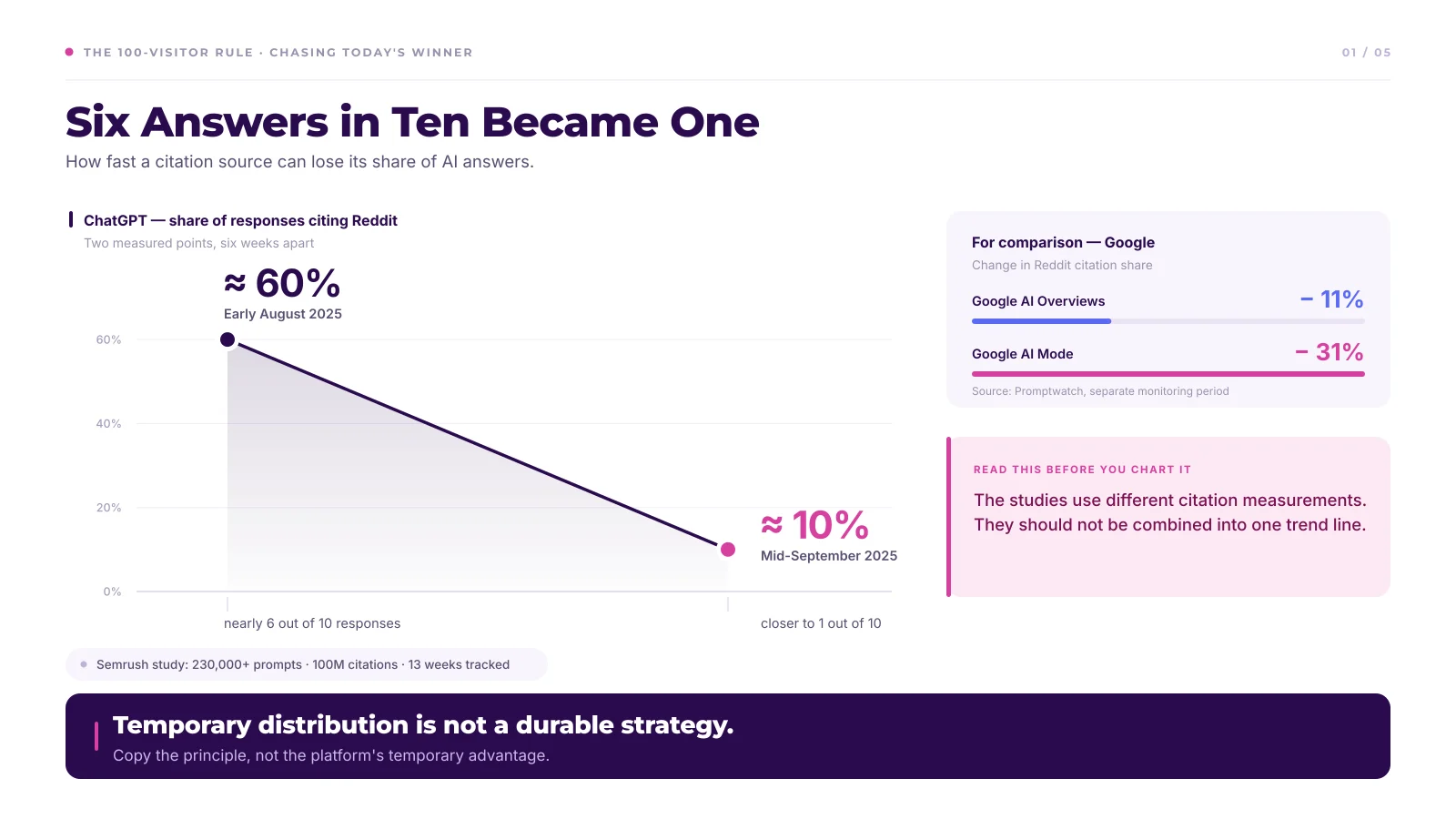
The studies count citations differently, so we should not mash the numbers into one perfect chart. We do not need to. The human lesson is simple: today's winning platform can cool down before your copycat strategy is even published.
This is why I would not tell you to "do Reddit SEO" just because Reddit had a moment. Learn from what worked—real questions, useful answers, lived experience—but do not confuse a temporary distribution advantage with a durable strategy.
When you see a success story, ask: "What part can we honestly transfer to our audience, product, and strengths?" Copy the principle, not the costume.
You do not need another software course
Most marketers do not have a lack-of-data problem. They have a too-many-dashboards problem.
You open GA4 and see reports, events, paths, filters, and attribution models. You open Semrush and find thousands of keywords. You open an UNmiss roadmap and see even more possibilities. It can feel as if you need three courses before you are allowed to make one decision.
You do not.
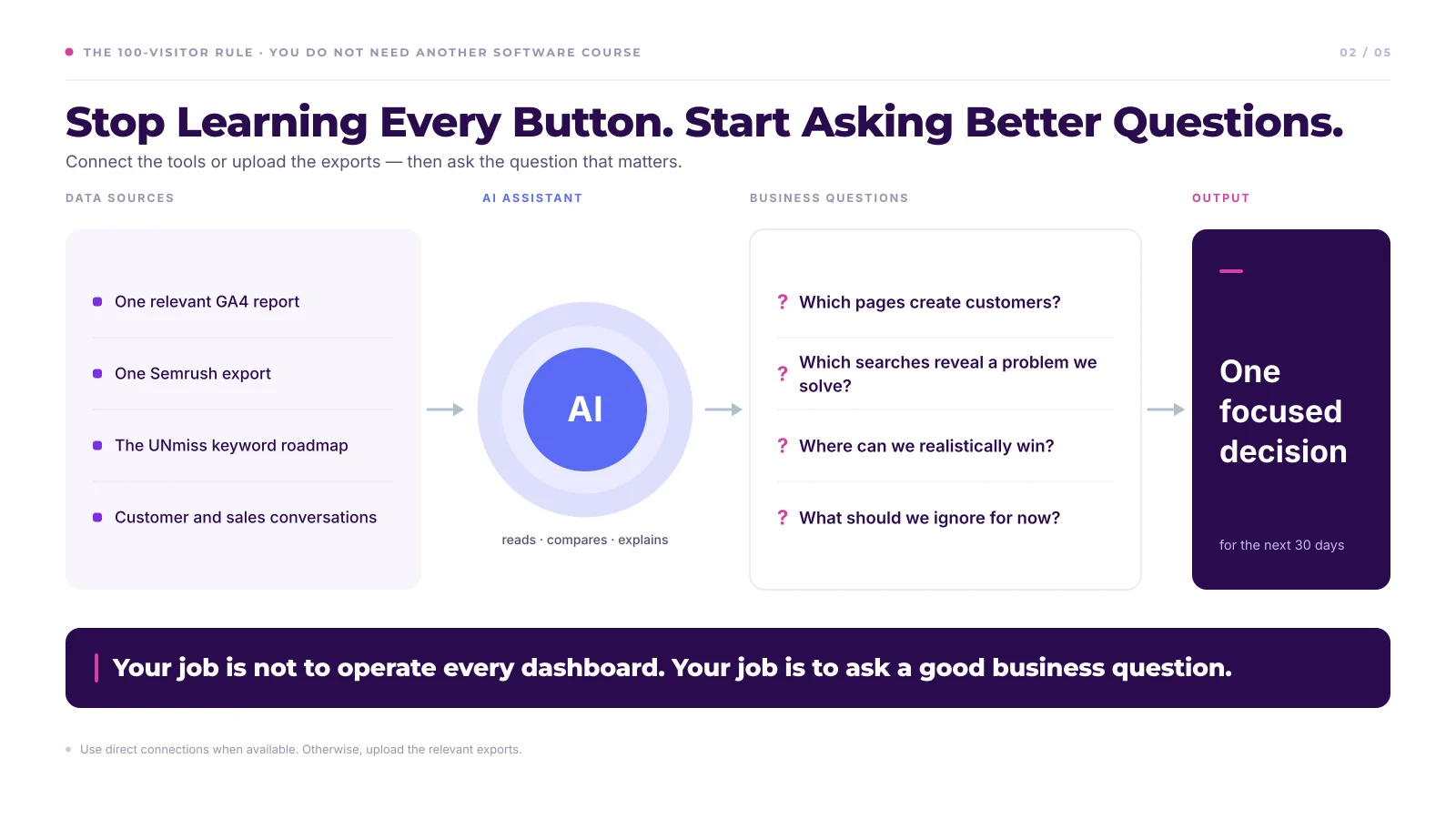
Today, you can give an AI assistant access to the relevant reports—or simply upload the exports—and speak to it like a thoughtful analyst. Your job is not to learn every button. Your job is to ask a good business question.
Try asking:
- Which pages bring visitors who become leads or customers?
- Which searches reveal a problem we genuinely solve?
- Where do we have a realistic chance to win?
- Which attractive ideas should we ignore for now?
AI can compare the signals in minutes. You still decide what matters, because no dashboard knows your customers, standards, or ambitions as well as you do.
Let AI find the signal for you
Let's make this real with a few keywords from the UNmiss planning sheet.
An AI assistant looking at the list would see:
- "link building agency" — 3,600 monthly searches, moderate difficulty, and about $19,019 in estimated monthly traffic value.
- "free rank tracker" — 4,400 searches, a realistic difficulty score, and a gap where UNmiss could build a useful tool.
- "free SERP simulator" — 1,900 searches, much lower difficulty, and marked as a quick win.
- "best free SEO tools" — 5,400 searches, but substantially harder competition.
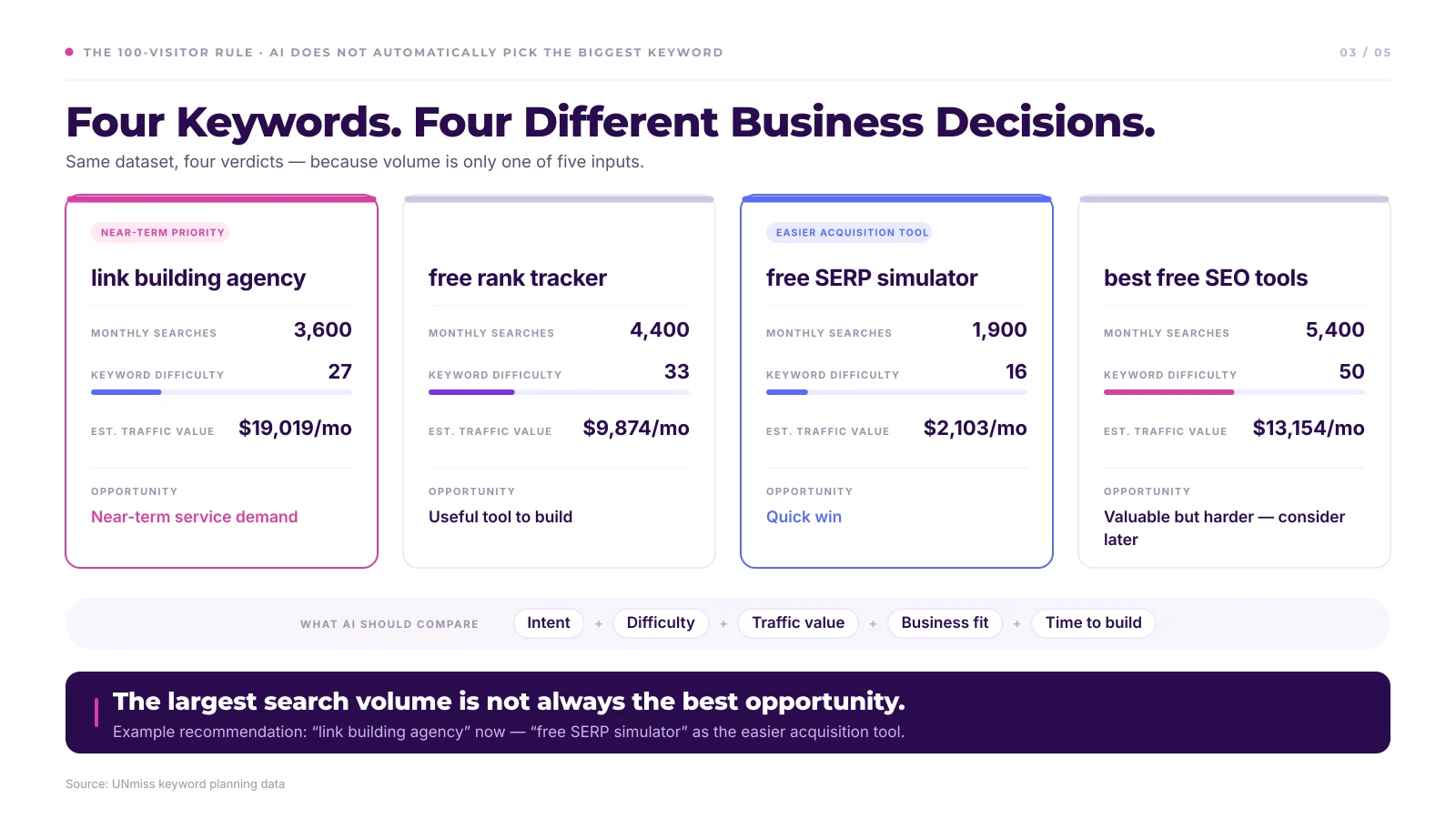
The beginner sees four keywords and may choose the biggest number. AI can see four different business decisions.
You could ask: "We are UNmiss. Which opportunity can produce useful customer value fastest? Do not choose by search volume alone. Compare buying intent, difficulty, traffic value, what we already offer, and how long the asset will take to build."
A sensible answer might prioritize "link building agency" for near-term service demand, pair it with the easier "free SERP simulator" as an acquisition tool, and leave the broad "best free SEO tools" target for later.
That is the shift: you are not using AI to write another generic article. You are using it to read the room before you invest.
Use AI heavily—but give it a better job
You do not need to become a GA4 specialist, a Semrush power user, and a spreadsheet expert at the same time. Connect the tools when possible, or export the relevant data, and ask AI to do the first round of analysis.
Speak to it normally:
"Look at our GA4 conversions, Semrush keyword data, and UNmiss roadmap. Find three opportunities that can bring qualified customers. For each one, show the evidence, the difficulty, the fastest useful asset we could create, and the reason we might be wrong. Recommend only one priority."
Then let AI help with the work:
- Summarize which pages and journeys already create customers.
- Group thousands of keywords into a handful of understandable customer problems.
- Turn the chosen opportunity into a strategy, brief, outline, internal-linking plan, and repurposing ideas.
- Draft the first version, then check every claim against the source data.
The important part comes next: challenge the answer. Ask why the highest-volume keyword lost. Ask what evidence would change the recommendation. Ask what the AI may be missing.
AI should remove the mechanical work so you have more time for judgment, creativity, and care.
Three tools, one conversation
Do not think of Semrush, UNmiss, and sem.chat as three more dashboards you must master. Think of them as three teammates, with AI carrying the context between them.
- Semrush is the researcher. It brings market demand, competition, traffic value, and competitor evidence. You can ask AI to translate those numbers into plain-language opportunities.
- UNmiss is the planning room. Its Keyword Research & Mapping Template helps AI connect one customer need to one page instead of producing a pile of overlapping content. Its AI Search Visibility Template helps you repeat the same customer questions and see whether your brand is present, accurate, and useful.
- sem.chat is the listener. Train an AI bot on the content you decided to create, let visitors ask their real questions, and review the conversations. Those questions reveal what your research missed and what the next useful page, tool, or answer should be.
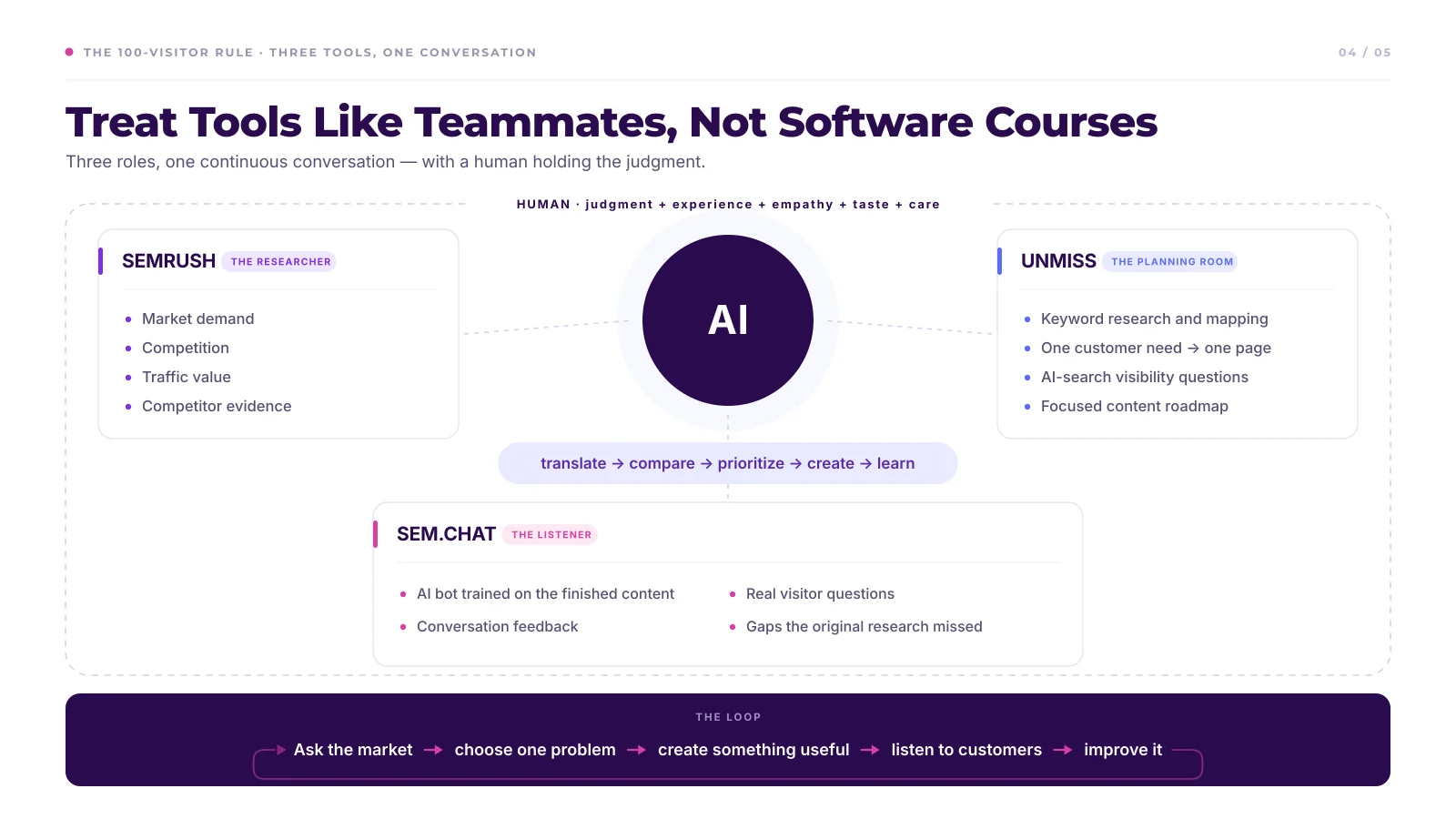
The loop becomes wonderfully simple: ask the market → choose one problem → create something useful → listen to customers → improve it.
Let AI rank the options—but keep the final choice
Ask AI to compare each option on four things: customer value, evidence that people will act, your realistic ability to win, and the cost of distracting the team.
Then have a conversation with the recommendation:
- "Why should we not choose the keyword with the biggest search volume?"
- "What evidence could prove this recommendation wrong?"
- "What is the smallest useful version we can publish and learn from?"
AI can make the trade-offs visible. It cannot decide what your company cares about. That remains your advantage.
Your advantage is caring about the answer
The durable advantage is no longer knowing where every button lives. Interfaces change, reports move, and AI can learn the mechanics faster than any of us.
What remains scarce is focus: knowing which customer you want to help, which problem deserves attention, and what "useful" looks like when the work is finished.
Use AI a lot. Let it analyze, organize, compare, draft, and challenge. Then bring the part it cannot manufacture: experience, empathy, taste, responsibility, and care.
Do not chase the loudest tactic. Use AI to hear the signal, then build something worth finding.
Try this tomorrow
You can begin without taking another analytics course.
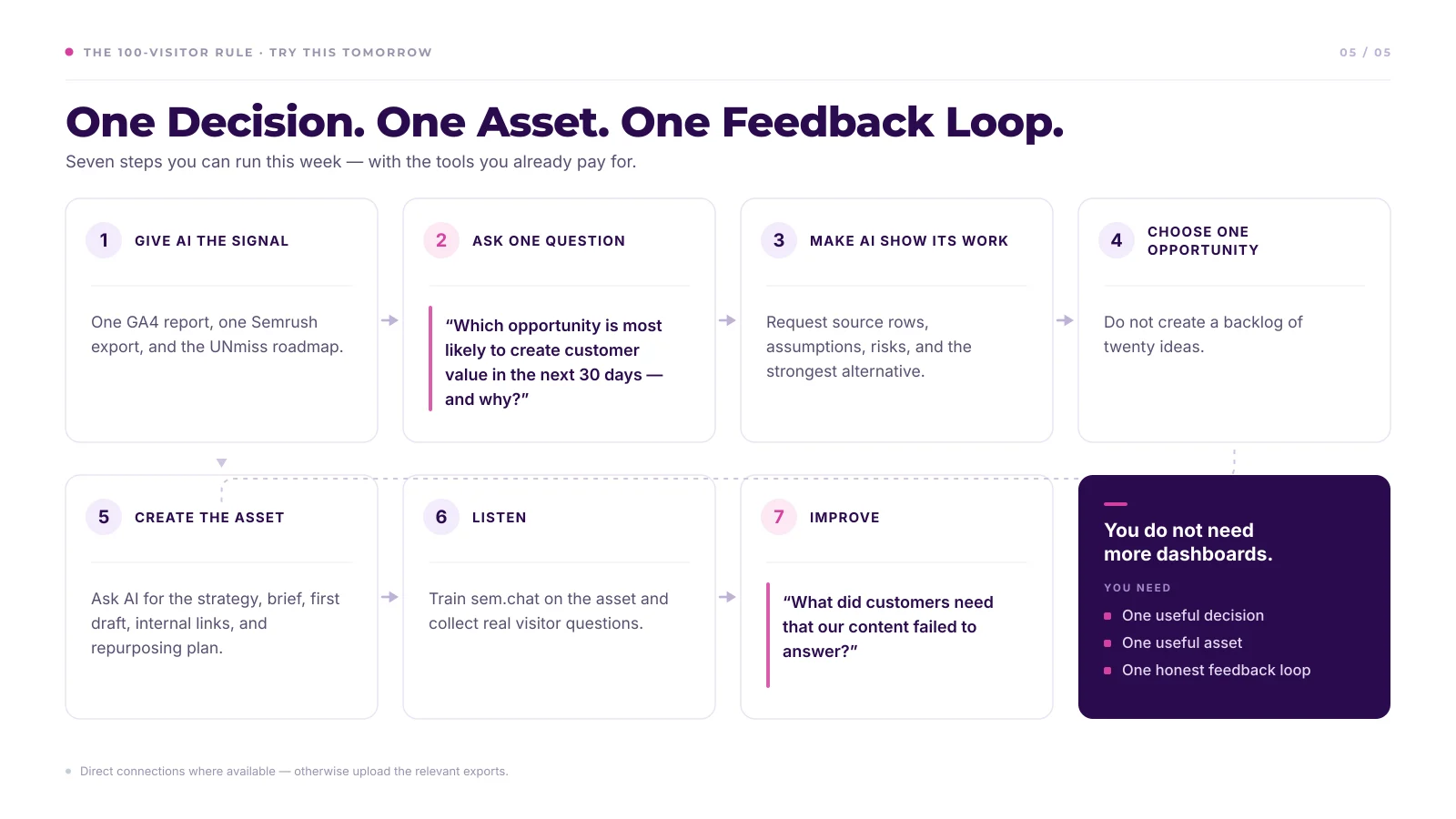
- Give your AI assistant one relevant GA4 report, one Semrush export, and the UNmiss keyword roadmap. If direct connections are available, use them; otherwise, the files are enough to start.
- Ask one question: "Which single opportunity is most likely to create customer value in the next 30 days, and why?"
- Make the AI show its work. Ask for the source rows, assumptions, risks, and the strongest alternative.
- Choose one opportunity and ask AI to create the strategy, content brief, first draft, internal links, and repurposing plan. Review the output like an editor, not a student taking instructions from a machine.
- Publish one useful asset. Then train sem.chat on it and listen to the questions visitors ask.
- After a week, return those conversations to the AI and ask: "What did customers need that our content failed to answer?" Improve the asset and stop one lower-value activity so the learning loop can compound.
You do not need more dashboards. You need one useful decision, one useful asset, and one honest feedback loop.
Start the conversation
Want to try this without becoming a full-time analyst?
Try Semrush free and bring the relevant keyword or competitor data into your AI conversation. Semrush sponsored the original video.
Use the UNmiss Keyword Research & Mapping Template to give the AI a practical planning structure, then use the AI Search Visibility Template to repeat the questions that matter.
Train a sem.chat AI bot on the finished content so customer conversations—not vanity traffic—guide the next decision.
Then ask your team one uncomfortable question: Which channel is producing the most business value—and which impressive distraction should we stop chasing?
Share your answer in the comments. The channel you stop funding may be the decision that finally lets your best channel compound.