This article is sponsored by Semrush. Opinions, process, and results are my own — Semrush is a tool I actually use to run this.
A few years ago, building a content plan meant a lost week. I would open a blank spreadsheet on Monday, pull keyword exports, cross-check them against my analytics, argue with myself about priorities, and by Friday I had a messy tab that already felt out of date. The strategy was sound. The process was brutal. And because it was so painful, I did it far less often than the business needed.
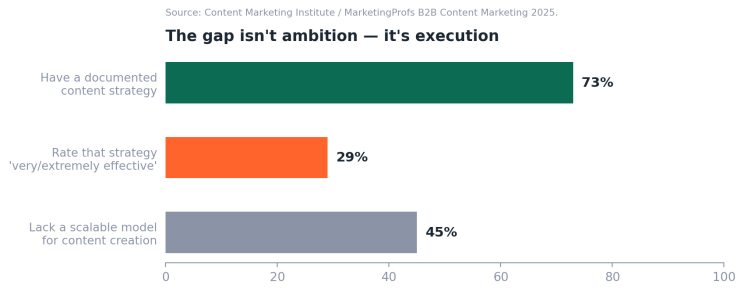
It turns out I wasn't alone. In the Content Marketing Institute's latest B2B research, 73% of marketers say they have a documented content strategy — but only 29% rate it "very" or "extremely" effective, and 45% admit they lack a scalable model for actually producing the content. The ambition is there. The execution engine isn't. That gap is exactly where most content plans quietly die.
Everything changed for me the day I stopped treating AI as a writer and started treating it as an analyst. Now I hand Claude access to my data — an all-in-one SEO platform (I use Semrush and SE Ranking), Google Search Console, and Google Analytics 4 — and ask it one question: where is the opportunity? What used to take a week now takes an afternoon, and the output isn't a vague list of ideas. It's a prioritized, 300-to-500-row content plan mapped to search demand, existing authority, and real traffic. Here's a small slice of what one looks like:
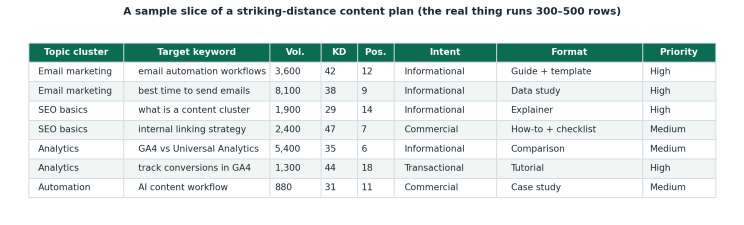
Here's the exact setup, the process, and the checklist — so you can build one like it yourself.
The shift: give the AI data, not prompts
Most people try to squeeze a content plan out of an AI by describing their business and hoping for the best. You get generic topics any competitor could have guessed, because the model is inventing, not analyzing. It has no idea what you already rank for, what's one position away from page one, or which pages quietly earn the links that hold your whole domain up.
This is also why blindly generating content backfires. Adoption is nearly universal now — 86% of SEO professionals have integrated AI into their workflow, and among companies with 200+ employees, 83% report improved SEO performance after doing so. But the winners aren't the ones publishing the most AI text. They're the ones using AI to decide what to publish. That decision needs data.
Claude only needs a few connected sources to reason like a seasoned SEO strategist:
- Semrush — the market view. The keyword universe, search volume, difficulty, competitor gaps, and the backlink/authority picture. This is where you find demand you haven't captured yet.
- SE Ranking — an all-in-one alternative for the market view. Rank tracking, competitor research, keyword and backlink data in one platform — a strong option if you want a second read on difficulty and visibility, or a lighter, budget-friendly primary tool.
- Google Search Console — your reality. Every query you already appear for, your true positions, impressions, and click-through rates. This is where the fastest wins hide.
- Google Analytics 4 — the business layer. Which pages actually drive engaged sessions and conversions, so priority follows value, not vanity.
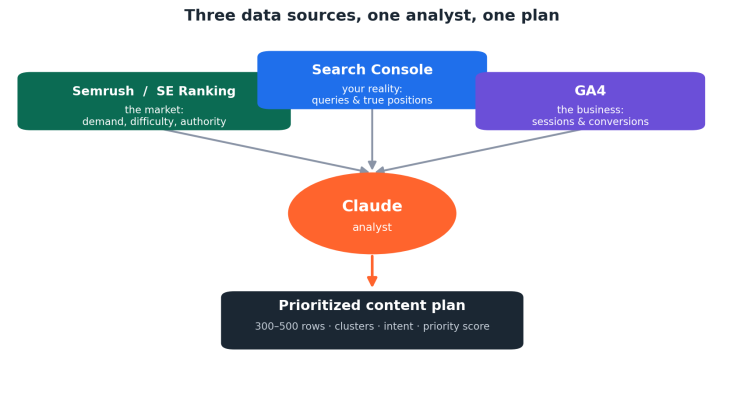
That triangulation is the whole trick. Market demand from your SEO platform, your real footprint from Search Console, and business value from GA4 — reconciled in minutes instead of over a week of manual spreadsheet work.
Why the plan is worth it: the click cliff
Ranking position isn't a vanity metric — it's the entire economics of organic search. The top three organic results capture roughly 68.7% of all clicks, and the #1 spot alone earns more clicks than positions three through ten combined. Meanwhile, anything on page two is effectively invisible: positions 11–20 pull almost nothing. That's brutal if you're stuck there — and it's the single biggest opportunity if you know where to look.
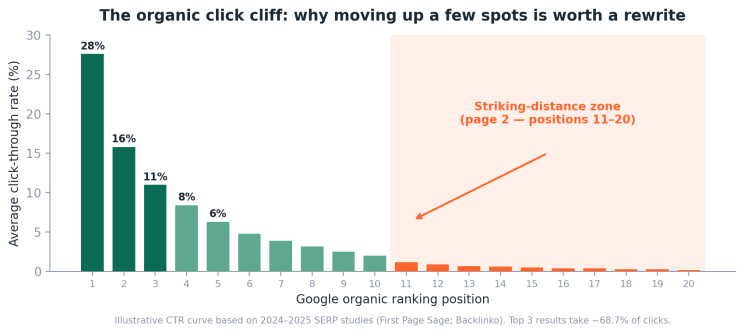
Those page-two rankings have a name: striking-distance keywords. They're terms you already rank for in positions 11–20 — pages with proven relevance that just need a nudge. Practitioners routinely report doubling or tripling a page's organic traffic within 30–60 days by pushing striking-distance terms onto page one. It's the highest-leverage work in SEO, and it's exactly what Claude surfaces first when it reads your Search Console data.
The process: four questions, one afternoon
1. Establish the benchmark
I point Claude at my SEO platform — Semrush or SE Ranking — and ask it to profile the domain: total keywords, visibility trend, top competitors, and the authority gap between us and them. This is the honest starting line — no plan means anything without it.
2. Find the opportunity pages
Next, Search Console. I ask Claude to surface every query ranking in positions 5–20 with meaningful impressions — the striking-distance terms. Cross-referenced with the difficulty scores from Semrush or SE Ranking, Claude ranks them by effort-to-reward. This step alone usually fills a quarter's worth of quick wins.
3. Protect what brings traffic and authority
Using GA4 plus the backlink data from Semrush or SE Ranking, Claude flags the pages carrying your traffic and the ones earning your links. The plan then does two things at once: it defends and refreshes those assets, and it builds new clusters around topics where you already have authority to spend. If the plan also needs authority, I pair it with an internal link and outreach pass; seotools.pro has practical guides for startup backlink building and B2B link-building strategies.
4. Build the prioritized plan
Finally, Claude assembles everything into a single sheet: topic clusters, target keywords, search volume, difficulty, current position, intent, suggested format, internal-link targets, and a priority score. That's the deliverable — a plan a writer can pick up on Monday without asking a single question.
The checklist: run this yourself
- Connect Claude to your SEO platform (Semrush or SE Ranking), Google Search Console, and GA4 (read access is enough).
- Ask for the benchmark: domain visibility, keyword count, top 3–5 competitors, authority gap.
- Pull striking-distance queries (positions 5–20) from GSC with real impressions.
- Score those opportunities against Semrush or SE Ranking keyword difficulty — sort by effort-to-reward.
- Identify top traffic pages in GA4 and top link-earning pages in your SEO platform; mark them for refresh/defense.
- Map keywords into topic clusters with a clear primary page for each.
- Add intent, suggested format, and internal-link targets to every row.
- Apply a priority score (demand × winnability × business value).
- Sanity-check the top 20 rows manually before you commit the team to them.
- Ship the sheet; review and re-run quarterly.
Why Semrush is the piece that makes this work
Search Console and GA4 tell you about the ground you already hold. Neither one shows you the ground you don't. Semrush is what opens up the rest of the map — the keywords you've never ranked for, the exact terms feeding your competitors, the backlink profiles behind their authority, and the difficulty scores that tell Claude what's realistically winnable. Remove Semrush and the AI can only optimize what exists. Add it, and the AI can plan for everything you could capture.
It's also the source Claude leans on most heavily, because it's the richest. The quality of your content plan is capped by the quality of your market data — and this is where that data comes from.
Where SE Ranking earns its place
Semrush isn't the only platform that can feed Claude a full market view — and for a lot of teams, SE Ranking is the smarter fit. It covers the same core jobs: keyword research, competitor analysis, daily rank tracking, a backlink checker, and site audits, all in one place. What sets it apart is the combination of granular rank tracking and a price that scales down to solo operators and small agencies, not just enterprise budgets.
Three things make it genuinely useful in this workflow. First, its rank tracking is precise — you choose exact locations and devices, which means the position data Claude reasons over is closer to what your real customers see. Second, its competitor research surfaces the keyword and backlink gaps you can realistically close, which is exactly the raw material a striking-distance plan is built from. Third, if you run client work, the white-label reports and agency features let you turn Claude's output into a branded deliverable in minutes.
In practice I use both, and I let the job decide. When I want the deepest possible keyword and backlink universe, I lean on Semrush. When I want affordable, location-accurate rank tracking and clean client reporting — or a second opinion on difficulty before I commit the team — I reach for SE Ranking. Either one gives Claude the market layer it needs. You can put SE Ranking to the test for free here.
Try them free — and let the tools build your next plan
If you've read this far, do the experiment. Start a free trial of Semrush or SE Ranking (or both — the trials cost nothing), connect it to Claude alongside your Search Console and GA4, and ask one question: "Where's my biggest content opportunity right now?" You'll get a straight answer in minutes — and probably a plan worth a quarter of work — before the trial even ends. With the click cliff being what it is, a single striking-distance page pushed onto page one can pay for the tool many times over.
The whole point of this process is speed: benchmark, opportunities, authority, and a finished strategy — in an afternoon, not a week. Semrush and SE Ranking are what make the AI fast and the plan real. Give one a run and see what your own data has been hiding.
— Anatolii Ulitovskyi
Sources
- Content Marketing Institute / MarketingProfs — B2B Content Marketing Benchmarks 2025
- First Page Sage — Google Click-Through Rates by Ranking Position
- SEO.com — AI Marketing Statistics
- Clearscope — What Are Striking Distance Keywords
Disclosure: This post is sponsored by Semrush and contains affiliate links for Semrush and SE Ranking. If you start a trial through them, I may earn a commission at no extra cost to you. I only recommend tools I use in my own work.