A SERP simulator makes a precise promise: paste a title and description, then see where Google will cut them off. The promise is testable. Google already shows the real result.
So I stopped comparing feature lists. I took 10 live UNmiss pages, copied the exact title and meta description from each page, ran every pair through five free preview tools, and compared the previews with the result Google actually rendered. I also measured the same text in the two tools that expose pixel calculations.
The finding is less comfortable than a normal roundup: the best simulators agreed with each other to within three pixels, but Google materially rewrote six of the ten descriptions. A tool can calculate the original text perfectly and still fail to predict the snippet, because Google may choose different text.
One disclosure before the ranking: UNmiss makes the tool ranked first. That is why the raw measurements, screenshots and downloadable CSV are included. Where our tool tied, I say it tied. Where a competitor could not be tested, I do not invent a score.
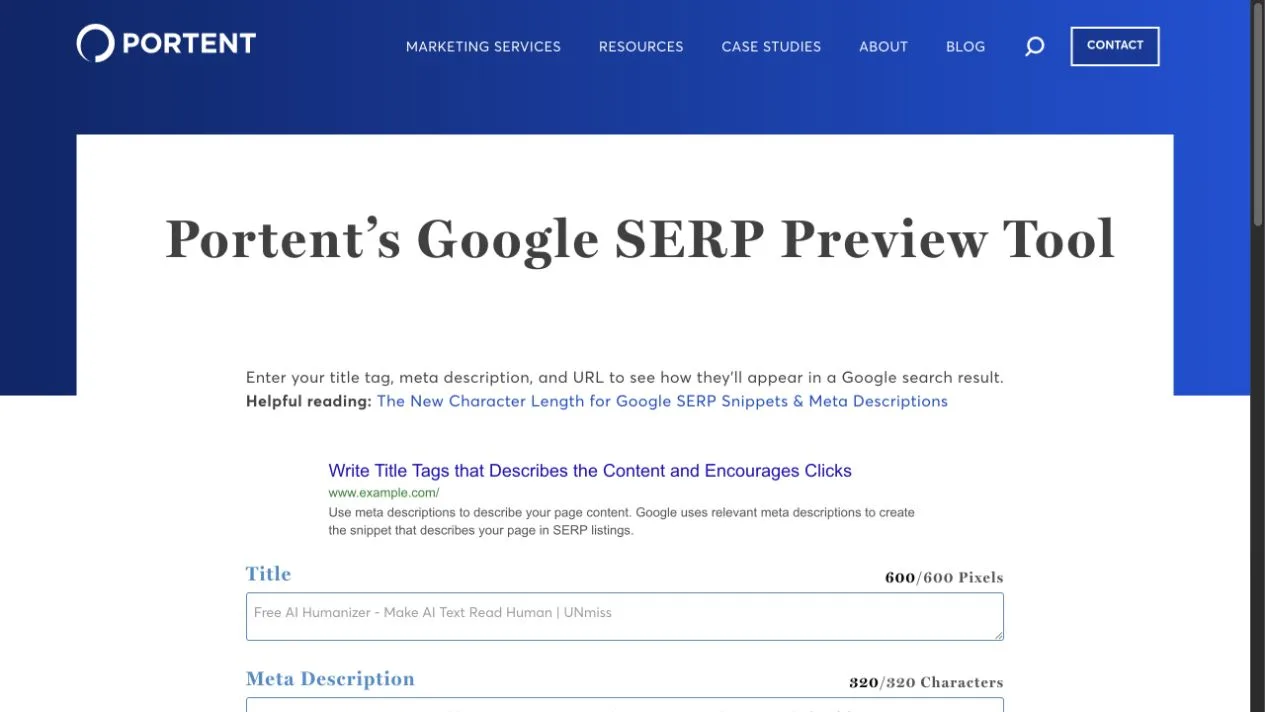
The UNmiss SERP Simulator is the best overall free preview in this test. Its desktop pixel measurements were within 0-3 pixels of Mangools across all 10 pages, and it added mobile previews, bolded search terms, date-aware description width, sitelinks, thumbnails, ads, AI Overview, People Also Ask, dark mode and a full competing-results view. Mangools is a near-tie for basic snippet measurement. Semrush rendered all ten inputs but kept the same 55/105 guidance. Portent rendered all ten but kept 600/600 pixels and 320/320 characters fixed. ToTheWeb's original tool URL now shows its own missing-page message.
The ranking
| Rank | Tool | What the test showed | Best for |
|---|---|---|---|
| 1 | UNmiss SERP Simulator | Pixel result matched Mangools within 0-3 px, with the broadest set of real SERP states. | Publishing and comparing a complete result page |
| 2 | Mangools SERP Simulator | Near-identical raw width measurement and a polished desktop/mobile preview. | A focused title-and-description check |
| 3 | Semrush SERP Simulator | All ten pairs rendered, but the visible 55/105 guidance stayed the same for every input. | Visual checks inside a Semrush workflow |
| 4 | Portent SERP Preview Tool | All ten pairs rendered, while the visible 600/600-pixel and 320/320-character labels stayed fixed. | A quick visual draft, not measurement |
| 5 | ToTheWeb | The original tool URL showed ToTheWeb's “It's gone? Where did it go?” page, so no input could be run. | Unranked until the tool returns |
This is not a claim that UNmiss predicts Google's chosen wording better than everyone else. No preview can know that. It is a ranking of what can be tested: width calculation, visual states, mobile behavior, and whether the tool helps you understand the result rather than merely showing a blue link.
How the experiment worked
The corpus included the UNmiss homepage, two metadata tools, four free product tools, one long-form case study and the pricing page. That mix matters. Short utility titles behave differently from long editorial titles, and product descriptions tend to carry more clauses than homepages.
- I fetched each live page and recorded its rendered title tag and meta description.
- I pasted the same text into UNmiss, Mangools, Semrush and Portent without changing punctuation.
- I recorded the pixel widths exposed by UNmiss and Mangools.
- I searched Google for the page and copied the visible title and description.
- I classified the Google result as exact, truncated source text, separator-only change, or material rewrite.
ToTheWeb could not complete step two because its original tool URL now opens ToTheWeb's own missing-page screen. It remains in the comparison because older SERP-preview roundups still recommend it, and an unavailable free tool is useful information. It does not receive a fabricated accuracy result.
Completion check across all ten inputs
| Tool | Ten title/description pairs | Visible measurement behavior | Evidence |
|---|---|---|---|
| UNmiss | 10 of 10 rendered | Title and description pixel values changed with every input | Captured long-input preview + CSV |
| Mangools | 10 of 10 rendered | Title and description pixel values changed with every input | Captured long-input preview + CSV |
| Semrush | 10 of 10 rendered | 55 and 105 remained visible on every run | Captured long-input preview + run log |
| Portent | 10 of 10 rendered | 600/600 pixels and 320/320 characters remained visible on every run | Captured long-input preview + run log |
| ToTheWeb | 0 of 10; tool unavailable | No input interface exists at the original URL | Captured live missing-page state |
The complete ten-page input, both pixel measurements and every Google outcome are in the measurement CSV. The screenshots below show the same long description in each working preview and the live Google results used for comparison.
The 10-page result: Google changed the source more often than it truncated it
| Page | UNmiss title / description | Mangools title / description | What Google did |
|---|---|---|---|
| Homepage | 449 / 1003 px | 448 / 1002 px | Rewrote both title and description |
| SERP Simulator | 231 / 911 px | 230 / 910 px | Changed the separator; description exact |
| Meta Tag Generator | 264 / 700 px | 264 / 699 px | Rewrote the description |
| Website Audit | 388 / 1006 px | 387 / 1005 px | Used a shorter prefix of the description |
| Keyword Research | 528 / 1035 px | 528 / 1035 px | Rewrote the description |
| Backlink Analyzer | 330 / 991 px | 329 / 991 px | Used a dated prefix of the description |
| AI Humanizer | 511 / 1098 px | 508 / 1096 px | Truncated the source description |
| Article Rewriter | 525 / 1014 px | 523 / 1014 px | Rewrote the description |
| RTINGS case study | 532 / 848 px | 532 / 848 px | Rewrote both title and description |
| Pricing | 455 / 887 px | 452 / 886 px | Shortened the title and rewrote the description |
The simulators agreed about the input. Google disagreed about what the input should be. That is the main result.
Only the SERP Simulator description appeared exactly as written. Three more results used a recognizable prefix or changed only title punctuation. Six descriptions were materially different from the meta description supplied by the page. The previews were not wrong about pixels; they were previewing text Google did not choose.
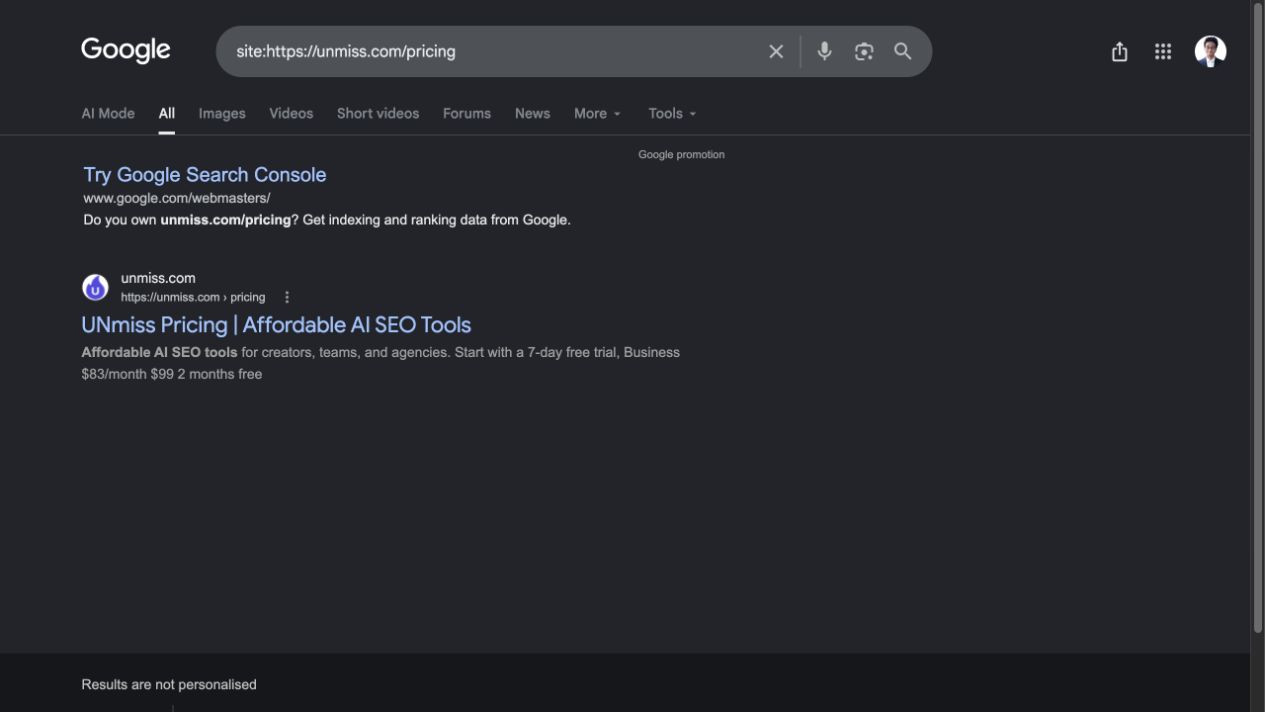
Truncation and rewriting are different failures
A simulator can predict truncation. It knows the text, font, weight and available width, then estimates where an ellipsis appears.
It cannot predict a rewrite. Google's snippet documentation says snippets are primarily created from page content and may use the meta description when it better describes the page. Its title-link documentation says title links may use the title element, headings, prominent on-page text, Open Graph metadata and anchor text. The source is selected after the page is indexed and in the context of the query.
Google also states that snippets are truncated to fit the device width and that there is no fixed meta-description character limit. That is why character counters are a weak approximation. A row of wide capitals occupies more space than the same number of narrow lowercase letters.
If Google displays different words, the simulator did not miscalculate truncation. Google changed the source. Diagnose the page and query first; changing a 580-pixel threshold will not fix a rewritten snippet.
Why UNmiss ranks first
The raw desktop widths do not create a runaway winner. UNmiss and Mangools differed by no more than three pixels across the ten titles and descriptions. That is functionally a tie for ordinary publishing decisions.
UNmiss wins on what happens around that calculation. The preview supports desktop and mobile, title and description keyword bolding, date prefixes that consume description width, sitelinks, thumbnails, ratings, ads, People Also Ask, AI Overview, dark mode and a full page of competing results. It can also generate variants from the Meta Tag Generator, then bring them back into the preview rather than leaving the writer to shuttle between unrelated pages.
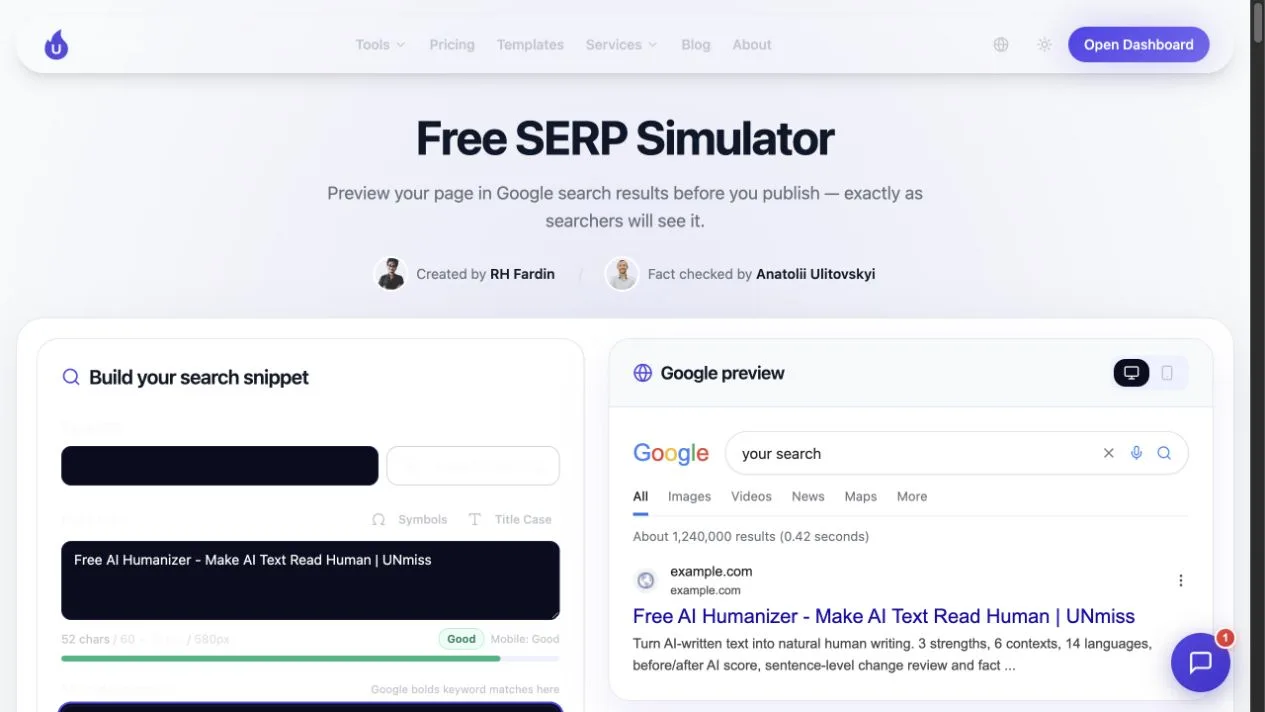
The practical advantage is not a prettier mockup. It is being able to ask the publishing questions in one place: will the date push the description over, does the title survive on mobile, does bolding change the break, and how does the result look beside three competitors?
Mangools is the closest competitor
Mangools produced almost the same measurements: 448 versus 449 pixels on the homepage title, 1,096 versus 1,098 on the AI Humanizer description, and exact ties on several rows. Its desktop and mobile states are clean, and it adds useful controls such as heatmaps, dates, ratings, ads and a map pack.
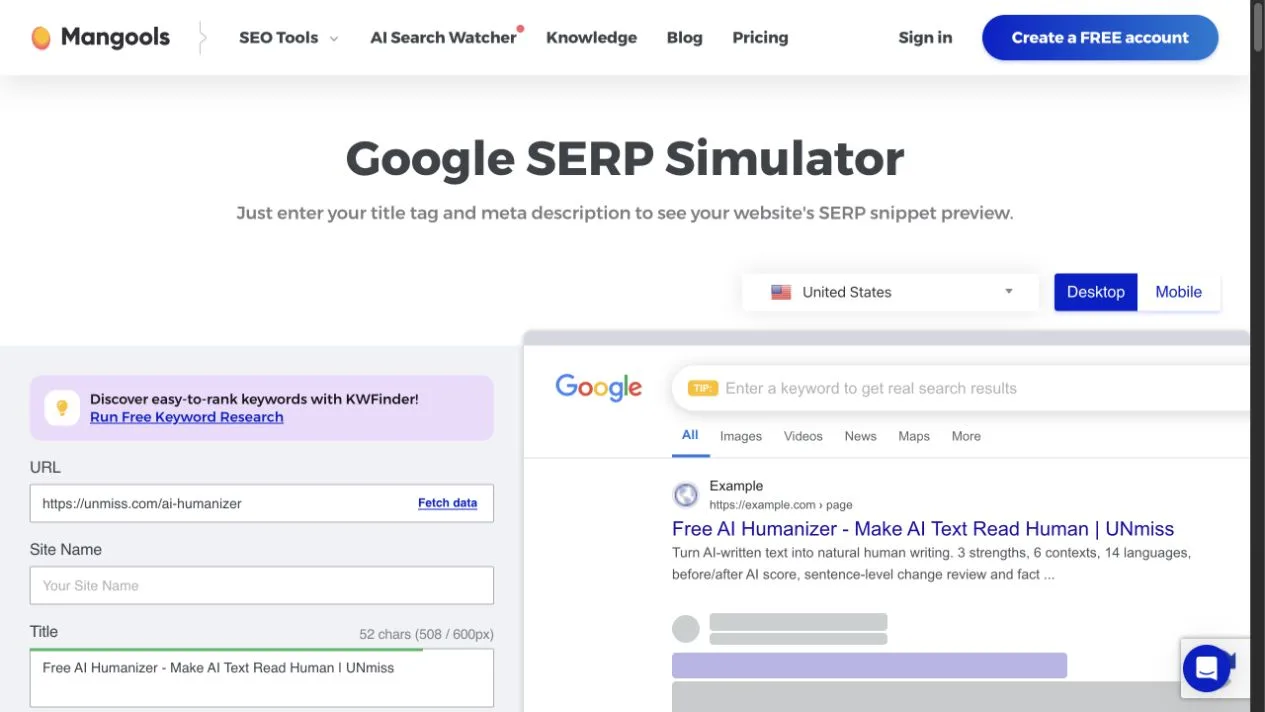
If all you need is a focused title and description check, Mangools is easy to recommend. UNmiss ranks above it because the same accurate core is connected to more result types and to the metadata workflow, not because a two-pixel difference proves superior accuracy.
Semrush is useful, but the measurement is less visible
Semrush's preview handled desktop and mobile views and exposed controls for a date, rating, ads and target keyword. It rendered a believable result for the same AI Humanizer input.
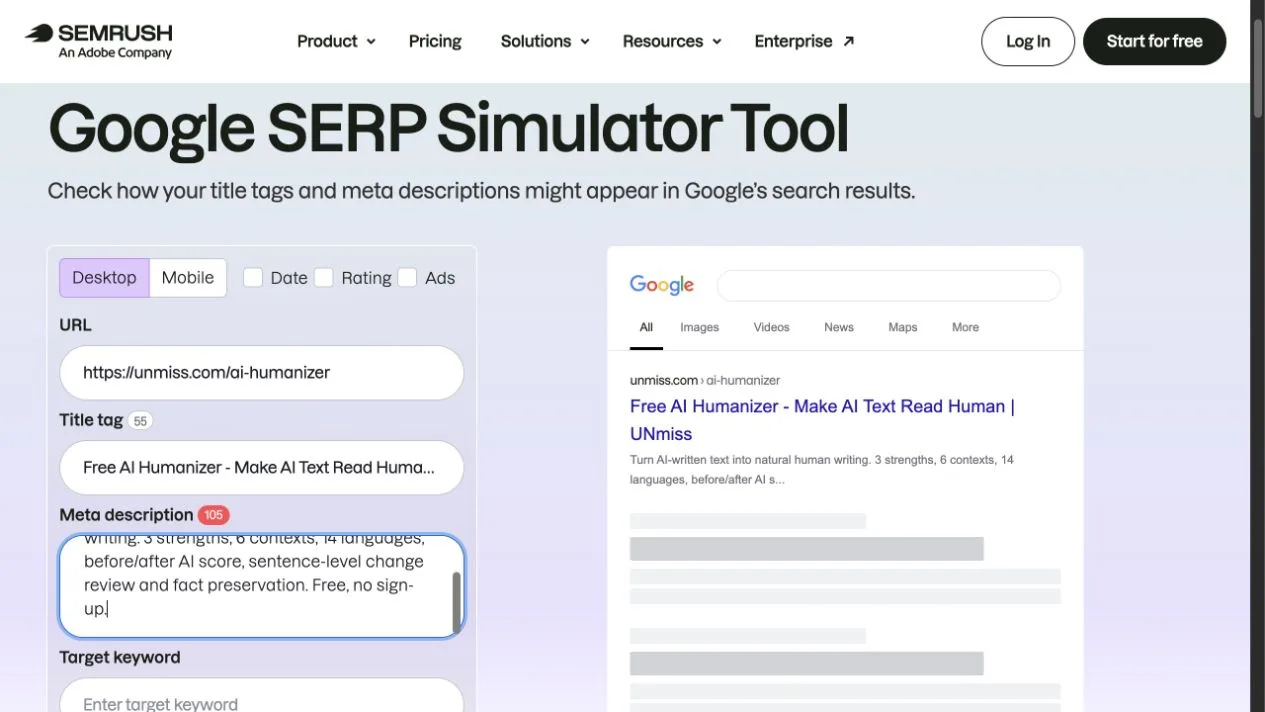
The limitation in this experiment was auditability. The visible counters behaved like text-length guidance rather than an exposed width calculation, so I could compare the screenshot but not reproduce a pixel figure from the interface. For a Semrush customer that may be enough. For a measurement experiment, it places the tool behind the first two.
Portent is a visual draft, not a trustworthy counter
Portent loaded and accepted the test text, but the visible title counter stayed at 600 of 600 pixels and the description counter stayed at 320 of 320 characters while the inputs changed. Those values looked like limits, not measurements of the entered text.
That does not make the preview useless. It means the interface should be used as a rough composition aid rather than evidence that a title is 600 pixels wide. In a category built around precise limits, a static-looking precision label is worse than no label because it invites the wrong conclusion.
ToTheWeb could not be tested
The original ToTheWeb tool URL opened a page headed “It's gone? Where did it go?” during this test. I checked the live official URL rather than relying on a search snippet, and I did not find a working replacement that clearly represented the same free simulator. It therefore remains fifth and unscored.

This is a status result, not a quality judgment. If the tool returns, it should be rerun with the same CSV and moved according to evidence.
What Google actually changed on the ten pages
The homepage is the clearest rewrite. Its source title put the product category first; Google moved UNmiss to the front. Its source description was generic marketing copy; Google selected a sharper product summary mentioning marketers, agencies and businesses.
The RTINGS case study also received a new title. Google replaced the benefit-led source title with a page-count teardown title, presumably because the visible article content made the scale of the analysis a stronger answer for the query.
The AI Humanizer was the cleanest genuine truncation example. Google kept the opening language of the source description and cut it when the available width ended. That is the scenario a simulator can model well.
The result is a practical diagnostic:
- If Google keeps your words and cuts them, edit for width.
- If Google swaps the separator, ignore it unless branding is damaged.
- If Google replaces the description, improve the meta description and the visible paragraph that answers the query.
- If Google replaces the title, check the H1, prominent headings, OG title and anchor text before trimming characters.
A better workflow than chasing a character limit
- Write the answer first. The description should state what the page gives the searcher, not repeat the title.
- Measure width. Use pixels for the title and description rather than assuming every 60-character title fits.
- Check desktop and mobile. The same source can break differently across devices.
- Simulate the real additions. Add a date, rating, sitelinks or thumbnail if the page can earn them.
- Compare the live result after indexing. If Google rewrites the source, classify the rewrite before editing.
- Retest the query that matters. Snippets can change by query, so one branded search is not the final answer.
Use the free Meta Tag Generator to create options, then test the strongest candidate in the SERP Simulator. The generator is for ideas. The simulator is for constraints. The live Google result remains the final measurement.
FAQ
What is the best free SERP simulator?
UNmiss ranks first in this test because its raw width result matched Mangools within 0-3 pixels while supporting the broadest set of desktop, mobile and rich-result states. Mangools is a near-tie if you only need a focused title-and-description preview.
How many characters should a meta title have?
There is no universal character count. Google renders to available width, so wide letters consume more space than narrow ones. Use a pixel-aware preview and check that the important phrase survives, instead of treating 60 characters as a guarantee.
How long can a meta description be?
Google says there is no fixed length limit for the meta description, but the displayed snippet is truncated to fit the device width. Write enough to describe the page accurately, then preview the likely visible portion.
Why does Google show a different description?
Google primarily creates snippets from page content and may use the meta description when it better describes the page for the query. A different snippet is a source-selection rewrite, not necessarily a simulator error.
Can a SERP simulator predict Google exactly?
No. It can model the layout and likely truncation of the text you provide. It cannot know whether Google will select a different title or description, which can also vary by query and device.
Were the tools tested with the same input?
Yes. Ten live title and meta-description pairs were copied into every working tool without changing punctuation. The full corpus and outcomes are available in the linked CSV.
The verdict
The most accurate-looking number in a SERP simulator is not the hardest part of the problem. UNmiss and Mangools already agree closely enough that their two-pixel differences do not change an editorial decision.
The harder problem is source selection. In this sample, Google materially rewrote six of ten descriptions. That makes the best simulator the one that helps you model the whole result, identify what kind of mismatch occurred, and move between generation, preview and live verification without pretending it can predict Google's choice.
That is why UNmiss ranks first, Mangools second and very close on the core measurement, Semrush third, Portent fourth, and ToTheWeb unranked until its tool is reachable again.
Tested on 21 August 2026 using ten live unmiss.com pages. Google results, interfaces and tool availability can change. Semrush links in this article are affiliate links; a purchase may earn UNmiss a commission without changing your price. UNmiss makes the first-ranked tool. All raw measurements are published so the ranking can be checked.
Measure title and description width, switch between desktop and mobile, and test the SERP features that consume real space.
- Pixel-aware title and description guidance
- Desktop, mobile and dark-mode previews
- Dates, ratings, sitelinks, thumbnails and ads
- Full competing-results view for context